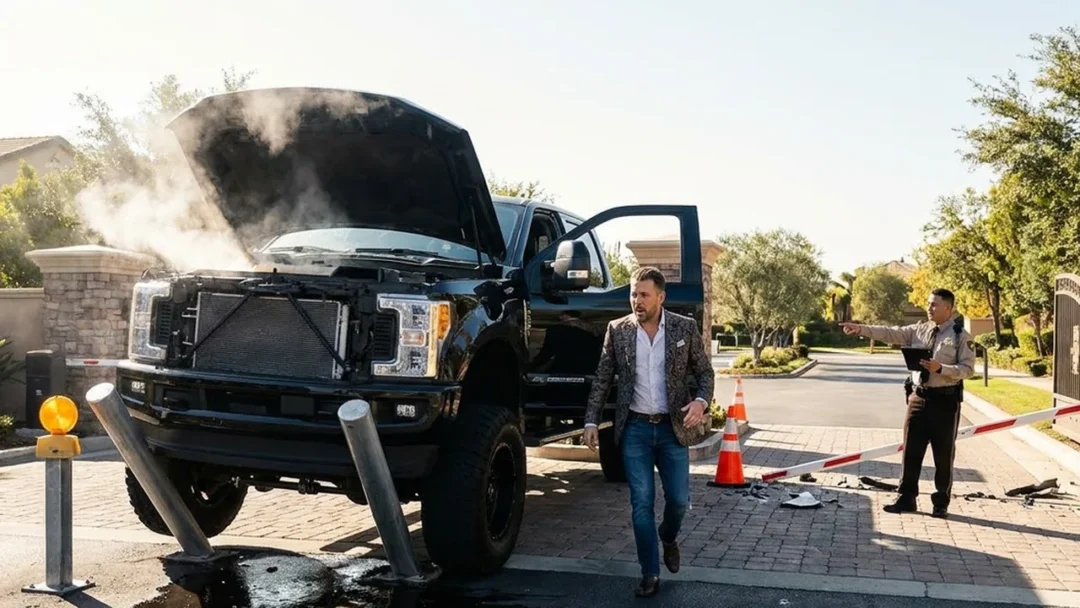
The Steel Bollards At Iron Gate And The Reckless Driver
CHAPTER 1: THE AMBER BEACON AT BLACKWOOD RIDGE
The high autumn sun hung cold and bright above the cedar bluffs of Williamson County, cutting long, hard shadows across the limestone entryway of Blackwood Ridge Estates. Forty feet above the brown eddies of the Cumberland River gorge, the private access road curved between dry-stacked retaining walls of native stone, narrowing down to a two-lane security checkpoint paved in reinforced white concrete. At the center of the inbound lane, a pair of subterranean steel sleeves sat flush with the road grade, their polished bronze collars ringed with recessed amber strobe lights that pulsed in rhythm with the cool river breeze.
Owen Vance stood beside an open stainless-steel junction pedestal, his heavy canvas field jacket zipped against the crisp drafts rolling off the water. In his gloved hands, he held a ruggedized Panasonic Toughbook connected via a heavy serial umbilical to the master hydraulic manifold beneath the roadbed. At thirty-eight, Owen carried himself with the deliberate, quiet economy of a man who had spent six years maintaining airfield blast gates and perimeter arresting systems for the Army Corps of Engineers before transitioning to high-security civilian architecture. His eyes moved steadily between the high-pressure barometric readings on his digital screen and the warning matrix thirty yards down the approach lane. Every hydraulic line had to be purged of micro-bubbles, every accumulator calibrated to exactly three thousand two hundred pounds per square inch, and every limit switch tested against certified structural standards.
Beside the approach curb, two heavy orange traffic cones supported a high-intensity LED message board. Its amber matrix pulsed with crisp alphanumeric clarity: BOLLARD TEST — USE BYPASS LANE. Beneath the text, a glowing directional chevron pointed unmistakably to the right. To the immediate right, the bypass lane stretched wide, clean, and completely unobstructed, marked by bright reflective pavement arrows that funneled traffic smoothly around the mechanical apron toward the resident transponder portal. A painted crosshatch zone of black and hazard-yellow enamel clearly demarcated the testing pit, where two sixty-inch hydraulic pistons waited in their sub-grade chambers. Highland Perimeter Systems had spent three days coordinating this window with the county emergency management office and the estate board, sending certified digital alerts to every resident forty-eight hours in advance.
The peace of the ridge shattered with the guttural, unbaffled roar of an eight-cylinder turbocharged diesel engine accelerating hard up the switchback.
Owen did not jump. He carefully stepped back to the safety curb, his boots remaining well behind the yellow staging line as a customized, midnight-black heavy-duty pickup truck crested the ridge. It was a three-quarter-ton crew cab lifted six inches on thirty-seven-inch mud-terrain tires, its oversized forged aluminum wheels throwing sharp glints of sun against the perimeter trees. Mounted across the front bumper was a fabricated steel bull bar the thickness of industrial railroad plate, finished in matte-black powder coat and armed with twin four-inch recovery clevises. Roof-mounted auxiliary light pods sat dark above the tinted windshield, projecting an aura of calculated intimidation.
The truck did not slow as it approached the painted warning lane. Instead, the driver stomped the brake pedal at the very last second, pitching the heavy nose forward so violently that the tires groaned against the concrete, leaving two smears of fresh rubber twenty feet from the lowered aluminum barrier arm. The engine idle rumbled like distant thunder, vibrating the loose gravel along the limestone curbing.
Behind the dark ceramic window tint, the driver’s door flew open with a harsh metallic click. Julian Thorne stepped down onto the roadbed, leaving the diesel engine rumbling at an impatient, aggressive idle. Julian was forty-two, tall, dressed in tailored Italian canvas trousers, an expensive charcoal fleece vest from a private Aspen ski club, and polarized aviator sunglasses that caught the afternoon glare like chrome shields. He was the founder of Thorne Crest Capital, a boutique private-equity group that had spent the last eighteen months aggressively snapping up ridge parcels and building spec mansions with rotating crews of unpermitted subcontractors. Julian lived by the philosophy that deadlines were for employees and rules were suggestions for people without capital.
Julian slammed the heavy truck door hard enough to rattle the window glass in its seals. He marched directly toward the lowered gate, ignoring the flashing LED advisory board and the orange cones. His designer leather boots clicked loudly against the white pavement.
“Vance,” Julian snapped, his voice sharp with the habit of issuing unilateral orders to foremen and junior architects. “Get this gate up. Now.”
Owen looked up from his Toughbook screen. His expression remained neutral, his pulse steady. “Good afternoon, Mr. Thorne. The main lane is closed for routine quarterly testing on the K12 impact bollards. Per the homeowners association notification sent out last Thursday, the bypass lane is open.”
Owen pointed with a gloved hand toward the unobstructed right channel, where an open twenty-foot roadway provided clear passage directly to the estate’s interior loop. The pavement there was swept clean, free of equipment, and ready for immediate transit.
Julian did not look at the bypass. He took two fast strides forward, planting his boots directly on the painted hazard crosshatch. “I don’t give a damn about your quarterly test, Vance. I have a concrete pump convoy coming up the ridge in twenty minutes, and I have a four-million-dollar closing on Lot Fourteen by three o’clock. I’m not weaving through a side alley like a delivery van. Lift the barrier arm and clear the lane.”
“The bypass lane is twenty-four feet wide, Mr. Thorne,” Owen replied calmly, keeping his voice level and flat. “It is engineered specifically for commercial concrete mixers and fire apparatus. The main lane’s control circuit is locked out on the master processor while we run the hydraulic cycle. The pump is currently running a pressurized purge. You cannot drive through here.”
Julian took off his aviator glasses, his jaw muscles clenching tight, veins bulging along his neck. “Listen to me, you glorified gatekeeper. My firm owns six lots in this development. My investment capital built the retaining walls on this hill. You work for a subcontracted maintenance company that my management dues pay for. If you don’t hit the manual override button on that box within ten seconds, I will personally see your contract torn up before sunset.”
Owen met the developer’s heated stare without flinching. He gestured again to the bypass lane. “The bypass is clear, Mr. Thorne. The testing lane is closed by county safety mandate. For your own safety and the integrity of your vehicle, please back up and use the bypass.”
Julian’s face flushed dark crimson. A sneer of pure, reckless contempt twisted his mouth. He stepped backward toward his idling truck, his gaze locked on the thin aluminum barrier arm painted in red-and-white reflective stripes.
“You think that flimsy piece of aluminum is going to hold my truck?” Julian snarled, his voice rising above the low rumble of the exhaust. “I’ve got six thousand pounds of reinforced steel and three hundred horsepower. I don’t wait on security guards, Vance. Move the arm or I punch through.”
Julian climbed back into the leather cabin, slammed the door shut, and dropped the transmission into drive with a heavy mechanical clunk, revving the turbocharged engine until the entire frame shuddered.