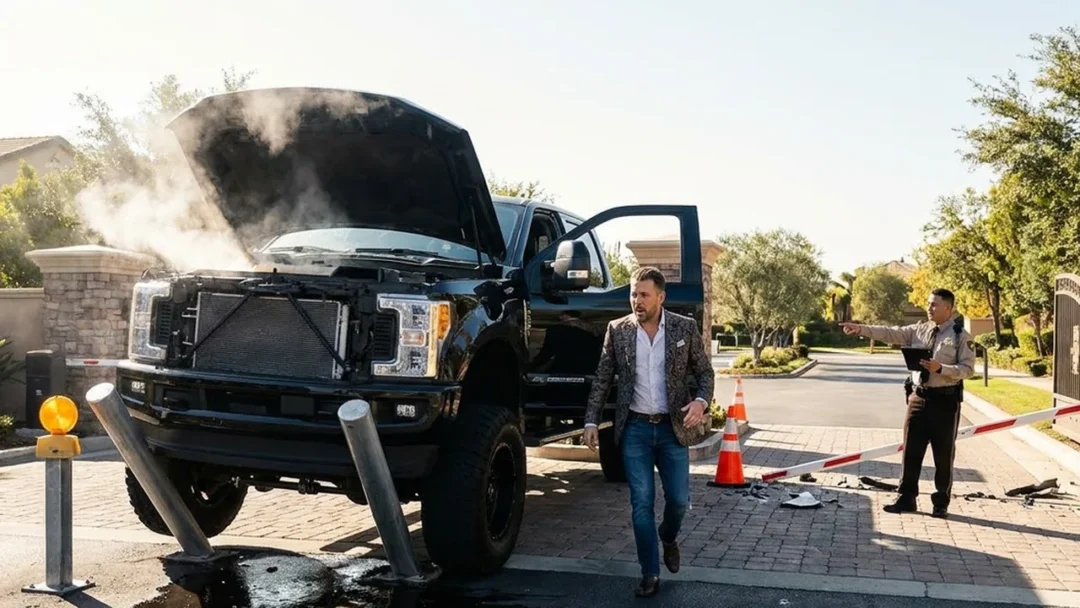
The Steel Bollards At Iron Gate And The Reckless Driver
CHAPTER 2: THE FRACTURE OF THE ALUMINUM GATE
Inside the climate-controlled cabin of the truck, the digital instrument cluster glowed with bright blue instrumentation, while a top-of-the-line dual-lens 4K commercial dashcam—permanently hardwired to the rearview mirror stem—pulsed with a steady red recording dot. Julian Thorne gripped the leather-wrapped steering wheel with white knuckles, glaring through the windshield at the lowered barrier arm and the quiet technician standing behind the pedestal. He tapped his fingers impatiently against the wheel, his heart thumping with the adrenaline of pure, unbridled arrogance. To Julian, backing down in front of a blue-collar field contractor was unthinkable. His entire professional identity was built on forcing his will through obstacles, legal or physical.
Outside on the concrete apron, Owen Vance did not yell or wave his arms in panic. His training as an Army engineer kicked in instantly: assess the hazard, secure the zone, and let the engineered safety systems perform their certified function. He stepped smoothly behind the protective reinforced concrete bunker wall of the gatehouse, keeping the Panasonic Toughbook cradled securely against his chest. His thumb flicked the master recording toggle on the diagnostic interface, syncing the gateway’s industrial surveillance cameras with the telemetry logs.
On the Toughbook display, the automated diagnostic sequence showed the primary accumulator pressure holding steady at three thousand two hundred pounds per square inch. The system had just entered the active deployment phase of its automated emergency cycle. A digital countdown timer on the upper corner of the display clicked from five seconds down to four.
Julian Thorne did not wait for four seconds.
With a furious curse that registered crisply on the dashcam’s omnidirectional cabin microphone, Julian stomped his right foot flat against the floorboards. The lifted diesel’s turbocharger spooled with a high-pitched, predatory whistle that rose above the rustle of the cedar trees. The massive mud-terrain tires broke traction for a split second, barking sharply against the clean concrete and leaving ten feet of black friction burns before biting into the pavement.
The black truck lunged forward like a battering ram.
The impact with the aluminum gate arm was explosive. The thin hollow tube, designed strictly as a visual deterrent rather than an anti-vehicular barrier, sheared cleanly at its cast-aluminum pivot bracket. The red-and-white striped spar shattered into jagged metallic splinters that went skittering across the roadbed, throwing bright yellow sparks as the truck’s massive fabricated steel bull bar plowed through without even a fraction of deceleration. The broken fiberglass sleeve whipped over the hood, leaving a light cosmetic scratch across the black clear coat.
“Stupid bastard,” Julian muttered through his teeth, a triumphant smirk spreading across his face as he felt the flimsy aluminum snap beneath his bumper. In his mind, he had already won. He had proven his dominance over the rule, over the technician, and over the gate. He kept his heavy boot planted firmly on the throttle, intending to speed past the guard shack, throw a dismissive gesture at Vance, and accelerate up the curving ridge road to his construction site.
He was traveling at twenty-two miles per hour when the heavy nose of his truck crossed the yellow crosshatch threshold.
Beside the gatehouse, Owen Vance watched the digital telemetry stream in real time. The impact sensor on the gate mount had registered the unauthorized breach at 14:02:11. Under the standardized Department of Defense antiterrorism specification K12/M50, the gate control module did not require a human command to initiate emergency barrier lock. The system’s programmable logic controller interpreted the sudden catastrophic severance of the gate arm during an active test window as an intentional ramming attack on a restricted residential infrastructure perimeter.
A deafening electronic siren, pitched at one hundred and twenty decibels, erupted from the underside of the gate canopy, its piercing warble echoing across the Cumberland gorge like an air-raid klaxon. Flashing red strobes mounted flush in the overhead limestone archway ignited in rapid alternation, painting the concrete roadbed in violent pulses of crimson light.
Beneath the roadbed, inside the reinforced subterranean vault lined with three-quarter-inch structural steel plate, two massive dual-acting hydraulic cylinders received full system pressure from the nitrogen accumulators. The hydraulic fluid surged at forty gallons per minute through braided stainless-steel lines rated for six thousand pounds of burst pressure.
In the center of the inbound lane, directly beneath the path of Julian’s accelerating front axle, the bronze covers slammed back on their mechanical hinges with a thunderous clatter. Two twelve-inch-diameter solid carbon-steel bollards, filled with high-density reinforced concrete and clad in polished structural stainless-steel sleeves, shot upward from the roadway at a velocity of six feet per second.
Julian Thorne saw the steel cylinders rise out of the pavement thirty feet ahead. His eyes went wide with sudden, animal terror. His pupils dilated behind the steering wheel as his brain finally registered the catastrophic difference between an aluminum gate arm and an anti-ram bollard. The smirk vanished from his face, replaced by a cold, sickening realization of physics.
He stood on the brake pedal with both feet, locking all four oversized wheels. The anti-lock brake system pulsed violently, the pedal kicking against the soles of his shoes, but six thousand pounds of momentum on slick concrete cannot be halted in thirty feet. The heavy black pickup skidded forward, tires smoking and screaming in agony, rubber peeling away in blue clouds of friction smoke as the truck slid directly toward the rising wall of immovable steel.