The Steel Bollards At Iron Gate And The Reckless Driver
CHAPTER 3: IMPACT ON THE CUMBERLAND RIM
The collision did not sound like metal hitting metal. It sounded like an artillery shell detonating inside a granite quarry.
When the fabricated plate-steel bull bar slammed into the lead bollard, the forces involved were measured not in hundreds of pounds, but in tens of thousands of foot-pounds of kinetic energy. The certified K12 bollard, anchored ten feet deep into a monolithic foundation poured with sixty yards of five-thousand-pound reinforced concrete keyed directly into the limestone bedrock of the ridge, did not yield a millimeter. The polished steel sleeve showed nothing more than a superficial scuff in its industrial clear coat. The ground beneath the gatehouse shuddered with the subterranean transmission of shockwaves, rattling the glass panes in the guard station windows.
The truck, however, suffered catastrophic structural destruction.
The heavy aftermarket bull bar, designed for visual intimidation on suburban highways rather than ballistic impact, folded backward like a cardboard carton. The two four-inch recovery shackles were driven straight through the chrome grille, punching deep into the aluminum radiator, the air-to-air intercooler, and the cast-iron accessory brackets of the diesel engine block. The truck’s hydroformed front frame horns crumpled instantly along their engineered crumple zones, telescoping into themselves with a deafening screech of ripping high-strength steel.
Because the bollards had locked at their maximum thirty-six-inch deployment height, the lower impact point caught the heavy solid front differential dead center. The front axle snapped clean at the passenger-side steering knuckle, shearing four-inch hardened steel bolts like dry twigs. Both massive thirty-seven-inch tires were wrenched backward into the wheel wells, crushing the steel fender liners and instantly puncturing the pressurized front shock absorbers, which vented their nitrogen gas in twin high-pitched shrieks.
The rear end of the heavy crew cab lifted four feet into the air under the violent forward pitch of the impact, hovering suspended against the pale autumn sky for a breathless half-second before gravity slammed it back down onto its rear leaf springs with a bone-jarring crash that bounced the rear tires two feet off the pavement.
Inside the cabin, the steering wheel airbag, knee bolster airbag, and side-curtain airbags detonated in a blinding flash of white powder and chemical propellants. Julian Thorne was thrown violently forward against his three-point seatbelt, the nylon webbing locking with a brutal snap across his chest that drove the air completely from his lungs and bruised his ribs against the sternum. The deploying nylon airbag struck his forehead and forearms like a wet baseball bat, knocking his expensive sunglasses off his face, shattering the bridge piece, and filling the cabin with acrid, suffocating smoke.
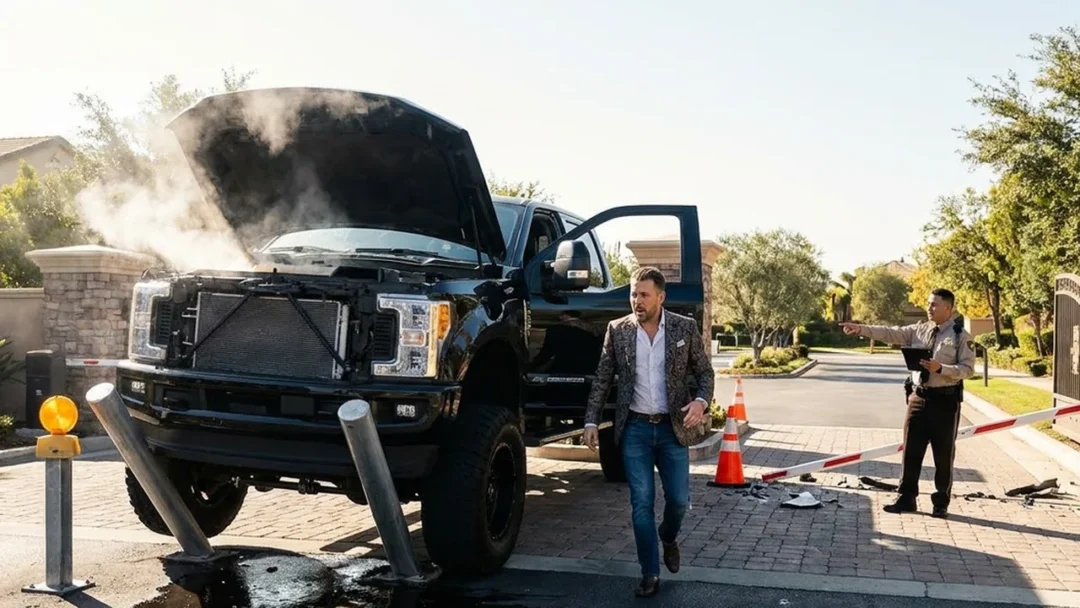
When the truck finally settled, it sat pinned like an insect on a collector’s needle. The front end was impaled nose-down against the two vertical steel bollards, the front wheels bent outward at impossible ninety-degree angles, and the radiator completely flattened against the serpentine pulleys of the ruined engine.
A geyser of scalding white steam hissed violently from the crushed engine bay, billowing through the shattered front grille and swirling past the cracked, webbed windshield. Dark, viscous synthetic motor oil, fluorescent green ethylene glycol coolant, and pink transmission fluid poured in heavy torrents from the ruptured reservoirs, cascading down the polished surface of the bollards and pooling rapidly across the pristine white concrete apron. The smell of burning rubber, hot lubricants, and ozone hung thick in the cool river draft.
Owen Vance stepped out from behind the gatehouse wall. He moved with practiced, steady calm. He did not run, and he did not shout. He reached into his pocket, retrieved his smartphone, and tapped the speed-dial icon for the Williamson County emergency dispatch center while keeping his Toughbook cradled under his left arm.
“Williamson County Emergency, what is your location?”
“This is Owen Vance, chief field specialist for Highland Perimeter Systems at the Blackwood Ridge Estates main security portal on River Bluff Road,” Owen reported, his voice crisp, clear, and perfectly steady. “I have a single-vehicle structural collision at the security gate. A heavy-duty civilian pickup truck breached a lowered maintenance barrier at speed and impacted the deployed K12 anti-ram bollards. Airbags have deployed. Driver appears conscious. Radiator and fluids compromised, but no active fire. Send emergency medical services and a sheriff’s unit for traffic reconstruction.”
“Copy that, Blackwood Ridge security gate. Units are in route. Medic Unit Four and Sheriff Unit Two-Fourteen are rolling.”
Owen clicked off the call. Through the steam and the chemical smoke, the bent driver’s door of the ruined pickup shuddered. With a metallic screech of strained hinges, the door swung open, and Julian Thorne stumbled down onto the oil-slicked asphalt.