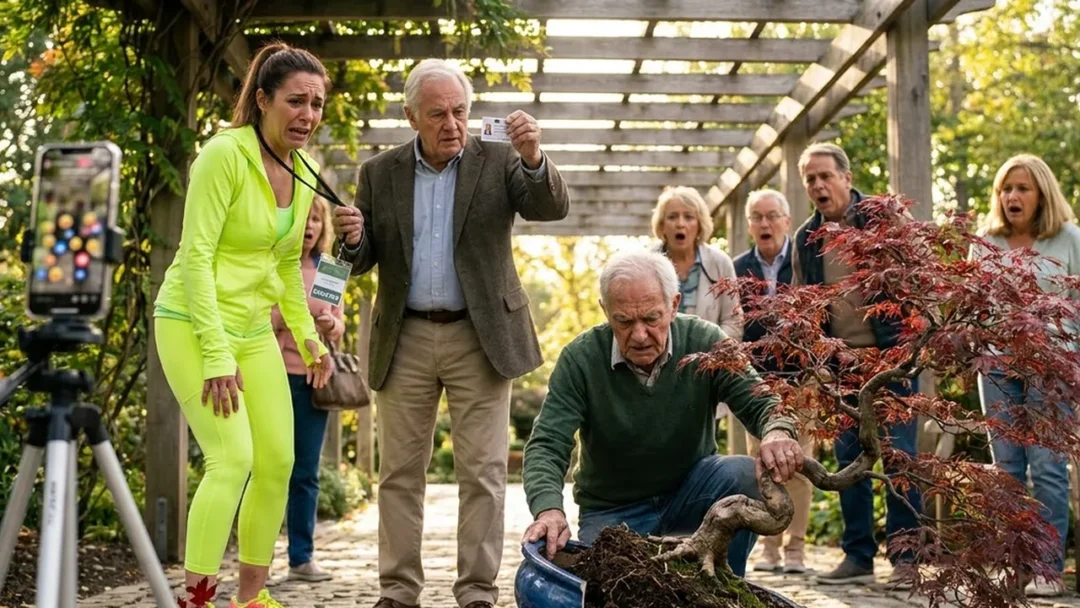
The Shattered Exhibition Bonsai And The Banned Fitness Livestream Influencer
CHAPTER 1: THE CRIMSON LEAVES BENEATH THE PERGOLA
The morning mist drifted lazily off the tranquil koi ponds of the Pacific Botanical Conservatory, rising through the carved cedar rafters of the Japanese Heritage Pavilion. Located in the forested hills of King County, Washington, the conservatory was an internationally acclaimed sanctuary of horticultural excellence, where centuries-old traditions of Japanese garden architecture were preserved under soaring glass pavilion domes. Along the central gallery, hand-chiseled granite flagstones wound beneath aged wisteria arbors, leading visitors toward the reserved exhibition alcoves where master bonsai specimens were displayed on heavy cedar benches.
Kenji Sato stood beside an antique cedar pedestal, his weathered hands holding a soft camel-hair brush, gently clearing microscopic dust motes from the moss-covered surface of an extraordinary living monument. At seventy-eight, Kenji was a revered third-generation Japanese-American bonsai master who had dedicated over six decades to the ancient art of miniature arboriculture. Before him sat a magnificent seventy-year-old crimson Japanese maple, known botanically as Acer palmatum. Standing barely twenty-six inches tall, the miniature tree possessed a thick, gnarled trunk with cascading weeping branches, crowned by an umbrella of delicate, five-pointed leaves that glowed in the morning sunlight like embers of crushed ruby.
The bonsai was planted in an irreplaceable Meiji-era oval ceramic dish, hand-thrown in Kyoto in the late nineteenth century and glazed in a deep, luminous imperial cobalt blue. Fixed to the cedar bench directly beneath the container was a polished brass exhibition medallion stamped with formal engraved lettering: “PACIFIC MASTER EXHIBITION — RESERVED ENTRY SPECIMEN #4 — STRICTLY DO NOT TOUCH.” The tree had been germinated in 1956 by Kenji’s late father following their family’s return from the wartime internment camps, representing seven decades of patient wiring, root pruning, and unbroken spiritual resilience.
The tranquil morning contemplation was violently shattered by the loud clatter of metal equipment bags dropped onto the flagstones and the sharp, echoing clack of high-heeled athletic sneakers.
Marching through the arched entry of the pergola came Chloe Davenport, accompanied by a beleaguered twenty-year-old production assistant carrying two heavy canvas gear bags. At twenty-six, Chloe was a viral social media fitness and luxury lifestyle influencer who operated the digital brand “ChloeFit,” boasting over one point eight million followers across multiple streaming platforms. She was dressed in skin-tight, neon-pink athletic compression wear, oversized designer sunglasses, and heavy gold hoop earrings, with a wireless lavalier microphone clipped to her sports bra. Chloe treated public spaces not as shared civic environments, but as free commercial production soundstages where other human beings were mere background props.
Chloe had secured a standard one-hour visitor ticket to the conservatory, but she had brought a commercial three-point LED ring-light kit, two carbon-fiber tripods, and a high-resolution smartphone rig to broadcast an unsanctioned, brand-sponsored live workout to her followers.
Chloe stopped dead in the center of the pergola, peering through her sunglasses at the shaft of warm golden sunlight cutting diagonally through the wisteria vines directly onto Kenji’s exhibition bench.
“Oh, perfect! Look at that lighting!” Chloe shouted to her assistant, completely ignoring the quiet rules posted at the pavilion entrance. “Tyler! Set the main camera right here! We’re going live in three minutes for the Ignite Energy drink launch!”
Chloe marched directly up to Kenji’s bench, scowling with deep, personal offense as she looked at the antique bonsai tree.
“Hey! Grandpa!” Chloe snapped, snapping her gum and waving her manicured acrylic nails dismissively at the cedar pedestal. “Move your little decorative shrub over to the corner. I need this whole bench to set up my resistance bands and my lighting rig. The natural sun angle here is incredible.”
Kenji Sato did not raise his voice. He set his camel-hair brush gently into a wooden tool box, rested his calloused hands on the front of his gardener’s apron, and met Chloe’s impatient stare with the calm, deep stillness of an old stone lantern.
“Good morning,” Kenji said softly, his voice quiet, dignified, and steady. “This bench is reserved for the Master Bonsai Exhibition. This Japanese maple is seventy years old, entering its final judging inspection for the International Federation awards this afternoon. The sunlight through this pergola is carefully calibrated for the tree’s photosynthesis. You may not film commercial workouts in this gallery, and you may not touch this bench.”
Chloe laughed, a shrill, grating sound that echoed off the glass ceiling, turning heads among the visitors fifty yards away. “Seventy years old? It’s a plant in a flowerpot, old man! I have forty thousand people waiting on my livestream right now, and my sponsor pays me fifteen thousand dollars a post! Your little garden club doesn’t tell ChloeFit where she can film! Move it, or I will!”
Chloe stepped forward, grabbed the telescoping leg of her heavy carbon-fiber tripod like a club, and stepped aggressively toward the fragile ceramic dish.
The art of bonsai, cultivated across more than a millennium in China and Japan, is not merely the dwarfing of a tree; it is the profound artistic condensation of nature’s grandeur into a miniature living sculpture. To train a Japanese maple into the Moyogi, or informal upright style, requires an unbroken conversation across generations between the human hand and the plant’s vascular structure. Copper wires are wound around tender saplings with calibrated tension to guide branches toward the light; fine root systems are pruned during each dormant spring cycle to stimulate microscopic fibrous feeder roots; and the apex is sculpted year after year to balance apical dominance with lower branch maturity. To Kenji Sato, this tree was not an object of property; it was his family’s ancestral living history, an unbroken green ribbon extending from the post-war resettlement of the nineteen-fifties into the twenty-first century.
In stark contrast, Chloe Davenport’s commercial empire was built upon the hyper-accelerated volatility of the digital attention economy. In the ecosystem of modern social media influencers, relevance is measured in seventy-two-hour cycles of algorithmic virality, where audience retention depends on constant sensory novelty, aggressive brand placement, and the visual projection of effortless, unearned luxury. Chloe’s agency, Vanguard Digital Talent, had negotiated lucrative endorsement packages with high-end sports apparel brands, functional beverage manufacturers, and boutique wellness resorts. Her contractual obligations required her to generate daily livestream impressions with strict visual standards: natural diffused daylight, uncluttered architectural backdrops, and an aspirational atmosphere of wellness. In her relentless pursuit of these synthetic digital metrics, the physical reality of the external world—and the dignity of the human beings inhabiting it—became completely invisible.
The gentle morning breeze carried the sweet scent of damp pine needles and blooming camellias through the open rafters of the pavilion. Kenji Sato paused in his work, taking a deep, reverent breath of the clean forest air. For seventy years, this garden had been his sanctuary—a sacred space where the frantic rush of the modern city fell silent, replaced by the slow, eternal cadence of growing trees. He had watched children grow into parents, and parents grow into grandparents, all walking these same cobblestones to marvel at the quiet beauty of miniature nature.
Across the gallery, Chloe Davenport adjusted the ring-light balance on her smartphone screen, tapping her foot with aggressive impatience. To Chloe, the pavilion was not a sanctuary; it was a scenic backdrop valued solely for its visual aesthetic. She had calculated the return on investment of this broadcast down to the minute: forty thousand live viewers, a twelve-percent conversion rate on brand discount codes, and a five-thousand-dollar performance bonus from her primary athleisure sponsor. She didn’t see an elderly master tending an ancient living art; she saw only a stubborn old man obstructing her commercial filming schedule.