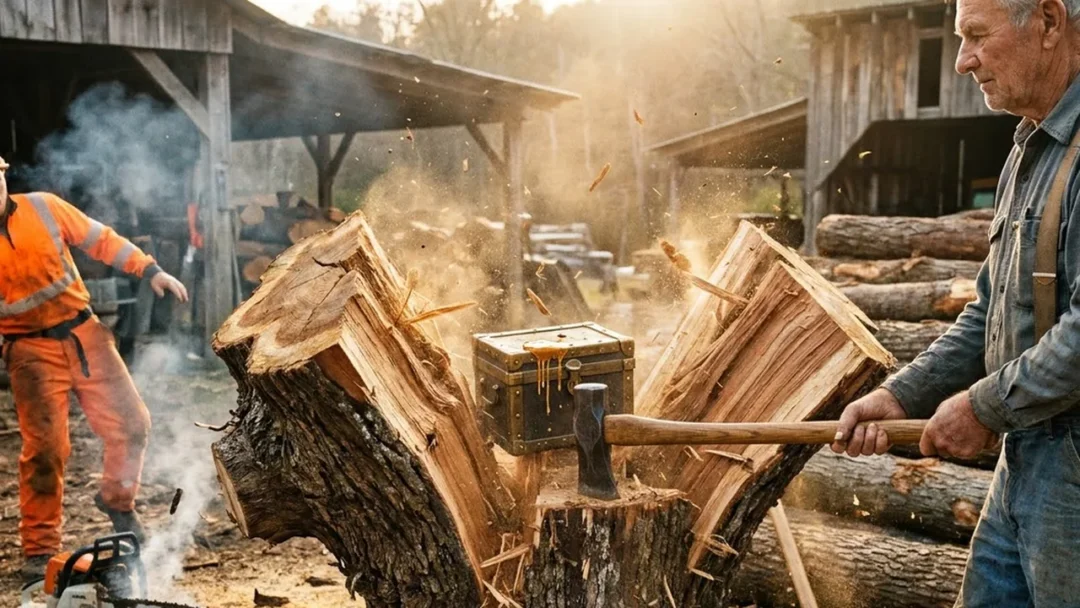
The Forgotten Oak Stump And The Ticking Heartwood Secret
CHAPTER 1: THE BROKEN CHAINS
The acrid stench of scorched two-stroke motor oil and roasted pine resin hung heavy over the sawdust-strewn yard of Blackwood Creek Timber. It was three in the afternoon under an oppressive Appalachian summer sky. Deep in the Shenandoah foothills, the air was stagnant, thick with humidity, and ringing with the frustrated, high-pitched scream of a 90cc German chainsaw engine being pushed far past its thermal breaking point.
The timber yard had stood in this creek bend since the late eighteen-hundreds, bordered by steep limestone bluffs where mountain laurel and dense stands of virgin hardwood had weathered centuries of Atlantic weather systems. Here, where the mountain cold collided with humid southern valley heat, the white oak trees grew with an agonizing, glacial slowness. Their annual growth rings were packed tighter than paper sheets in a legal brief, forging a wood whose density earned it the regional moniker of mountain ironwood.
Clint Bradley stood with his steel-toed logging boots braced in the damp cedar shavings, his muscular forearms shaking violently as he buried all nine horsepower of the professional power saw into the heart of a massive, three-foot-wide white oak stump. The stump was no ordinary piece of timber; it was a seasoned, three-hundred-pound chunk of ancient Appalachian ironwood oak, felled from the high rocky ridges of Blackwood Ridge seven months prior and left to cure in the baking sun until its cellular lignin had hardened into something resembling solid industrial granite.
The saw’s heavy twenty-eight-inch guide bar shrieked in protest. A geyser of fine, powdery brown dust erupted from the kerf—not the long, curling ribbons of a healthy cut, but the scorched powder of metal grinding against petrified grain. The cooling fins on the engine cylinder head were glowing with intense heat, and the oiler nozzle was spitting useless droplets of smoking vegetable bar oil against the friction-welded wood fibers.
Suddenly, a deafening metallic screech tore through the engine’s roar.
A brilliant shower of white-hot sparks sprayed across Clint’s heavy leather chaps. With a violent kickback that nearly wrenched the aluminum handlebars from his grip, the tungsten-carbide chain snapped cleanly in two.
The severed chain whipped through the air like an angry steel viper, gouging a two-inch furrow into the seasoned bark before slumping lifelessly into the sawdust. Beneath the guide bar, the clutch drum glowed a cherry-red dull orange, smoking furiously as blue exhaust billowed into the humid air. The centrifugal clutch shoes had melted their friction lining, binding the crankshaft dead in its bearings.
“Dammit to hell!” Clint roared, flinging his protective face shield upward and kicking the smoking power head with the heel of his boot.
Clint was thirty-four years old, thick-chested, heavily tattooed, and perpetually in a hurry. He had taken out a two-hundred-thousand-dollar commercial equipment lease on three brand-new skid steers, two feller-bunchers, and an industrial horizontal grinder, convinced that modern horsepower and hydraulic throughput were the only metrics that mattered in the twenty-first-century timber trade. He scoffed at traditional forestry, viewing the old hand-tools of the valley as nostalgic museum relics that belonged in antique markets. Yet for the past four hours, his entire high-efficiency operation had ground to an embarrassing, total halt because of a single, stubborn oak stump that sat squarely across the primary access ramp of the saw shed.
“That’s the second carbide chain in forty minutes!” Clint spat, wiping grease-stained sweat from his forehead with the back of his leather work glove. “The clutch plates are welded solid to the drum! That seasoned ironwood isn’t wood—it’s damn concrete! No saw on the East Coast can slice through those twisted grain knots without throwing chains!”
From the shadowy interior of the historic post-and-beam blacksmith shop thirty yards away, the rhythmic, measured clinking of an anvil ceased.
Silas Vance stepped out into the blazing sunlight. Silas was seventy-eight years old, the third-generation master sawyer of Blackwood Creek, standing lean and straight as an old white pine in faded denim work dungarees held up by thick leather suspenders. His linen work shirt was rolled past his elbows, revealing forearms that looked less like human flesh and more like cured hickory heartwood—corded with thick, rope-like veins that had spent sixty-five years swinging felling axes, peeling hemlock bark for local tanneries, and guiding heavy two-man crosscut saws through virgin timber.
In his right hand, resting casually over his shoulder like a walking cane, was a hand-forged, twelve-pound carbon-steel splitting maul mounted on a straight thirty-six-inch handle of seasoned mountain ash. The steel of the maul head was dark, pitted with hammer scale from the forge, but the cutting edge gleamed with an immaculate, mirror-like polish that had been honed on Arkansas oilstones until it could shave the hair from an arm.
Silas did not look at the smoking, ruined chainsaw. He looked at the massive gnarled stump, his pale blue eyes squinting against the glare with the calm, practiced appraisal of a veteran physician examining an old compound fracture.
“Machines have plenty of horses in the tank, Clint,” Silas said softly, his voice carrying the deep, unhurried cadence of the mountain hollows. “Trouble is, horses don’t know where the grain wants to open. You’re trying to chew through eighty years of wind-shear with spinning teeth. You’re fighting the muscle of the tree instead of looking for its spine.”
Clint scoffed, leaning heavily against the handlebars of his dead saw, an arrogant grin breaking across his sweat-streaked face.
“Don’t give me that folk-tale mountain nonsense, Silas,” Clint snapped, tossing his ruined five-hundred-dollar bar into the dirt. “You think you’re going to touch that with an antique sledgehammer? That seasoned white oak broke two diamond-ground carbide chains. I’ll bet you five hundred dollars in cash right now your little hand axe bounces right off that knot and takes your kneecap off!”
Silas did not answer the wager. He walked forward across the sawdust, his worn leather work boots making no sound, and knelt beside the petrified stump. He laid his bare knuckles against the rough, grey bark, closed his eyes, and began to tap.
The economics of Appalachian lumber had always been brutal, but Clint’s generation had traded patience for crippling debt. In the nineteen-eighties, a family-owned timber operation in the Shenandoah Valley could thrive on selective harvesting—felling thirty mature white oaks each autumn, letting the saplings grow under the shelter of the canopy, and curing the lumber slowly in open-air pole barns where the seasonal mountain breezes wicked away the moisture without checking the ends. But corporate consolidators like the Sterling Appalachian Land Trust had changed the rules of the trade. They offered massive short-term supply contracts to young contractors, dangling seven-figure equipment lines with ballooning interest rates, while quietly acquiring the tax liens on the surrounding sawmills. Clint had fallen directly into that trap, borrowing heavily against the deed to Blackwood Creek to purchase German-engineered felling heads that were never designed for the twisted, dense grain of mountain ironwood.
Every hour the main access ramp remained blocked by the petrified stump cost Clint six hundred dollars in idle machinery interest. The feller-buncher was parked in the lower holler, its hydraulic cooling lines humming uselessly, while three flatbed tractor-trailers sat waiting at the county blacktop, their drivers charging detention fees by the quarter-hour. Clint could feel the financial walls closing in around his throat. If he failed to deliver four hundred thousand board-feet of certified white oak veneer logs to the railhead by Friday evening, the bank’s automated forfeiture clause would activate, transferring operational control of the entire mill yard to Walter Sterling’s investment group. That desperation had blinded him to the basic physics of the wood before him.