The Forgotten Oak Stump And The Ticking Heartwood Secret
CHAPTER 3: THE RESIN TOMB
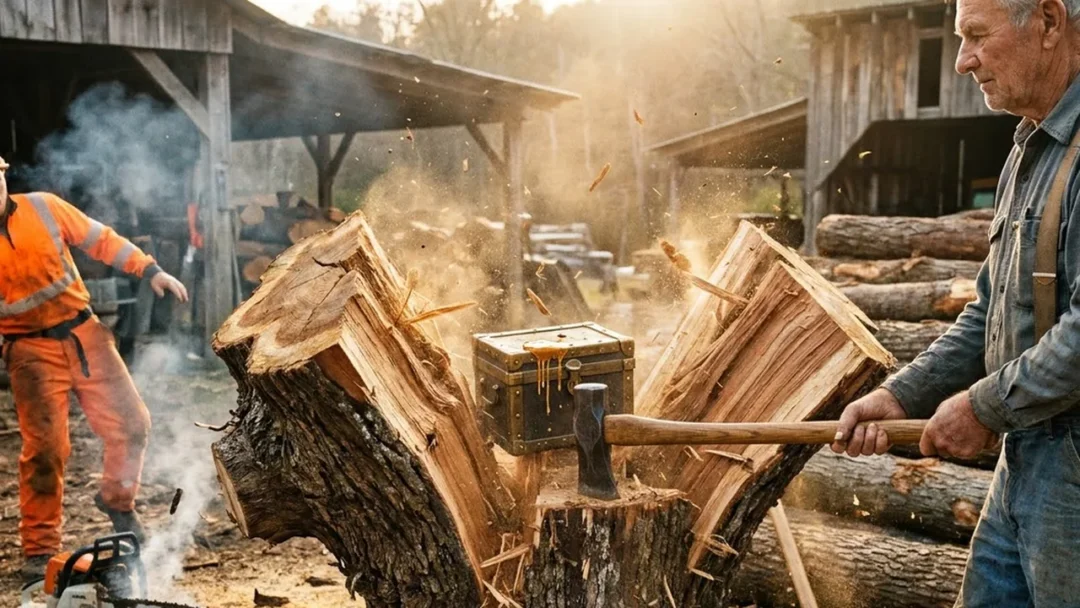
Clint Bradley froze in his tracks, the hair on the back of his sunburnt neck standing straight up like wire bristles. He looked down into the freshly split heartwood, his hands trembling as he reached toward his tool belt, his eyes darting frantically between the two slabs of oak.
“Silas…” Clint whispered, his voice cracking with sudden, breathless dread. “What the hell is that? Is that… is that an explosive? Did someone bury dynamite in that tree?”
Silas Vance did not flinch. He set his maul aside against the chopping block, leaned over the split face of the timber, and peered into the dark cavity exposed in the golden core.
The interior of the massive oak had never been solid heartwood. Eighty years ago, when the tree was merely a young sapling clinging to the rocky soil of Blackwood Ridge, someone had carefully notched a rectangular chamber into its trunk. Over the decades, the tree’s natural defense mechanisms had kicked in: annual rings of dense xylem had formed around the intrusion, sealing the foreign object in an airtight, sterile tomb of hardened, amber-colored resin. The tree had effectively swallowed the foreign body whole, insulating it from oxygen, moisture, fungal rot, and terrestrial decay.
Resting dead-center within the petrified wooden cocoon, bound in heavy, tarnished brass chains that were partially fused with the surrounding wood fibers, was an antique, heavy-gauge cast-iron strongbox.
The box measured approximately fourteen inches long, eight inches wide, and six inches deep. Its exterior was coated in a dark, greenish-black protective lacquer that had resisted the moisture of the sap, and on its front face was a heavy, hand-forged brass tumbler lock stamped with an eagle clutching an anchor and the date: 1945.
And from within the heavy iron walls of that forgotten container, loud, precise, and completely uninterrupted by the eighty years that had passed since the end of the Second World War, came the mechanical ticking of an active, heavy-duty brass clockwork mechanism.
Tick. Tick. Tick. Tick.
“That’s no bomb, Clint,” Silas whispered, his voice trembling with a rare, deep reverence that silenced the entire timber yard. “My grandfather… Captain Thomas Vance. He planted that white oak sapling in the spring of nineteen-forty-five, right after he returned from the European theater. He told my father that if the valley ever faced dark waters, the mountain would remember its rightful owner.”
Silas reached down with his bare, calloused hand, his fingers tracing the amber resin that still wept against the cold iron lid. The sap was warm, fragrant with the sharp, medicinal perfume of fresh turpentine and wild pitch pine.
Before Silas could grip the brass chains, the heavy iron gate at the entrance of Blackwood Creek Timber shrieked open with a violent metallic shudder.
A convoy of three pristine, pearl-white Lincoln Navigators accompanied by a heavy commercial flatbed wrecker tore through the sawdust gate, kicking up a rooster tail of gravel that pelted the corrugated walls of the saw shed. The luxury SUVs moved with aggressive, calculated speed, braking in a tight semi-circle that completely blocked the sawmill’s exit ramp.
The doors of the lead Navigator clicked open.
Stepping down into the fresh cedar dust with the polished confidence of a corporate predator was Walter Sterling. Sterling was sixty-two years old, clad in a four-thousand-dollar bespoke wool hunting suit, polished alligator-skin boots, and wearing a platinum signet ring bearing the crest of the Sterling Appalachian Land Trust. Behind him, four private security guards in tactical black windbreakers and holstered sidearms stepped out of the secondary vehicles, their hands resting deliberately on their belts.
Sterling glanced at the smoking, ruined chainsaw, then at the two split halves of the giant oak stump lying on the ground. A cold, victorious smile spread across his thin, predatory face.
“Well, well, Clint,” Sterling drawled, his voice oily with condescending amusement. “I see you finally cleared the access lane. I was beginning to think my foreclosure demolition crews would have to wait until Monday morning to bring in the bulldozers.”
Clint stepped forward, his fists clenching defensively. “Mr. Sterling, our payment extension doesn’t expire until Friday at midnight! We have forty-eight hours to mill this timber and cover the loan installment!”
Walter Sterling laughed softly, pulling a leather-bound legal folio from his breast pocket and tapping it against his palm.
“That was under the old contract, Clint,” Sterling purred. “As of two hours ago, my legal firm executed the accelerated default covenant on your equipment leases. But more importantly… your timber lease specifically covers all raw materials currently situated on Blackwood Creek property.”
Sterling pointed a manicured finger directly at the split heartwood of the oak stump, his eyes narrowing like a hawk spotting prey in the grass.
“That cast-iron box sitting in your grandfather’s stump,” Sterling said, his voice dropping into hard, merciless steel. “Under paragraph twelve of the regional resource conveyance agreement, all antiquities, minerals, and subterranean fixtures belong to the Sterling Trust. Load that log onto my flatbed immediately, or my security detail will clear this yard by force.”
The preservation of the iron box inside the tree was a marvel of natural botany. In temperate hardwoods, when a mechanical injury penetrates the outer bark and cambium, the tree undergoes a process known as compartmentalization of decay in trees. Specialized parenchyma cells along the wound perimeter produce high concentrations of suberin, gallic acid, and natural polyphenolic resins, sealing the breach against wood-rotting fungi and aerobic bacteria. For eighty years, while the storms of the Shenandoah raged overhead and the seasons turned the mountain from emerald green to winter white, the living oak had pumped gallons of sterile, antimicrobial sap around the cast-iron casing, forming a protective resinous cocoon that rivaled the embalming tombs of ancient Egypt.
The brass clockwork ticking inside the box was no less extraordinary. In nineteen-forty-two, the Swiss horological firm of Vacheron & Constantin had manufactured a limited run of fifty marine chronometers for Allied naval intelligence, designed to maintain micro-second accuracy inside submarine ballast compartments even during depth-charge concussions. Engineered with solid beryllium-copper hairsprings that resisted magnetic interference and lubricated with non-gumming synthetic sperm-whale oil, the chronometer’s double-barrel mainspring could store enough mechanical tension to run an internal dehumidifying fan for decades if shielded from atmospheric oxidation. Captain Thomas Vance had acquired the chronometer during his service with the Naval Salvage Service in the Mediterranean, modifying its housing to protect his family’s most sacred legal covenant.