The Forgotten Oak Stump And The Ticking Heartwood Secret
CHAPTER 2: THE STRIKE OF THE SPINE
To Clint Bradley and the two young skidder operators watching from the equipment bay, the old man’s actions looked like pure Appalachian eccentricity. Silas knelt in the dirt like an old country doctor with his ear pressed to a patient’s chest. He drew back his scarred right knuckles and delivered three deliberate, sharp taps against the top face of the oak.
Tock. Tock. Tock.
The sound was not dead and flat like striking stone. To the trained ear of a master woodworker, the acoustic resonance of seasoned timber tells an entire biological history. Wood is an anisotropic composite material—an intricate bundle of millions of parallel cellulose tubes bound together by natural lignin polymers. As an oak tree grows on an exposed Appalachian ridge, decades of prevailing western gales, winter ice storms, and summer droughts create asymmetrical tensile and compressive stress zones within the annual growth rings. When the tree is felled and cured, that moisture evaporates, locking thousands of pounds of internal hydraulic tension into microscopic crystalline faults.
A motorized saw blade cuts blindly across these tension fields, generating tremendous frictional heat that binds the chain links against the expanding grain walls. But a wedged blade driven along the exact fault line does not cut fibers; it releases them.
Silas tapped a second time near the outer cambium ring, three inches from a massive, twisted burl where two ancient limbs had fused sixty years earlier.
Tink.
The sound was half an octave higher—a sharp, clear, singing ring that vibrated cleanly through the hickory core. Silas’s eyes opened. A faint, knowing smile creased the deep wrinkles around his eyes.
“Found it,” Silas muttered.
He reached into the pocket of his denim overalls and pulled out a small chunk of natural white limestone chalk gathered from the creek bed. With a steady hand that did not waver a millimeter, Silas drew a single, clean white line four inches long across the top of the stump, bisecting the petrified heartwood along an invisible hairline fracture that no machine sensor could detect.
“What are you doing, drawing him a target?” Clint laughed loudly, looking toward two young skidder operators who were watching from the shade of an equipment shed. “Hey, boys! Come watch the old man donate five hundred bucks to my tool account! He thinks he’s Robin Hood with a hammer!”
Silas stood up slowly. He rolled his shoulders back, shook the tension from his wrists, and stepped into his stance.
He planted his left boot six inches back from the chopping block, his right foot anchored squarely forward in the sawdust, hips aligned forty-five degrees to the chalk mark. He gripped the smooth mountain-ash handle with both hands—left hand locked at the butt swell, right hand choked halfway up the shaft near the forged steel eye.
The twelve-pound maul head was a masterpiece of 19th-century blacksmithing: drop-forged high-carbon railroad steel, ground with a narrow primary entry wedge that swelled abruptly into wide, concave cheeks designed to act as an explosive wedge upon impact.
Silas took a single, deep breath of cedar-scented air.
There was no wild wind-up, no nervous bobbing, and no jerky acceleration. In one blindingly smooth, continuous motion, Silas lifted the twelve-pound steel maul in a fluid overhead circle. His hips uncoiled with explosive, hydraulic power, driving upward through his heels, his core locking into a rigid pillar of kinetic energy as his arms extended to the apex of the arc.
The steel wedge descended not with brute muscular force, but with the terrifying, accelerated velocity of a falling meteor.
CRACK!
The sound was not the dull thud of an axe striking wood. It was an explosive, deafening acoustic detonation that echoed off the limestone bluffs like a high-powered hunting rifle fired in an enclosed barn. A shockwave rippled through the sawdust, kicking up a ring of golden pine powder two feet in every direction.
The narrow steel wedge struck the white chalk mark with mathematical perfection.
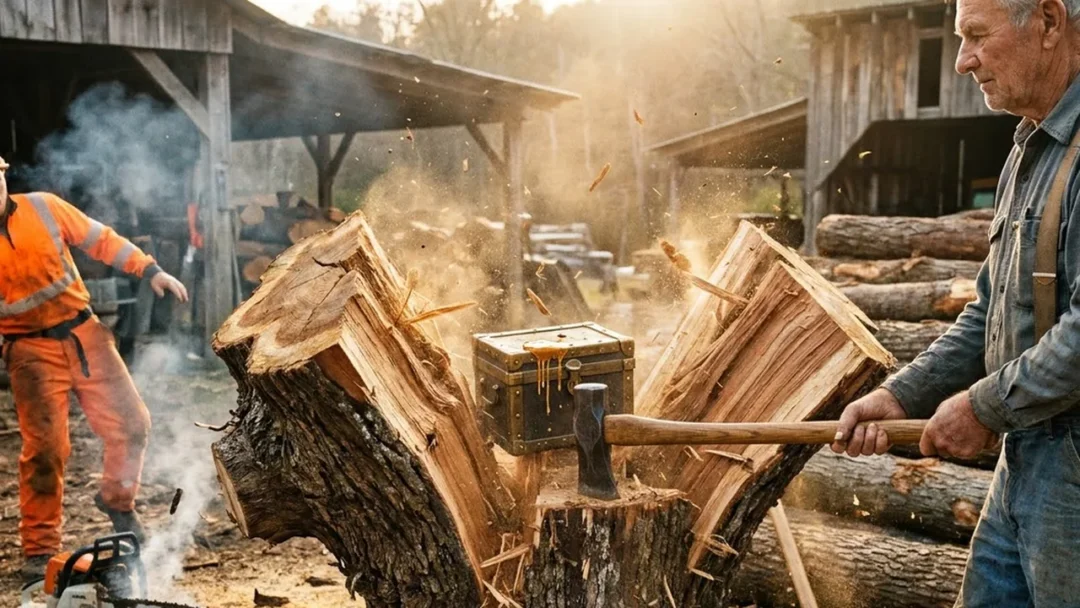
For a tenth of a second, the universe seemed to pause. Then, the locked eighty-year tension within the seasoned oak fibers released in an instantaneous catastrophic burst. With a sound like tearing canvas magnified ten thousand times, a jagged fissure ripped straight down through the three-foot diameter of the stump.
The massive, three-hundred-pound knotty stump burst cleanly into two symmetrical halves. The two multi-ton slabs of seasoned ironwood slammed down into the sawdust on either side of the chopping block with an earth-shattering thud, rocking the foundations of the saw shed.
Clint Bradley took three involuntary steps backward, his jaw hanging completely slack, his eyes wide as dinner plates. He stared at the two fallen halves of the impossible wood, then down at Silas, who stood completely balanced, the head of his maul resting calmly on the chopping block beneath, his breathing as steady and even as a church bell.
“One swing…” Clint stammered, his face draining of all color. “You… you split seasoned ironwood in one swing? That stump was three hundred pounds of solid knot!”
“You were fighting the tree’s muscle, son,” Silas said calmly, setting the maul against his leg. “You have to strike the spine.”
Before Clint could stammer an apology or reach for his wallet, an eerie, unnatural sound cut through the settling sawdust.
From the dead center of the split heartwood—from a deep, hollow cavity that had been sealed inside the dark interior of the living tree for eighty years—came a distinct, rhythmic metallic sound.
Tick. Tick. Tick. Tick.
The science of hand-splitting timber is a dying art, preserved only in the muscle memory of the oldest sawyers. When an ironwood oak grows on an exposed limestone bluff, the tree does not grow straight; it spirals imperceptibly toward the sun, wrapping its annual vascular bundles into a dense, interlocking helix. A mechanical wedge driven with an excavator or a hydraulic splitter applies blunt, linear force across the entire face, compressing the grain walls until the wood fibers mushroom and bind the steel tight. But a hand-forged splitting maul, swung by a craftsman who understands the natural fault line, functions as a dynamic acoustic wedge.
The secret lay in the velocity of the strike. Silas’s swing did not rely on the brute force of bicep contraction, which would have slowed the head through muscular tension. Instead, he utilized the whip-like principle of kinetic chaining: initiating the drive from the plantar flexion of his rear ankle, transferring the torque through his rotating pelvic girdle, and releasing his wrists at the final millisecond before impact. At the instant of contact, the 12-pound high-carbon head was traveling at over forty-five miles per hour. That concentrated kinetic energy did not merely crush the surface cells; it sent a supersonic acoustic shockwave radiating straight down the natural fault line, tearing the lignin bonds apart before the surrounding fibers could compress. It was the exact principle used by quarrymen to split ten-ton blocks of granite with a single feather wedge.