The Forty Kilogram Clay Spade And The Fake Soil Report
CHAPTER 1: THE GLACIAL CLAY BLADE
The October morning fog hung low and cool across the terraced apple benches of the upper Yakima Valley, draping the rows of heavy-limbed Honeycrisp trees in a silver veil that smelled of damp volcanic silt, crushed autumn leaves, and ripening fruit. High above the valley floor, where the ancient basalt bluffs rose toward the foothills of the Cascade Range, the volcanic soil transitioned into a dense, mineral-rich stratum deposited during the catastrophic cataclysms of the Pleistocene epoch. For four generations, the Vance family had pruned, irrigated, and harvested these one hundred and fifty acres, establishing root systems that plunged deep into the mineral heart of the Columbia Basin.
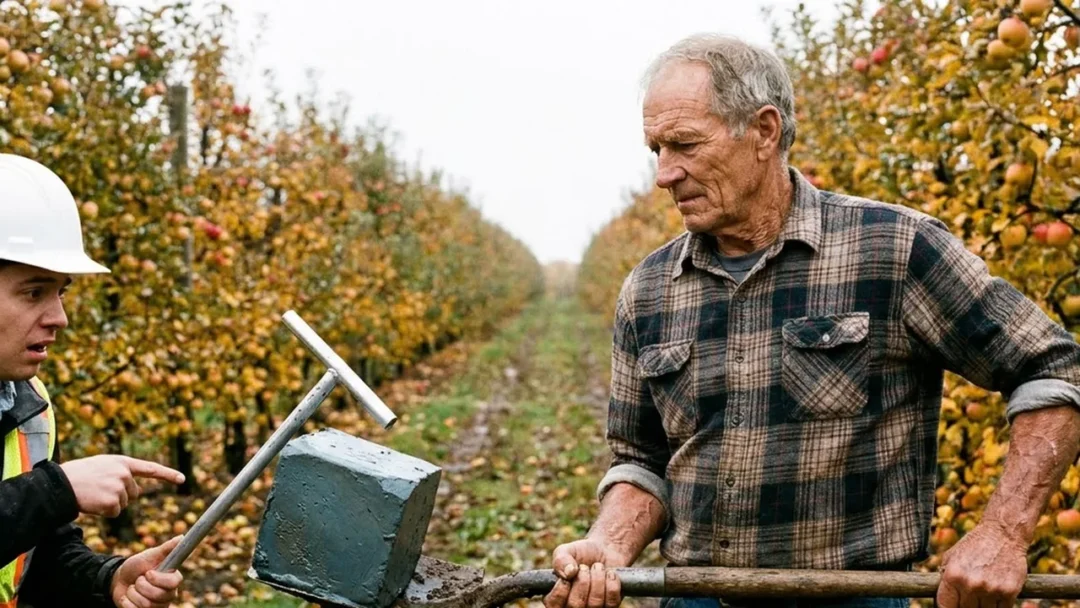
Standing at the edge of an irrigation lateral in Block 4 was Arthur “Grit” Vance. At seventy-three years old, Arthur was a master orchardist, former heavy earthworks trenching contractor, and veteran combat engineer who possessed the leathery, weather-scored visage of a man who had worked outdoors through fifty-five Washington winters. He stood six feet tall with broad, sloping shoulders, thick wrists that looked as though they had been carved from seasoned white oak, and ice-blue eyes set beneath bushy, silver-threaded brows. He wore a heavy red-and-black wool Pendleton overshirt over a faded denim work vest, stained Carhartt canvas work dungarees caked with dry earth at the cuffs, and heavily greased bull-hide work boots with steel shanks.
In his calloused hands, Arthur held an authentic professional trenching spade. Unlike ordinary stamped garden shovels sold at modern home improvement stores, Arthur’s spade was an industrial-grade implement drop-forged from high-carbon manganese alloy steel, featuring an eighteen-inch-long, narrow, heat-treated blade sharpened to a knife-edge and socketed to an unyielding, straight-grained Northern white ash handle reinforced with a through-riveted steel strap.
Standing three paces from Arthur, looking conspicuously out of place among the damp orchard soil, was thirty-three-year-old Julian Sterling. Julian was an environmental geologist employed by Cascade Horizon Development, a multi-state commercial real estate syndicate that had spent the past eight months aggressively buying up surrounding farmland to construct a massive regional intermodal freight distribution terminal. Julian wore a spotless white fiber-reinforced safety hard hat, high-end Italian Gore-Tex field boots that had never touched virgin briars, and an immaculate yellow surveyor’s vest. In his left hand, Julian clutched a heavy aluminum clipboard loaded with thick legal briefs; in his right, he carried a lightweight two-piece aluminum T-handle soil penetrometer rod.
“Mr. Vance, I’m trying to do you a professional courtesy,” Julian said, his voice carrying the practiced, patronizing cadence of a corporate representative accustomed to dealing with aging rural landowners. He tapped the clipboard with an expensive ballpoint pen. “Our preliminary geotechnical borehole survey along the western boundary has returned disastrous results. The subsurface stratum beneath your entire bench consists of un-compacted volcanic ash and saturated, liquefiable silt. Under standard engineering classification, this ground is technically classified as pseudo-quicksand. It cannot support structural foundations, and the county is preparing to declare this entire drainage an unstable geohazard zone. Cascade Horizon is willing to maintain its buyout offer of three thousand dollars an acre today, but if you force the county to condemn the parcel, you won’t get fifteen hundred.”
Arthur Vance looked at the young surveyor with an expression of quiet, impenetrable gravity. His eyes dropped from Julian’s polished boots to the lightweight aluminum rod in his manicured hand.
“Loose silt?” Arthur’s voice was a low, resonant rumble, weathered like river gravel. “You’ve been out here drilling with that rental rig for three days, boy, and you claim this ground is quicksand?”
“The data doesn’t lie, Mr. Vance,” Julian insisted, thrusting the clipboard forward. “Standard Penetration Test N-values under three. Saturated silty void ratio exceeding zero point eight. This bench is a fluid swamp waiting for an earthquake.”
Without another word, Arthur turned his body toward the wet, open trench floor between the apple rows. He held the long ash handle of the trenching spade vertically in his left hand, positioning the razor-sharp manganese blade directly over a fresh cut of blue-grey earth.
He did not tap the spade into the soil. He did not rock the blade back and forth to break the crust.
With smooth, terrifying biological violence, Arthur raised his heavy right boot eighteen inches into the air and stomped downward onto the steel foot-step of the spade with all one hundred and ninety pounds of his dynamic mass.
THWACK-SCHRUNK!
The eighteen-inch steel blade sliced straight through the surface turf, driving full-depth into the dense, subterranean earth until the forged steel socket buried itself flush with the ground.
Arthur did not bend his lumbar spine. He set his feet shoulder-width apart, bent his knees slightly into an athletic power stance, and wrapped both thick hands around the upper grip of the ash handle. Engaging his core, latissimus dorsi, and forearm flexors in an unyielding isometric contraction, he levered the long wooden shaft backward against his hip.
The earth groaned with a wet, suctioning acoustic tear.
Slowly, deliberately, Arthur hoisted the trenching spade straight upward. Balanced squarely upon the eighteen-inch steel blade was an intact, perfectly cubed forty-kilogram—eighty-eight pound—slab of virgin, glistening blue-grey subterranean clay.
The biomechanical torque required to execute this maneuver was staggering. Holding an eighty-eight-pound concentrated deadweight cantilevered forty inches forward on a wooden shovel handle places over two hundred and eighty foot-pounds of rotational moment across the wrists, forearms, and lumbar vertebrae. Under that immense physical lever, the straight-grained white ash handle bowed slightly into an arc, but Arthur’s corded forearms and locked wrists did not tremble by a millimeter.
He raised the shovel until the forty-kilogram clay cube rested horizontally at chest height, suspended motionless in the damp morning air like an iron anvil.
Julian’s eyes widened in sudden, visceral shock. He stepped backward involuntarily, his boots skidding on the damp grass.
“You say this ground is loose silt,” Arthur said calmly, holding the eighty-eight-pound slab steady with the casual poise of a man holding a cup of black coffee. “Stick your probe into it.”
Julian swallowed hard, his face flushing crimson beneath his white hard hat. “Mr. Vance, that’s not how geotechnical testing works—”
“I said stick your probe in it, son,” Arthur repeated, his voice dropping into steel. “You say it’s quicksand. Prove it.”
Eager to reassert his technical authority, Julian stepped forward, gripped the aluminum cross-handle of his T-handle penetrometer rod with both hands, positioned the conical tip against the center of the suspended clay block, and threw the entire upper weight of his body downward into a frantic thrust.
CRUUUNCH-BEND!
The conical tip penetrated barely three-eighths of an inch into the rock-solid clay before encountering impenetrable resistance. Under Julian’s frantic downward surge, the thin-walled, hollow aluminum shaft suffered catastrophic structural buckling, folding violently into a sharp forty-five-degree dogleg.
Julian stumbled forward, his hands slipping off the ruined tool, nearly tumbling face-first into the trench.
Throughout the entire violent impact, Arthur Vance’s hands remained locked on the ash shaft. The shovel blade did not drop a single fraction of an inch; the forty-kilogram clay cube absorbed the full force of Julian’s impact without cracking.
“That’s not silt, boy,” Arthur said, his gaze drilling into Julian’s pale face. “That’s late-Pleistocene glacial hardpan clay deposited by the Missoula floods twelve thousand years ago. It’s got an over-consolidation ratio of eight and an unconfined compressive strength over five tons a square foot. You could set the foundation pillars of an eighty-story skyscraper on this bench, and it wouldn’t settle a quarter of an inch.”
As Julian stared in horrified silence at his crumpled aluminum probe, Arthur shifted his top left hand, keeping the entire eighty-eight-pound load cantilevered on his right arm for two seconds. With his thumb and forefinger, Arthur reached out and caught the corner of a white paper shipping label pasted over the top of the geotechnical summary report on Julian’s aluminum clipboard.
With a sharp, tearing rasp, Arthur peeled the adhesive label back.
Printed clearly in bold black industrial ink beneath the peeled sticker was the true legal parcel tax description: CASCADE HORIZON DEVELOPMENTS LLC – PARCEL 48B, LOWER AHTANUM SLOUGH.
The fraudulent geotechnical condemnation report did not belong to Arthur’s high-elevation orchard bench at all; it was the actual soil report from the developer’s own flood-prone, saturated swamp parcel located three miles down the river highway.
“Next time you try to steal a man’s farm with a fake soil report,” Arthur said, his voice deadly quiet, “make sure you peel your boss’s tax parcel off the paperwork first.”
Arthur turned the shovel blade ninety degrees.
The forty-kilogram block of dense blue-grey clay slid off the polished manganese steel and crashed directly onto the wet grass with a concussive, bone-rattling THUMP, splashing wet clay splatter across the spotless leather toes of Julian Sterling’s expensive boots.
Julian snatched his clipboard back, his hands shaking violently as he scrambled toward his luxury four-wheel-drive pickup parked at the access gate.
Arthur stepped to the edge of the irrigation road and raised his calloused hand, pointing toward the southern orchard perimeter. Hovering two hundred feet above the treeline were two commercial survey drones equipped with high-resolution LiDAR scanners, buzzing like mechanical hornets over his land.
Arthur reached into his vest pocket, pulled out an iron paddock padlock, and snapped the heavy steel chain shut across the main entrance gate, trapping the trespassers’ tire tracks in the mud while the drone cameras whirred overhead.