The Forty Kilogram Clay Spade And The Fake Soil Report
CHAPTER 5: THE AMBUSH AT THE COUNTY ASSESSOR’S OFFICE
The historic Yakima County Courthouse, a grand neoclassical stone edifice constructed from native Tenino sandstone and granite pillars, bustled with tense, agitated energy as the afternoon sun cast long shadows across the courthouse square. Outside on the courthouse steps, over two hundred local fruit growers, orchard workers, and agricultural business owners had gathered, their weathered faces set in expressions of fierce determination as they hoisted signs demanding an immediate audit of Cascade Horizon’s land-condemnation schemes.
Inside the third-floor commission chambers, beneath polished brass chandeliers and high coffered timber ceilings, the air was stiflingly hot and thick with tension. Behind the elevated mahogany dais sat the three Yakima County Commissioners, flanked by the county planning director, Harold Vance-Miller, whose nervous glances toward the corporate defense table betrayed his deep internal anxiety.
Sitting at the primary petitioner’s table was Gregory Vance-Sterling, the arrogant fifty-eight-year-old CEO of Cascade Horizon Development, flanked by a phalanx of four corporate attorneys and his disgraced field geologist, Julian Sterling. Julian looked pale and disheveled, nervously rotating an unblemished Montblanc pen between sweaty fingers.
“Members of the Commission,” CEO Vance-Sterling announced, standing with polished corporate bravado as he gestured to a series of glossy architectural renderings displaying a massive twenty-acre multi-modal freight terminal. “Our geotechnical findings are unassailable. The western bench of the upper valley represents an immediate public safety hazard due to subsurface liquefaction vulnerability. Under the emergency provisions of the Washington Growth Management Act, the county must immediately condemn these unproductive parcels, revoke their agricultural exemptions, and allow responsible capital to remediate the subsoil for regional economic development.”
Planning Director Harold Vance-Miller cleared his throat, reaching for his gavel to call for an immediate vote on the condemnation resolution. “Seeing no further technical objections filed prior to the statutory deadline, the planning department recommends immediate approval of the geohazard reclassification—”
BANG!
The heavy double oak doors at the rear of the commission chamber swung open violently, striking the brass wall stops with concussive force.
Every head in the packed chamber snapped around.
Walking down the center carpeted aisle was Arthur “Grit” Vance. He wore his pressed canvas ranch jacket, clean denim work trousers, and polished bull-hide boots. In his left hand, Arthur carried the buckled, forty-five-degree crumpled aluminum penetrometer rod that Julian had ruined against the glacial clay. In his right hand, he carried a sealed, heavy glass jar containing a polished cross-section of the blue-grey Missoula flood hardpan clay.
Walking immediately beside Arthur were Tori Vance, carrying a stack of certified lab affidavits from Washington State University, and Detective Marcus Kane, wearing his full sheriff’s uniform and flanked by two armed state agricultural investigators.
The chamber erupted into stunned murmurs from the gallery.
“Mr. Vance, this public hearing is closed to unscheduled public testimony!” Director Harold barked, slamming his gavel onto the wood.
“The public testimony is just beginning, Harold,” Arthur replied, his resonant voice cutting through the hall with the clarity of a church bell.
Arthur reached the petitioner’s table, stood directly before CEO Vance-Sterling and Julian, and slammed the buckled aluminum rod down onto the polished mahogany wood with a sharp CLACK.
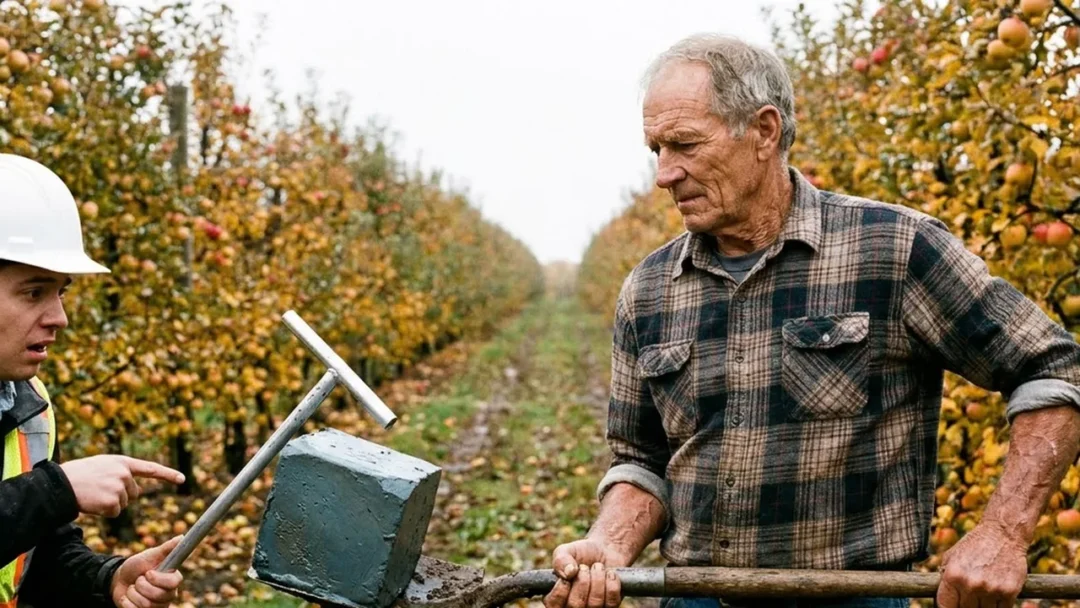
“That is Julian Sterling’s state-certified soil penetrometer rod,” Arthur announced to the three commissioners. “He brought it to my orchard yesterday morning, claiming my bench was loose silt. I held an eighty-eight-pound block of virgin clay on a trenching spade and told him to push his probe into it. The rod folded like a wet cardboard box.”
Julian shrunk back in his leather chair, his face turning an ashen white.
Tori stepped forward and laid the certified engineering report from Dr. Elizabeth Vance-Chen onto the commissioners’ desk. “This morning at Washington State University, certified triaxial shear tests proved the Vance bench has an unconfined compressive strength exceeding eighty-two tons per square foot. It is one of the most structurally competent clay shelves in the Pacific Northwest.”
“This is completely irregular!” CEO Vance-Sterling shouted, jumping to his feet with reddened cheeks. “A farmer with a shovel cannot refute professional geotechnical borehole logs!”
“He didn’t just refute them, Mr. Sterling,” Detective Marcus Kane said, stepping forward and placing a manila folder containing high-resolution photographs onto the table. “He exposed your systematic fraud.”
Marcus pointed to the photographs. “When Arthur peeled the shipping label off Julian’s clipboard report at the orchard, we discovered that the geohazard data was stolen directly from Cascade Horizon’s swamp property at Parcel 48B on Ahtanum Slough. Furthermore, my detectives executed a search warrant on Julian Sterling’s corporate laptop two hours ago. We recovered the original CAD borehole logs. Julian never drilled a single test hole on the Vance orchard. He was paid a fifty-thousand-dollar cash bonus by Cascade Horizon to forge geohazard reports across four adjacent family orchards to force distress sales.”
A collective gasp swept through the chamber, followed by furious shouts of outrage from the assembled orchardists in the gallery.
Marcus turned toward Planning Director Harold, pulling a sealed envelope from his uniform breast pocket. “And Harold… we also found the offshore wire transfer records showing three hundred thousand dollars deposited into your private consulting account in the Cayman Islands last Friday, timed to coincide with this emergency condemnation vote.”
Harold’s face drained of all color. His hand trembled so violently that he dropped his wooden gavel onto the floor, where it rolled harmlessly off the dais.
Two uniformed state troopers stepped forward from the rear of the room, positioning themselves behind Harold and CEO Vance-Sterling.
Commissioner Evelyn Hayes, a lifelong valley resident and senior member of the board, looked down at the forged documents, the certified laboratory analysis, and the crumpled aluminum rod lying on the table before her.
She picked up the county seal stamp, struck the condemnation resolution with a heavy, definitive blow, and looked directly at Arthur Vance.
“The petition for emergency geohazard condemnation is summarily denied with prejudice,” Commissioner Hayes declared, her voice ringing with authority. “This commission refers this entire matter to the United States Department of Justice for immediate federal criminal investigation.”
The chamber erupted into thunderous, standing applause as neighboring farmers cheered, wept, and embraced in the aisles.
Arthur turned to look at CEO Vance-Sterling, who was being escorted out of the room in handcuffs by federal investigators.
“You can buy politicians with paper, Sterling,” Arthur said softly, “but you can’t fake the earth.”