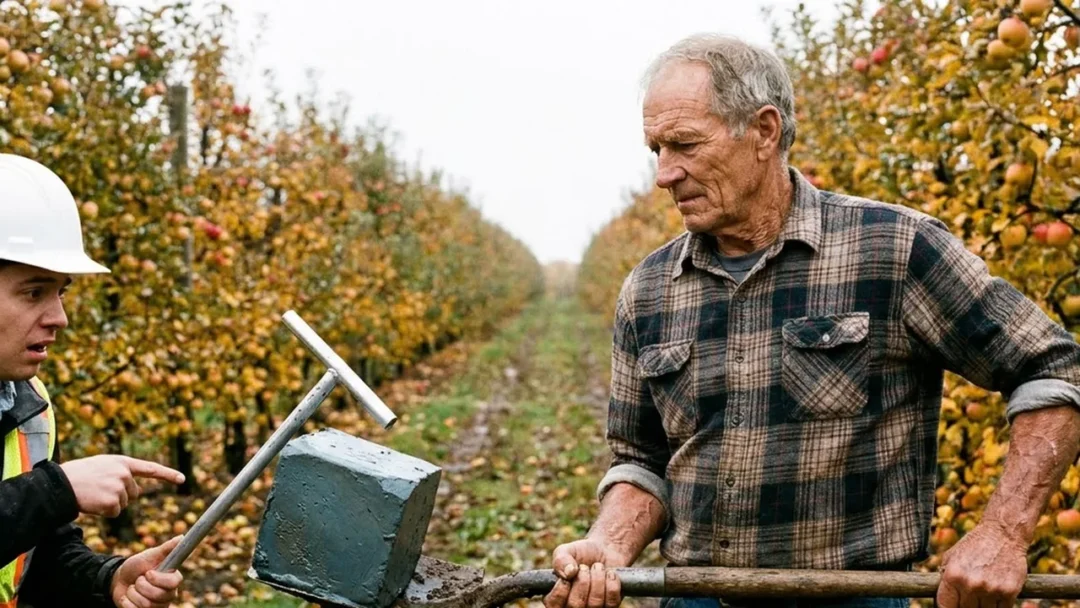
The Forty Kilogram Clay Spade And The Fake Soil Report
CHAPTER 2: THE CORE SAMPLE SWINDLE
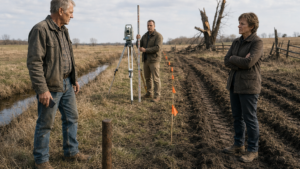
The sharp clang of the heavy iron padlock echoed across the rows of Honeycrisp trees, cutting through the high-pitched hum of the surveying drones circling overhead. Arthur Vance did not look back at Julian Sterling’s truck as the young geologist spun his wheels in the slick grass, frantically trying to maneuver his luxury vehicle around the locked perimeter gate before speeding away along the outer gravel easement.
Arthur walked back to his vintage 1978 four-wheel-drive farm truck, his heavy boots leaving deep, clear imprints in the volcanic silt. Leaning against the steel tailgate was his thirty-six-year-old daughter, Victoria “Tori” Vance. Tori held a master’s degree in agricultural soil physics from Washington State University and had spent the last decade working as an irrigation hydrologist across the Columbia Basin before returning to help her father manage the family’s premium fruit operations. She wore a faded canvas chore coat, denim jeans tucked into rubber muck boots, and safety glasses pushed up onto her forehead, her auburn hair pulled back in a practical braided knot.
In her hands, Tori held a portable digital tablet connected to the orchard’s automated soil-moisture sensor network, cross-referencing soil electrical conductivity readings against the legal parcel maps of Yakima County.
“I saw the whole thing from the pump house, Dad,” Tori said, her eyes flashing with a mixture of anger and professional vindication. “The way that aluminum probe buckled… Julian Sterling wasn’t just performing sloppy fieldwork. He was committing deliberate geotechnical fraud.”
Arthur wiped the cold mist from his brow with the back of his canvas sleeve. “He had a white mailing label pasted over the tax parcel number on his clipboard. Underneath that sticker was Cascade Horizon’s parcel at the Lower Ahtanum Slough. The developer bought forty acres of saturated marshland near the interstate three years ago for pennies, and now they’re trying to project the liquefaction test logs from that swamp onto our high-elevation bench.”
Tori tapped her screen, pulling up the public records database of the Washington Department of Natural Resources. “Look at this borehole registration registry. Julian Sterling filed four preliminary geotechnical drilling notices with the Yakima County Planning Department last week, claiming to have drilled exploratory boreholes B-1 through B-4 along our western boundary line. But our irrigation field cameras only recorded their drilling rig on-site for twenty minutes on Tuesday morning. You can’t drill sixty feet into glacial hardpan and pull undisturbed Shelby tube core samples in twenty minutes.”
“They never dropped a hollow-stem auger on this bench,” Arthur said grimly. “They parked their rig on the road shoulder, drank coffee in the cab, and substituted pre-existing core logs from their swamp parcel to generate a synthetic geotechnical report. If they can convince the Yakima County Board of Commissioners that this entire bench is an active geohazard liquefaction zone, the county will revoke our commercial agricultural zoning permit and depress our assessed property value to zero. Once the land is legally condemned, Cascade Horizon buys the whole bench at a foreclosure tax auction, uses an emergency variance to rezone it for heavy industrial warehousing, and clears thirty million dollars in site-preparation arbitrage.”
Before Tori could reply, the crunch of heavy tires on gravel heralded the arrival of a dark green Dodge Ram pickup bearing the gold seal of the Yakima County Sheriff’s Office. The vehicle pulled up alongside the locked paddock gate, and a tall, broad-shouldered man wearing a tan Stetson and a wool county patrol jacket stepped out.
It was Detective Marcus Kane, a twenty-year veteran of the sheriff’s department specializing in commercial fraud, water rights theft, and agricultural crimes. Marcus had grown up in the valley and knew every irrigation lateral and boundary ditch from Selah to Grandview.
“Morning, Arthur. Morning, Tori,” Marcus said, resting his hand casually on the fence rail as he glanced at the locked gate and the heavy mud splatter on the road. “I saw Julian Sterling burning rubber down the county highway like he’d seen a ghost. What’s going on out here?”
Arthur reached into the bed of his truck, picked up Julian’s buckled aluminum penetrometer rod—its hollow shaft bent into an acute forty-five-degree angle—and handed it through the fence rails to the detective.
Marcus inspected the crumpled metal with a dry, knowing whistle. “Looks like somebody tried to drive an aluminum toothpick into a granite boulder.”
“Julian Sterling attempted to serve a fraudulent condemnation notice on behalf of Cascade Horizon,” Arthur explained calmly. “He claimed this orchard sits on liquefaction quicksand. I held an eighty-eight-pound block of glacial hardpan clay on a spade and told him to push his probe in. His rod crumpled like tinfoil. And when I peeled the mailing label off his clipboard report, his geotechnical data was registered to Parcel 48B at Ahtanum Slough.”
Detective Kane’s expression darkened instantly. His casual posture vanished, replaced by the razor-sharp intensity of an investigator who had just connected a critical piece of evidence.
“Arthur, you’re not the only one they’ve visited,” Marcus said, his voice dropping into a guarded, serious cadence. “Yesterday afternoon, seventy-one-year-old Henry Lindstrom signed an emergency purchase option on his eighty-acre pear orchard down on the lower bench. Cascade Horizon’s lawyers told him the county was filing a mandatory geohazard lien on his farm due to subsurface liquefaction risk. Henry was terrified he’d lose his life savings, so he sold for twenty cents on the dollar. This morning, two more fruit growers in the Tieton drainage called my desk saying they were visited by the same surveyor waving the same clipboard.”
“It’s an organized racketeering operation,” Tori stated firmly. “They are systematically targeting elderly, independent orchardists who don’t have engineering staff to audit their soil mechanics data.”
Marcus looked directly at Arthur and Tori. “A bent probe and a peeled sticker prove Julian Sterling is a liar, Arthur, but to get a search warrant signed by a superior court judge against a two-hundred-million-dollar development corporation, we need definitive, unassailable physical evidence. We need undisturbed, certified core samples extracted directly from your bench, analyzed by an accredited geotechnical laboratory under strict chain of custody, to prove in open court that this soil is structural hardpan.”
Arthur looked across the misty orchard rows toward his equipment shed, where his vintage rubber-tired diesel backhoe sat under cover.
“We have an undisturbed excavation permit for our new frost-protection irrigation reservoir,” Arthur said quietly. “Tonight, we dig our own geotechnical test trench. Ten feet down, right into the heart of the glacial bed.”
Marcus nodded slowly, his hand resting on his badge. “I’ll monitor the access road. But be careful, Arthur. Cascade Horizon has private security details patrolling the perimeter, and they know what’s at stake.”