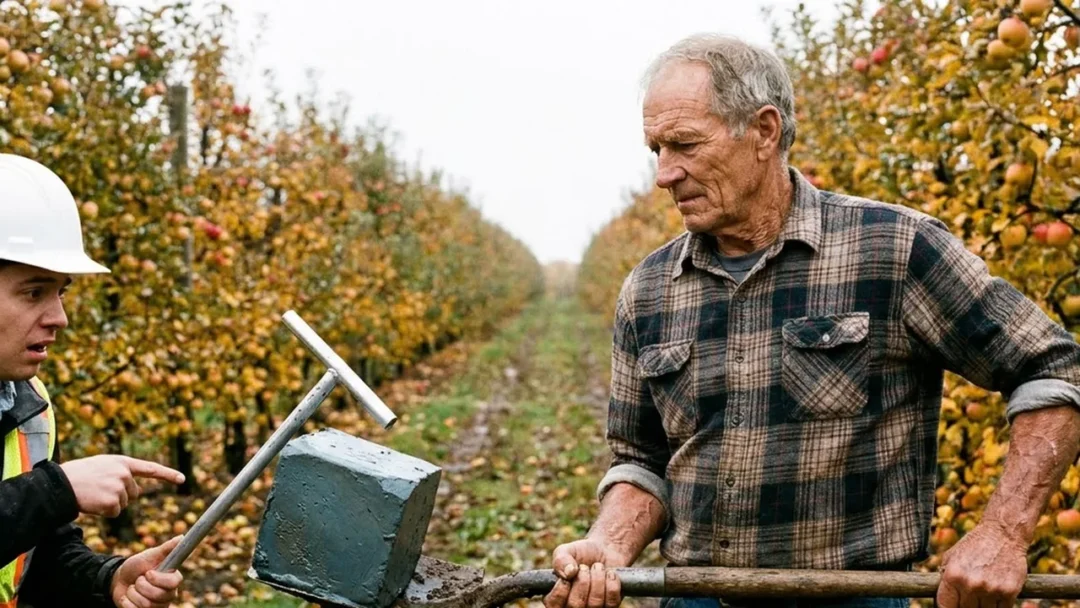
The Forty Kilogram Clay Spade And The Fake Soil Report
CHAPTER 4: THE LABORATORY SHEAR TEST
The high-bay structural testing laboratory at Washington State University’s Department of Civil and Environmental Engineering in Pullman smelled of wet crushed stone, machine hydraulic oil, and pulverized concrete dust. Massive steel reaction frames towered thirty feet toward the corrugated ceiling, equipped with high-pressure MTS servo-hydraulic actuators, computerized data acquisition racks, and multi-channel load cells capable of applying millions of pounds of force to bridge girders, seismic dampers, and subterranean structural foundations.
Standing before the central geotechnical test station was Dr. Elizabeth Vance-Chen, a renowned professor of geotechnical earthquake engineering and an expert witness in international dam failure investigations. Dr. Vance-Chen, wearing a white lab coat over safety coveralls and heavy protective glasses, inspected the four sealed Shelby tube capsules that Arthur and Tori Vance had transported across the state under strict legal chain-of-custody protocols verified by Detective Marcus Kane’s official evidence seals.
“The chain of custody documentation is flawless, Tori,” Dr. Elizabeth said, carefully slicing through the thick paraffin wax seal of Sample Core 2 with an electric heated spatula. “The field documentation, GPS coordinates, and depth logs meet every standard specified under ASTM D2166 and ASTM D2850 for undisturbed cohesive soil testing.”
Using a precision hydraulic extrusion piston, Dr. Elizabeth smoothly pushed the undisturbed soil core out of the seamless steel tube.
The core emerged as an immaculate, solid cylinder of dense, blue-grey glacial clay three inches in diameter and six inches in length. Its surface was completely smooth, exhibiting zero air pockets, micro-fractures, or structural discontinuities.
“Look at that mineral density,” Dr. Elizabeth remarked, running a stainless steel micro-spatula along the circumference. “This is classic Missoula flood lacustrine hardpan—smectite and illite clays compressed under centuries of glacial ice sheets and catastrophic over-burden pressures. Let’s see what the automated triaxial shear frame says.”
She carefully mounted the three-inch clay cylinder onto the pedestal of a computer-controlled unconfined compression testing frame. A precision linear variable differential transformer (LVDT) was calibrated against the top loading cap to measure axial deformation down to the single micron, while a fifty-thousand-pound load cell stood ready to measure compressive axial resistance.
Across the room, connected to the lab’s mainframe terminal, the digital display glowed with real-time graphs plotting compressive stress in pounds per square inch against percentage strain.
“Initiating strain-controlled axial loading at one point two millimeters per minute,” Dr. Elizabeth announced, keying the command into the terminal.
The hydraulic pump purred to life with a steady, high-pitched mechanical whine. The hardened steel piston descended until it made firm contact with the top cap of the blue-grey clay specimen.
In a weak, unconsolidated soil or saturated quicksand—such as the fraudulent report Julian Sterling had submitted to the county—the soil cylinder would have sheared, bulged, or liquefied within seconds, collapsing under less than ten to fifteen pounds per square inch of axial pressure.
Instead, the digital stress readout began to climb with breathtaking speed.
50 psi… 100 psi… 250 psi… 500 psi…
The blue-grey clay cylinder stood rock-solid between the hardened steel platens, refusing to deform. The servo-hydraulic pump began to labor, its oil pressure gauge spiking as the machine exerted massive downward force to induce mechanical shear in the ancient glacial sample.
750 psi… 900 psi… 1,120 psi!
The digital monitor flashed bright green as the compressive stress crested at one thousand one hundred and forty-five pounds per square inch—equivalent to an unconfined compressive strength exceeding eighty-two tons per square foot.
Suddenly, with a sharp, resonant CRACK that sounded like a rifle shot inside the laboratory, the clay cylinder underwent classic diagonal shear failure along a precise forty-five-degree plane, the natural crystalline cleavage angle of over-consolidated, high-cohesion clay.
Dr. Elizabeth stared at the digital readout in utter astonishment, then let out a low whistle of profound professional admiration.
“Eighty-two tons per square foot,” she whispered, printing out the certified laboratory calibration curve and signing the engineering certification affidavit in blue ink. “That is nearly twenty times the structural load-bearing capacity required for heavy industrial foundations. This soil doesn’t just resist liquefaction—it represents one of the most competent, over-consolidated cohesive foundation strata in the entire Pacific Northwest. To claim this bench is quicksand is not merely professional incompetence; it is an outright scientific fabrication.”
Before Tori could take the signed laboratory certificate, the heavy steel door of the testing facility swung open.
A tall, impeccably dressed corporate attorney wearing an expensive bespoke wool suit and carrying an embossed leather briefcase entered the room, flanked by two armed private security guards. It was Bradley Vance-Cross, the chief legal counsel for Cascade Horizon Development.
“Dr. Vance-Chen, I advise you not to certify those test results,” Bradley said, his voice dripping with smooth, venomous legal intimidation. He placed a formal cease-and-desist document onto the counter. “Cascade Horizon has filed an emergency petition in Yakima County Superior Court, alleging that the soil samples tested here were unlawfully extracted from disputed property subject to pending eminent domain proceedings. If you release or certify those findings to the county commissioners, Cascade Horizon will initiate a twenty-million-dollar tortious interference lawsuit against this university and you personally.”
Arthur Vance stepped forward from the shadow of the structural reaction frame. His towering, straight-backed presence and iron-jawed glare instantly shifted the gravitational center of the room.
Arthur reached out his massive, calloused hand, picked up the attorney’s formal cease-and-desist notice, and calmly tore the thick legal parchment in half with his bare hands.
“You’re too late, counselor,” Arthur said, his voice echoing through the steel rafters of the lab. “Detective Kane already uploaded the video of Julian’s buckled probe and our chain-of-custody logs to the State Attorney General’s Agricultural Crimes Division. And in exactly three hours, the Yakima County Board of Commissioners convenes an emergency public hearing to rule on your condemnation request.”
Arthur looked directly into the attorney’s pale eyes. “Tell your developer to bring his checkbook. Because he’s about to find out what happens when you try to swindle a valley built on glacial stone.”