The Forty Kilogram Clay Spade And The Fake Soil Report
CHAPTER 6: THE FEDERAL GRAND JURY INDICTMENT
Two weeks after the dramatic confrontation at the county courthouse, the grand jury proceedings in the United States District Court for the Eastern District of Washington in Spokane convened behind closed doors to examine the full scope of Cascade Horizon Development’s racketeering enterprise. What had begun as an elderly orchardist disputing a soil report had metastasized into one of the largest corporate land-fraud investigations in the history of the American agricultural west.
Inside the secure federal courtroom, Assistant United States Attorney Claire Henderson stood before the twenty-three empaneled grand jurors. Displayed across three large digital projection screens were forensic electronic exhibits prepared by state agricultural investigators, FBI cyber-forensics specialists, and soil mechanics experts from Washington State University.
On the witness stand sat Arthur “Grit” Vance. He wore his finest Sunday suit, looking composed, dignified, and immovable as he answered the prosecutor’s questions with precise, factual clarity.
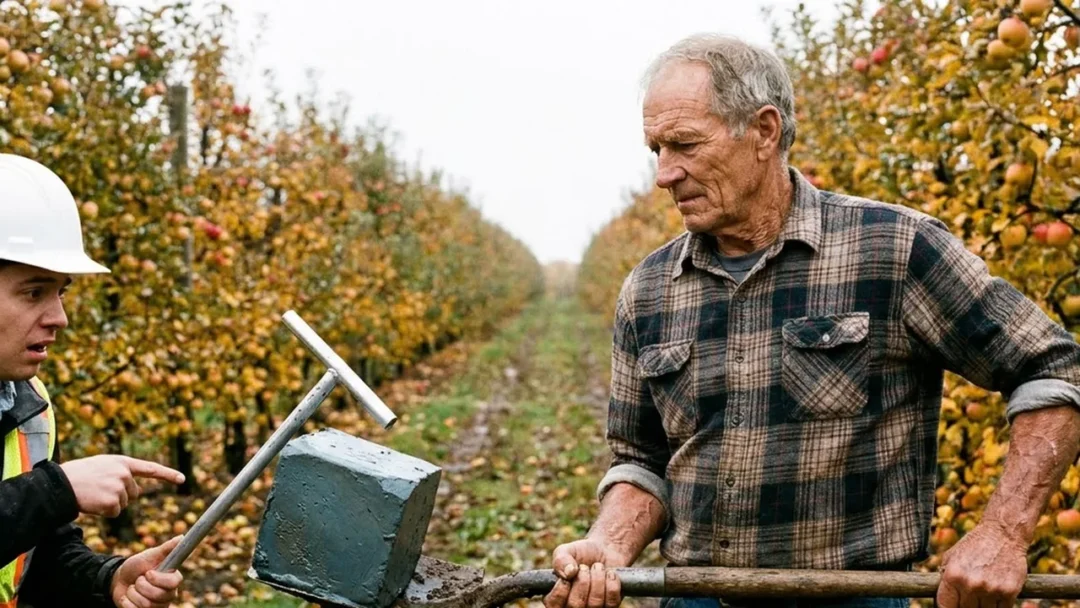
“Mr. Vance,” Prosecutor Henderson said, gesturing to Exhibit 14—a high-resolution photographic macro-scan of the virgin glacial hardpan core—”can you describe for the grand jury the exact physical reaction when the defendant, Julian Sterling, attempted to force his penetrometer into the clay specimen you held on your trenching spade?”
“The soil core did not compress,” Arthur testified, his voice resonant and steady in the quiet courtroom. “Glacial lacustrine clay deposited during the Missoula floods has been consolidated under hundreds of feet of sediment and ice for twelve thousand years. Its mineral grains are locked in an interlocking matrix that resists horizontal and vertical shear. When Julian applied his body weight, the hollow aluminum shaft of his penetrometer reached its critical Euler buckling load of approximately one hundred and twenty pounds force and suffered immediate catastrophic plastic deformation. The shovel blade beneath the clay did not deflect by a single millimeter.”
The jurors leaned forward, captivated by the elderly orchardist’s effortless mastery of physical mechanics and agronomic science.
Prosecutor Henderson next called Supervisory Special Agent David Vance-Miller of the FBI’s Complex Financial Crimes Division.
Agent Miller stepped to the podium, pulling up an interactive network diagram linking Cascade Horizon Development to six offshore shell entities in the British Virgin Islands, three commercial land brokerage syndicates, and a private equity investment fund based in Manhattan.
“Through forensic decryption of Julian Sterling’s seized corporate servers, the FBI uncovered a coordinated conspiracy code-named ‘Operation Greenfield,'” Agent Miller testified. “Cascade Horizon had contracted with institutional investors to acquire two thousand contiguous acres of prime agricultural land along the Yakima Valley railway corridor to build an intermodal distribution and data center complex. However, because Washington’s Growth Management Act strictly protects designated Agricultural Lands of Long-Term Commercial Significance, the developers could not legally rezone the property under normal municipal procedures.”
Agent Miller clicked his remote, bringing up a series of internal corporate emails between CEO Gregory Vance-Sterling and his legal team.
“To bypass state environmental protections, the syndicate devised a systematic extortion scheme. Julian Sterling was tasked with generating fabricated geotechnical reports alleging severe subsurface soil liquefaction, sinkhole instability, and seismic geohazard risks. The syndicate then leveraged these falsified reports to threaten elderly landowners with mandatory municipal condemnation, forcing them to sign distress sale options at seventy to eighty percent below fair market value. Once sixty percent of the target acreage was acquired, the corrupt planning director would execute a blanket geohazard variance, allowing the developers to ‘remediate’ the ground by paving it over with twenty million square feet of reinforced concrete warehouses.”
The jury gasped as Agent Miller displayed the financial ledgers detailing thirty-four million dollars in illicit profits projected from the fraudulent rezoning scheme.
The prosecutor then presented the physical evidence that had unraveled the entire enterprise: the buckled aluminum penetrometer rod, the peeled paper shipping label revealing the true swamp tax parcel, and the certified triaxial shear tests establishing the extraordinary structural strength of the glacial hardpan.
In the defense anteroom down the hall, Julian Sterling, facing twenty-five years in federal prison for wire fraud, mail fraud, and environmental forgery, signed a comprehensive proffer agreement with federal prosecutors. In exchange for sentencing leniency, Julian provided sworn testimony detailing every illicit transaction, every forged borehole log, and every secret cash kickback paid to county officials over the preceding three years.
By late afternoon, the federal grand jury returned a comprehensive thirty-eight-count felony indictment charging CEO Gregory Vance-Sterling, Planning Director Harold Vance-Miller, and five senior corporate executives with racketeering under the RICO Act, conspiracy to commit wire and mail fraud, and extortion under color of official right.
Federal judges immediately issued emergency asset-freeze orders covering over forty-five million dollars in Cascade Horizon bank accounts, halting all pending land acquisition contracts across the Yakima Valley and initiating formal proceedings to return Henry Lindstrom’s pear orchard and the other stolen family farms to their rightful owners.
As Arthur and Tori walked out of the federal courthouse into the bright autumn sunlight, Detective Marcus Kane shook Arthur’s hand with deep, reverent gratitude.
“You didn’t just save your orchard, Arthur,” Marcus said, looking across the Spokane River falls. “You saved sixty family farms and broke a syndicate that thought money could buy anything in this valley.”
Arthur looked down at his calloused hands, hands that had worked the earth for over half a century.
“Money can buy a lot of things, Marcus,” Arthur said with a faint, knowing smile. “But it can’t buy an honest man, and it sure as hell can’t break glacial clay.”