The Man Who Set Down the Tray
Part I — The Woman on the Stairs
Daniel Carter saw Emily Whitman before she saw him.
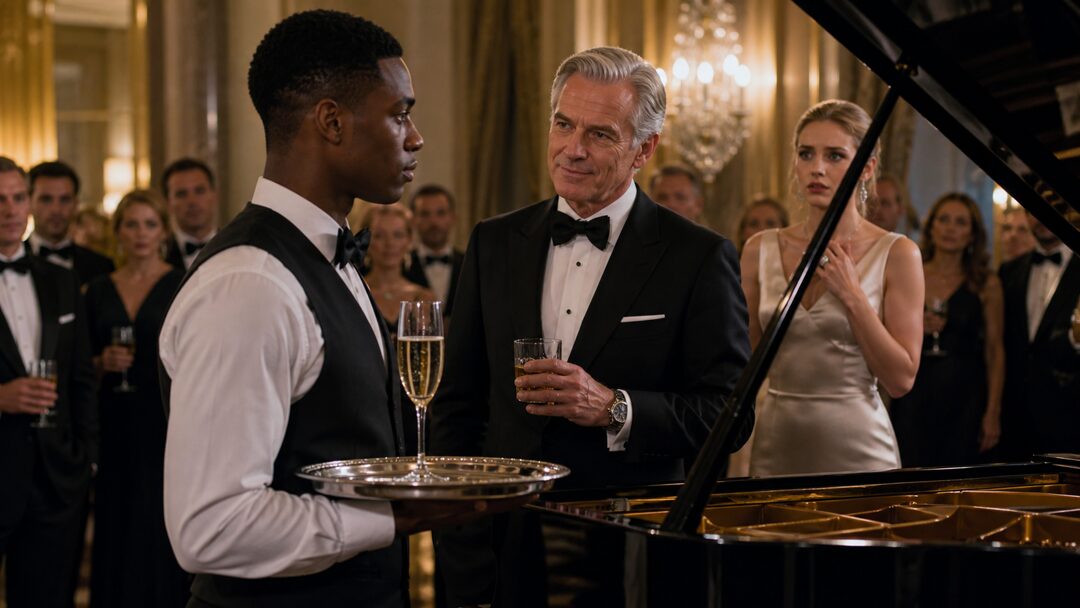
She came down the marble staircase on Michael Harris’s arm, pale satin moving around her like poured milk, her engagement ring catching the chandelier light with every step. Daniel stood at the edge of the ballroom in a black vest and bow tie, a silver tray of champagne coupes balanced on his left hand, and felt the old part of his life walk into the room wearing someone else’s future.
No one noticed him looking.
That was the advantage of being dressed to disappear.
The Whitman Foundation gala had always been designed for people who were meant to be seen. Men in tuxedos lifted glasses beneath chandeliers the size of small storms. Women in diamonds touched each other’s arms and laughed softly. Donors moved through the ballroom as if money had made the air gentler around them.
Daniel stood near the wall with the other temporary servers, tall, quiet, careful. His hands were still the best thing about him. They had once made teachers lower their voices. They had once made Emily sit beside him on a practice bench until midnight, her shoulder against his, whispering, “Play that part again.”
Now those hands held champagne for people who would not remember his face.
A tray passed. A woman took a glass without looking at him.
“Thank you,” she said to the air.
Daniel nodded.
He had told himself he could do this job. Four hours. Black vest. White shirt. Move where directed. Keep his face smooth. Leave with the check. He had not known it was a Whitman event until he arrived and saw the crest on the program: The Whitman Foundation Annual Gala for Young Artists.
Young artists.
The words had almost made him laugh.
Then Emily appeared on the stairs, and laughter became impossible.
Michael leaned toward her and said something that made her smile. It was a practiced smile. A public one. Daniel knew the difference because he remembered the other one—the private smile, the one she used to hide against his shoulder when they were nineteen and stupid enough to believe talent could outrun class.
Richard Whitman saw him next.
Emily’s father stood near the piano with a drink in his hand, silver-haired and relaxed in a black tuxedo that fit like authority. He was listening to a donor, or pretending to. His eyes moved across the ballroom, touched the servers, passed over Daniel, then returned.
For one second, Richard’s smile did not change.
Then it deepened.
Not surprise. Not guilt.
Recognition.
He lifted his glass slightly, as if greeting a performer who had arrived early.
Daniel looked away first.
That was what angered him. Not Richard’s smile. Not Emily’s ring. The fact that his own body still remembered how to survive that family.
A woman in a headset hurried past the service line, whispering too loudly into her phone.
“What do you mean he’s still in Philadelphia?”
Daniel did not move.
The woman pressed two fingers to her temple. “No, I understand weather delays. I’m asking whether he is on the plane.”
Across the room, the grand piano waited under a warm pool of light.
Daniel had noticed it the moment he walked in. A Steinway concert grand, black and polished enough to reflect the chandeliers. Its lid was raised. A small arrangement of white flowers sat on the curve. Programs rested on the seats nearby.
He had not let himself look at it for more than a second at a time.
Looking was dangerous.
Wanting was worse.
“Daniel.”
His name landed behind him like a hand on the back of his neck.
He turned.
Emily stood five feet away.
Up close, she looked both exactly the same and altered beyond mercy. Same gray-blue eyes. Same small scar near her left eyebrow from the time she slipped on wet leaves outside the conservatory and laughed until she cried. But her face had learned restraint. Her beauty had become disciplined.
“Emily,” he said.
Her gaze dropped to the tray.
The ring flashed again.
“You’re working here?” she asked.
It was the wrong question, and they both knew it.
“I’m holding drinks,” Daniel said. “That’s usually what it means.”
Color rose in her face. “I didn’t know.”
“No?”
“No.”
Behind her, Michael watched from the base of the stairs, polite smile fading into attention.
Emily lowered her voice. “You should leave.”
Daniel looked at her then.
Not because the words surprised him, but because they didn’t.
“Before the toast?” he asked.
“Daniel, please.”
There it was. The old softness. The one that asked for mercy while standing safely behind her father’s walls.
He shifted the tray to keep it level. The champagne trembled but did not spill.
“Is that concern,” he asked, “or crowd control?”
Her eyes shone, but she did not answer quickly enough.
That was answer enough.
Part II — A Little Music
The first rule of working a room like the Whitman gala was simple: never become part of the event.
Daniel moved between tables. He offered champagne. He stepped back before conversations resumed. He learned the choreography of being useful and absent.
But Richard Whitman had never liked absence unless he had arranged it himself.
At the front of the ballroom, the event coordinator hovered near him, pale with panic. Richard listened, glass in hand, his expression mild.
“The pianist’s flight is grounded,” she whispered.
“I heard.”
“We have the quartet for later, but the donor introduction was built around the piano performance.”
Richard’s smile stayed pleasant. “Then adjust it.”
“We can’t just—”
“Of course we can.” He patted her shoulder. “Never let the room know the room has a problem.”
Daniel heard the words while replacing empty glasses near the stage.
He should have kept walking.
Instead, his eyes betrayed him.
They went to the piano.
Only for a heartbeat.
Richard caught it.
The older man turned, and Daniel felt the room tilt around that small movement.
“Daniel Carter,” Richard said warmly.
Several nearby donors looked over.
Daniel stood still with the tray in his hand.
Richard approached as if greeting an old family acquaintance. That was his gift: he could make cruelty sound like hospitality.
“I thought that was you.” Richard’s gaze traveled from Daniel’s face to his vest, then to the tray. “How long has it been?”
“Long enough,” Daniel said.
One of the donors, a woman in emerald earrings, smiled politely. “You two know each other?”
Richard’s eyes did not leave Daniel’s. “Daniel was once connected to one of our youth music programs.”
Once connected.
Not sponsored. Not selected. Not promised a conservatory recommendation signed by Richard himself.
Connected.
Daniel felt the word slide over the past like a cloth over furniture.
“You played a little, didn’t you?” Richard said.
The donor laughed, unsure whether she was meant to.
Daniel said nothing.
Richard tipped his glass toward the grand piano. “Or did I imagine that?”
A small silence formed.
Not large enough to stop the party. Just large enough for humiliation to have a shape.
Daniel could feel servers behind him pretending not to listen. He could feel Emily somewhere across the room. He could feel the piano waiting, black and bright, like a dare.
“I’m working,” Daniel said.
“Of course.” Richard’s tone was smooth. “I’d never interfere with honest work.”
A few people smiled at that.
Daniel lowered his eyes first, because if he kept looking at Richard, something in him might become visible.
He carried the tray toward the service corridor.
Emily followed him.
She caught up near the narrow hallway behind the ballroom, where the music softened and the smell changed from perfume to coffee urns and polished silver.
“Daniel.”
He stopped.
She glanced back toward the ballroom. “My father is doing this on purpose.”
“I noticed.”
“You need to go.”
“You already said that.”
“I’m saying it again because you don’t know what he’ll do.”
Daniel looked at her left hand. She curled it slightly, too late to hide the ring.
“I know exactly what he’ll do,” he said. “He’ll smile. He’ll offer help. He’ll make sure everyone thinks whatever happens was my choice.”
Emily’s mouth trembled.
For a moment, the years fell away. He remembered her in jeans and bare feet, sitting beside him in the Whitman music room while rain hit the windows. He remembered writing the first bars of a melody because she had said she hated songs that sounded too sure of themselves.
“Make it sound like it wants to say something but can’t,” she had told him.
He had.
He had named it nothing. Private things did not need names.
“Michael seems nice,” Daniel said.
Emily flinched.
“That’s not fair.”
“No,” he said. “Fair would have been a long time ago.”
She stepped closer. “I didn’t know you’d be here.”
“I didn’t know this was your engagement party disguised as charity.”
“It’s not—”
“Then why does everyone keep congratulating him?”
Her silence answered before she could.
From the ballroom, applause rose briefly, then faded.
Emily lowered her voice. “Please don’t let him turn you into something people talk about.”
Daniel almost smiled.
“He already did.”
Part III — The Program
Richard did not ask Daniel to leave.
That would have been too obvious.
Instead, he gave an instruction to the event coordinator, and five minutes later Daniel was assigned to serve the front tables—the donors closest to the piano.
“Mr. Whitman requested experienced staff near the stage,” the coordinator said, not looking at him. “Can you handle that?”
Daniel almost asked what experience meant in this room.
Instead, he said, “Yes.”
The front tables were filled with people who used generosity like a language. They spoke of opportunity while wearing watches worth a semester of tuition. They said words like access and excellence and discipline as if talent were a wild animal that wealthy people had invented cages for.
A man with a red face took champagne from Daniel’s tray and said, “The Whitmans do more for young artists than the city schools ever could.”
His wife nodded. “Especially the disadvantaged ones. They just need structure.”
Daniel held the tray steady.
Structure had not saved him.
At eighteen, he had been the foundation’s miracle story. A scholarship student from the east side who could play Rachmaninoff like he was arguing with God and then write something small enough to break your heart. Richard had brought donors into practice rooms to hear him. Emily had sat in the corner, pretending to study, listening with her whole face.
Then Richard found out Daniel was not just the student Emily admired.
He was the boy she loved.
The conservatory recommendation vanished first. Then the stipend. Then the polite calls. Daniel’s mother stopped asking why the Whitmans no longer invited him. His stepfather’s medical bills appeared on the kitchen table like another language no one could translate.
A month later, Daniel signed papers he barely read.
After that, Emily’s messages stopped.
Or his did.
He no longer knew which silence came first. Only that both survived.
“Excuse me.”
Michael Harris stood beside him.
Daniel turned.
Up close, Michael was exactly the kind of man Richard would choose for Emily. Clean-cut, confident without seeming eager, handsome in a way that had never had to defend itself.
“Daniel, right?” Michael said.
Daniel nodded.
“Emily knows you.”
“She used to.”
Michael absorbed that with a lawyer’s stillness. “Should I be worried?”
Daniel looked past him to Emily, who stood near her father, white-knuckled around a glass of water.
“That depends,” Daniel said.
“On what?”
“On whether you want to be loved or approved.”
Michael’s jaw tightened.
Before he could answer, the event coordinator began placing programs on the front tables. One slipped from the stack and landed near Daniel’s shoe.
He bent to pick it up.
The cover was thick cream paper embossed in gold.
THE WHITMAN FOUNDATION PRESENTS
A NIGHT FOR YOUNG ARTISTS
Featuring Selections from the Whitman Legacy Collection
Daniel opened it without meaning to.
His eyes moved down the page.
Speeches. Awards. Donor recognition. A delayed piano performance now probably doomed by weather.
Then he saw the title.
Untitled Bridge in G Minor
Anonymous Student Artist, Whitman Foundation Archive
The ballroom noise receded.
He read it again.
Untitled Bridge in G Minor.
No one else would know what it was.
Emily would.
Daniel’s hand tightened around the program until the paper bent.
That title was not a title. It was a theft made tidy.
He had written the piece for Emily when they were twenty. Not for school. Not for donors. Not for applause. It had begun on a rainy night in the Whitman music room when she asked him to write something that sounded unfinished in the right way.
He had played the bridge only once.
She had cried and then laughed at herself.
“You can’t show anyone that,” she had said.
“I wasn’t going to.”
“It feels like you read my diary and made it prettier.”
He had kissed her temple. “Then it’s yours.”
Now it belonged to the Whitman Legacy Collection.
Anonymous Student Artist.
Not even his name.
Daniel looked up.
Emily was already staring at him.
She knew exactly what page he had reached.
Part IV — What Was Kept
Emily found him by the coatroom ten minutes later.
The hallway was dimmer there, lined with framed photographs of past galas. Richard shaking hands with mayors. Richard beside scholarship recipients. Richard smiling with children holding violins.
Daniel stood beneath a photograph of himself at nineteen.
Not the main subject. He was in the background, seated at a piano while Richard addressed donors in the foreground. His face was blurred by motion. His hands were clear.
Even in the photo, they had kept the useful part.
Emily stopped when she saw what he was looking at.
“Daniel,” she said.
He held up the program. “Did you know?”
Her answer was in her face before it became words.
“Yes.”
Something inside him went quiet.
That was worse than anger. Anger still believed in impact.
“For how long?” he asked.
She swallowed. “Since last winter.”
“Last winter.”
“My father found the sheet music years ago. After everything. I didn’t know he kept it until the archive committee—”
“Donated it anonymously?”
Her eyes closed.
Daniel laughed once, without humor. “That’s generous. He stole it without taking credit.”
“It wasn’t like that.”
“Tell me what it was like.”
Emily looked toward the ballroom doors. Music from the string quartet drifted through, polite and harmless.
“He said it belonged to the foundation because it was written while you were under their sponsorship.”
“I wrote it for you.”
“I know.”
“No,” Daniel said softly. “You knew. That’s different.”
Her face tightened as if he had struck her.
Good, he thought.
Then hated himself for wanting it to hurt.
Emily stepped closer. “I should have stopped it.”
“Yes.”
“I didn’t know how without dragging everything back up.”
“Everything,” he repeated. “You mean me.”
“That is not what I mean.”
“It’s always what you mean when I become inconvenient.”
Her eyes filled. “Do you think I wanted this?”
Daniel looked at her ring.
“I think wanting has never been your problem.”
She pressed her lips together. For a second she looked young again, trapped between confession and obedience.
“I kept the copy,” she said.
Daniel went still.
“What?”
“The original sheet music. The one with your notes. I kept it because after you left, it was the only thing in the house that still felt like you.”
He stared at her.
There were kinds of tenderness that arrived shaped like theft.
“You kept it,” he said, “but you didn’t call.”
“My father—”
“Don’t.”
She stopped.
The word hung between them, sharper than a shout.
Daniel looked back at the photograph on the wall. His younger self at the piano. Richard in focus. Daniel blurred.
“You let him keep the part of me that didn’t embarrass you.”
Emily’s tears spilled then, silent and immediate.
“Please don’t play it tonight,” she whispered.
He turned toward her.
There it was. The real request.
Not don’t get hurt.
Not don’t let him use you.
Don’t make me stand in public beside the truth.
“Why?” Daniel asked.
She wiped under one eye carefully, as if even grief had to remain presentable. “Because he’ll ruin you.”
“He already tried.”
“Daniel, you don’t understand. If you embarrass him in front of these people, he won’t stop.”
The old ache moved in him, deep and familiar.
“You’re still warning me about what he’ll do,” he said. “Not asking yourself why you’re standing with him.”
Emily had no answer.
That was the tragedy of her. She could feel the right thing with her whole body and still not do it.
A burst of applause came from the ballroom. Then Richard’s voice, amplified by a microphone, warm and assured.
“Ladies and gentlemen, if you’ll begin taking your seats…”
Emily looked toward the sound like a daughter trained from birth.
Daniel watched her.
“Go,” he said.
She turned back. “Daniel—”
“Your father’s calling.”
The cruelty of it landed between them.
She deserved it.
He wished she didn’t.
Part V — The Price of Silence
Richard was waiting for Daniel near the service entrance.
Of course he was.
He stood beneath a sconce with his hands folded around a glass, removed from the noise but not from control. He looked less amused now. That should have satisfied Daniel.
It didn’t.
“Walk with me,” Richard said.
“I’m working.”
“I’ll compensate your employer.”
Daniel kept still.
Richard smiled faintly. “Still proud. I always admired that before it became impractical.”
Daniel followed him because refusing would have made a scene too early, and Richard knew it.
They stopped in a smaller corridor near a locked side door. The sound of the gala was muffled here, reduced to clinking glass and distant applause.
Richard reached inside his jacket and removed an envelope.
Daniel looked at it.
“No.”
“You don’t know what’s inside.”
“I know who’s holding it.”
Richard’s expression did not change. “Five thousand dollars. For your evening, your inconvenience, and your discretion.”
There it was. Help.
Richard always dressed a leash as help.
Daniel said, “I’m not nineteen anymore.”
“No,” Richard said. “At nineteen you were more reasonable.”
Daniel’s hand curled once at his side.
Richard noticed. His eyes moved there and back.
“I know what you’re thinking,” he said. “You think I destroyed something pure. Your music. Your young love. Your future. It’s a comforting story.”
Daniel stared at him.
“What happened,” Richard continued, “is that I prevented my daughter from confusing rebellion with devotion. You were talented. Very talented. You were also angry, poor, and in love with a girl whose life you could not understand.”
Daniel’s voice stayed low. “You don’t know what I understood.”
“I know exactly what you signed.”
The hallway seemed to narrow.
Richard tilted the envelope slightly. “You accepted our terms.”
“My stepfather was sick.”
“Yes.”
The word came too easily.
Daniel felt the first crack of something under his ribs.
Richard watched him with mild interest, as if observing whether a glass would break or merely ring.
“What did you say?”
“I said yes, your stepfather was sick. His treatment was expensive. Your mother was exhausted. Your family needed help.”
Daniel could hear his own breathing now.
Richard went on, almost gently. “I paid the debt. In return, your family agreed there would be no further claim against the foundation, no public accusations, no contact with Emily. You signed because your mother asked you to sign.”
Daniel remembered the kitchen table. His mother’s red eyes. His stepfather coughing in the next room. The papers. The shame. The way no one would say Emily’s name.
He had thought his family wanted him gone because loving Emily had made him foolish. Because accepting Whitman money had made him dependent. Because he had failed them by dreaming too loudly.
Richard’s voice softened.
“They chose survival. I don’t blame them.”
Daniel looked at him then.
For the first time all night, the tray was gone from his hand, and he did not know what to do with his fingers.
“You bought them,” Daniel said.
“I helped them.”
“You bought me.”
Richard’s face cooled. “No, Daniel. You were never mine to buy. That was the problem.”
The line was almost honest.
That made it uglier.
From the ballroom came a swell of polite applause. Richard checked his watch.
“Take the envelope,” he said. “Leave through the service entrance. Let Emily have her evening. Let yourself have some peace.”
Daniel looked at the envelope.
He thought of his mother at the kitchen table. Thought of Emily keeping his sheet music like a private candle while letting her father hang his nameless music in public. Thought of Richard’s smile when he saw him carrying drinks.
Silence had cost him everything once.
Now the same man was offering to buy it again at a discount.
Daniel turned toward the ballroom.
Richard’s voice sharpened. “Do not mistake attention for justice.”
Daniel paused.
Then he looked back.
“Do not mistake silence for consent.”
For the first time, Richard’s expression changed.
Not much.
Enough.
Part VI — The Original Version
The room was ready for music that did not arrive.
Guests had returned to their tables. The stage lights warmed the grand piano. Programs lay open beside dessert plates. The event coordinator stood near the wall, smiling the frightened smile of someone watching a polished evening split at the seam.
Richard stepped back into the ballroom as if nothing had happened.
Daniel followed with a fresh tray.
That was important.
He wanted Richard to see him still carrying it.
Richard took the microphone.
“Ladies and gentlemen,” he said, voice rich with practiced ease, “thank you for your patience. As you may know, tonight we celebrate not only established excellence but the unexpected places excellence can emerge.”
A murmur of approval moved through the room.
Daniel stood near the piano.
Emily sat at the front table beside Michael. Her face was pale. Michael watched her, then Daniel, then Richard. The geometry had become visible to him at last.
Richard continued, “Our scheduled pianist has been delayed, but in the spirit of discovery, I believe we may have a small surprise among us.”
Emily’s head lifted.
“No,” she whispered.
Richard smiled toward Daniel.
“Daniel here used to play a little. Maybe he can give us a few bars while we wait.”
The room laughed politely.
Not cruelly. That was worse.
The laughter of people who trusted the host to tell them who was safe to laugh at.
Daniel felt it pass over his vest, his bow tie, his tray. Felt it touch the part of him that had once sat in practice rooms while donors praised his promise as if promise were a pet they had adopted.
Richard held out one elegant hand toward the piano.
“Well?” he said.
A server froze near the wall.
The event coordinator looked like she might faint.
Emily stood halfway from her chair. “Dad, don’t.”
Every face turned to her.
Richard did not even look at her fully.
“Sit down, Emily.”
Three words.
Soft. Public. Complete.
She sat.
Daniel saw it happen and understood too much. Love did not always fail because it vanished. Sometimes it failed because it obeyed.
Michael leaned toward Emily, quiet but sharp. “Who is he?”
She did not answer.
Daniel walked to the piano.
The room watched him now. Not as a person. As a risk.
He set the silver tray on the polished black lid.
One champagne glass trembled.
It did not spill.
That small mercy nearly undid him.
He sat on the bench.
The keys waited, clean and indifferent.
For a second, his hands hovered above them, and he was nineteen again. Emily beside him. Rain on glass. Her voice saying, Make it sound like it wants to say something but can’t.
Richard stood to the side with his drink.
Smiling.
Daniel placed his fingers on the keys.
He did not play the arrangement printed in the program.
He played the beginning as he had written it.
The first notes were simple enough that the room did not understand. A restrained line in G minor, almost hesitant. Something reaching, then stopping itself. The sound rose under the chandeliers and slipped between the tables.
A few guests settled politely.
Then Daniel changed the voicing.
Emily’s hand went to her mouth.
She knew.
The bridge came earlier than the archive version. Softer. More exposed. He had never written it down completely because some things had felt too private for paper. He had carried the missing measures in his hands for seven years.
Now he gave them back to the room that had taken everything else.
The music moved from restraint into ache. Not loud. Not dramatic. It did not beg to be believed.
It simply refused to disappear.
A donor stopped lifting her glass.
The red-faced man who had spoken about disadvantaged children lowered his eyes.
Michael looked at Emily, and whatever he saw there answered the question she had not.
Richard’s smile faded slowly.
That was the moment Daniel felt the room change.
Not because they understood the whole truth. They didn’t. They could not know about the kitchen table, the papers, the paid debt, the messages never sent, the girl who kept stolen sheet music because grief made her selfish.
But they understood enough.
They understood that the waiter was not being funny.
They understood that Richard had misjudged the object of his joke.
They understood that something private and dangerous had entered the room through the piano.
Daniel played on.
The piece opened under his hands, the way a wound opens when someone finally stops pressing it shut. He did not look at Emily, but he felt her listening. He did not look at Richard, but he felt the man’s authority thinning with every measure.
In the final passage, Daniel returned to the first theme.
This time, he did not let it stop itself.
He finished the sentence.
The last note held in the ballroom longer than it should have.
No one moved.
Then applause began at the back.
Uncertain at first. Then growing. People stood because other people stood. A few stood because they had actually heard him. Daniel did not try to separate them.
He lifted his hands from the keys.
Only then did he look at Richard.
The older man’s face was controlled again, but control was not the same as victory. His glass hung forgotten at his side.
Daniel stood.
The applause continued around them, too loud and too late.
Richard approached, stopping close enough that no microphone could catch him.
“You’ve made your point,” he said.
Daniel looked at the tray on the piano. The champagne still trembled faintly from the applause.
“No,” he said. “I played what was mine.”
Richard’s eyes hardened.
But he had no room left to smile.
Part VII — Without the Tray
Daniel left the ballroom through the side corridor while they were still applauding.
No one stopped him at first. That was another kind of power, he realized. To leave while people were deciding what they had just witnessed.
He made it past the coatroom before Emily called his name.
“Daniel.”
He stopped because once, a long time ago, that voice had been home.
She came toward him quickly, satin gathered in one hand, no longer graceful. Her cheeks were wet. Behind her, at the ballroom entrance, Michael stood still. He did not follow.
Good man, Daniel thought, and almost hated him for it.
Emily stopped an arm’s length away.
For once, she did not reach for him.
“I should have said something,” she said.
Daniel looked down the corridor toward the service exit.
“Yes.”
“I should have chosen you when it mattered.”
The words broke in the air between them.
They were the words he had wanted for years.
Hearing them now did not heal him.
That was the cruelest part.
Some truths arrived late enough to become another injury.
Emily touched her ring, then let her hand fall.
“I loved you,” she said.
Daniel looked at her then, fully.
“I know.”
Her face crumpled.
He could have been cruel. There were sentences in him sharp enough to last her whole life. He could have told her love was not the same as courage. He could have told her she had kept his music because keeping was easier than standing. He could have asked whether she would cry like this tomorrow when the photographers arrived.
He said none of it.
He had given enough of himself to that house.
“I loved you too,” he said.
She closed her eyes.
Then he added, quietly, “That was never the whole question.”
The ballroom applause began to fade behind them.
Emily opened her eyes. “What happens now?”
It was the question of someone still hoping pain could become a doorway back.
Daniel had no doorway to offer.
“Now you decide what kind of life requires that much silence.”
She flinched, but she did not look away.
For the first time all night, that felt like something.
Not enough.
But something.
Michael appeared behind her then. He did not touch her. He looked at Daniel with an expression stripped of polish.
“Was it yours?” he asked.
Daniel knew what he meant.
“The music?”
“Yes.”
Daniel nodded.
Michael looked at Emily. Not angry exactly. Worse. Awake.
Richard’s voice carried faintly from the ballroom, already repairing the evening. Thanking the guests. Praising unexpected talent. Folding the disruption into the foundation’s story before anyone else could name it differently.
Daniel almost smiled.
Of course.
Power survived by narrating quickly.
Emily heard it too. Her face changed.
For one second, Daniel thought she might go back in there and stop him. Say Daniel’s name. Say the piece was his. Say her father had lied. Say all the things that would cost her something.
She took one step toward the ballroom.
Then stopped.
Not because she chose Richard.
Because choosing against him had become a language she did not yet know how to speak.
Daniel understood.
He could even pity it.
He just could not live inside it anymore.
He turned toward the service exit.
“Daniel,” Emily said again.
This time, he did not stop.
The night air outside was cold enough to clear his lungs. The alley behind the hotel smelled like rain and exhaust. A catering truck idled near the curb. Somewhere above him, behind tall glowing windows, the gala continued.
Daniel looked at his hands.
They were empty.
No tray. No envelope. No program. No stolen sheet music. No hand reaching for a girl who could love him in private and lose him in public.
Just his hands.
For years, he had thought silence was the last thing he owned.
He had been wrong.
He walked away from the hotel slowly, without hurry, while behind him the ballroom kept applauding a truth it still did not fully understand.
Inside, Richard Whitman stood beneath the chandeliers, smiling for his donors with a face that no longer fit him.
And Daniel Carter, who had entered through the service door carrying champagne for people who did not see him, left with nothing in his hands.
That was how he knew he was finally carrying only himself.