The Locket on the Table
Part I — The Child at the Rail
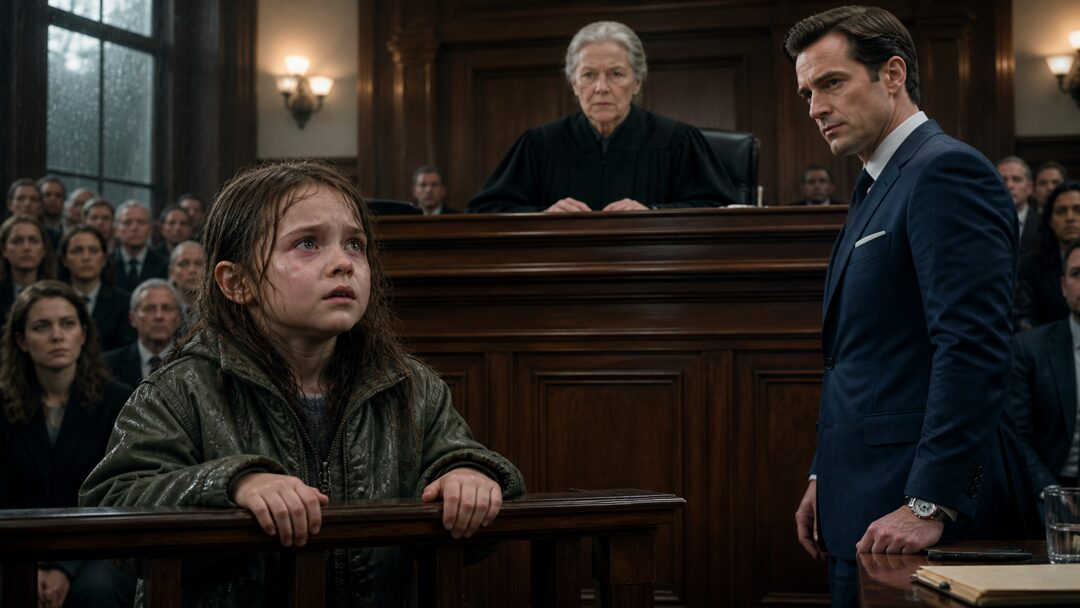
The girl stood alone in the center of the courtroom, dripping rain onto the polished floor, while half the county whispered that she had broken into David Whitman’s mansion and stolen from a dead woman’s bedroom.
She was nine years old.
Her jacket was too large for her shoulders, army-green and shiny with rain. Mud had dried along one knee. Her brown hair hung in tangled ropes around a pale face that looked younger whenever she tried not to cry.
No one sat beside her.
Not a parent. Not a foster worker. Not even the tired public advocate who had brought her in and then stepped back as if distance could protect him from the embarrassment of the case.
Judge Margaret Hale looked down from the bench.
She had presided over custody fights, neglect petitions, bitter divorces, inheritance disputes that wore the faces of children. She knew how to keep a room still. She knew how to cut through hysteria with one cold sentence.
But this child made the room feel wrong.
“Your name?” Margaret asked.
The girl gripped the wooden rail with both hands.
“Emily Hale.”
A murmur moved through the benches.
Margaret’s pen stopped.
“Hale?”
The girl nodded.
David Whitman sat three tables away in a navy suit, clean-shaven, handsome in the practiced way of men who knew cameras liked them. He lowered his eyes at the murmur, as though embarrassed on everyone else’s behalf.
His attorney rose. “Your Honor, the child has used several names in different placements. We believe—”
Margaret raised one finger.
The attorney sat.
Margaret looked back at the girl. “Where is your guardian, Emily?”
Emily’s knuckles turned white on the rail.
“Because everyone who was supposed to claim me got paid not to.”
The courtroom went quiet enough for the rain against the windows to sound like fingernails.
David’s face did not change.
That was the first thing Margaret noticed.
Not shock. Not anger. Not even offense.
Only patience.
The kind of patience powerful people wore when they expected the room to eventually come back to them.
Margaret leaned forward. “Paid by whom?”
Emily looked at David.
Not quickly. Not dramatically. She simply turned her wet face toward him, and the room followed her eyes.
David gave her a sad smile.
It was beautiful, that smile. Careful. Soft. Public.
“Your Honor,” he said, rising before his attorney could stop him, “I would never blame a child for grief. Or confusion.”
Emily flinched at the word confusion.
Margaret saw it.
So did David. He kept smiling anyway.
“This has been difficult for everyone,” he continued. “My late wife’s room was a private place. The girl was found there last night with a jewelry box open. I am not asking for punishment. I am asking that she receive help before these delusions hurt her further.”
Emily’s mouth trembled.
“She wasn’t your wife’s,” she said.
David looked gently pained. “Emily.”
The way he said her name made it sound like a favor.
“She wasn’t your wife’s,” Emily repeated, louder. “She was looking for mine.”
Someone in the back whispered, “Lord.”
Margaret tapped her pen once on the bench.
“Mr. Whitman,” she said, “you will sit down.”
David obeyed.
But he did not look worried.
Emily did.
She looked like a child who had walked into a room full of adults and discovered that truth needed permission to breathe.
Part II — The Man Who Sounded Kind
David Whitman had entered the courthouse through the side doors, under the old stone arch his family had paid to restore.
Everyone knew that.
Everyone also knew about the engagement party scheduled for that weekend, the donors, the Whitman Foundation, the photographs of David beside his new fiancée in the Sunday paper. He had been widowed young, wealthy longer, and forgiven for things most men would never have been accused of because no one important wanted to accuse him.
His attorney, Paul Mercer, stood with a folder thick enough to look merciful.
“Your Honor, the facts are simple,” Paul said. “This child has had three foster placements in two years, chronic school absences, and repeated claims regarding Mr. Whitman that are unsupported by any record.”
Emily stared at the table.
“She appeared at Mr. Whitman’s residence on four occasions. Last night she entered through a service door during preparations for a private family event. Security discovered her upstairs in the blue bedroom, holding a necklace box that belonged to Mr. Whitman’s deceased wife.”
“Was anything missing?” Margaret asked.
Paul paused. “The contents were disturbed.”
“That is not what I asked.”
“No confirmed missing property.”
Emily looked up.
David did not.
Paul recovered quickly. “The concern here is not theft in the ordinary sense. It is fixation. The child has repeatedly claimed that Mr. Whitman is her father. She has also made statements about her mother, Sarah Hale, who passed away last year. Records indicate Ms. Hale struggled with instability.”
“She wasn’t unstable,” Emily said.
Paul turned to her with polite sorrow. “Emily, no one is trying to insult your mother.”
“You just did.”
A few people shifted. Someone coughed into a hand.
Paul’s expression tightened, then softened again.
That was how the room hurt her: softly.
David stood once more, slower this time, as if reluctant to participate in cruelty.
“Your Honor,” he said, “Sarah was a troubled woman. I tried to help her when I could. She worked briefly with one of our charitable programs years ago. She formed attachments. Misunderstood kindness. I regret not doing more.”
Emily swallowed hard.
“You said you loved her.”
The words cut through the room like dropped glass.
David finally looked at her.
Only for a second.
“No, sweetheart,” he said. “I don’t think I did.”
Emily’s face changed.
Not with surprise.
With the terrible recognition of hearing a practiced lie spoken in front of strangers.
Margaret felt something move under her ribs.
She had heard many men deny many things. Children. Bruises. Bank accounts. Promises made in kitchens and broken in court.
But David denied with elegance. He did not shove the child away. He lowered her gently into a category where no one had to believe her.
Confused.
Troubled.
Attached.
Helped.
Margaret looked at Emily’s jacket. The collar had folded outward, and inside the faded fabric, written in black marker almost worn away, was a name.
Sarah.
Not a label from a store.
A hand-written claim.
“Emily,” Margaret said, “how did you know about the blue bedroom?”
Paul started to object, then thought better of it.
Emily glanced toward David. “My mom told me.”
“What did she tell you?”
“That the walls were blue. Not light blue. Dark. Like night before rain.” Emily tightened her grip on the rail. “She said there was a window seat. She said he used to sit there and tell her he hated all the rooms downstairs because downstairs was where people watched him.”
David’s jaw moved once.
It was small.
It was enough.
Emily continued, eyes on the wood now. “She said upstairs he was different.”
Margaret waited.
Emily’s voice dropped. “She said he promised he would tell people. After his father died. After the money was settled. After one more Christmas. After one more thing.”
David let out a breath that sounded almost like a laugh.
“Your Honor, this is precisely the fantasy structure we’ve been trying to—”
“Did Sarah Hale ever enter your home?” Margaret asked.
David blinked.
“She may have attended foundation functions.”
“That is not what I asked.”
The room leaned in.
David’s smile returned, thinner now. “I do not recall every person who has ever been inside my house.”
Emily whispered, “You remembered her enough to send money.”
David turned to her.
This time the kindness was gone before he could put it back.
Part III — The Lady in Black
Margaret called a recess after Emily began shaking too hard to answer.
Not crying. Shaking.
There was a difference.
Crying asked for comfort. Shaking meant the body had stopped waiting for permission.
Margaret ordered a clerk to bring Emily to the small conference room beside chambers. She told David and his attorney to remain outside. Paul protested. Margaret looked at him once, and he remembered where he was.
Emily sat at the end of a long table with her shoes not touching the floor.
Up close, she looked smaller.
The green jacket swallowed her wrists. Beneath it, at the base of her throat, a thin chain disappeared under her shirt. Emily kept touching it with two fingers, not like jewelry, but like a pulse she needed to check.
Margaret sat across from her.
“Emily,” she said, softer than she had meant to, “why did your mother tell you to come here?”
Emily studied her face.
“My mom said courts listen to papers before people.”
Margaret absorbed that.
“She said if I ever had to talk to a judge, I should not cry first. I should say what happened.”
“And what happened?”
Emily’s fingers closed around the chain.
“My mom died before she could make him say it.”
“Say what?”
“That she wasn’t crazy. That I wasn’t made up.” Emily looked down. “That he knew.”
The room hummed with the old courthouse heat.
Margaret had spent her life inside rooms like this one, rooms that smelled of paper, coffee, wet wool, and people trying not to fall apart in public.
She had learned early that the world rewarded composure.
When she was twenty-two, pregnant, unmarried, and terrified of her father’s silence, she had learned it completely.
The memory came like a door cracking open.
Her father standing at the foot of a hospital bed.
A nurse who would not meet her eyes.
A baby she was allowed to hold once.
Then fever.
Then sleep.
Then waking to the sentence that built the rest of her life.
The baby didn’t make it.
Margaret pushed the memory down.
She had buried it so well that even grief had become formal.
Emily watched her carefully.
“My mom called you the lady in black,” she said.
Margaret looked up.
“What?”
“She said if the lady in black ever asked who I was, I should open it last. Not first. Last.”
Emily pulled the chain an inch from beneath her shirt.
A battered heart-shaped locket swung free.
The gold had worn thin at the edges. One side was dented. The clasp looked fragile enough to break under a careless thumb.
Margaret stopped breathing.
She knew that shape.
Not because heart lockets were rare. They were not. Girls wore them. Mothers bought them. Husbands forgot them in drawers after anniversaries.
But this one had a nick near the hinge, shaped like a tiny crescent.
Margaret’s father had given her one like it when she was sixteen.
No.
Not like it.
That one.
Her throat tightened.
“My mother had a locket,” Margaret said.
Emily’s hand closed around it at once. “This is mine.”
“I’m not taking it.”
“That’s what people say before they take things.”
Margaret had no answer for that.
A knock came before she could try.
David entered without waiting.
He had removed his overcoat. His suit looked expensive enough to make the old room seem ashamed of itself.
“Judge Hale,” he said, and smiled at Emily as if she were a spill on the carpet. “I apologize. Paul is concerned about ex parte issues.”
“This recess is not for your convenience, Mr. Whitman.”
“No, of course not.” He shut the door behind him. “I only thought, given the sensitivity, we might avoid turning a sick woman’s tragedy into theater.”
Emily’s shoulders rose.
Margaret noticed.
David did too.
He looked almost satisfied.
“Sarah was not sick,” Emily said.
David sighed. “Sarah was many things.”
“She loved you.”
That landed.
Not loudly. Not visibly for everyone. But Margaret saw the old wound move under David’s smooth face.
“Yes,” he said quietly. “She did.”
Emily’s eyes filled.
“And you loved her.”
David’s gaze sharpened. “Children hear stories differently than adults tell them.”
Margaret stood.
“That is enough.”
David turned toward her.
His voice lowered. “Margaret. You know what families like ours survive by not letting every private mistake become public record.”
It was the first time he used her first name.
It was also the first threat.
“My family funded part of this courthouse,” he continued. “Yours helped build its reputation. There are reporters outside. My fiancée’s parents are in the gallery. I am asking you to consider whether humiliating everyone involved helps this child.”
Margaret felt heat rise in her face.
He had wrapped the knife in concern.
“She would have ruined everything,” David said, and for one second the sentence came raw. Not polished. Not legal. Human, and ugly.
Emily stared at him.
Margaret heard what he had not meant to confess.
Not that Sarah lied.
That Sarah mattered.
David noticed too late.
He adjusted his cuff. “I mean the allegations would have ruined everything. For herself. For the child. For everyone.”
Margaret opened the door.
“Return to the courtroom.”
David’s expression hardened.
Then the smile came back, camera-ready and empty.
“As you wish, Your Honor.”
Emily waited until he was gone.
Then she whispered, “That’s how he talked to her when he wanted her to disappear.”
Part IV — The Woman in the Rain
When court resumed, the room had multiplied.
More spectators crowded the benches. A reporter stood near the back wall pretending not to be one. David’s fiancée sat between her parents, beautiful and rigid, her left hand folded so the diamond showed.
Emily saw it.
Margaret did too.
David’s attorney adjusted his papers. “Your Honor, we move to conclude this matter. The child’s statements are becoming increasingly inflammatory.”
Margaret looked at Emily.
“Emily, did your mother ever contact this court?”
Paul frowned. David went still.
Emily nodded. “She wrote letters.”
“To whom?”
Emily pointed at Margaret.
The room inhaled.
Margaret felt the bench beneath her hands.
“To me?”
“My mom said you never answered.”
A clerk at the side table looked down too fast.
Margaret turned. “Mr. Allen.”
The clerk froze.
“Search the sealed correspondence index for Sarah M. Hale.”
“Your Honor, that may not be necessary,” David said.
Margaret did not look at him. “Now.”
The clerk moved.
David’s fiancée whispered something to her mother. Her mother did not answer. The diamond stayed visible.
Emily’s face had gone white.
Margaret softened her voice. “Tell me about the night your mother died.”
David stood. “Absolutely not.”
“Sit down.”
“Your Honor—”
“Sit down, Mr. Whitman.”
He sat.
For the first time, anger marked him plainly.
Emily looked at the door as though measuring how far she would get if she ran.
Then she touched the locket.
“She wore this jacket,” Emily said. “Because it was raining. She put on lipstick in the car even though she was crying. She said people listen better if you look like you meant to come.”
No one moved.
“She had the locket in her hand. She said it was time. She said he was getting engaged in front of everybody, and if he could say he loved another woman in public, he could say he knew us in public too.”
David’s face drained of color.
Emily kept going, because stopping would have killed her.
“There were lights everywhere. Music. People laughing inside. My mom told security her name. They called someone. He came to the side door.”
David looked down.
That was worse than denial.
“He didn’t let her in,” Emily said. “She said, ‘David, please. Not tonight. Not like this.’ He said she was embarrassing herself.”
The fiancée’s hand dropped from the diamond.
“He told the guard she was trespassing.” Emily’s voice broke. “He told them not to call police because she had a child and he didn’t want to be cruel.”
David closed his eyes.
Emily stared at him. “You said that like you were kind.”
A sound moved through the room, low and ashamed.
Margaret’s clerk returned with a gray file.
His hands trembled.
Margaret opened it.
Three envelopes lay inside.
All addressed to Judge Margaret Hale.
All marked RETURNED PER FAMILY INSTRUCTION.
The instruction page beneath them bore her father’s name.
Her dead father, who had told her the baby was gone.
Her dead father, who had stood beside her hospital bed and stroked her hair and said, “This is mercy, Margaret. You will understand when you are older.”
Margaret had understood obedience.
She had mistaken it for healing.
Her fingers rested on the envelopes.
She did not open them.
Not yet.
Because if she did, she might not be able to remain upright.
Emily watched her.
“My mom said she tried you first,” she said. “Before him. Before the party. Before she got sick.”
Margaret could barely speak.
“Sick?”
Emily nodded.
“She walked home in the rain because she didn’t have money for another cab. She got pneumonia. She kept saying she just needed him to say one true thing before she got too tired.”
David whispered, “Enough.”
Emily turned to him.
“No.”
It was the smallest word in the room.
It was also the first one that belonged entirely to her.
Part V — The Price of Silence
David stood again, but this time the movement had lost its grace.
“Your Honor, this is no longer a hearing. This is a public execution based on the memories of a grieving child.”
Margaret looked at him over the envelopes.
“You object to memory?”
“I object to manipulation.”
Emily flinched.
David saw it, and his voice softened instantly. “Emily, look at me.”
She did not.
“I understand you miss your mother. I understand she told you things. Adults sometimes say painful things when they are disappointed.”
Emily stared at the rail.
“I can help you,” he said.
The room changed.
Everyone felt it.
Even before the offer came, they knew it would be expensive.
David turned slightly, enough for the fiancée’s family, the reporter, the donors, and the courthouse staff to hear him as a man choosing generosity.
“I will fund counseling. A stable placement. Education. Whatever she needs.” He looked at Margaret. “Provided this ends here. Provided these damaging claims stop.”
Emily’s mouth parted.
For one weak second, she looked like a child offered warmth after years of cold.
A home. School supplies. A bedroom nobody could take away after three months. Adults who signed papers and kept appointments. A life where she did not have to carry her mother’s name like contraband.
David saw the hesitation.
He stepped into it.
“You don’t have to keep fighting your mother’s battles,” he said gently. “You can have a future.”
Emily’s eyes filled again.
“What about hers?”
David blinked.
“My mom’s future,” Emily said. “The one you kept promising when nobody was watching.”
His face hardened so quickly the kindness looked exposed as costume.
Margaret rose from the bench.
Not fully. Just enough.
“Emily,” she said, “do you have anything else you wish this court to see?”
Emily’s hand went to her throat.
For a moment she looked terrified.
Not of David.
Of the object itself.
Some proofs are too heavy because once you show them, no one can pretend you are only making noise.
“My mom said not first,” Emily whispered. “Last.”
Margaret nodded once.
“Then now.”
Emily pulled the chain over her head.
The locket caught for a second in her tangled hair. She freed it carefully, almost tenderly. Then she walked toward the table.
Every step sounded too loud.
Mud from her shoes marked the clean floor.
David whispered, “Emily.”
She stopped.
His voice dropped low enough that only the nearest people heard. “Think very carefully.”
Emily turned.
“I did,” she said.
Then she placed the heart-shaped locket on the courtroom table.
It looked absurdly small there.
A cheap, battered thing among files, motions, legal pads, and the polished machinery of people who knew how to make pain official.
Margaret descended from the bench.
The entire courtroom watched her step down.
Judges did not usually look smaller when they left the bench.
Margaret did.
But she also looked more human.
She stood before the table and looked at the locket.
The crescent nick near the hinge.
The worn gold.
The clasp she remembered fighting with as a girl, laughing because it never opened when she wanted and always opened when she didn’t.
Her father’s voice rose from somewhere buried.
This is mercy.
Margaret reached for the locket.
Her fingers would not behave.
Emily stood beside her, not touching her, watching with the guarded hope of someone who had learned that adults could break a promise simply by breathing.
Margaret opened it.
Inside was a photograph, creased with age.
A young woman lay in a hospital bed, exhausted and glowing, silver-dark hair loose around her face. She held a newborn wrapped in a white blanket.
Margaret heard someone gasp.
It was not until the sound faded that she realized it had come from her.
Behind the photograph, folded twice and pressed flat with time, was a hospital bracelet.
Sarah M. Hale.
Margaret did not fall.
But the room tilted.
The baby did not die.
The sentence moved through her without sound.
The baby did not die.
The child at the rail was not a stranger’s child.
She was Sarah’s child.
Sarah, who had written letters.
Sarah, who had stood in the rain.
Sarah, who had been called unstable because the truth made respectable people uncomfortable.
Margaret pressed one hand to the table.
Emily whispered, “Is that her?”
Margaret could not answer at first.
Her throat had closed around thirty-four years.
At last she nodded.
“That is your mother.”
Emily’s face crumpled.
The whole courtroom understood then that something larger than a trespassing accusation had died in front of them.
David stood so fast his chair struck the table.
“This is outrageous.”
Margaret turned toward him.
Her eyes were wet. Her voice was not.
“Do you still wish to accuse this child of theft while I am holding evidence that links her to the daughter I was told died in infancy?”
Silence crashed down.
David’s attorney said nothing.
The reporter stopped pretending not to write.
David stared at the locket like it had betrayed him.
“She never told me that part,” he said.
It was the first true thing he had said all day.
Then, because truth had frightened him, he reached for control again.
“Sarah was complicated. She knew what this would do. To my family. To yours. To everyone. I gave her money. I tried to keep things private because no one would have survived the scandal.”
Emily looked up at him.
“She didn’t.”
Two words.
No volume.
No performance.
Just the fact he had arranged his whole life not to hear.
David sat down as if something inside him had been cut.
Margaret looked at the hospital bracelet again.
Sarah M. Hale.
Her daughter had lived.
Her daughter had begged to be known.
Her daughter had died with a locket in her hand because the people who loved respectability more than truth kept calling abandonment mercy.
Margaret closed the locket.
Then she faced the room.
“This matter will be transferred immediately to another judge,” she said. “I am recusing myself from all further proceedings involving Emily Hale, David Whitman, or the estate records connected to Sarah M. Hale.”
Paul rose weakly. “Your Honor—”
“I am not finished.”
He sat.
“Pending transfer, this court orders immediate protective placement for Emily Hale outside the influence, funding, or private arrangement of Mr. Whitman or any affiliated foundation. All records involving Sarah M. Hale, including correspondence, sealed instructions, payments, medical documentation, and security reports from Mr. Whitman’s residence, are to be preserved.”
David said, “You can’t—”
Margaret looked at him.
The room saw him stop.
Not because she had power.
Because for the first time that day, he was afraid of what power looked like when it stopped protecting him.
Margaret took off her glasses.
Her hand shook.
She stepped away from the table, away from the bench, away from the height that had let her spend years above other people’s grief.
Then she turned to Emily.
Not as a judge.
Not yet as family.
As a woman holding a truth too late.
“Emily,” she said, “your mother’s name was Sarah Hale. And she will not be called unstable in this courtroom again.”
Emily looked at her for a long time.
Then she nodded once.
It was not forgiveness.
It was enough to keep standing.
Part VI — What Truth Cannot Repair
The courthouse hallway smelled like rain and old stone.
Outside the courtroom, voices rose and fractured behind closed doors. Attorneys called other attorneys. A clerk cried quietly near the copy machine. Someone from David’s party spoke too loudly into a phone, saying, “No comment,” which meant there was already something to comment on.
Emily sat on a wooden bench beneath a portrait of a judge no one remembered except by last name.
The green jacket hung heavy around her.
Margaret stood a few feet away, still in her black robe though she had never felt less like a judge. In her hand were the three unopened letters Sarah had sent.
She had not read them yet.
She was afraid of the handwriting.
Emily held the locket in both hands.
Her thumbs traced the dented heart over and over.
A social worker waited at the end of the hall, giving them space because Margaret had asked for two minutes and because, for once, someone had listened.
Margaret sat down beside Emily.
Not too close.
Emily noticed.
Children who have been moved from house to house become experts in distance. They know when adults are reaching to soothe themselves.
Margaret placed the letters on her lap.
“I should have known,” she said.
Emily looked at the floor.
“My mom said that sometimes.”
Margaret closed her eyes.
It hurt more because it was not accusation. It was reporting.
“She said maybe you didn’t get them.” Emily’s voice was small. “Then later she said maybe you did.”
Margaret opened her eyes.
“I didn’t,” she said. “But that does not make it clean.”
Emily turned the locket over.
“Did you want her?”
The question entered Margaret more deeply than any verdict she had ever delivered.
She could have answered with history. With her father. With the hospital. With fever, drugs, lies, and a young woman trained to obey a house where love was always conditional.
Instead she gave Emily the only answer that mattered.
“Yes.”
Emily’s chin trembled.
Margaret did not reach for her.
“I wanted her,” Margaret said. “And then I believed what I was told because believing it was easier than fighting the people who told me.”
The hallway sounds blurred.
Emily opened the locket.
The photograph lay between them: young Margaret with the baby, frozen in a tenderness no one had permitted to continue.
“My mom looked like you when she was mad,” Emily said.
Margaret laughed once, and it broke into something close to a sob.
“She did?”
“She got quiet.” Emily glanced at her. “Not like scared quiet. Like she was putting the knife somewhere safe.”
Margaret pressed her lips together.
That sounded like a daughter she had never raised and somehow recognized.
“Did she talk about me?” Emily asked.
“She loved you,” Margaret said.
“You don’t know that.”
“No,” Margaret said. “I don’t know it from being there.”
Emily waited.
Margaret touched the letters on her lap. “But I know what it costs to keep proof when everyone wants you to throw it away.”
Emily’s fingers tightened around the locket.
For a moment, she looked nine. Only nine.
Not a witness. Not a disruption. Not evidence wrapped in a wet jacket.
Just a child whose mother was dead.
Margaret wanted to gather her close. The wanting was so strong it frightened her.
She did not move.
“I won’t ask you to call me anything,” Margaret said. “Not grandmother. Not family. Not now.”
Emily stared ahead.
“Good.”
The word was blunt. Defensive. Honest.
Margaret nodded.
“But I will say your mother’s name correctly,” she continued. “In every room where it was made small.”
Emily looked at her then.
The hallway held still around them.
Margaret extended one hand, palm up, not touching the locket.
Emily hesitated.
Then she placed the chain across Margaret’s palm.
Only the chain.
Not the heart.
Not the photograph.
Just enough to let Margaret feel the weight.
Margaret held it carefully, as if the metal could bruise.
After a few seconds, Emily took it back.
She slipped it over her own head again and tucked it beneath the green jacket.
The social worker approached softly. “Emily? We need to go.”
Emily slid off the bench.
At the end of the hall, reporters had gathered behind the glass doors, their faces pale shapes in the rain.
Emily saw them and stopped.
Margaret stood beside her.
“Do I have to talk to them?” Emily asked.
“No.”
“Will he?”
“Probably.”
Emily thought about that.
Then she lifted her chin in a way that made Margaret’s chest ache.
“My mom said people like him always get the first story.”
Margaret looked at the glass doors, at the waiting cameras, at the world David had trusted to arrange itself around him.
“Not today,” she said.
Emily did not smile.
But she did not lower her chin either.
They walked toward the side exit together, not touching, with enough space between them for everything lost and everything not yet decided.
At the door, Emily paused.
“Judge Hale?”
Margaret turned.
Emily swallowed. “When you read her letters… don’t fix the spelling.”
Margaret understood.
Sarah had not needed polishing. She had needed believing.
“I won’t,” Margaret said.
Emily nodded and stepped into the rain with the social worker.
Margaret stayed beneath the courthouse arch, holding the unopened letters against her robe.
For thirty-four years, she had been told grief was something that ended when respectable people stopped speaking of it.
Now a child had placed a locket on a table and proved that silence did not bury the truth.
It only taught the truth to wait.
Margaret looked through the rain until Emily disappeared into the waiting car.
Then she opened the first letter and saw, in uneven blue ink, the name she should have heard long ago.
Mom.