What He Brought Into the Room
Part I — The Man in the Rain
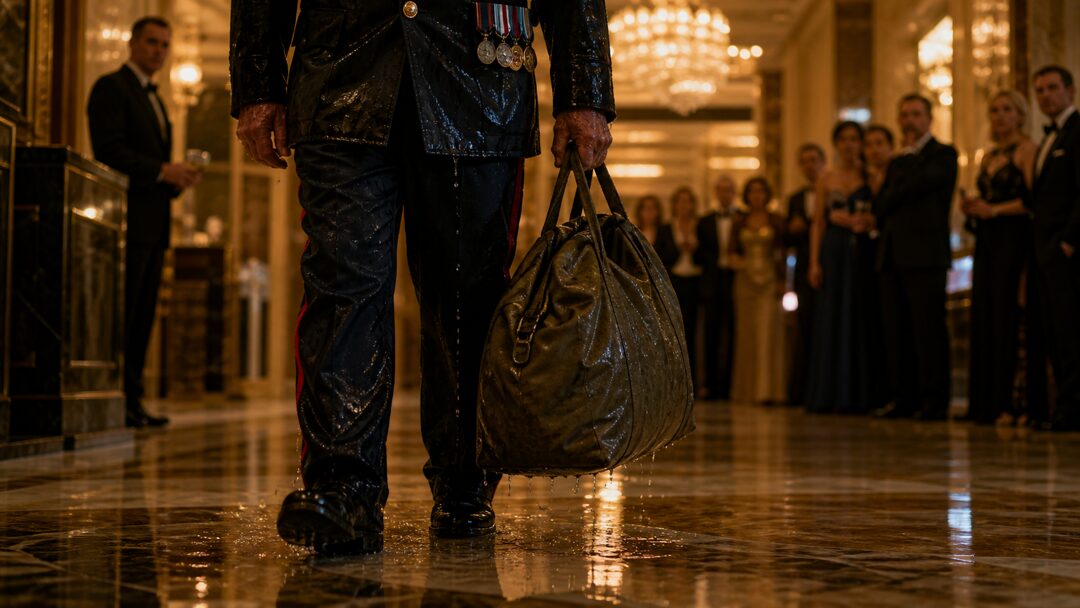
The old man crossed the marble lobby leaving water behind him, one slow step at a time, as if the storm had followed him inside and refused to let go.
Every head turned.
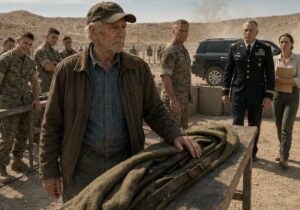
At the Fairmont Crest Hotel, water did not belong on the floor. Neither did a faded canvas duffel bag. Neither did an elderly man in an old Marine dress uniform, soaked through, his silver hair plastered to his forehead, his medals dark with rain.
The lobby had been polished for the Valor Foundation Gala until it looked almost unreal. Chandeliers glowed over the marble. Servers carried champagne on silver trays. Men in tuxedos and women in black dresses drifted toward the ballroom doors, speaking softly beneath banners printed with gold lettering and solemn faces.
Then Robert Hale walked in.
For three seconds, nobody moved.
Michael Turner saw him before security did.
That was Michael’s job: to see problems while they were still small enough to manage. A crooked centerpiece. A late donor. A photographer in the wrong hallway. A guest too drunk before dinner. A stain before anyone else noticed it.
And now this.
An old man dripping rainwater across Italian marble fifteen minutes before the opening remarks of the most important charity event the hotel had hosted all year.
Michael crossed the lobby fast, but not so fast that he looked alarmed. He kept his shoulders square, his expression controlled, his shoes silent. In his left hand was a folded white linen towel he had taken from a side station without thinking.
He stopped in front of the old man.
“Sir,” Michael said, low enough not to carry too far. “Can I help you?”
Robert Hale looked at him with pale, tired eyes.
The old man’s hand tightened around the duffel handle. The bag looked older than half the people in the room.
“I’m here for the event,” Robert said.
His voice was calm. Not confused. Not pleading. Just worn down by weather and time.
Michael glanced at the uniform. The jacket had once been sharp, but now the shoulders sagged around Robert’s thin frame. The medals were real enough to make Michael hesitate, but the rainwater pooling under the man’s shoes erased that hesitation quickly.
The Valor Foundation Gala had drawn donors, officials, veterans, families, press.
It had also drawn people who wanted to be seen near grief.
Michael had learned the difference.
“The lobby is closed for a private event,” Michael said. He lifted the towel slightly, not offering it, not exactly. “If you need assistance, I can have someone help you outside.”
A few people nearby stopped pretending not to listen.
Robert looked at the towel. Then at Michael’s face.
“I have an invitation.”
“Of course,” Michael said. “May I have your name?”
“Robert Hale.”
Michael turned toward the front desk. Sarah Miller, his assistant coordinator, was already there with the guest tablet in hand. Her hair was pinned tight, her black suit perfectly pressed, but her eyes flicked once to the water beneath Robert’s feet.
Michael did not like that look. It was the look people gave a situation after it had already become something.
“Check the list,” he said.
Sarah typed. Her thumb moved once, then again. She frowned.
Michael knew the answer before she said it.
“I don’t see him.”
A murmur passed through the nearest cluster of guests, soft as fabric brushing fabric.
Robert stood still.
No embarrassment. No explanation. No apology for the water on the floor.
Michael felt irritation sharpen under his ribs. He had spent months preparing this evening. The foundation board had trusted him because his name mattered here. Because he understood what this gala meant. Because his father’s portrait stood twenty feet away beside the ballroom doors.
Captain James Turner.
Decorated officer. Honored dead. One of the faces of the foundation’s campaign.
Michael had been six when his father came home in a flag-draped casket. He had spent thirty years learning how to carry a father he could not remember clearly. Tonight, he had finally made something beautiful out of that absence.
And now an old stranger was standing in front of it, dripping onto the floor.
“Mr. Hale,” Michael said, softer and firmer. “You’re not on the guest list.”
Robert looked past him.
For the first time, his face changed.
It was barely anything. A tightening at the mouth. A small break in the eyes.
Michael followed his gaze.
The old man was looking at James Turner’s portrait.
Michael stepped slightly to block his view.
That was when he noticed an older man near the donor table go very still.
Charles Bennett, retired colonel, foundation board member, silver-haired and dry in a perfect tuxedo, stared at Robert Hale as if a locked door had opened by itself.
Robert saw him too.
Neither man spoke.
Michael felt the lobby shift around them.
The problem was no longer small.
Part II — Not on the List
“Mr. Hale,” Michael said, “I’m going to ask you to step aside.”
Robert’s eyes returned to him.
“I promised I’d deliver this before the speeches.”
The duffel bag hung between them.
Michael looked at it. So did Sarah. So did security.
A dark green canvas bag with frayed seams, swollen from the rain. Nothing about it belonged in the Fairmont Crest lobby. Nothing about it belonged near donors, cameras, or families who had come to remember people they already missed.
“What’s in the bag?” Michael asked.
Robert did not move.
“Something that should have come home thirty years ago.”
The words landed too quietly to be dramatic. That made them worse.
A woman near the registration table lowered her champagne glass. A man in uniform turned his head. One of the servers froze with a tray balanced against his palm.
Charles Bennett went pale.
Michael saw it.
He also saw Sarah notice it.
“Sir,” Michael said, “this is not the place for personal demonstrations.”
Robert’s posture straightened. For a moment, under the wet hair and the sagging uniform, Michael saw the outline of someone who had once given orders and expected them to be understood.
“I’m not demonstrating.”
“Then help me understand why you came here without being listed.”
Robert glanced again toward James Turner’s portrait.
Michael’s patience snapped one thread.
“No,” he said, stepping closer. “Don’t look at him.”
Robert looked back at him.
“You his boy?”
The question was so direct that Michael forgot to answer.
Sarah’s eyes widened. Charles looked down.
Michael’s jaw tightened. “I’m Michael Turner.”
Robert took that in like a man receiving news he had both expected and feared.
“You were smaller than I remember.”
“I don’t know you.”
“No,” Robert said. “You wouldn’t.”
Michael hated the sympathy in the old man’s voice. Hated the way it sounded like familiarity. Hated that guests were watching him inside his own hotel as if he had lost control of the floor.
“My father is being honored tonight,” Michael said. “Along with families who came here to honor real soldiers. I won’t let anyone use that.”
Robert did not flinch.
He should have defended himself. He should have raised his voice. He should have pointed to the medals. He should have made Michael regret the sentence.
Instead, he only said, “Your father was real.”
Something in the room tightened.
Michael heard Sarah inhale.
Charles Bennett finally moved.
He crossed the marble slowly, his expression composed, his eyes fixed on Robert. The guests made space for him without realizing they were doing it.
“Gunny Hale,” Charles said.
The title cut through the lobby.
Security stopped walking.
Michael turned toward Charles. “You know him?”
Charles did not answer right away. He looked at Robert’s soaked uniform, the duffel, the water on the floor. For one unguarded second, regret moved across his face.
Then the colonel returned.
“Robert,” Charles said quietly. “This should be handled somewhere private.”
Robert’s laugh was almost not a laugh.
“I already waited thirty-one years for private conversations.”
Michael felt the number hit the air.
Thirty-one years.
His father had been gone thirty-one years.
Charles lowered his voice. “Not here.”
“Where, then?” Robert asked. “Your office? Your car? Another phone call where you tell me never to speak of it again?”
Michael looked from one man to the other.
Sarah’s tablet buzzed in her hand. She ignored it.
“What is he talking about?” Michael asked.
Charles did not look at him. “Michael, the program is about to begin. We can resolve this after.”
Robert’s grip tightened on the duffel.
“After is how men like you bury things.”
Michael’s face warmed. “Enough.”
He heard himself and hated that it sounded like command.
The old man’s eyes shifted to him again, steady and exhausted.
“I walked from the bus station,” Robert said. “Cab broke down six blocks out. Couldn’t get another one in the rain. I thought about turning around twice.”
“Then why didn’t you?” Sarah asked.
Michael shot her a look. She lowered her eyes, but not before Robert answered.
“Because if I leave again, I don’t know if I’ll remember why I came.”
The lobby went very quiet.
Robert tapped one finger against the duffel.
“And because this doesn’t belong to me anymore.”
Part III — The Portrait
The ballroom doors opened behind Michael, and warm sound spilled into the lobby: strings tuning, glasses clinking, a hundred polite voices preparing to become solemn.
Sarah stepped closer to Michael. “Opening remarks in seven minutes.”
Michael nodded without looking at her.
He should have ended it there. He should have had security escort Robert to a private room, called someone from the foundation board, kept the lobby clean, kept the evening on schedule.
That was what a good manager did.
That was what a good son did.
Protect the room. Protect the name.
But Robert Hale was staring at his father’s portrait again, and Charles Bennett looked like a man trying not to bleed through his tuxedo.
Michael heard his own voice come out lower.
“What do you want with my father?”
Robert’s expression tightened.
Charles said, “Michael—”
“No.” Michael turned on him. “You called him Gunny Hale. You know him. He knows my father. And everyone keeps telling me this should happen somewhere else. I want to know why.”
Charles looked toward the ballroom doors.
Guests were gathering. Donors. Families. A photographer standing uncertainly with his camera lowered. The evening’s carefully prepared reverence had cracked, and everyone was trying to see inside.
Robert took one step toward the portrait.
Michael moved to stop him.
The old man stopped first.
Up close, the medals on his chest were worn but clean beneath the rain. Not costume. Not fantasy. They had weight. History. Small scratches that no hotel polish could remove.
“Your father served with me,” Robert said.
Michael swallowed.
“In Kharan Province,” Robert continued. “Last year of the relief mission.”
Michael knew the name. He had heard it at ceremonies, in foundation videos, on plaques. He had written it into speeches. Kharan Province was where his father had become permanent.
“He saved three men from a convoy fire,” Michael said.
“He did.”
“And died doing it.”
Robert closed his eyes once.
“Yes.”
The answer should have ended the matter. It did not.
Charles stepped close enough that only the small circle around them could hear. “Robert, you are tired. You are wet. You are not thinking clearly.”
Robert looked at him. “I’m clearer now than I was when I obeyed you.”
Charles’s face hardened. “That is not fair.”
“No,” Robert said. “It wasn’t.”
Michael felt the floor tilt beneath the simple exchange. “Obeyed him about what?”
Charles turned to him at last. “Your father was a good man.”
“That isn’t what I asked.”
“He was a good man,” Charles repeated, as if saying it again could make it a wall.
Robert’s voice dropped. “A good man can still leave something behind.”
Michael’s throat tightened.
There were things children of honored men learned not to ask. They learned to accept clean sentences. Brave. Sacrifice. Duty. They learned that grief was easier when polished.
Michael had built a career on polished things.
But the old man had brought rain into the room.
“What’s in the bag?” Michael asked again.
Robert looked at Charles.
Charles gave one small shake of his head.
Robert looked back at Michael. “Ask him why my name isn’t on your guest list.”
Michael turned.
Charles said nothing.
Sarah’s tablet buzzed again. She checked it this time, her face tense. “Michael. They’re asking for you backstage.”
“Let them ask.”
Charles leaned in. “You are risking the entire evening.”
Michael stared at him. “Then tell me what I’m risking it for.”
For the first time, Charles looked old.
“Your mother suffered enough,” he said.
The sentence struck Michael harder than anger would have.
His mother had died eight years earlier. She had kept James Turner’s medals in a cherrywood box and dusted the framed commendation every Sunday. She had never remarried. She had never raised her voice when people spoke of sacrifice, but she had always left the room afterward.
Robert’s face changed at the mention of her.
“She suffered with the wrong story,” he said.
Michael felt something cold open in his chest.
“What does that mean?”
Robert did not answer directly.
“What did they tell you about the day your father died?”
Michael hated the question. Hated that he knew the answer too well.
“He pulled three wounded men from a burning convoy after an ambush. He went back for the last one and didn’t make it out.”
Robert nodded slowly.
“That happened.”
Michael waited.
Robert’s next words were almost gentle.
“Just not the way they wrote it.”
Part IV — What Came Home
Security moved when Robert bent to open the duffel.
Charles raised one hand.
“Stand down,” he said.
The authority in his voice still worked. That, somehow, made Michael angrier.
Robert knelt slowly. His fingers shook at the zipper, whether from cold or age or the weight of the moment, Michael could not tell. Rainwater dripped from his sleeve onto the canvas.
Sarah stepped forward, then stopped herself.
Robert opened the bag just enough.
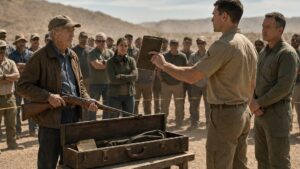
Inside was a folded field jacket sealed in plastic. A small velvet box. A flat pouch, cloudy with age, holding an envelope.
Michael saw his own last name written in faded ink.
Turner.
His vision narrowed.
Robert did not touch the envelope yet. He rested one hand on the bag as if steadying both of them.
“Earlier that day,” Robert said, “your father’s convoy reached a checkpoint outside Dar Safir. There was an interpreter with us. Nineteen, maybe twenty. Two civilians too. A woman and her brother. They had passed information to our unit. Bad information, good information—it depended who you asked after. But they were ours in that moment.”
Charles’s voice was tight. “Robert.”
“No details,” Robert said. “Not the kind that lets men argue maps instead of souls.”
Michael said nothing.
Robert continued. “Command wanted movement. There was pressure. Roads closing. Reports shifting. Your father was in charge on the ground. I told him we couldn’t leave them.”
The ballroom sound swelled behind them, then softened as the doors closed again.
“He overruled me.”
Michael’s stomach turned.
Robert’s mouth tightened, but he kept going. “He believed the convoy would be hit if we delayed. Maybe he was right. Maybe he wasn’t. That’s the part men like me replay until our brains wear out.”
Charles looked at the floor.
“They were left at the checkpoint,” Robert said. “Your father gave the order. I obeyed it.”
Michael looked at the portrait.
The face in the frame did not change. The handsome young officer still looked past the room with clean courage, untouched by any sentence spoken beneath him.
Robert drew a breath.
“Later, the convoy was hit anyway. Vehicle two caught. Men trapped. Your father ran toward it. Everyone knows that part.”
“He saved them,” Michael said, but it came out weak.
“Yes,” Robert said. “He did.”
“Then what are you saying?”
“I’m saying he wasn’t just brave.” Robert’s eyes shone, but his voice held. “He was ashamed. And he decided shame would not get the last word if he could still move.”
Michael could not speak.
Charles stepped in, desperate now. “This is exactly why it was kept private. Because men who were not there would reduce him to one decision. They would forget what he did after.”
Robert turned on him. “You didn’t keep it private. You turned it into marble.”
Charles flinched.
The line hung there.
Michael looked at the banners, the gold lettering, the portrait, the donors pretending not to listen. The whole night seemed suddenly built out of things nobody had said.
Robert reached into the bag and removed the velvet box.
He opened it.
Inside was a silver service ring.
Michael knew it without having seen it in person. His mother had described it once after too much wine on a Christmas Eve when Michael was twelve.
“He wore it on a chain,” she had said. “Said rings got in the way out there.”
Robert held it out.
Michael did not take it.
Not yet.
Robert’s hand stayed extended. It trembled.
“He gave this to me before he went back,” Robert said. “Told me if he didn’t come through, I should get it to your mother.”
“You didn’t,” Michael said.
Three words. No shouting. Worse than shouting.
Robert’s face folded around the pain.
“No.”
“Why?”
Robert looked at Charles.
Charles closed his eyes.
“Because I ordered him not to,” Charles said.
Michael turned slowly.
Charles had regained his posture, but not his certainty. “The operation was under review. There were families. There was political pressure. The official account was not false.”
Robert’s laugh was hollow. “Just cleaned.”
Charles’s jaw flexed. “It preserved the part that mattered.”
“To whom?” Michael asked.
Charles looked at him then, and for the first time there was no board member, no colonel, no polished elder. Only a man who had made a choice long ago and lived long enough to hear it named.
“To everyone who needed him to remain a hero.”
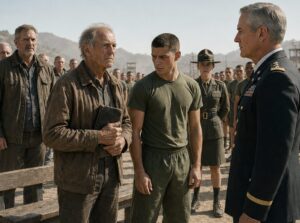
Michael finally took the ring.
It was colder than he expected.
Robert pulled the old envelope from the plastic pouch. The paper had been protected, but age had still touched it. The ink was faded at the edges.
“He wrote this before the final run,” Robert said. “Didn’t seal it. Didn’t know if he had the right.”
Michael stared at the name.
To Mary and Michael.
His mother’s name.
His own.
Sarah put one hand over her mouth and lowered it quickly, as if feeling was unprofessional.
Michael opened the letter.
He read only the first lines.
Mary, if this finds you, I need you to know I was afraid today.
The words blurred.
Michael blinked hard and kept reading.
Tell our boy I hope he grows into a man who knows honor is not the same as being admired.
The lobby disappeared for a second.
All his life, Michael had wanted his father’s voice.
Now he had it, and it did not sound like a plaque.
Part V — Before the Speeches
The ballroom doors opened again.
This time, the sound came with pressure.
A staff member leaned out. “Michael? They’re ready.”
Sarah looked at him. Her face said what her mouth did not: You have to choose now.
Charles stepped closer, voice low and urgent. “Michael, listen to me. Whatever you feel in this moment, do not make a public decision while emotional. The foundation funds counseling, housing assistance, family support. A scandal tonight hurts people who had nothing to do with any of this.”
Robert looked down at the ring in Michael’s palm.
“I didn’t come to ruin your father,” he said.
Michael looked up.
Robert’s eyes were wet now, but not from the rain.
“I came because he asked me to bring those home if I ever found the courage. I waited too long. My wife died waiting for me to stop waking up in rooms I wasn’t in. My memory’s getting loose at the edges. Some mornings I can’t remember where I left my keys.”
He tapped the duffel.
“But I remembered this.”
No one spoke.
Robert’s voice dropped.
“I’m not asking you to forgive me. I’m not even asking you to believe I did the right thing now. I’m only asking you not to let him be made out of stone before you’ve met the rest of him.”
Michael looked at his father’s portrait.
He had loved that portrait because it never changed. It never got older. It never disappointed him. It never had to explain why it had left.
A perfect father was easier to lose.
A human one could still hurt you.
Sarah came closer, careful, as if approaching a ledge.
“Michael,” she said quietly, “they’re waiting.”
He looked at the ballroom.
Then at Robert.
The old man stood soaked, shivering now that the adrenaline had begun to drain, still refusing to ask for a chair.
Michael remembered the first thing he had done when Robert entered.
He had reached for a towel.
Not to warm him. Not to help him.
To protect the floor.
The shame of it moved through him slowly and completely.
Charles saw the change before anyone else did.
“Michael,” he warned.
Michael folded the letter carefully and placed it back in the pouch. He closed the velvet box around the ring, then opened it again. He could not decide where the ring belonged because, for the first time, it seemed to belong to more than one person.
“What exactly do you want said in there?” Michael asked Robert.
Robert shook his head. “Not everything.”
That surprised him.
Robert saw it. “Your father’s story belongs to you too. And your mother. And men who aren’t here. I didn’t come to spill it across dinner plates.”
“Then why come here?”
“Because this is where the lie was going to stand up and get applause.”
Charles looked wounded by that, but he did not argue.
Robert added, “Let the truth enter. That’s enough for tonight.”
Michael understood then.
The old man did not want revenge. That would have been easier to dismiss.
He wanted witness.
Michael turned to Sarah. “Hold the program for two minutes.”
Her eyes flicked to Charles, then back to Michael.
“Yes,” she said.
Charles said, “You are making a mistake.”
Michael faced him.
“No,” he said. “I’m making one less.”
Then he picked up the white towel from where he had set it on the registration table.
For a second, Robert looked at it the way he had at the beginning.
As if expecting it to be used against him.
Michael did not hand it over yet.
“Come with me,” he said.
Robert straightened, though the effort cost him.
The guests in the lobby parted as Michael walked toward the ballroom with Robert beside him. Not behind him. Beside him.
The duffel remained in Robert’s hand.
The water remained on his uniform.
Michael did not ask him to clean up first.
Part VI — What Stayed
The ballroom went quiet one table at a time.
At first, people smiled because they thought the program had begun. Then they saw Michael’s face. Then they saw Robert Hale.
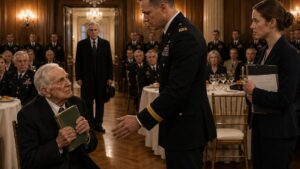
The room took him in the way the lobby had: the soaked uniform, the medals, the duffel, the old man’s stubborn dignity. But this time Michael did not step in front of him.
He stepped to the microphone.
His opening remarks were waiting on the podium. Three printed pages, revised six times. Polished sentences about service, sacrifice, legacy, and the responsibility of remembrance.
Michael turned them facedown.
A small ripple moved through the front tables.
He looked at his father’s portrait on the easel beside the stage. Then at the ring in his hand.
“My name is Michael Turner,” he began.
His voice held, barely.
“Most of you know me as the general manager of this hotel. Some of you know me as the son of Captain James Turner, whose portrait is here tonight.”
He paused.
Robert stood several feet away, still holding the duffel. He looked like a man trying to disappear after making disappearance impossible.
Michael continued.
“I planned to welcome you with a speech about honor. A clean one.”
A few people shifted.
“I’m still going to speak about honor,” Michael said. “But not the kind that stays clean because no one is allowed to touch it.”
Charles stood at the back of the room.
His face had gone gray.
Michael did not look at him.
“This foundation exists because service leaves unfinished stories. Some are proud. Some are painful. Some arrive late. Tonight, one of those stories came home.”
No one moved.
Michael turned slightly.
“This is Robert Hale. He served with my father.”
A low murmur passed through the ballroom.
Robert’s chin lowered, not in shame exactly. More like impact.
Michael lifted the ring.
“He brought something my father wanted returned.”
He did not explain the checkpoint. He did not name every failure. He did not turn his father into a headline in front of people holding salad forks and donation cards.
He walked to the portrait instead.
For a moment, he stood in front of the image of the father he had inherited from ceremonies.
Then he placed the ring beside the frame.
The silver caught the chandelier light.
Small. Real. Unpolished.
Michael turned back to the room.
“I used to think remembering meant protecting the version of someone that hurt the least,” he said. “I don’t think that anymore.”
The room stayed silent.
Not hostile. Not comfortable.
Awake.
Michael picked up the white towel from the edge of the podium and walked to Robert.
He held it out.
Not like a command.
Like an apology he did not yet know how to say.
Robert looked at the towel. Then at Michael.
His hand rose slowly.
He accepted it.
Only then did Michael see how badly the old man was shaking.
Sarah appeared from the side with a chair. No announcement. No drama. Just a chair placed where it was needed.
Robert sat.
It was the first time all evening he allowed himself to look tired.
No one applauded at first.
That was right.
Some moments should not be rescued too quickly by noise.
Then an older woman near the front table stood. Not clapping. Just standing.
A man in dress blues rose after her.
Then another.
Soon half the room was on its feet, but the sound remained restrained, almost careful. Not celebration. Recognition.
At the back, Charles Bennett stayed seated.
That was his punishment.
Not disgrace. Not exposure.
Witness.
Later, after the ceremony had continued in a different shape than planned, after donors spoke more softly and families lingered longer before the portraits, Michael found Robert in a service corridor behind the ballroom.
Sarah had brought him coffee in a white china cup from the banquet kitchen. He held it with both hands.
The corridor smelled faintly of bread, floor polish, and rain drying from old wool.
Michael sat beside him on a folded service chair.
For a while, neither of them spoke.
Michael had read the letter in a small office after the opening remarks. Not all at once. He had stopped twice and put it down. His father’s handwriting had made him feel six years old and thirty-six at the same time.
Finally Robert said, “I didn’t come for forgiveness.”
Michael looked at him.
“I’m not sure I can give it.”
Robert nodded, almost approving.
“Good. Don’t rush the things that matter.”
The line settled between them.
Michael turned the ring in his hand. “Was he a good man?”
Robert stared down into the coffee.
The corridor hummed around them. Staff moved at the far end, careful not to interrupt.
“He was a man who failed,” Robert said. “And then spent the last hour of his life trying not to let failure have the final word.”
Michael closed his fingers around the ring.
It was not the answer he wanted.
It was the first one that felt true.
After a moment, he held the ring out to Robert.
Robert looked at it but did not take it.
“Tell me one thing about him,” Michael said. “Not from a plaque.”
Robert’s mouth trembled.
Then, unexpectedly, he smiled.
“He made terrible coffee.”
Michael blinked.
Robert’s smile grew faintly. “Burned it every time. Didn’t matter where we were. Field kitchen, tin cup, rain coming sideways. Your father could ruin coffee in five countries.”
Michael let out a breath that almost became a laugh.
Robert looked down the corridor, past the hotel, past the gala, past the years.
“One night, he gave his dry socks to a nineteen-year-old private who’d been pretending his feet weren’t torn up. Told the kid he had another pair. He didn’t. Complained for two days after that his boots were trying to kill him.”
Michael looked at the ring in his palm.
A man who failed.
A man who ran back.
A man who burned coffee.
A man who gave away dry socks and left people behind and wrote to a son he would never raise.
Not marble.
Not clean.
His father.
Robert shifted as if to stand, but Michael stopped him with a hand on his arm.
“Stay for coffee,” Michael said.
Robert looked at the hand, then at him.
The old man’s eyes filled again, but he did not let the tears fall.
“All right,” he said.
Outside, the storm had softened against the service doors.
Inside, the chandeliers were still glowing. The portraits still stood. The gala went on, but not as it had been meant to.
The truth had not fixed the past.
It had only stopped waiting in the rain.