What Trust Remembered
Part I — The Line in the Dust
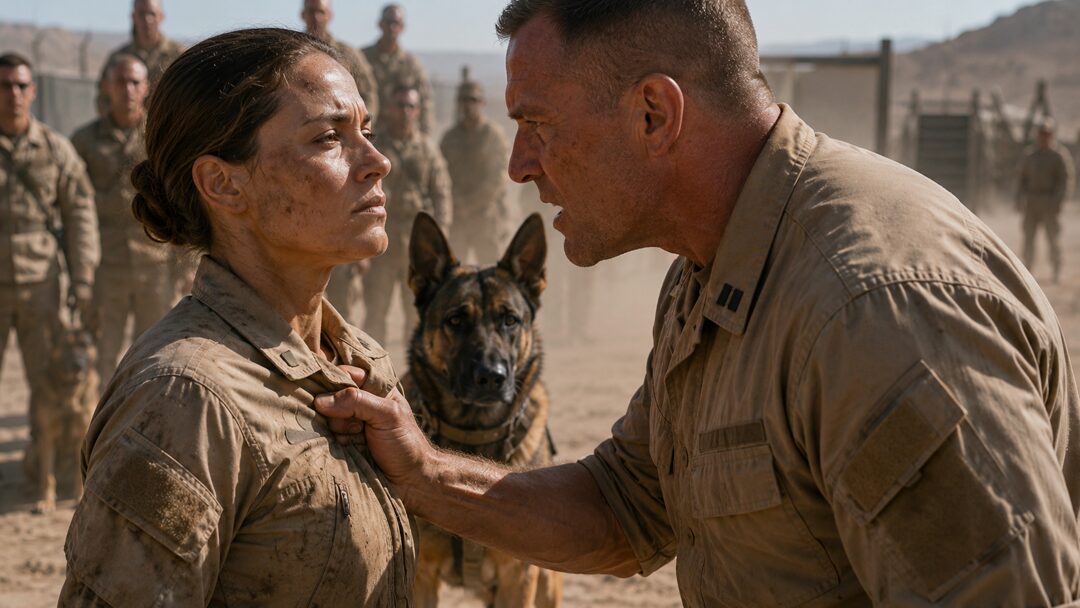
Major David Harris had Sarah Mitchell by the front of her uniform before anyone in the yard had decided whether to look away.
His fist closed in the fabric below her collarbone, twisting the tan cloth hard enough to pull the name tape crooked. He shoved her back one step, not far enough to drop her, just far enough to make the message clear.
He could move her if he wanted.
Behind her, six military working dogs stood at the handler line in the white heat of Fort Callum’s K-9 yard. Their leashes were clipped to steel posts. Their tongues hung low. Their eyes did not leave Sarah.
Not Harris.
Sarah.
“Say it,” Harris ordered.
Dust moved across the packed earth in a thin sheet. No one spoke. Two dozen soldiers stood in formation near the obstacle course, their boots aligned, their faces stiff with the effort of pretending this was procedure.
Sarah’s cheekbone was bruised from yesterday’s training impact. Her hair was pulled tight at the back of her head. Sweat had cut clean lines through the dirt on her face.
She kept her hands at her sides.
Harris leaned closer. “Tell them why you disobeyed a direct order.”
Sarah looked past his shoulder, not because she was avoiding him, but because looking straight at him gave him too much.
Ranger gave one short, low sound from the handler line.
Sarah’s eyes moved to him.
The Belgian Malinois stood rigid, ears forward, body still except for the small tremor in his shoulders. He had watched Sarah take hits before. Training hits. Controlled hits. Falls into sand, shoulder checks, impact drills.
This was different.
Harris heard the sound and turned his head just enough to notice. His jaw hardened.
“You control your dog, Staff Sergeant,” he said.
Sarah’s mouth opened, then closed.
That silence made Harris angrier than any argument could have.
Yesterday, during Operation Sandglass, Sarah had stopped a convoy drill cold. The exercise was supposed to impress the visiting evaluators: three vehicles, two extraction dummies, one simulated hostile corridor, and a gate obstacle Ranger was meant to clear. Harris had ordered the gate opened.
Sarah had ordered Ranger to hold.
The convoy missed its timing window. The evaluators saw the delay. Harris’s clean demonstration became a question mark on a clipboard.
Now everyone was paying for it.
“Maybe you froze,” Harris said, loud enough for the whole yard. “Maybe the noise got to you. Maybe you forgot that a handler follows command before instinct. I am giving you one chance to stand in front of this unit and admit it.”
Sarah said nothing.
A younger handler near the line shifted his weight. One of the German Shepherds turned its head toward Ranger. Another dog stopped panting.
Harris released Sarah’s uniform with a sharp push.
She rocked back half a step.
The soldiers saw it.
The dogs saw it too.
“Look at me,” Harris said.
Sarah did.
For a moment, the yard held still around them: the sun, the dust, the dogs, the soldiers, the old gate obstacle at the far end of the course with its metal hinges and cracked tan paint.
Harris pointed toward it.
“That gate cost this unit an evaluation score and made this command look undisciplined. You cost us that.”
Sarah’s gaze flicked to the gate.
Ranger’s body tightened.
Harris noticed again. This time, something like satisfaction crossed his face.
“There it is,” he said. “Fear.”
Sarah’s voice came out low. “No, sir.”
The answer was small, but it moved through the yard like a match head struck in dry brush.
Harris stepped close again.
“No?”
“No, sir.”
“Then what was it?”
Sarah looked at the gate. Ranger looked with her.
And still, she did not answer.
Part II — Yesterday’s Gate
Harris turned away from Sarah and faced the soldiers as if the yard had become a courtroom and he had appointed himself judge.
“Operation Sandglass was designed to test sequence discipline,” he said. “Three-stage entry. K-9 clearance. Convoy movement. Extraction. Withdrawal. Simple under pressure if every member of the unit performs.”
No one moved.
Sarah could still smell yesterday on the air, even under today’s dust and sun: rubber tires warming on hard ground, diesel from the lead vehicle, the metallic bite of the gate prop after Ranger stopped ten feet short of it and refused to advance.
Not refused wildly.
Not panicked.
Stopped.
Ranger had lowered his head, lifted it, and looked back at her.
The look had been enough.
Sarah had said, “Hold.”
Harris had snapped over the radio, “Send him through.”
She had answered, “Negative. He’s alerting.”
“He’s hesitating,” Harris had said. “Push him.”
Sarah had held the leash tight in her fist and felt Ranger’s body speak through the line.
Every handler learned the difference between disobedience and warning. Every good handler learned it before someone else had to pay the price.
“He’s alerting,” she had repeated.
The convoy clock had kept running.
That was what Harris cared about. The clock. The evaluators. The optics. The clean report.
Not the dog.
Not the warning.
Now Harris paced in front of the soldiers, shaping yesterday into a story that made him innocent.
“Staff Sergeant Mitchell chose personal judgment over command structure,” he said. “She chose hesitation over movement. She chose embarrassment over execution.”
Sarah stared at the ground ten feet ahead of her.
Ranger gave another low sound.
“Quiet,” Harris snapped.
Ranger did not quiet because Harris said so.
He quieted when Sarah lifted two fingers at her side.
That small obedience should have ended the matter for anyone paying attention.
It did not.
Harris turned back to Sarah. “You hear that? Even now, he feeds off you.”
Sarah kept her face still.
He wanted her defensive. He wanted her angry. Anger could be written up. Defensiveness could be called instability. Tears could be called proof.
Silence gave him nothing.
“You’ve been told before,” Harris said, lowering his voice. “That dog is not a shrine.”
For the first time, something changed in Sarah’s eyes.
It was gone almost instantly.
But Captain James Miller saw it.
Miller had just arrived at the edge of the yard with his medical bag slung over one shoulder and sleeves rolled to his elbows. He was tall, sun-browned, and tired in the permanent way of men who had treated both animals and soldiers and knew which ones complained less.
He paused beside the water station.
His eyes went first to Sarah’s uniform, twisted at the collar.
Then to Ranger.
Then to the other dogs.
Not restless.
Aligned.
That made Miller’s expression sharpen.
Harris noticed him. “Captain Miller. You here to supervise the animals or undermine command?”
Miller did not answer quickly. That was his habit. He trusted pauses more than most men trusted rank.
“I came because Ranger was reported agitated,” Miller said.
“He’s agitated because his handler is unfit to separate judgment from attachment.”
Sarah’s jaw tightened.
Miller looked at her, but she did not look back. Her eyes were on Ranger.
“What happened to your cheek?” Miller asked.
“Training impact,” Sarah said.
Harris cut in. “From yesterday’s obstacle failure.”
Miller studied the bruise. “That obstacle failure may be worth discussing.”
“It’s being discussed,” Harris said. “In the proper direction.”
Ranger shifted forward until the leash drew tight. The steel clip gave a small sound against the post.
Every dog on the line heard it.
So did every soldier.
Harris looked toward the gate again, then back at Sarah.
“You want to prove this was judgment?” he said. “Fine.”
Sarah already knew what he was going to say.
Her stomach went cold before the words reached the air.
“Run it again.”
Part III — The Second Refusal
No one said no to Major Harris in front of a formation.
That was why he chose the formation.
He pointed toward the obstacle course, where the gate stood half open in the sun. “You will demonstrate control. You will take Ranger to the start line, issue the clearance command, and send him through.”
Sarah’s eyes did not leave him.
“No, sir.”
The yard changed.
It was not a loud change. It was worse than that. A quiet rearrangement of breath. A few soldiers looked at her fully now, unable to hide behind discipline. The younger handler’s hand twitched near his leash.
Harris smiled once, without warmth.
“You want to repeat that?”
“No, sir.”
“Staff Sergeant Mitchell,” he said, “do you understand what happens if you refuse a direct order twice in two days?”
“Yes, sir.”
“And you still refuse?”
Sarah’s voice was steady. “Yes, sir.”
Harris stepped toward her.
Ranger moved too.
Not far. Just one pace, front paws pressing into the dust, eyes fixed on Harris’s center mass.
Sarah lifted her hand again. Ranger stopped.
Miller saw the control in it. So did the soldiers closest to the line.
Harris saw only defiance.
“You have turned that animal into a mirror of your own insubordination,” he said.
Sarah looked at the gate.
Ranger did too.
The motion was small, but it was perfectly synchronized.
Miller’s face changed.
Harris’s did not.
“Why?” Harris demanded. “Say it.”
Sarah swallowed.
She had not said Mark’s name in front of Harris for seven months.
Not because she had forgotten.
Because once a name entered the mouth of a man like Harris, it could be bent into whatever shape he needed.
Sarah looked at Ranger, and for one sharp second the yard was not Fort Callum.
It was another heat. Another road. Another gate. Ranger younger then, ribs showing more, coat dusty, leash in Mark Ellis’s hand. Mark grinning at Sarah over his shoulder after Ranger alerted on a culvert everyone else wanted to pass.
“Dog’s smarter than all of us,” Mark had said.
Then the radio.
Then the order.
Then Mark’s face changing because the order made no sense, but orders carried weight even when they carried men toward ruin.
Sarah forced herself back into the present.
Harris was still waiting.
The soldiers were still watching.
Ranger was still holding.
Sarah said, “He was right yesterday.”
The words were not loud.
They did not need to be.
Harris’s face flushed. “The dog was right.”
“Yes, sir.”
“And command was wrong.”
Sarah did not answer.
That was answer enough.
Harris moved so fast Miller took one step forward without thinking. Harris did not touch Sarah this time, but he came close enough that his shadow crossed her boots.
“You are done,” he said. “You hear me? I will strip your handler status before lunch.”
Ranger’s lips lifted.
Sarah lowered her hand.
“Ranger,” she said softly.
The dog settled back, but his eyes stayed on Harris.
Miller stepped into the open space between the formation and the handler line.
“Major,” he said, “I need five minutes with Staff Sergeant Mitchell.”
Harris turned on him. “No.”
“Then I need five minutes with the dog.”
“This is not a veterinary matter.”
Miller’s voice stayed calm. “It became one when six dogs started tracking the same stressor.”
Harris glanced at the line.
It was true. The dogs were no longer watching random movement. They were watching him.
A man could command soldiers to look forward.
He could not command dogs to lie.
Harris took one breath, then another.
“Five minutes,” he said. “Then she runs the gate.”
Sarah said nothing.
But Ranger’s ears moved at the word gate.
Miller saw that too.
Part IV — The Patch
The shade beside the kennel building was thin, but it was enough to hide Sarah from the formation for a few minutes.
Miller stood with her near the water drums. Ranger sat at her left side, close enough that his shoulder touched her knee. He was not panting now. His mouth was closed. His whole body was listening.
Miller kept his voice low. “What did he alert on?”
Sarah stared out at the yard. “The gate.”
“I know that part.”
“Then you know enough.”
“No,” Miller said. “I know enough to understand you’re protecting something. I don’t know whether it’s the dog, yourself, or a dead man.”
Sarah looked at him then.
Miller regretted the words as soon as they landed. Not because they were false. Because they were precise.
Sarah’s face did not break. That was what made it harder to look at.
“Don’t use him,” she said.
“I’m trying not to.”
“Harris will.”
Miller glanced toward the yard. Harris was speaking with two senior noncommissioned officers, his posture controlled again, his hands behind his back.
“He already is,” Miller said.
Sarah looked down at Ranger. “Yesterday, Ranger alerted at ten feet. Same way he did outside Al-Mazir.”
Miller’s throat tightened.
Al-Mazir was not a word people said casually at Fort Callum.
Not around Sarah.
Not around Ranger.
Not around anyone who had read the after-action report and noticed what was missing.
Miller said, “You reported the alert.”
“Twice.”
“During the drill?”
“Over comms. Then after, to Harris directly.”
Miller’s eyes moved to the gate obstacle in the yard.
Sarah saw the calculation beginning in him, the professional mind trying to build a bridge between instinct and proof.
“There was nothing scheduled in that gate,” he said.
“There wasn’t supposed to be.”
“That’s not an answer.”
Sarah’s hand moved to Ranger’s head. She did not pet him, not really. She rested two fingers between his ears.
“Harris ordered Mark through after Ranger alerted in Al-Mazir,” she said.
Miller closed his eyes for half a second.
There it was.
The sentence that had lived under Sarah’s silence for seven months.
“When Mark questioned it,” Sarah continued, “Harris told him the dog was reading old residue. Told him the route had to stay on schedule. Told him hesitation gets people killed.”
Her voice did not shake.
That made it worse.
Miller had treated Ranger after Al-Mazir. Sedated him when he fought every hand that was not Mark’s. Sat outside the kennel until dawn while the dog stared at the empty hook where Mark’s leash used to hang.
Sarah had been there too, back against the wall, Mark’s handler patch clenched in her fist until the edge cut into her palm.
She had not cried then either.
Some people broke loudly.
Sarah had broken into discipline.
“Why didn’t you say it in the report?” Miller asked, though he knew enough to hate himself for asking.
“I did.”
Miller went still.
Sarah looked at him. “I wrote that Ranger alerted before the order. I wrote that Mark requested a pause. I wrote that Harris overrode it.”
“That wasn’t in the final file.”
“No.”
Miller’s jaw worked once.
Sarah gave him a tired look. “Now you understand why I don’t hand Mark’s name to a man who knows how to erase it.”
Miller reached slowly into the side pocket of his medical bag.
Sarah’s eyes dropped.
He pulled out a small square of cloth, faded tan and green, the Velcro backing worn soft at the edges.
Mark Ellis’s old handler patch.
Sarah took a step back as if it had weight enough to push her.
“Why do you have that?”
“You left it in the kennel the night Ranger stopped eating,” Miller said. “I kept meaning to return it.”
“For seven months?”
“For seven months, I kept waiting for the right time.” His voice lowered. “That was cowardice dressed up as patience.”
Sarah stared at the patch.
Ranger leaned forward and sniffed once.
Then he looked up at her.
Miller closed his hand around the patch again. “I requested a sweep of the gate this morning.”
Sarah looked sharply at him.
“The training crew found residue in the hinge housing,” he said. “A charge had been seated there last week for a different scenario and not fully cleaned out. Inert casing, active residue. Enough for Ranger to alert. Enough to make yesterday’s refusal legitimate.”
Sarah absorbed this without relief.
Miller understood. The proof had come late. Proof often did.
“So say it,” Miller said.
Sarah looked back toward the yard, where Harris waited.
“If I say it,” she said, “it becomes about me winning.”
“No,” Miller said. “If you don’t, it stays about him never being wrong.”
That reached her.
Not fully. Not cleanly.
But enough.
Harris’s voice cut across the yard. “Time.”
Sarah drew one breath.
Ranger stood before she gave the command.
Part V — The Dogs Knew
When Sarah returned to the yard, the soldiers looked different.
Not softer. Not kinder.
More awake.
Harris had regained the center of the space. He stood near the start line of the obstacle course, polished boots clean except for a thin rim of dust at the soles. He had another handler beside him now, a young corporal named Steven, whose face had gone pale under his helmet.
Harris pointed at Ranger.
“Corporal,” he said, “take the dog.”
Steven did not move.
Harris turned his head slowly. “That was not a suggestion.”
Steven stepped forward.
Ranger looked at him once.
Only once.
It was not aggression. It was refusal without drama.
Steven stopped three feet away.
Sarah did not command Ranger to stay. She did not have to.
Harris’s face hardened. “Staff Sergeant Mitchell, transfer control.”
“No, sir.”
A murmur moved through the formation and died quickly.
Harris’s voice dropped. “You are making this worse.”
Sarah looked at him. “No, sir. I’m making it visible.”
For a second, Harris had no answer.
Then he stepped toward her.
Ranger moved first.
One clean pace.
He placed himself between Harris and Sarah, body angled, head level, silent.
No snarl.
No lunge.
Just a line.
“Get him back,” Harris said.
Sarah did not move.
“Get him back.”
Ranger held.
Another dog shifted at the handler line. A German Shepherd named Duke, broad-chested and gray at the muzzle, stepped forward until his leash tightened. His handler whispered a correction.
Duke did not sit.
Then another dog moved. Then another.
The steel clips clicked against the posts one by one, small sounds in the heat.
Harris looked at the handlers. “Control your animals.”
They tried.
The dogs did not break command. They did not pull wild or bark or bare themselves into chaos. They simply oriented toward the same point.
Harris.
The line of them changed the yard.
Sarah had been alone a moment ago.
Now she stood behind Ranger while the others formed a loose barrier, each dog held by training, each body saying what no soldier dared say yet.
Stop.
Miller stepped forward with the patch still in his fist.
“Major,” he said.
Harris did not look away from Ranger. “Not now.”
“Yes,” Miller said. “Now.”
The word had rank in it, but more than rank. It had decision.
Harris’s eyes cut to him.
Miller lifted a sealed evidence bag in his other hand. Inside was a small swab tube marked with the gate obstacle number.
“I requested a sweep of the hinge housing after yesterday’s exercise,” Miller said. “The results came back twenty minutes ago. Explosive training residue was present.”
No one spoke.
The sun seemed to press harder on every helmet, every shoulder, every closed mouth.
Harris said, “Residue from prior drills does not justify—”
“It justifies an alert,” Miller said. “And it justifies the handler holding the dog.”
Sarah looked at Miller then.
Not with gratitude.
With recognition.
He had stepped out from behind process. Finally.
Harris’s lips thinned. “Captain, you are outside your lane.”
“My lane includes the dogs,” Miller said. “And yesterday, the dog was right.”
The words came back, no longer Sarah’s alone.
Ranger stood steady.
Harris looked around the yard, searching for the old arrangement: soldiers silent, subordinate exposed, dogs as tools, himself at the center.
It was gone.
So he reached for the only weapon left.
“If Staff Sergeant Mitchell had concerns,” he said, “she had proper channels. She chose public defiance because she could not manage personal attachment to an animal and to a former handler.”
Sarah felt Mark’s name before Harris said it.
She felt it in Ranger’s body, in Miller’s breath, in the silence of every soldier who had heard fragments but never the whole.
Harris looked directly at her.
“Isn’t that right?” he said.
Sarah stepped forward until her knee nearly touched Ranger’s flank.
The dog did not look back.
He trusted her to be there.
“No, sir,” she said.
Her voice carried.
“I reported the alert yesterday. Twice during the exercise. Once after. You dismissed it.”
Harris’s face did not change, but his eyes did.
Sarah kept going.
“I reported the alert at Al-Mazir too. So did Sergeant Mark Ellis before he moved through the route.”
Miller lowered his head.
A few soldiers looked down.
Harris said, “Careful.”
Sarah’s face stayed calm.
That one word might have worked on her yesterday.
Not now.
“Mark asked for a pause,” she said. “Ranger had alerted. You ordered him forward.”
“That is not what happened.”
“You said old residue. You said timing mattered. You said hesitation gets people killed.”
Harris’s mouth opened.
Nothing came out.
Sarah did not raise her voice. She did not need to.
“Yesterday, you said the same thing.”
The yard held the sentence.
Ranger’s ears stayed forward.
The dogs stayed aligned.
Harris looked at them all, and for the first time that morning, he looked smaller than his rank.
Sarah’s next words were quiet, but they reached everyone.
“Obedience is not loyalty when it asks you to ignore the truth.”
No one cheered.
That would have made it easier.
Instead, the soldiers stood with the weight of having witnessed something they could no longer pretend was only a disciplinary matter.
A vehicle rolled up near the far fence. The base executive officer stepped out with two senior staff members. Someone must have called. Maybe Miller. Maybe one of the handlers. Maybe the truth had finally found more than one route into the yard.
Harris turned toward them, his face flushed beneath the hard mask of command.
Ranger did not move.
The executive officer spoke quietly with Miller first. Then with Harris. Then with Sarah.
Harris objected once.
Only once.
The executive officer’s face did not change, but his answer was clear enough that Harris stopped speaking.
When Harris was told to leave the yard pending review, he looked back at Sarah.
His expression was not apology. It was not remorse.
It was shock.
The shock of a man who had believed fear was the same thing as respect, and had just learned the difference in front of everyone.
Part VI — What Remained
After Harris left, the yard did not relax.
It loosened slowly, like a hand unclenching after holding something too sharp.
The soldiers were dismissed in small groups. The handlers checked their dogs with hands that moved more gently than usual. No one made a joke. No one came to Sarah with easy praise.
That was good.
Sarah did not have room for easy things.
Ranger finally turned and looked at her.
Only then did she kneel.
The dust pressed into her uniform. Her knees hit the ground harder than she expected. She put both hands on either side of Ranger’s head, fingers sinking into the short fur behind his ears.
He leaned into her.
Not much.
Enough.
“You did good,” she whispered.
Ranger closed his eyes.
Miller stood a few feet away. For once, his medical bag looked too heavy for him.
Sarah did not look up when she said, “You should have given me the patch.”
“Yes,” Miller said.
No defense.
No explanation.
That mattered.
He came closer and knelt, slower than she had. From his pocket, he took Mark’s handler patch and set it on the ground between Sarah and Ranger.
The faded cloth looked too small to carry what it carried.
A name.
A warning.
A missing voice.
Seven months of Sarah refusing to let grief become evidence in the wrong hands.
Ranger lowered his nose to the patch.
He inhaled once.
Then he folded down onto the ground, front paws on either side of it, chest covering the edge as if settling over a place he had been guarding all along.
Sarah’s hand stopped on his head.
For the first time that day, her face changed.
Not much.
Just enough for Miller to look away.
Across the yard, the old gate obstacle stood open in the sun. It looked harmless now. That was the worst part. Dangerous things often did, once everyone had survived them.
The executive officer would ask for statements. The report would be reopened. Harris would defend himself in careful language. The institution would move at the speed institutions moved when truth embarrassed them.
But the yard had already changed.
The soldiers had seen Sarah stand still.
They had seen the dogs choose the line.
They had heard Mark’s name return to the air.
Sarah kept one hand on Ranger and touched the edge of the patch with the other.
She did not say Mark’s name again.
She did not have to.
Some truths did not need to be repeated once they had finally been allowed to stand.
Ranger rested his head over the patch and went still, calm for the first time since morning.
Sarah stayed beside him in the dust.
No applause came.
No clean ending arrived.
But the silence was different now.
It no longer belonged to Harris.