The Second Watch
Part I — The Old Man on the Radio
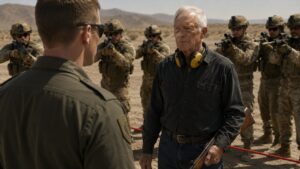
The old man put his fishing boat directly in front of the destroyer and told it to turn.
Not asked.
Told.
“Destroyer, you’re in restricted waters.”
His voice came through the bridge speakers in a rough, salted rasp, the kind of voice that sounded like it had been dragged across rope and weather for seventy years. Outside the glass, his trawler bucked on the gray Pacific, absurdly small against the long steel body of the USS Arden.
Lieutenant Ryan Miller stared at the boat and smiled.
It was not a friendly smile.
“Say again, civilian vessel,” Ryan said, lifting the radio handset. “You are entering an active exclusion zone. Alter course immediately.”
The trawler did not alter course.
It climbed the next swell, dropped hard, and kept coming.
Chief Petty Officer Sarah Walker stood two steps behind Ryan, one hand braced near the console, her eyes narrowed against the glare coming off the water. She had been quiet all morning. Walker was often quiet. She had a way of making silence feel like a correction.
Ryan did not look back at her.
He was twenty-nine, sharp in his pressed uniform, polished in the way young officers became when they knew older eyes were measuring them. The commanding officer was below in a secure briefing room. For the moment, the bridge belonged to Ryan.
And now a fishing boat was trying to make him look foolish in front of his watch team.
The radio crackled again.
“Your heading is wrong. Come left twelve degrees and reduce speed.”
Ryan’s smile thinned.
Outside, the trawler’s green hull slapped through the chop. Its paint was faded. Rust bled down from the railings in orange streaks. Across the stern, partly hidden by spray, Ryan could make out the name.
Second Watch.
The old man stood inside the cabin window, one hand gripping the microphone, the other planted against the frame. He wore a dark faded cap pulled low, a zip-up jacket, and the kind of expression Ryan associated with retired men at marina diners who believed every rule had been written after their prime.
Ryan pressed the handset closer.
“Turn around now, old timer. Go back to fishing.”
A few sailors on the bridge shifted. No one laughed, but Ryan felt the silence notice him.
The trawler came closer.
The old man’s reply arrived without hesitation.
“Son, if I wanted to fish, I wouldn’t be wasting breath on a ship full of deaf men.”
Ryan blinked once.
Walker’s head turned slightly.
The sea was already restless, dark under a low ceiling of cloud. The Arden was scheduled for a classified systems trial along a narrow offshore track. Civilian boats had been warned off. Notices had gone out. Patrol craft had cleared the lane at dawn.
This trawler should not have been there.
Ryan gestured to the navigation display. “Confirm civilian position.”
“Bearing zero-four-six relative,” a sailor answered. “Range decreasing.”
“Speed?”
“Eight knots, sir. Holding steady.”
Ryan gave a short breath through his nose. “He thinks he’s making a point.”
Walker said nothing.
The old man cut in again. “You are standing into Grid Seven. Reduce speed.”
Ryan’s fingers tightened around the radio.
Grid Seven was not public language. It was not something a fisherman should know. But old men around ports collected phrases. They heard things. They repeated them with confidence and got half of them wrong.
Ryan had seen it before.
He keyed the handset.
“Sir, you don’t give orders out here.”
The line came out clean. Controlled. Almost amused.
The bridge seemed to settle around it.
Then, through the forward glass, the trawler angled closer across the Arden’s projected path.
Not drifting.
Cutting.
Ryan’s smile vanished.
Part II — That Cap
“Contact is narrowing angle on bow,” the sailor at the console said.
Ryan stepped toward the glass. “Is he trying to cross us?”
“Looks that way, sir.”
The trawler pitched again. Its little bow disappeared behind a swell and rose, dripping, stubborn as a fist. Through binoculars, Ryan saw the old man clearly now.
Gray stubble. Deep creases. Pale eyes fixed on the destroyer without a flicker of awe.
And the cap.
Dark blue once, now sun-bleached along the crown. Gold stitching across the front, worn almost flat. Ryan could not read the letters.
He did not care about the letters.
“Log civilian obstruction,” he said. “Prepare report for unsafe maneuvering in active zone.”
Walker finally spoke.
“Lieutenant.”
Ryan kept looking forward. “Chief?”
“You may want to look at him again.”
“I am looking at him.”
“No,” Walker said, low. “At the cap.”
Ryan turned then.
Walker’s face had changed. Not dramatically. Walker never wasted emotion. But something had tightened around her eyes, and the quiet she carried now had weight.
The radio snapped alive.
“Arden, you are thirty seconds from a mistake your charts won’t admit.”
Ryan lifted the handset. “Civilian vessel, identify yourself.”
A pause.
The old man’s breath came through first, rough and close.
“Fishing vessel Second Watch.”
“Your name.”
Another pause.
“Burke.”
Walker’s hand moved to the edge of the console.
Ryan heard the name, filed it, found nothing, and almost keyed the radio again.
Then Walker said, “Ryan.”
Not Lieutenant.
Ryan.
He looked at her.
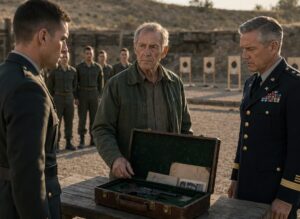
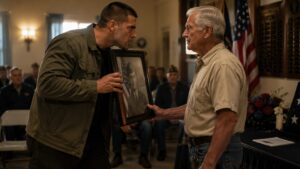
She was staring past him toward the bulkhead beside the bridge entrance. Mounted there beneath protective glass was an old photograph: a previous ship, an older crew, a line of officers squinting into sun. Ryan had passed it a hundred times without reading the small brass plate beneath it.
Now he followed Walker’s gaze.
In the photograph, a younger man stood near the center. Broad stance. Hard jaw. Same pale eyes. Same cap style, new then, the gold letters bright.
Captain William “Hawk” Burke.
Commanding Officer, USS Arden predecessor vessel.
Ryan’s stomach dropped so fast he almost forgot the radio in his hand.
He looked back at the trawler.
The old fisherman was still there in the cabin window, small against the sea, impossible now to make small.
Ryan grabbed the handset with both hands.
“Captain Burke?”
The bridge changed.
Not loudly. No one gasped. No one stepped back. But the room lost its easy shape. The sailors who had been waiting for Ryan to handle a civilian nuisance now watched him as if they had all heard a hatch close behind them.
On the radio, Burke said, “Took you long enough.”
Ryan’s mouth went dry.
“Captain, I—”
“Don’t apologize into a live channel. Slow your ship.”
Ryan felt heat climb his neck.
Walker moved closer, voice clipped. “Sir, range is closing.”
The navigation display showed nothing dangerous except the trawler. The trial route remained clear. The sea grid was marked safe. Every instrument Ryan had been trained to trust told him the old man was wrong.
Every line in Burke’s voice told him the instruments were late.
Ryan keyed the radio. “Captain Burke, our charts show this lane clear.”
“I know what they show.”
“Then explain the hazard.”
Burke’s face hardened behind the glass of his cabin.
“You don’t have time for the story.”
Ryan swallowed.
That was when Commander Mark Reynolds entered the bridge.
He came in with the contained irritation of a man who had been interrupted from something more important. Broad-shouldered, silver at the temples, uniform immaculate. His eyes moved from Ryan to Walker to the forward glass.
Then to the trawler.
“What,” Reynolds said, “is that boat doing in my lane?”
No one answered quickly enough.
The radio answered for them.
“Saving it.”
Part III — The Name on the Stern
Commander Reynolds took the radio from Ryan’s hand.
“This is Commander Reynolds of the USS Arden. Identify your intention.”
Burke’s reply was immediate. “My intention is to keep your crew alive.”
Reynolds’ jaw shifted.
Ryan watched him recognize the voice a half-second before the name caught up. It was there and gone, a crack in the commander’s control.
“Captain Burke,” Reynolds said.
“Mark.”
The use of the first name landed harder than any rank.
Walker looked down at her console.
Ryan looked at Reynolds, then back at the trawler. He had the sudden, cold sense that everyone older than him had walked into a room where something terrible had happened years before, and he was the only one still standing in the hallway asking where the lights were.
Reynolds lowered his voice. “This is not the place.”
“It is exactly the place,” Burke said.
The bridge went still.
A warning tone chirped from one of the consoles. Soft. Almost polite.
“Minor sonar irregularity,” the operator said. “Bearing zero-three-nine. Weak return.”
Ryan turned fast. “Confirm.”
“Intermittent, sir. Could be debris. Could be weather scatter.”
Burke’s voice cut in. “It’s not scatter.”
Reynolds looked to the display. “Our survey passed this track.”
“Your survey passed three weeks ago,” Burke said. “Storm shifted the bottom five nights back.”
Ryan stared at the old man’s trawler. “How would he know that?”
Walker answered before Reynolds could stop her.
“Because he’s been mapping it.”
Ryan looked at her.
Walker’s eyes stayed on the sea. “Every season. Every storm. Every change in that grid.”
Reynolds said, “Chief.”
It was a warning.
Walker heard it. She did not retreat.
“Sir, he knows that water.”
Ryan felt the bridge tilt under him. Not physically. Worse. Morally.
The old man was not guessing.
Reynolds kept the handset close but did not speak. Something in his face had become older.
Ryan looked again at the name on the fishing boat.
Second Watch.
It no longer sounded quaint.
“Chief,” Ryan said quietly, “what happened in Grid Seven?”
Walker’s lips pressed together.
Reynolds said, “Not now.”
Burke said, “Now is all he has.”
For a few seconds, only the sea spoke. Wind against glass. The low steady hum of ship power. The trawler engine coughing through the distance.
Then Walker turned to Ryan.
“There was a recovery operation years ago,” she said. “Classified. Bad weather. Bad calls. Burke disagreed with the approach.”
Reynolds’ voice sharpened. “Chief.”
Walker kept going, quieter.
“He saved most of the task group after the first failure. Not all.”
Ryan knew, before she said the next part, that it would change the shape of the old man standing in the trawler.
“His son was on one of the teams.”
Ryan looked out at Burke.
The old man had lowered the microphone. His cap shadowed his face. He was not watching the bridge like a man demanding respect.
He was watching the water.
A line came to Ryan then, unwelcome and clean:
Some people do not return to places because they are healed. They return because no one else stayed.
The sonar chirped again.
This time the return held longer.
The operator leaned forward. “Contact strengthening. Multiple small returns. Low profile.”
Reynolds moved to the display.
Ryan’s skin prickled.
Burke raised the radio again.
“Come left twelve degrees. Reduce speed now.”
Reynolds did not answer.
Ryan turned to him. “Sir?”
The commander’s face had gone flat with calculation. “We are in a live trial window.”
“Sir, we have a possible hazard.”
“We have an intermittent return and a civilian vessel obstructing operations.”
Walker said, “And Captain Burke telling us exactly where it is.”
Reynolds looked at her.
That silence had teeth.
Ryan knew what Reynolds was protecting. Not only the trial. Not only the ship’s schedule. There were reports, clearances, careers, old sealed pages that had stayed sealed because reopening them would make living men answer for dead ones.
But the Arden was still moving.
And Burke was still in front of them.
Part IV — Seconds to Choose
“Civilian vessel Second Watch,” Reynolds said into the radio, voice formal again. “Clear the exclusion zone immediately.”
Burke’s answer came back like iron dragged over stone.
“No.”
Ryan’s pulse beat once in his throat.
Reynolds stepped closer to the glass. “Captain, do not force this.”
Burke laughed once. No humor in it.
“You boys forced it years ago.”
The trawler turned sharper across the destroyer’s path.
“Range decreasing,” the console sailor said. “Closest point of approach narrowing.”
Ryan looked at the screen, then at the water, then at Reynolds. Everything had become too fast and too clear.
Burke was not trying to win an argument.
He was putting his own hull where Ryan’s conscience had to look.
Reynolds snapped, “Signal patrol craft.”
“Patrol craft is seven minutes out,” Walker said.
“We don’t have seven minutes,” Ryan said.
The words escaped before he dressed them in permission.
Reynolds turned.
“What did you say?”
Ryan felt the bridge watching him again. This time, there was no smile to hide behind.
He had wanted command to feel like confidence. Like clean answers. Like being the kind of man other people trusted because his voice never shook.
Now command felt like a hand closing around his ribs.
“Sir,” Ryan said, “we have a civilian vessel crossing our bow, multiple sonar returns in the predicted grid, and a retired captain with direct knowledge of this water giving us a specific correction.”
Reynolds’ eyes hardened. “And we have orders.”
“Yes, sir.”
“Then follow them.”
Ryan looked out at Burke.
The old man stood braced in the cabin of a boat that should not have mattered. His jacket whipped at the collar. His cap sat low against the wind, that faded piece of cloth carrying more weight than the gold on Ryan’s shoulders.
Walker spoke softly, only for Ryan.
“Procedure tells you who answers for the decision. It doesn’t make the decision for you.”
Ryan’s mouth was dry.
The sonar tone came again, sharper this time.
“Returns multiplying,” the operator said. “Sir, there is something down there.”
Reynolds reached for the radio. “Captain Burke, this is your final warning. Clear our path.”
Burke did not answer.
Instead, the Second Watch increased speed.
For one absurd second, Ryan saw only the physical mismatch: steel against wood and fiberglass, thousands of tons against one old man and a coughing engine.
Then the old man’s radio clicked.
“Lieutenant Miller.”
Ryan froze.
Burke had heard his name. Maybe from Walker. Maybe from the channel. Maybe from some instinct old commanders had for the young man holding the line.
“Sir,” Ryan said.
“Your ship is still yours while you’re standing watch.”
Ryan’s hand closed around the edge of the console.
Burke continued, voice low now, no anger left to waste.
“Don’t wait for permission to be responsible.”
The bridge seemed to hold its breath.
Reynolds said, “Lieutenant.”
Ryan looked at him.
It would be easy, later, to say there had been no time. That the situation had forced him. That the sensors confirmed enough. That anyone would have done it.
But Ryan knew the truth as it happened.
There was a moment.
A small one.
In that moment, he chose.
“All engines,” Ryan said, voice carrying across the bridge, “reduce speed. Helm, come left twelve degrees.”
No one moved for half a heartbeat.
Then Walker’s voice cracked through the hesitation.
“You heard the officer of the deck. Reduce speed. Come left twelve.”
The helm answered. “Aye. Coming left twelve degrees.”
Reynolds stared at Ryan.
Ryan did not look away.
The Arden began to turn.
The sound changed first. A deep shift through the deck. Then the bow eased off its line, slow but certain, the whole ship obeying a young officer who had stopped performing certainty and started accepting consequence.
Outside, the Second Watch rode a swell too close off the bow.
For a second, it looked as if Burke had misjudged even that.
Then the sea opened between them.
Part V — What the Water Held
The first debris broke the surface in the destroyer’s wake.
Not large. Not dramatic. A dark, jagged shape rolled once in the churn and vanished.
Then another.
Then the sonar display filled with returns.
The bridge fell into a stunned, professional quiet. No one said what they all understood. Had the Arden held course at full speed, the ship would have driven straight through a field that had not been on the official track.
“Multiple submerged objects,” the operator said. His voice sounded younger than before. “Position matches Captain Burke’s warning.”
Ryan exhaled once. It did not feel like relief.
It felt like debt.
Reynolds stepped toward the display, his face unreadable.
Walker looked through the glass toward the trawler. “Sir.”
Ryan turned.
The Second Watch had been caught in the disturbed water from the destroyer’s turn. The trawler pitched hard, vanished behind a swell, and rose crooked. Its mast angled wrong. Spray burst over the cabin roof.
Burke’s boat had saved them.
Now it was struggling to stay upright.
“Get rescue team ready,” Ryan said.
Reynolds said nothing.
Ryan reached for the radio. “Second Watch, this is Arden. Report condition.”
Static.
Ryan tried again.
“Captain Burke, report condition.”
For two seconds, there was only the hiss of the channel.
Then Burke’s voice came through, strained.
“Still floating.”
It should have been funny.
No one laughed.
Ryan gripped the handset. “Are you injured?”
“Busy.”
“Captain—”
“Your ship clear?”
Ryan looked at the display, at the debris, at the route they had not taken.
“Yes,” he said. His voice changed on the word. “We’re clear.”
The radio stayed open long enough for Ryan to hear Burke breathe.
Then the old man said, “Good.”
The connection cut.
“Launch assistance,” Ryan said. “Now.”
This time, he did not look to Reynolds for permission.
Walker moved beside him, issuing confirmations, her voice steady. Ryan worked through the next minutes in hard, clean pieces. Rescue craft. Medical team. Position. Wind. Approach.
He had never felt less polished.
He had never felt more awake.
When the small boat reached the trawler, Burke refused a stretcher. Ryan watched through binoculars as the old man stepped across with help, one hand pressed to his ribs, his cap gone.
The cap.
Ryan scanned the water and saw it near the trawler’s rail, caught against a coil of rope, dark and soaked but still there.
“Recover that,” he said.
Walker glanced at him.
Ryan lowered the binoculars.
“Please.”
Walker gave the order.
Commander Reynolds remained near the rear of the bridge, looking at the old photograph on the wall.
The younger Burke in the picture seemed almost cruel now. Not because he looked proud, but because he looked unburdened by what the sea would ask of him later.
Ryan looked at the photograph, then at the water.
He understood, with a force that made him ashamed, that he had not mocked an old man.
He had mocked a watch that had lasted longer than his entire career.
Part VI — The Cap Returned
Burke refused ceremony before anyone could offer it.
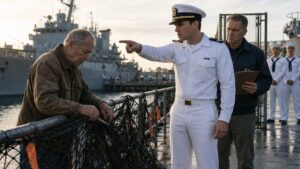
By late afternoon, the Second Watch sat damaged at a Navy pier, listing slightly, her green hull scraped raw along one side. The sky had cleared in broken patches. Sunlight moved over the water in cold strips.
Ryan found Burke sitting on a piling near the boat, jacket zipped, ribs bandaged under his shirt, a paper cup of coffee untouched beside him.
He looked smaller away from the radio.
Not weaker.
Just human.
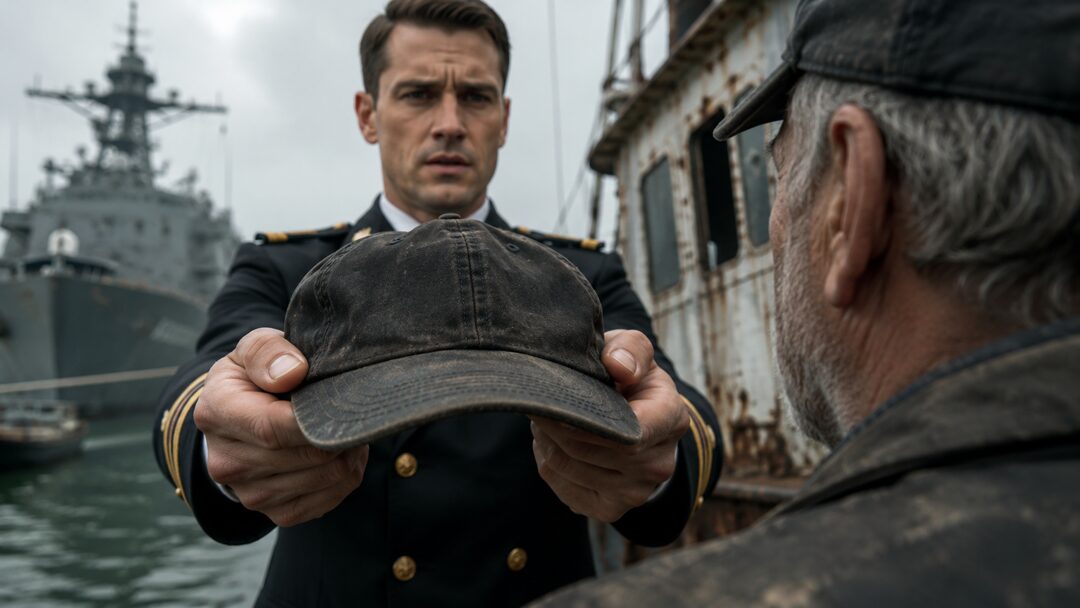
Ryan stopped a few feet away. He held the cap in both hands.
It had been rinsed and dried as best as anyone could manage. The gold stitching was still faded. The brim still bent slightly to the right. It looked like an object that had survived by refusing to be important to anyone except the person who understood it.
“Captain Burke,” Ryan said.
Burke looked at the cap before he looked at Ryan.
“Lieutenant.”
Ryan swallowed. The apology he had prepared sounded useless now. Too clean for what had happened.
Still, he owed the attempt.
“I was wrong.”
Burke reached for the coffee, then seemed to decide against it.
“Yes.”
Ryan almost smiled, but the old man’s face did not invite it.
“I dismissed you,” Ryan said. “I treated you like you were in the way.”
Burke looked toward the damaged trawler.
“I was in the way.”
“That’s not what I mean.”
“I know what you mean.”
Wind moved between them.
Ryan held out the cap.
Burke did not take it right away.
For a moment, his eyes stayed on the stitching. Ryan wondered if he was seeing the bridge of another ship, a younger crew, a son still alive somewhere in a morning that had not yet broken open.
Then Burke took the cap and rested it on his knee.
Ryan’s hand dropped to his side.
“I read the preliminary file,” Ryan said. “What they let me read.”
Burke’s face closed.
“Don’t go digging because you feel guilty.”
“I’m filing the full report.”
That made Burke look at him.
Ryan kept his voice steady. “The sonar returns. Your warnings. The grid condition. The prior survey failure. All of it.”
Burke studied him for a long second.
“Commander Reynolds approve that?”
“He allowed it to stand.”
That was not the whole truth. The whole truth was that Reynolds had sat in his cabin for twenty minutes with Ryan’s report in front of him, saying nothing. Then he had signed the routing page and told Ryan, very quietly, “Be accurate.”
Not safe.
Accurate.
Burke looked back at the water.
“Reports don’t raise the dead.”
“No, sir.”
“They don’t clean what men buried.”
“No, sir.”
Burke’s fingers tightened once around the cap.
Ryan waited.
The old man’s voice came softer, but not gentler.
“My son used to say the Navy remembered everything except what hurt to remember.”
Ryan felt the sentence go through him.
He did not answer. There was no answer that would not make it smaller.
Burke turned the cap in his hands. “You almost saluted me on the pier.”
Ryan stiffened. He had. The reflex had risen before shame stopped it.
“I wasn’t sure what to do.”
“That’s the first honest thing you’ve said all day.”
Ryan accepted it.
Burke lifted the cap slightly, not putting it on yet.
“Don’t salute the cap,” he said. “Listen before you need proof.”
Ryan looked at him.
The words were not forgiveness.
They were not comfort.
They were an order stripped down to the part that mattered.
“Yes, sir,” Ryan said.
Burke’s mouth twitched, almost a smile and almost pain.
“Go on, then.”
Ryan stepped back.
Behind him, the USS Arden waited at the pier, huge and gray and quiet. Men and women moved along her deck, small against all that steel. A ship looked powerful from a distance. Up close, Ryan could see how much of it depended on people choosing, every minute, not to look away.
He turned once before heading up the gangway.
Burke had put the cap back on.
He sat facing the water, one hand resting on the damaged rail of the Second Watch, the other on his knee. He did not look triumphant. He did not look healed.
He looked tired.
He looked heard.
That was not enough.
But it was something.
Ryan climbed back aboard the Arden with the report under his arm and the old man’s words still burning clean through every excuse he had ever mistaken for command.