The Name He Carried
Part I — Behind the Curtain
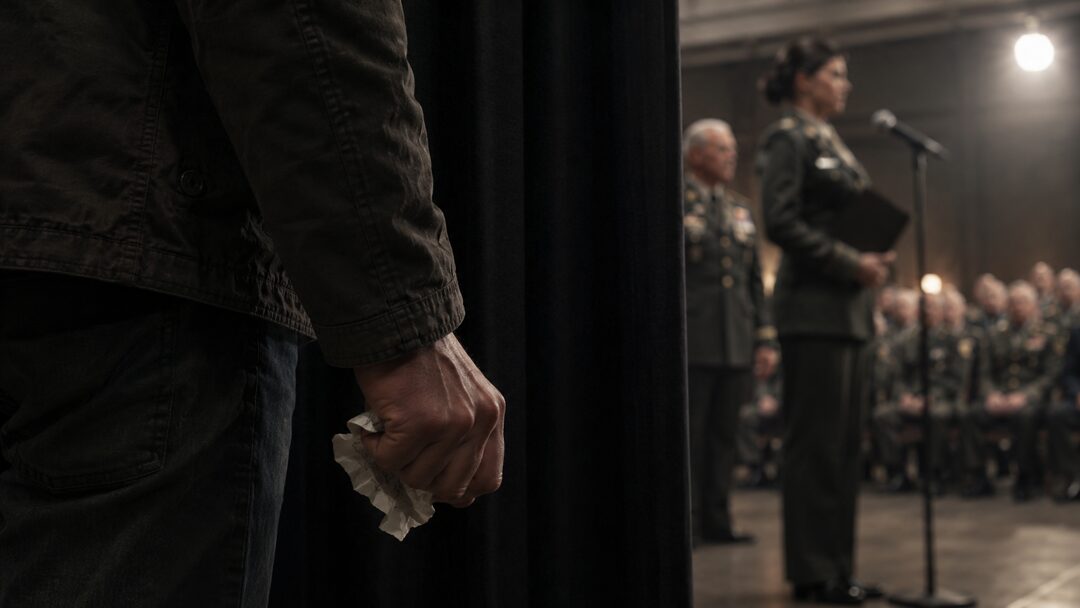
Joshua Miller stood behind the black side curtain in an old green T-shirt while three hundred people applauded the woman he had come there to hate.
Onstage, Captain Emily Carter stood beneath warm auditorium lights, her dress jacket pressed flat, her medals catching flashes of gold every time she breathed. She did not smile. That somehow made it worse. If she had smiled, Joshua could have called her heartless. If she had basked in it, he could have made her simple.
But she stood there like a person waiting for a sentence.
The applause rolled through the base auditorium in soft waves. Polished shoes shifted. Programs fluttered. Someone coughed into a fist. In the first row, officers sat with their chins lifted, faces arranged into the careful seriousness of public respect.
Joshua’s hand tightened around the folded memorial program he had carried in his jacket for eleven months.
The paper tore at the crease.
On the cover was his brother’s name.
Sergeant Brian Miller.
Joshua had told himself he was only here for that name. Not for the medal. Not for Captain Carter. Not for the general with the silver hair and rehearsed sadness. Not for the official words that always sounded clean because they were written far away from the people who had to live inside them.
He had come to listen.
He had come to leave.
He had not come to step out.
“Captain Emily Carter,” General Robert Hayes said from the podium, his voice deep enough to make every sentence sound carved in stone, “demonstrated extraordinary courage and command judgment during the Black Ridge incident, bringing her convoy through impossible conditions and ensuring that no soldier was left behind in spirit.”
Joshua stopped breathing.
In spirit.
The words passed through the room smoothly. Nobody flinched. Nobody in the second row turned to look at Karen Miller, sitting alone with her purse on her knees and her hands folded so tightly her knuckles had gone pale.
Joshua looked at his mother.
She had worn the dark blue dress she wore to church when she wanted no one to ask if she was all right. Her hair was pinned carefully. Her back was straight. She looked smaller than she had before Brian’s notification officers came to the door.
No soldier was left behind in spirit.
Brian’s body had come home two mornings later.
Joshua closed his eyes.
For a second, he was not behind the curtain. He was back in the hallway of their house, barefoot, twenty-three, half-asleep, watching two officers remove their caps on the porch. His mother had opened the door before he could stop her. One of the officers said her name. The other looked at the floor.
Karen did not scream.
That was the thing Joshua remembered most.
She made one soft sound, like she had dropped something inside herself.
Then her knees folded.
Onstage, General Hayes continued.
“Captain Carter made the hard call many could not have made. She held the line. She preserved the lives entrusted to her. She brought her people home.”
Not all of them, Joshua thought.
He looked back at Emily.
At that exact moment, she turned her head slightly toward the side curtain.
She saw him.
It lasted less than a second. Her composure shifted, almost invisibly. Her mouth softened. Her eyes changed before her face remembered where it was.
Then she looked forward again.
That tiny recognition moved through Joshua like a match dragged across dry paper.
She knew he was there.
Maybe she had expected him.
Maybe she had hoped he would stay hidden.
His fist closed harder around Brian’s program.
The applause started again.
And this time Joshua did not know if he could survive it quietly.
Part II — The Words They Chose
The official version had always been short.
Brian Miller died during an unauthorized rescue attempt.
That was the phrase the Army used. It appeared in one letter, two briefings, and one stiff conversation with a chaplain who had looked like he wanted to be anywhere else. Unauthorized rescue attempt. Four words that made Brian sound reckless, disobedient, complicated.
Brave, they said.
But complicated.
Joshua hated that word almost as much as he hated hero. Complicated was what people said when they wanted grief to sit down and behave.
General Hayes read from the citation.
“Under deteriorating conditions, with communications impaired and the convoy exposed, Captain Carter ordered a tactical withdrawal that preserved the integrity of the remaining team—”
Joshua laughed once under his breath.
A soldier standing near the backstage wall glanced at him.
Joshua looked away.
He had not been invited backstage. Not really. A staff sergeant who remembered Brian had let him through after Joshua said he needed air. He was supposed to return to his seat before the presentation began.
But the moment he saw Emily Carter in full uniform, standing beneath the stage lights with Brian’s absence tucked neatly between official phrases, his feet would not move.
The general’s voice kept rising and falling.
Integrity.
Command.
Sacrifice.
Impossible conditions.
Each word landed on Joshua like something polished over a crack.
His phone sat heavy in his pocket. He had listened to Brian’s last voice message in the parking lot before coming inside. He knew it by heart.
Hey, Josh. If Mom’s making that lasagna thing again, tell her I said it’s illegal in twelve states.
A pause. Wind in the background. Someone laughing far away.
And if anything happens out here, don’t let them turn me into a poster, all right? I mean it. I’m not that handsome.
Then Brian laughing at his own joke.
Joshua had kept the message because deleting it felt like killing him a second time. He had also kept it because of that line.
Don’t let them turn me into a poster.
But today they had done something worse.
They had made him a footnote in someone else’s frame.
The general stepped aside as another officer approached the microphone to read the formal citation. Emily stood with her hands behind her back. Still. Controlled. Almost blank.
Joshua watched her and tried to feel triumph in her stiffness.
He wanted her guilt to be obvious.
He wanted her to look like what she had done.
Instead, she looked tired.
That angered him too.
He started to leave.
The movement was small. One step back into the shadow behind the curtain. One breath. One decision to spare his mother, spare himself, spare the room the ugly thing sitting at the back of his throat.
Then the young soldier beside the stage straightened as Emily passed him.
“Ma’am,” he whispered, low but not low enough. “Just wanted to say—thank you. For making the tough call nobody else could make.”
Emily’s face changed.
Only Joshua saw it.
The soldier meant respect. He meant admiration. He meant the kind of thing people said when they were grateful someone else had carried the part of duty they hoped never to touch.
Emily nodded once.
“Thank you,” she said.
Joshua stopped leaving.
The tough call.
His brother had not been tough enough to leave a child under a vehicle. That was the difference. That was what the citation would not say.
He turned back toward the stage.
Emily’s gaze flicked to him again.
This time she did not look away quickly enough.
Part III — The Patch
When Emily stepped away from the microphone, the general began speaking again, filling the room with words about service and continuation. Emily moved toward the side of the stage, carrying a dark folder against her ribs.
Joshua remained behind the curtain.
He felt her before she spoke. Not in any mystical way. Just in the sudden quiet of the soldier beside him, the straightening of posture, the small shift that rank made in a room.
“Joshua.”
His name sounded wrong in her mouth.
Not because she said it badly. Because she said it gently.
He turned.
Up close, Captain Emily Carter looked younger than he wanted her to look. Older than her picture in the articles. The lights had not hidden the shadows under her eyes. A thin line of tension held at the corner of her jaw.
“You shouldn’t be back here,” she said.
He smiled without humor. “That all you’ve got?”
Her eyes lowered to the memorial program crushed in his hand. “Your mother is here.”
“Don’t.”
“I’m not trying to—”
“Don’t say her name like you care.”
Emily accepted that. No defense. No command voice. Just one slow breath through her nose.
“I saw you come in,” she said.
“Then you should’ve changed the speech.”
A flicker crossed her face.
“It isn’t my speech.”
“But it’s your medal.”
The words stayed between them.
Beyond the curtain, General Hayes said something that made the audience chuckle softly. A strange sound. Polite warmth in the next room while Joshua stood three feet from the woman who had ordered his brother away from someone who needed him.
Emily’s grip tightened on the folder.
“You think I don’t know what today is doing to your family,” she said.
Joshua stepped closer. “You don’t get to talk about my family.”
“I carried Brian out in my head every day for eleven months.”
That sentence almost made him hit something.
“You carried him?” His voice dropped. “You signed the order that left him there.”
Emily’s face went very still.
“Careful,” she said.
There it was. Rank. Authority. The steel under the exhaustion.
Joshua leaned in. “Or what, Captain?”
Her eyes held his.
“Or you’ll say something in anger that your mother has to live with.”
He hated her for finding the right wound.
He glanced toward the audience. Karen sat with her face turned toward the stage, unaware her living son was standing in the dark, coming apart.
When Joshua looked back, he saw the edge of something inside Emily’s folder.
Green fabric. Worn stitching. A familiar black border.
His body went cold.
“What is that?”
Emily followed his gaze, and her hand moved too quickly to cover the folder.
Joshua reached for it.
She pulled back.
“Don’t,” she said.
He stared at her. “That’s Brian’s.”
Emily’s mouth tightened.
“Joshua—”
“That’s his patch.”
Her silence answered.
The room seemed to tilt around him. His brother’s unit patch, the one that should have been in the box with his watch and field notebook and scratched silver ring, was tucked inside Emily Carter’s folder like a private relic.
Joshua’s voice came out low. “You kept it?”
“He gave it to me.”
“Don’t lie to me.”
“He gave it to me before he went back.”
Joshua shook his head. Once. Then again. “No.”
Emily’s eyes shone, but nothing fell. “He knew what he was doing before I did.”
“Stop.”
“He—”
“Captain Carter.”
General Hayes stood at the edge of the stage, smiling for the room but not for her.
His eyes dropped briefly to Joshua, then returned to Emily.
“They’re ready for you.”
Emily closed the folder.
Joshua looked at the place where the patch had disappeared.
The general’s voice lowered. “Captain.”
Emily turned toward the stage.
Joshua caught her sleeve before she could leave.
For one second, rank vanished. She looked down at his hand on her uniform, then up at him.
“If you go back out there and let them say his name like a mistake,” Joshua whispered, “I swear I will.”
Emily did not ask what he meant.
Maybe she already knew.
She pulled her sleeve free and walked back into the lights.
Part IV — The Line She Couldn’t Read
Emily returned to the microphone to another round of applause.
This time, she did not look like a hero to Joshua.
She looked like someone walking across thin ice.
The general opened the medal case. A flash of metal caught the light. Cameras lifted in the aisle. Someone near the front sniffed quietly.
Joshua watched his mother watch the stage.
Karen’s face was careful. Too careful. She had always been good at keeping rooms comfortable. When Brian’s friends came after the service, she fed them coffee cake and asked about their wives and laughed softly at stories she had already heard. At night, Joshua had found her in the laundry room holding one of Brian’s old sweatshirts against her chest.
She had refused to see Emily Carter after the funeral.
Joshua had been glad.
Now he was not sure.
The medal was pinned. The applause rose.
Emily accepted it without lowering her head.
Then she stepped to the microphone.
The room quieted.
Joshua moved closer to the curtain opening, close enough to see her fingers resting against the folder on the podium. One fingertip trembled. Only once.
“I am grateful,” Emily began, “for the lives that came home from Black Ridge.”
Her voice was clear.
Too clear.
“I am grateful for the men and women who did what was asked of them under conditions no citation can fully hold.”
Joshua’s jaw tightened.
Say his name.
Emily looked down at the page.
“The success of that withdrawal depended on discipline, trust, and the clarity of command leadership under impossible conditions.”
She stopped.
The room waited.
General Hayes shifted behind her.
Joshua saw Emily’s hand close over the folder. Over the patch hidden inside it. Her eyes moved to the first row.
To Karen.
The silence grew teeth.
For one wild second, Joshua thought she would do it.
He thought she would tear open the clean version herself.
Then General Hayes stepped half a pace closer to the microphone. It looked casual. It was not.
Emily inhaled.
“The clarity,” she repeated, quieter now, “to preserve as many lives as possible.”
Something in Joshua gave way.
Not loudly at first.
It broke like a thread.
He stepped out from behind the curtain.
A few heads turned. Then a few more. The soldier backstage whispered, “Sir,” and reached for his arm, but Joshua was already in the light.
The auditorium saw him all at once.
Plain green shirt. Torn program in his fist. Face burning with eleven months of words nobody had let him say.
Emily stopped speaking.
General Hayes’s smile disappeared.
Joshua walked three steps across the side of the stage and faced the room.
“My brother’s name was Brian Miller.”
His voice cracked through the microphone space even without a microphone.
The audience froze.
Karen stood.
“Joshua,” she said, but it did not carry far.
He looked at Emily, not at his mother, because if he looked at his mother he might stop.
“His name was Brian Miller,” he said again, louder. “Not an unauthorized rescue attempt. Not a complication. Not some line you skip so her medal sounds better.”
Two uniformed security officers moved from the side aisle.
Emily raised one hand.
They stopped.
General Hayes leaned toward her. “Captain, do not engage.”
Joshua heard him.
So did the first three rows.
Emily did not move away from the microphone.
Joshua’s breath came hard. His anger had carried him into the open. Now grief was arriving behind it, larger and less useful.
He pointed at Emily.
“Tell them,” he said. “Tell them what you ordered.”
Emily’s face had gone pale.
“Joshua,” Karen said again, this time from the aisle.
He still did not look at her.
“Tell them if you ordered my brother to leave that interpreter behind.”
The room made one sound. Not a gasp exactly. More like every person drawing back inside their own skin.
Emily looked at him for a long moment.
Then she said, “Yes.”
The word was quiet.
It reached everyone.
Joshua felt a terrible flash of satisfaction.
There. Finally. There it was. The thing he had known. The thing the letters had covered. The thing the ceremony had tried to polish.
But Emily did not step back.
She kept her hand on the folder.
“I ordered the team to withdraw,” she said. “The lead vehicle was disabled. The second was on fire. We had wounded in the rear truck and no stable communications. We were exposed, and another delay would have cost more lives.”
General Hayes said, “Captain.”
Emily ignored him.
Joshua’s satisfaction began to curdle.
“Brian heard the order,” she continued. “So did everyone.”
“You left him,” Joshua said.
Emily’s eyes did not leave his. “He looked under the axle and saw the interpreter’s daughter.”
The room changed.
Joshua felt it before he understood it. The audience, the officers, even the security men—something shifted in them. Not away from Brian. Toward the part of the story nobody had been given.
Emily’s voice stayed even, but every word looked like it cost her.
“She was pinned under debris. Alive. Barely visible. Her father couldn’t move her.”
Joshua shook his head. “No.”
“Brian took two steps toward the truck. I ordered him back.”
“No.”
“He looked at me,” Emily said. “And then he ran.”
Joshua’s mouth opened, but nothing came.
Emily’s hands were no longer still.
“I did not chase him because I had seven wounded soldiers in the rear vehicle and five more trying to hold a perimeter that was collapsing. I did not chase him because command is not a feeling. I did not chase him because if I had, I would have lost twelve more people.”
The room was silent now.
Not ceremonial silence.
Human silence.
Joshua had imagined this moment a hundred times. In every version, Emily broke. She confessed. He won. Brian’s name rose clean from the wreckage.
But this did not feel like winning.
This felt like someone had opened a door under his feet.
Part V — What Brian Knew
Joshua’s hand dropped to his side.
The torn program brushed against his leg.
“Why didn’t you tell us?” he asked.
It came out smaller than he wanted. More like a boy than a man.
Emily looked toward Karen.
Karen stood in the aisle, one hand gripping the back of a chair. Her face was white, but she had not sat down. She looked at Emily as if seeing her for the first time and remembering refusing to see her before.
“I came to your house after the service,” Emily said.
Karen closed her eyes.
Joshua turned toward his mother.
“You never told me.”
Karen’s lips trembled. “I couldn’t.”
Three words. Not an excuse. Not enough. Everything.
Emily opened the folder.
General Hayes moved. “Captain Carter, that is enough.”
“No, sir,” Emily said.
The words were respectful.
They were also final.
She took out the patch.
Joshua saw it fully then: faded green, black border, the stitching slightly frayed at one corner where Brian used to worry it with his thumb. It looked smaller than memory. Too small to hold a life.
Emily held it in both hands.
“He gave this to me before he went back,” she said. “Not after. Before.”
Joshua stared at it.
“He knew?” he whispered.
Emily swallowed.
“He knew he was disobeying. He knew I couldn’t follow. He knew exactly what that would look like later.”
The room had vanished. There was only the patch and Emily’s voice and Brian’s laugh in Joshua’s pocket.
“If anything happens,” Emily said, and her composure cracked for the first time, “he said to give this to Josh when he stops needing someone to hate.”
The sentence hit Joshua so hard he took one step back.
Not because it was cruel.
Because it sounded like Brian.
Not the poster. Not the citation. Not the footnote. His brother.
The brother who stole fries off Joshua’s plate and pretended not to know why he was being yelled at.
The brother who taught him how to shave after their father left.
The brother who knew Joshua’s anger before Joshua had a name for it.
The brother who had seen, from thousands of miles away, exactly what Joshua would try to do with grief.
Give this to Josh when he stops needing someone to hate.
Joshua pressed the heel of his hand against his mouth.
He had spent eleven months feeding that hate because it was warmer than emptiness. Hate got him out of bed. Hate answered questions. Hate gave Brian’s absence a shape.
Without it, there was only the unbearable fact that Brian had made a choice no one could undo.
Emily turned back to the microphone.
She removed the medal from where it had been pinned to her uniform.
A murmur moved through the room.
General Hayes’s voice cut low behind her. “Captain.”
Emily placed the medal case on the podium.
“I cannot accept this as written,” she said.
The audience did not move.
“The citation names my command judgment. It does not name Sergeant Brian Miller. It does not name David Rahimi, the interpreter who stayed with his daughter when he could have run. It does not name the child Brian saw under the axle.”
Joshua looked at his mother.
Karen’s eyes were open now. Wet, stunned, fixed on Emily.
Emily’s voice shook once and steadied.
“The language says the withdrawal was clean because language likes clean things. It was not clean. It was necessary. It was terrible. It saved lives. It cost lives. And one of the lives it cost belonged to a man who made a choice I could neither order nor stop.”
Joshua could hear people breathing.
Emily lifted her chin.
“Sergeant Brian Miller was not an error in the story. He was part of the truth.”
There were no more cameras rising.
No applause.
No one knew what to do with honesty when it did not arrive polished.
Emily stepped back from the microphone.
The medal remained on the podium.
The patch remained in her hands.
And Joshua, who had come to break her, found himself standing in front of everyone with nothing left to throw.
Part VI — The Name in the Room
The ceremony did not end.
It dissolved.
People stayed seated because no one had dismissed them. Officers looked toward General Hayes and then away. The security men stood uselessly at the aisle, hands folded in front of them. Somewhere in the back, a phone buzzed and was silenced.
General Hayes leaned toward Emily, said something Joshua could not hear, then turned and walked offstage with the stiff posture of a man already calculating damage.
Emily did not follow him.
She stepped down from the stage.
Every eye tracked her. She crossed the small gap between ceremony and aisle, between rank and grief, between the version that had been prepared and the one that had arrived anyway.
Joshua did not move.
Karen came toward them slowly. The crowd parted for her without being asked.
When she reached Joshua, she touched his arm once. Not to stop him now. Not to forgive him. Just to make sure he was still there.
Emily stood in front of them with Brian’s patch in her open palm.
Up close, Joshua saw that her hands were shaking.
“I should have tried again,” Emily said to Karen.
Karen looked at the patch.
Then at Emily.
“For a long time,” Karen said, “I thought if I didn’t hear it, I could keep the version of him I had.”
Emily nodded once. “I understand.”
“No,” Karen said softly. “You don’t. But maybe I don’t understand your part either.”
That was as close to mercy as the room could hold.
Emily turned to Joshua.
He expected her to hand him the patch with ceremony, maybe with words. Instead, she simply held it out.
He took it.
The fabric was warm from her hand.
For a moment, Joshua could not look at it. He folded his fingers around the patch and felt the frayed corner. Brian’s thumb had been there. Brian had stood somewhere hot and loud and impossible, touching that same thread, thinking of him.
Not because Joshua deserved a message.
Because Brian knew he would need one.
Joshua looked at Emily.
His apology rose and failed. It was too soon for that. Maybe too small.
So he asked the only question left.
“What did he look like?”
Emily’s face changed.
Not with confusion. With understanding.
“At the end?” she asked.
Joshua nodded.
Karen made a quiet sound beside him, but she did not stop him.
Emily looked past them, not at the stage, not at the audience, somewhere no one else could see.
“He was scared,” she said.
Joshua closed his eyes.
Good, he thought, and the thought nearly broke him. Good. Not because Brian had suffered. Because fear made him real again.
Emily continued.
“He was moving fast. Too fast. Like he thought speed could make the choice easier.” Her mouth trembled. “And he was trying to make the little girl laugh.”
Karen pressed both hands to her lips.
Joshua looked down at the patch.
“What did he say?”
Emily shook her head faintly. “I couldn’t hear all of it. Just enough.”
“What?”
Emily’s eyes filled, but her voice stayed clear.
“He told her not to worry because he had a little brother who was way more annoying than this.”
For one second, Brian was in the room.
Not as a name in a citation.
Not as a body recovered later.
Not as an argument between command and conscience.
He was there in the stupid joke. In the impossible tenderness of it. In the way he had reached for laughter while fear ran beside him.
Joshua bent forward as if the air had gone out of him.
Karen put her hand on the back of his neck.
No one applauded.
That was the mercy of it.
Across the auditorium, people remained silent while a family received what the ceremony had not known how to give: not closure, not victory, not a clean ending.
Just Brian.
Joshua held the patch against his chest.
Emily stood in front of him without her medal.
Karen looked at the empty podium where the bright case still sat open under the lights.
Then, quietly, in a room built for speeches, she said her oldest son’s name.
“Brian.”
No one corrected her.
No one improved it.
No one folded it into anything else.
And for the first time all morning, Joshua did not feel the curtain behind him.