The Blocked Seaplane Dock At Puget Sound And The Harbor Director
CHAPTER 3: THE CUTTERS ROUND THE BREAKWATER
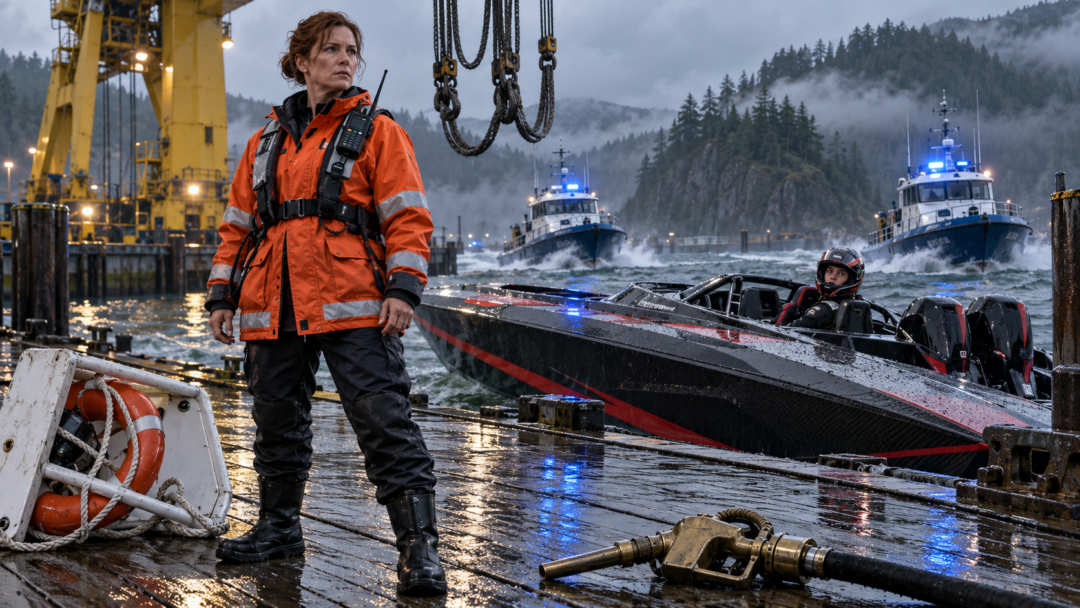
The roar of twin Caterpillar marine diesel engines shook the timber deck of Slip 4 as the two forty-five-foot tactical interceptor cutters rounded the granite breakwater with military precision. Their deep-V aluminum hulls threw towering walls of white spray that caught the cold wind, showering the outer pilings with fine sea mist. Each vessel was equipped with heavy-duty reinforced bow push-knees, thermal night-vision tracking cameras, and automated high-pressure firefighting monitors mounted above the forward cabin.
With a masterclass of throttle work and twin water-jet thrusters, the lead cutter, Patrol One, spun ninety degrees, reversing its impellers to back down directly into the mouth of Slip 4, laying its armored rubber rub-rail alongside the outer dock to block Troy’s racing catamaran from reaching open water. The second cutter, Patrol Two, took up position thirty yards off the stern, its high-intensity marine searchlights slicing through the gray drizzle to pin the racing boat in a blinding cone of white light.
Uniformed officers in navy-blue maritime tactical suits, flotation vests, and ballistic helmets moved briskly to the gunwales, securing heavy nylon spring lines to the outer bollards and deploying boarding ladders.
Stepping through the sliding wheelhouse door of Patrol One was Commander Jack Harris. He was fifty-four years old, broad-shouldered and weathered, with silvering stubble along a rugged jaw, wearing a high-collared foul-weather jacket bearing the gold command crest of the Regional Harbor Patrol. He was a veteran of thirty years on the northern waters, a decorated commander who had led countless winter search-and-rescue operations during freezing nor’easters. In his hand, he carried a waterproof digital citation pad.
Commander Harris stepped off the cutter’s forward deck, his heavy combat boots landing solidly on the cedar dock planks. He marched directly past Troy Sterling without sparing the young racer so much as a glance, stopping three paces in front of Diana Cross.
With crisp, unhesitating respect, Commander Harris brought his right hand to the brim of his tactical cap, rendering a formal military-grade salute.
“Good afternoon, Director Cross,” Commander Harris announced, his gravelly baritone ringing out across the dock with absolute authority. “Regional Harbor Patrol responding as ordered. The outer basin is locked down, all civilian traffic is halted, and the aeromedical landing lane is cleared. What are your orders, ma’am?”
Troy Sterling’s mouth hung open. The arrogant smirk vanished from his face as if it had been struck by a sledgehammer. His energy drink can slipped from his fingers, rolling across the timber planks to splash into the dark water below. His knees wobbled beneath his expensive wetsuit.
“D-Director?” Troy stammered, his voice suddenly squeaking like a frightened child. “Director Cross? You’re… you’re Diana Cross? The Chief Executive of Harbor Operations?”
Diana did not look at him. She returned Commander Harris’s salute with a sharp, respectful nod. “Thank you, Jack. Commander, this vessel has unlawfully obstructed the emergency medevac berth and severed the primary safety tether. The owner has refused three lawful orders to clear the lane, while an inbound aircraft with a critically injured child is now five minutes out.”
Commander Harris turned his gaze toward Troy Sterling. His eyes, cold and dark as flint, bored into the young man with absolute disgust.
“Officers, board that vessel immediately,” Commander Harris barked over his shoulder. “Secure the helm, isolate the ignition cut-offs, and conduct a full hazardous materials sweep of the hull!”
Four armed maritime officers leaped onto the racing catamaran’s carbon-fiber deck, their boots thudding against the lightweight composite flooring. Blake Carver immediately threw his hands in the air, cowering against the passenger console. “I didn’t do anything! I told him we should move! Check the security cameras, I told him to back out!”
Within ninety seconds, the lead boarding officer called out from the aft engine bay, his voice tight with alarm: “Commander! We have a major hazardous violation! They’ve installed two unauthorized five-hundred-gallon collapsible rubber fuel bladders in the forward storage voids, plumbed directly into the main fuel manifold with unshielded brass fittings! The forward port seam is ruptured—there are over fifty gallons of high-octane racing aviation gas pooling directly in the bilges!”
Diana’s face tightened into stone. “High-octane racing gas? In an uncertified bladder right next to the public marine intake?”
“Yes, ma’am,” the officer called back, holding up a portable digital gas analyzer whose alarm was beeping furiously in the red zone. “The vapor density is approaching explosive limits. If those twin outboards are cranked, the starter arc could detonate the entire slip!”
The realization that the entire dock was floating on a bomb of volatile racing fuel sent a chill through every officer on the pier. The incoming seaplane was now five minutes away, descending through the cloud deck with a failing engine, heading straight toward a fueling dock on the verge of catastrophic combustion.