The Blocked Seaplane Dock At Puget Sound And The Harbor Director
CHAPTER 2: THE INBOUND BEACON FROM ORCAS ISLAND
The silence that collapsed over Slip 4 following Diana’s radio transmission was broken only by the cold whistling of the northern gale through the yacht rigging and the relentless, rhythmic thud of slate-gray waves slapping the seawall.
Troy Sterling froze mid-stride, his leather-gloved hand resting on the carbon-fiber coaming of his racing boat. He glanced back over his shoulder, his lips curling into a forced, dismissive smirk, though a sudden flicker of unease darted across his eyes. “Code Red? Unit One? What kind of amateur roleplay is that? You think you can scare me with fancy radio jargon? I’ve raced boats from Miami to Vancouver, lady. You’re talking to a registered offshore pilot whose family finances half the maritime council.”
Before Diana could reply, the speaker on her chest harness crackled to life with a sharp burst of static, followed by the deep, urgent voice of Captain Ben Vance, veteran chief pilot for the San Juan Island Medevac Service, transmitting on the emergency aeronautical frequency:
“Unit One, this is Medevac Echo-Four on final approach from Orcas Island. We have a nine-year-old boy on board—Lucas Adams—with third-degree chemical burns across sixty percent of his body from a cannery steam boiler rupture at Eastsound. His vitals are crashing fast—blood pressure seventy over forty, heart rate one hundred and sixty, peripheral pulses thready. Flight paramedic reports severe hypovolemic shock and rapid airway compromise. Our port fuel tank developed a high-pressure line fracture five minutes after departure—we have exactly twelve minutes of fuel remaining before the radial engine starves of fuel! We are committed to landing on the western basin runway. If we cannot reach Slip Four for immediate fuel stabilization and patient transfer to the waiting trauma unit, we will be forced to ditch in open, freezing water. Please confirm Slip Four is clear!”
The cockpit speaker of the floatplane remained open for several seconds, transmitting the frantic, high-pitched beeping of pediatric cardiac monitors and the voice of flight paramedic Sarah Lin fighting to keep the boy breathing through a bag-valve mask.
Diana keyed her microphone instantly, her voice steady as iron, projecting absolute reassurance across the airwaves. “Echo-Four, this is Unit One. Maintain your descent vector on runway three-two. Slip Four will be cleared, secured, and foam-protected by the time your pontoons touch the water. We are staging the critical pediatric trauma ambulance at the head of the ramp right now. Bring that boy home, Ben. The basin is yours.”
“Copy that, Unit One,” Captain Vance replied, the strain evident in his voice over the thunderous roar of the De Havilland Beaver’s nine-cylinder Pratt & Whitney radial engine. “Estimated touchdown in seven minutes. Fuel pressure gauge is flickering in the yellow. We’re coming straight in.”
Troy Sterling stood on the wet dock planks, his face turning pale under the gray daylight. He had heard every word of the pilot’s transmission, every beep of the medical monitor, every syllable of the dying fuel pressure. Yet instead of stepping aside, his stubborn, narcissistic pride hardened into desperate defiance. The thought of backing down in front of his crew and admitting that he had made a catastrophic error was unbearable to his pampered ego.
“That’s not my problem!” Troy yelled, his voice rising in pitch, crackling with erratic frustration. “Tell him to land at the county airport three miles inland! He’s got wings, doesn’t he? Why does he need this specific dock? I have eighty thousand dollars in race registration fees riding on this afternoon’s trials! My crew is fueling right now, and nobody is touching my lines!”
Blake Carver, his throttleman, nervously stepped forward, his eyes wide with rising terror. “Hey, Troy… man, listen to that radio! That’s a medevac flight with an injured kid on board! His plane is leaking fuel! It’s a floatplane—it doesn’t have wheels, Troy! It can only land on the water! If that plane ditches in forty-five-degree water out in the channel, they’ll all drown in three minutes! We’ve gotta move the boat right now!”
“Shut up, Blake!” Troy snapped, slapping his partner’s hand away with a vicious snarl. “If we unhook now, we lose our fuel pressure and miss our departure window! Get back in the cockpit and fire up the auxiliary pumps! We’re taking our fuel, and this lady can file a complaint with city hall on Monday morning!”
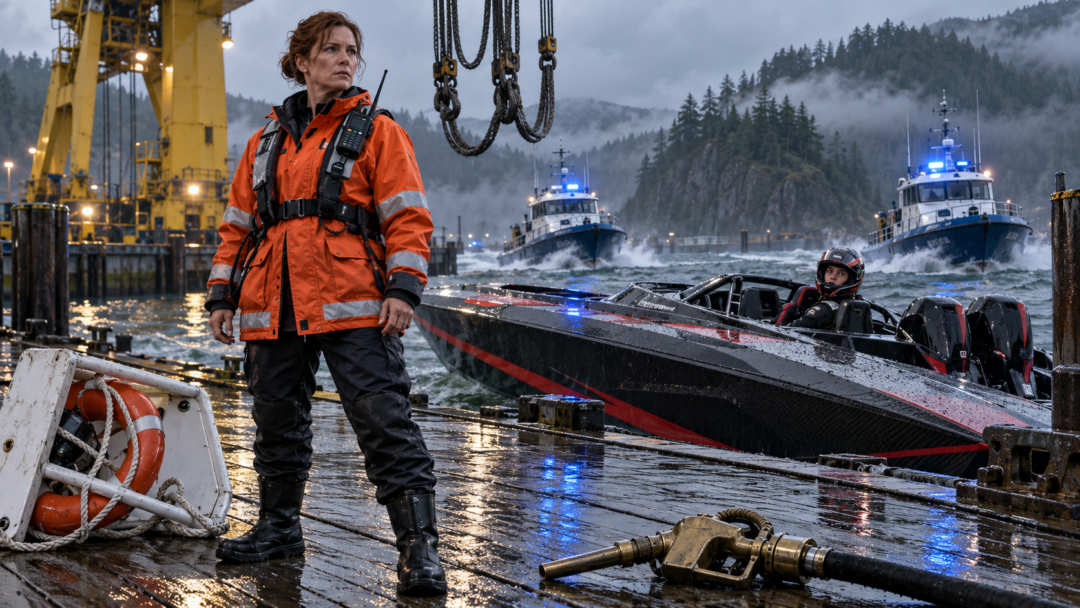
Diana Cross stepped forward, her tall silhouette framed against the misty bay. Her orange rescue parka stood out like a warning flare against the dreary overcast sky. Her slate-gray eyes locked onto Troy with piercing intensity, reflecting decades of maritime discipline that had no patience for reckless cowards.
“Mr. Sterling, you have committed three separate federal maritime offenses in the span of five minutes,” Diana said calmly. “Reckless obstruction of an active aeromedical flight corridor, malicious damage to emergency lifesaving apparatus, and non-compliance with lawful harbor directives under Title Eighty-Eight of the Revised Code. Your race is canceled. Your vessel is detained. Step away from that helm.”
Troy threw his head back and laughed loudly, pointing his finger at her face, his voice trembling with hysterical defiance. “Detained by who? You? You’re just a harbor inspector! I know the city manager personally! I play golf with the municipal harbor commissioners! You touch my boat and you won’t have a job by sundown!”
Across the broad expanse of Bellingham Bay, the low, mechanical drone of the approaching radial engine began to echo down from the cloud base. High above the pine-covered bluffs of Chuckanut Mountain, the silhouette of the yellow-and-white De Havilland Beaver floatplane broke through the mist, its high-visibility navigation strobes flashing brightly against the gloom.
At the exact same instant, the harbor’s automated emergency sirens wailed to life from the top of the port control tower, their piercing two-tone howl echoing across three miles of open water.
From the northern shipping channel, two massive rooster-tails of white spray exploded across the surface of the sound. Slicing through the choppy swells at forty-five knots came twin Regional Harbor Patrol high-speed interceptor cutters, their heavy aluminum hulls painted in high-visibility blue and white, their dual roof-mounted cobalt emergency beacons flashing furiously against the rain.
Troy Sterling turned toward the water, his jaw dropping in disbelief as the two tactical vessels bore down directly on Slip 4, cutting off every possible escape route into the open bay.