The Figure Eight Oak Post Pull And The Pasture Wiretap Discovery
CHAPTER 2: THE FIGURE-EIGHT SQUELCH
To Julian Sterling and his two sweating landscapers, the old man’s actions looked like an absurd rural ritual.
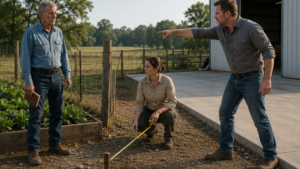
Everett Douglas knelt in the grass, his work boots planted firmly in the sod. He tipped the galvanized bucket and poured a slow, deliberate circle of clear well water directly around the base of the six-inch oak post, right where the seasoned wood entered the tightly packed red clay.
The soil mechanics of the Virginia Piedmont are governed by the specialized mineralogy of Cecil series clay. The soil is rich in kaolinite and microscopic iron-oxide platelets that interlock under dry atmospheric conditions, forming an electrostatic cohesive seal. When an oak post is driven four feet deep into this clay and left to season for decades, the wood absorbs moisture during winter rains and expands, compressing the surrounding soil into an impenetrable collar.
When dry summer heat arrives, the moisture evaporates, creating a localized subterranean vacuum. Pulling straight up or pulling horizontally against such a post forces the soil particles into extreme compression, requiring thousands of pounds of sheer breakout force to overcome the vacuum seal.
Everett did not pull straight. He understood fluid dynamics and shear-strain fatigue.
As the cold well water sank into the hairline fissures between the timber and the clay, Everett stood up. He lowered his hips into a deep, disciplined sumo-deadlift stance, his knees bent at ninety degrees, his spine locked in an unbending forty-five-degree pillar of structural alignment. He wrapped both thick, scarred arms around the rough-hewn oak trunk in a tight, full-body bear-hug, his hands locking behind the timber.
He did not attempt to lift.
Instead, Everett engaged his hips and core, applying a rhythmic, deliberate lateral oscillation. He rocked the top of the post in a tight, continuous figure-eight pattern.
CREAK… SLOSH… CREAK…
The figure-eight motion was a masterclass in applied soil mechanics. By moving the timber in an orbital elliptical path, Everett was not compressing the soil; he was introducing rotational shear fatigue to the clay walls, widening the microscopic annular gap by half a millimeter on each oscillation.
The cold well water, following the path of least resistance, flowed down along the expanding gap, lubricating the dry wood grain and equalizing the atmospheric pressure along the entire four-foot subterranean length of the post.
In less than eight seconds, the structural vacuum collapsed.
SCHLUCK-POP!
The sound was as sharp and loud as a wet cork being extracted from a massive champagne bottle. Air rushed violently down into the bottom of the post hole, breaking the subterranean suction with a distinct, wet bubbling squelch.
The instant the vacuum popped, Everett transitioned his effort.
He did not jerk his arms or strain his shoulders. Driving through his heels with the explosive, piston-like power of his glutes and hamstrings, Everett locked his core and stood up.
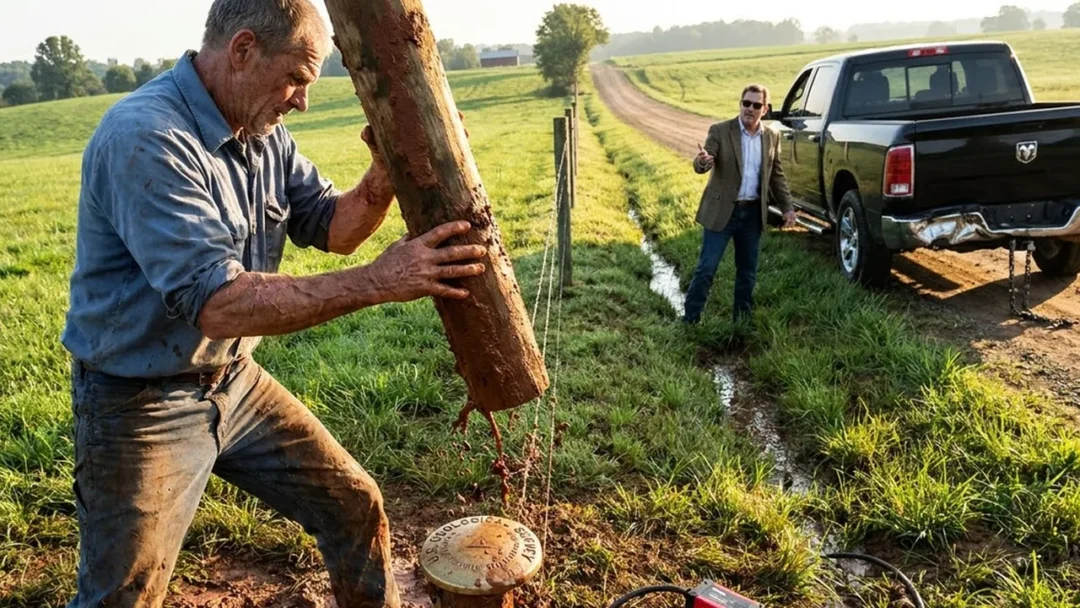
With a single, smooth, breathtaking deadlift, Everett hoisted the entire four-foot buried, mud-caked, one-hundred-and-twenty-pound oak post straight out of the earth in his bare arms.
Muddy water and red clay cascaded off the freshly exposed subterranean root end of the timber, splashing into the dewy grass. Everett stood tall, cradling the massive six-foot-tall, twelve-inch-around wooden pillar against his chest with the effortless balance of an athlete holding a medicine ball.
Dale Watson and the second landscaper took three involuntary steps backward, their eyes bulging in absolute, terrified awe.
“Dear God in heaven…” Dale whispered, his jaw trembling as he stared at the seventy-six-year-old farmer holding the massive timber. “He… he pulled it out like a carrot. With bare hands.”
Julian Sterling stood frozen, his mouth opening and closing without producing a sound.
Everett did not gloat. He rotated the post in his arms to inspect the newly exposed, dark underground butt of the timber.
Attached securely to the very bottom tip of the wood—bolted into the solid heartwood with an antique hand-forged bronze lag-bolt that eighty years of burial had not corroded—was a circular, three-inch-wide cast-bronze medallion. Engraved across the face of the bronze cap was an official eagle crest and sharp, raised capital letters: UNITED STATES GEOLOGICAL SURVEY – PRIMARY PIEDMONT BOUNDARY BENCHMARK – ESTABLISHED 1920 – DO NOT REMOVE.
Everett looked up at Julian, his grey eyes piercing the developer’s soul.
“My grandfather set this post with the federal surveyors in nineteen-twenty, Julian,” Everett said softly. “The boundary line isn’t ten feet west. It’s exactly where this bronze was buried. You can move the dirt with money, son, but the bronze remembers the line.”
Before Julian could stammer an excuse, a strange, rhythmic electronic sound echoed from deep within the freshly opened four-foot post hole.
BEEP… BEEP… BEEP…
Everett leaned over the open hole, looking down into the wet clay.
Resting four feet beneath the pasture sod, exposed by the extraction of the post, was a severed underground commercial conduit carrying high-capacity armored fiber-optic cables. And spliced directly into the glass strands, encased in a waterproof Pelican housing and blinking with a bright, pulsed red LED light, was an active military-grade digital data transmitter.
The physical methodology of the figure-eight extraction technique is grounded in the principles of dynamic soil fatigue and boundary lubrication. When an operator applies a linear vertical pull to an embedded cylinder, the surrounding soil responds with uniform passive earth pressure, resisting displacement through compressive hoop stress. However, by introducing an orbital, figure-eight rotational oscillation, the operator subjects the soil-structure interface to cyclic shear deformation. Because clay exhibits thixotropic properties—losing structural shear strength when agitated or deformed under constant volume—the cyclic motion breaks the electrostatic bonds between the clay platelets, creating a dilated annular gap along the perimeter of the timber. As water flows down this developing fissure, it reduces the effective stress of the soil to zero, transforming the dense, adhesive clay into a pressurized fluid slurry. The mechanical suction that previously locked the post is instantly dissipated, reducing the required extraction effort from multiple tons of brute force to the simple dead-weight of the timber itself.
The biomechanics of the human sumo-deadlift posture utilize optimal skeletal lever arms to maximize vertical force generation while protecting the lumbar spine from excessive shear strain. By placing the feet substantially wider than shoulder-width with the toes externally rotated at forty-five degrees, the lifter shortens the horizontal moment arm between the load and the coxofemoral hip joints. This anatomical alignment allows the massive gluteus maximus, adductor magnus, and quadriceps muscle groups to act as the primary prime movers, transferring force directly through the femurs into the ground. Furthermore, by keeping the torso upright and engaging the latissimus dorsi to pull the load tight against the center of gravity, the shear stress exerted on the L5-S1 lumbosacral disc is reduced by nearly sixty percent compared to a conventional narrow-stance deadlift. When executed by an experienced laborer whose connective tissue has been conditioned across decades, this posture allows a seventy-six-year-old farmer to generate explosive, unassisted vertical lift that exceeds the mechanical breakout capacity of light motorized machinery.