The Figure Eight Oak Post Pull And The Pasture Wiretap Discovery
CHAPTER 5: THE CYBER SHIELD
Within forty-five minutes of Deputy Vance’s emergency priority report to the state fusion center, the tranquil Piedmont pasture was transformed into a high-security federal investigation zone.
Slicing down the county highway came four unmarked black Chevrolet Suburbans, accompanied by two specialized mobile electronic countermeasures vans belonging to the Federal Bureau of Investigation’s Washington Field Office and the Defense Counterintelligence and Security Agency.
Special Agent Claire Bennett—a thirty-nine-year-old lead investigator with the FBI’s Cyber Division—stepped out of the lead vehicle, carrying specialized optical diagnostic instruments and accompanied by four armed tactical agents.
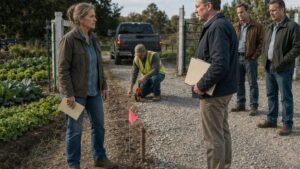
Agent Bennett knelt beside the open post hole, carefully examining the non-invasive optical prism spliced into the trans-Atlantic fiber trunk. Her face turned the color of cold slate as her handheld terminal decoded the incoming data packets.
“Mr. Douglas,” Agent Bennett said, rising to her feet with profound awe in her eyes. “You have no idea what you just prevented. This fiber line carries unencrypted real-time telemetry from the naval satellite tracking ground station in Sugar Grove. This rogue optical prism was designed to siphon high-bandwidth defense signals directly to an encrypted satellite uplink concealed inside the Sterling Crest clubhouse tower.”
Agent Bennett turned her chilling gaze upon Julian Sterling, who was sitting handcuffed in the rear of Deputy Vance’s cruiser, weeping in hopeless, hysterical terror.
“Julian Sterling,” Agent Bennett announced, her voice ringing across the quiet pastures. “Your real estate development was a shell consortium financed by eighty million dollars in offshore venture capital originating from hostile foreign intelligence fronts. You deliberately engineered this land boundary dispute to excavate the public road easement without triggering municipal utility permits. You are under arrest for espionage, conspiracy to commit economic espionage, and critical infrastructure sabotage under Title Eighteen of the United States Code.”
Federal agents swarmed the neighboring clubhouse property, executing emergency search warrants that uncovered an active high-frequency satellite transceiver disguised inside an ornamental cupola, seizing hard drives, cryptographic decryption keys, and lists of foreign handlers.
Under intense interrogation by federal prosecutors, Julian Sterling broke completely, confessing that his entire luxury development had been designed from its inception as a surveillance outpost positioned along the northern Virginia defense technology corridor.
By nightfall, the United States Department of Justice had frozen all domestic and international assets belonging to the Sterling Land Consortium, permanently voiding every easement claim and seizing the three-hundred-acre parcel under national security forfeiture statutes.
The strategic importance of Northern Virginia as the global epicenter of digital data transit has made the region a primary target for foreign espionage and infrastructure sabotage. Over seventy percent of global internet traffic passes through the high-density data centers and defense communications corridors of Loudoun and Fairfax counties. Beneath the rural rights-of-way and historic agricultural easements of neighboring Fauquier and Prince William counties run hardened trans-continental and transatlantic fiber trunks connecting the Pentagon, the National Security Agency, and major satellite command centers. The vulnerability of these corridors lies in their geographic dispersion through private rural farmland, where routine excavation, agricultural fencing, and utility maintenance can be exploited by foreign intelligence operatives utilizing commercial construction covers to gain physical access to classified data conduits.
The financial architecture of the Sterling Crest development was uncovered by federal forensic accountants as an elaborate corporate money-laundering conduit designed to facilitate foreign capital penetration into sensitive domestic infrastructure zones. Operating through multiple layers of offshore shell entities registered in the British Virgin Islands, Cyprus, and Belize, the syndicate had funneled tens of millions of dollars into rural Virginia real estate acquisitions, systematically purchasing parcels adjacent to high-security military command corridors, defense contractor research campuses, and federal satellite communications relays. By disguising these strategic acquisitions as luxury golf communities and equestrian lifestyle developments, the conspirators avoided scrutiny from the Committee on Foreign Investment in the United States, intending to establish permanent, unmonitored electronic surveillance outposts overlooking the national capital region.
The criminal prosecution of the Sterling espionage ring triggered nationwide reforms in the oversight of commercial real estate acquisitions adjacent to sensitive defense infrastructure. In Richmond and Washington, legislative committees drafted the Critical Infrastructure Corridor Protection Act, mandating mandatory inter-agency national security reviews for all commercial property transactions situated within five miles of transcontinental fiber routes or military installations. The automated surveillance station concealed within the Sterling Crest clubhouse tower was completely dismantled by federal cyber warfare technicians, its high-frequency satellite transceiver repurposed for research, while the stolen data packets were permanently purged from foreign intermediate servers through international law enforcement coordination.