The Golden Rice Harvest And The Battalion Of Runner Ducks
CHAPTER 2: THE SLUICE GATE GAMBIT
Murdock took a furious step toward Silas, his chest heaving, his fists clenched tight against his thighs until his knuckles turned chalk-white. “The state agricultural code gives my district emergency authorization to eradicate invasive pests, Thorne! If you interfere with chemical suppression on an active vector zone, I’ll have the county agricultural commissioner impound your entire marsh sanctuary by nightfall!”
“The commissioner won’t touch a federal migratory wetland reserve, Clint, and you know it,” Silas replied smoothly, not flinching an inch as a dozen heavy locusts bounced off the brim of his straw hat. “Besides, your methyl-parathion won’t do a damn thing against this swarm. You’re selling snake oil to a drowning man. Look at the Henderson field across the ditch if you want to see what your poison accomplishes.”
Julian turned his gaze past the boundary fence toward the neighboring sixty-acre tract owned by the Henderson brothers. Two commercial tractor-mounted spray rigs were crawling through the dry margins, belching thick, billowing clouds of acrid, gray-white chemical mist across the rows. The chemical stench drifted across the canal, sharp and foul, burning Julian’s eyes and throat like battery acid. But the locusts were not dropping.
The airborne swarm was so dense, so layered in its descent, that the chemical droplets coated only the outer layer of flying insects, acting as a momentary shield for the millions crawling beneath the canopy. Even worse, the high-pressure nozzles on Henderson’s heavy booms were snapping the brittle, over-ripened grain heads off their stalks, trampling nearly as much rice into the mud as the insects were devouring. Within minutes, the engine of the lead spray tractor began to shudder violently. Choked by thousands of fat insects sucked into the radiator grille and cooling fan, the tractor belched a greasy puff of black smoke and ground to a dead, boiling halt in the middle of a ruined furrow.
“You see that, Julian?” Silas said, his voice cutting through the rising din like a sharp blade. “Chemicals are a blunt, clumsy instrument. When a swarm moves this fast, poison only destroys the microbial health of the soil and suffocates your own machinery. You cannot fight millions of airborne jaws with an aerosol can. You need predators that hunt by instinct. You need creatures that turn an agricultural disaster into fuel.”
Julian looked from the smoking tractor in Henderson’s ruined field back to his own paddies. The devastation was accelerating at a terrifying rate. Along the southern edge of his plot, the golden color was already disappearing, replaced by a squirming, twitching blanket of black-and-ochre insects. Every passing minute cost him hundreds of bushels of premium grain. The knot in his stomach tightened into hard iron, cold and heavy.
“How many do you have in the reserve pens, Silas?” Julian asked, his voice steadying as he made his choice.
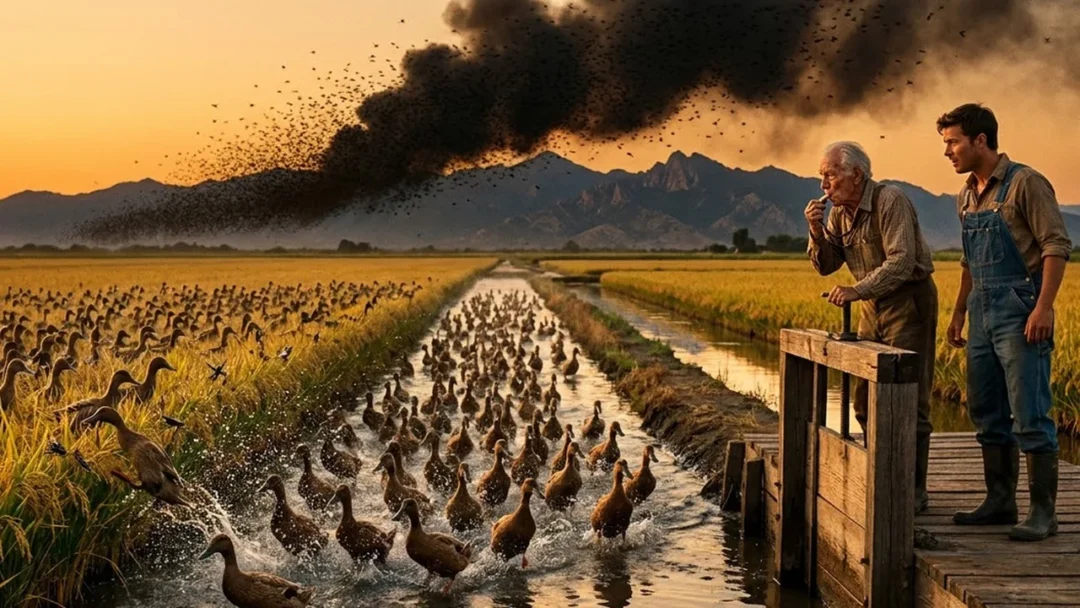
“Two thousand Khaki Campbell runners,” Silas answered, tapping the brass whistle against his chest. “Bred for two centuries to forage in flooded grain without flattening the stems. They’ve been on dry corn scratch for two days while we dredged the marsh retention ponds. They’re starved, they’re disciplined, and they know the whistle calls like trained cavalry.”
“You’re betting your whole family legacy on a flock of barnyard ducks?!” Murdock yelled, laughing with bitter derision as he waved his clipboard at the darkening sky. “They’ll scatter into the tules! They’ll gorge themselves and drown in the mud! They’ll trample the grain into soup! You’ll be bankrupted by sunset, Vance, and your father’s land will be carved up for tract housing!”
“It’s my crop to risk, Murdock,” Julian said coldly. He turned his back on the chemical salesman and stepped onto the wooden catwalk above the primary floodgate.
The floodgate was a massive slab of two-inch-thick white oak, reinforced with hand-forged iron straps and seated in a heavy concrete spillway. It separated the deep, cool water of the state-monitored wetland marsh from the shallow irrigation channels of Julian’s rice field. The gate was held fast by two heavy steel locking pins driven into the oak frame, wedged tight by years of hydrostatic pressure. If Julian pulled those pins and cranked the rusted iron gear wheel, six inches of cool, fresh mountain water would surge out of the marsh, flooding the rice furrows to their maximum operational depth and connecting the two ecosystems.
Murdock reached for the door handle of his truck, pulling a two-way radio from his belt. “Deputy Vance! Get down to lateral four right now! Your little brother is about to commit commercial suicide and dump unauthorized marsh water into an active quarantine perimeter!”
Julian ignored the blaring radio. He grabbed a heavy sixteen-pound iron sledgehammer leaning against the winch post. He set his stance on the slippery catwalk, hoisted the hammer, and swung with the full leverage of his shoulders. The hardened face of the hammer struck the first locking pin with a deafening metallic crack that rang out like a rifle shot across the valley. Rust flaked from the iron strap in a red shower. He struck it again, grunting with exertion, driving the tapered wedge upward until the steel pin popped free with a shriek of tortured metal and tumbled into the ditch.
He moved quickly to the eastern pin. The roar of the locust swarm was deafening now, a dark canopy blotching out the sun until the golden fields looked like an eerie twilight graveyard. Heavy insects bounced off his forehead, his neck, his arms, their thorny legs scraping his skin and tangling in his hair. He set his feet, brought the hammer down with all his remaining strength, and sheared the second pin cleanly from its bracket.
Silas stepped beside him on the narrow planks, placing both hands on the heavy iron winch wheel. “On three, son. Turn it with everything you’ve got in your back.”
“One. Two. Three!”
Together, they threw their combined weight against the iron spokes. The gears groaned, grooved teeth biting into the rack with a harsh, grinding protest, and the heavy oak gate rose six inches from the silted threshold. A torrent of dark, amber marsh water erupted beneath the timber, foaming white as it cascaded into the dry lateral ditches. The water rushed forward like a living artery, filling the narrow channels between the four-foot-tall rice rows, lifting the drooping green leaves and creating a shallow, continuous waterway throughout the entire forty-acre basin.
Silas took a deep, steadying breath, raised the notched brass whistle to his lips, and blew a sharp, three-tone blast that sliced clean through the deafening roar of the swarm.