The Golden Rice Harvest And The Battalion Of Runner Ducks
CHAPTER 3: THE SURGE ACROSS THE ROWS
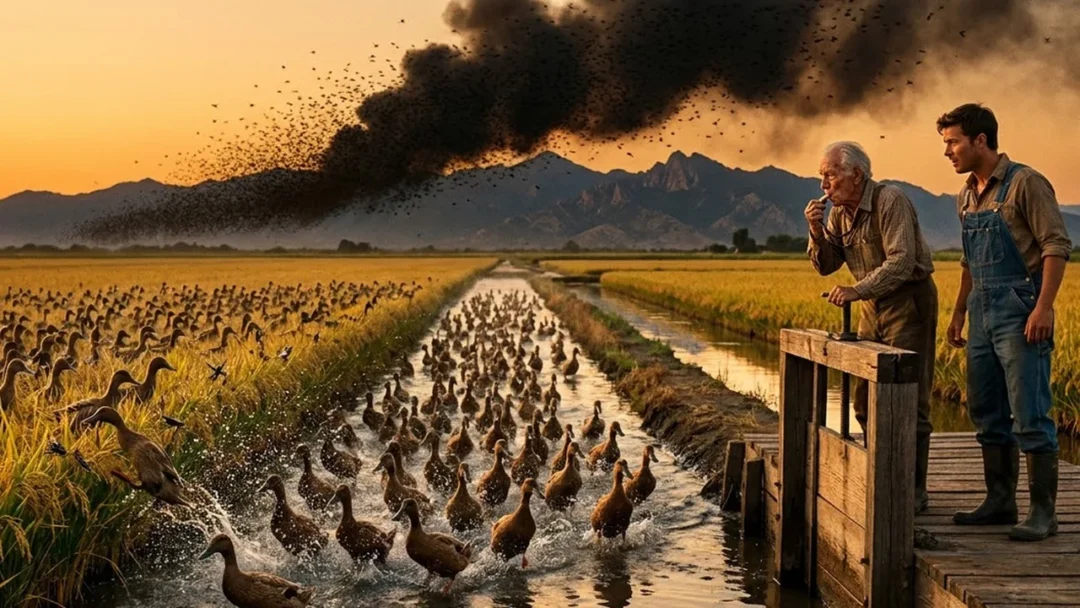
The piercing sound of Silas’s whistle had barely faded when a deep, rumbling resonance emerged from the dense willow thickets of the marsh sanctuary. It began as a low murmur of rustling reeds and splashing shallows, then swelled into a chaotic symphony of eager quacking, whistling wings, and churning mud.
At the far end of the drainage corridor, the secondary wooden gate of the holding pen swung open on its iron hinges. Out poured a continuous, surging wave of brown, bronze, and white. Two thousand Khaki Campbell runner ducks erupted onto the central levee like an unbroken tidal surge of living feathers. Unlike common domestic ducks that waddled with clumsy, side-to-side gaits, these birds moved with high, upright postures, their slender necks arched like thoroughbred horses, their long, muscular orange legs propelling them forward in a rapid, synchronized sprint.
“Look at that formation,” Silas murmured, his weathered face breaking into a fierce, triumphant grin as he watched his flock advance. “Generations of working blood, Julian. In the old days, they drove these birds across the paddies of England and Southeast Asia to clear the armyworms. They don’t scatter. They don’t lose their heads. They follow the waterline.”
The flock hit the primary canal at a dead run, plunging into the rushing current without a fraction of a second’s hesitation. Water erupted into glittering spray beneath thousands of paddling webbed feet. The lead ducks, sleek drakes with dark bronze heads and gleaming black bills, fanned out instantly as they reached the perimeter ditch. Behind them, the massive body of the flock divided into disciplined files, peeling off into the narrow furrows between the rice rows as if guided by an invisible, perfectly choreographed battle plan.
Murdock stood on the bank, his jaw slack, his radio still clutched limply in his hand as water droplets splattered his clean chemical uniform. “They’re… they’re running in rows. Why aren’t they breaking the stalks? Why aren’t they knocking the heads into the water?”
“Because their center of gravity is completely vertical,” Silas shouted back over the splashing roar. “A runner duck weighs four pounds, carries its weight over its hips, and has broad webbed feet that distribute its mass across four square inches of water. They don’t push through the plants like a dog or a hog. They glide through the irrigation gaps, using the water to buoy their weight!”
Julian watched in stunned silence, his heart hammering against his ribs. As the first wave of ducks entered the infested rows, the dynamic of the field shifted instantly. The locusts, which had been methodically severing the grain heads in absolute silence, sensed the sudden vibration of the water and the violent displacement of air. Thousands of insects attempted to take flight, launching themselves into the air in frantic, buzzing clouds that darkened the spaces between the rows.
It was precisely what the flock had been bred to exploit.
The anatomical precision of the Khaki Campbell breed was the product of two centuries of selective husbandry. Originating in Gloucestershire and refined across the rice-growing river valleys of the Pacific, their upright spinal posture allowed them to sprint through standing water without pitching forward or disturbing the root beds. Their bills were equipped with sensitive tactile lamellae along the inner margins, miniature sensory combs that allowed them to detect insect movement in murky water by vibration alone. Where mechanical sprayers saw only an impenetrable wall of green vegetation, the birds perceived an abundant, multi-dimensional banquet.
The lead drakes did not wait for the insects to settle or land. With astonishing athletic agility, the ducks leaped vertically from the water, their wings snapping forward to maintain balance while their bills clicked shut like spring-loaded shears. Snap. Snap. Snap. In a single forward stride, a single runner duck plucked four locusts directly out of the air in mid-flight, swallowed them whole with a single gulp, and immediately drove its bill into the lower stalk to rip away three more that were clinging to the leaf sheath.
The sound across the forty-acre field was extraordinary. The deafening buzz of the locust swarm was drowned out by the rhythmic, continuous clatter of two thousand hungry bills snapping shut in rapid succession. It sounded like an army of reapers marching through dry grass with miniature iron scythes.
Along row seven, where the locusts had formed a writhing, three-inch-thick carpet across the central levee, a platoon of fifty ducks converged in a tight, aerodynamic wedge. They moved forward at a steady jogging pace. The ground did not merely clear; it was scrubbed clean down to the bare earth. The insects had no time to crawl, no time to spread their wings, no time to bite. The moment an insect twitched or flexed its legs, a duck’s neck darted forward with the blinding speed of an uncoiling viper.
“They’re taking them off the stalks!” Julian exclaimed, scrambling along the catwalk to get a better angle as the golden rows re-emerged before his eyes. “Look at the grain heads, Silas! They aren’t snapping the stems! They’re pulling the bugs off the husk without breaking a single kernel!”
“A duck’s bill is smooth horn, not serrated teeth,” Silas explained, leaning over the timber rail with his pale eyes gleaming in the afternoon sun. “They strip the bug off the husk without bruising the rice kernel. And their droppings are dropping straight into the water, releasing nitrogen and phosphorus that the roots will draw up before harvest. They’re saving your crop and fertilizing your field at the exact same second!”
Suddenly, the violent roar of an engine shattered the rhythm of the feeding birds. Murdock had climbed back into his red pickup. He slammed the transmission into reverse, spun the heavy mud tires in the canal berm, throwing chunks of wet sod into the air, and angled his reinforced steel bumper toward the secondary wooden floodgate.
“If you won’t spray my chemical, you won’t use this public irrigation canal either!” Murdock snarled out his open window, his face purple with fury. “I’m dropping this ditch gate and cutting your water off right at the levy, Vance! Let’s see your ducks swim in dry mud!”