The Golden Rice Harvest And The Battalion Of Runner Ducks
CHAPTER 6: THE RIDGE OF BLACK GLASS
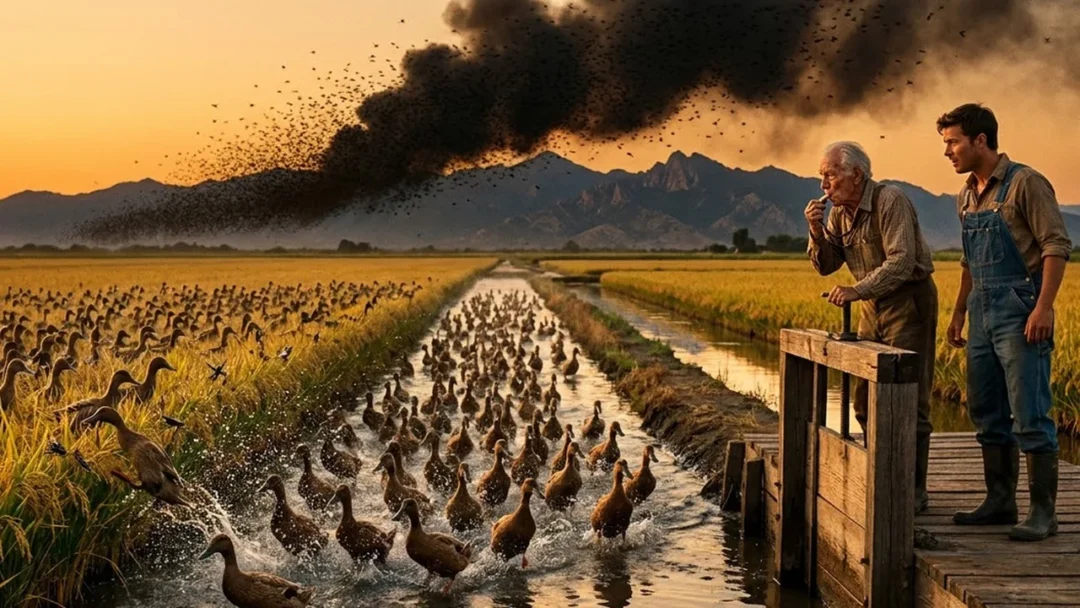
The sun touched the sharp, volcanic crest of the western Coast Range, bathing Blackwillow Valley in a brilliant, blood-red twilight. The air had gone completely still, heavy with the quiet calm that always followed a summer gale. Across Julian’s forty acres, the two thousand runner ducks had gathered in the shallow main canal, preening their sleek bronze feathers and dipping their bills into the cool, clear water.
Julian leaned against the wooden headgate rail, sipping cold spring water from a metal canteen. The tension that had coiled through his muscles for hours was finally beginning to unknot. Across the road, the Henderson brothers were already working frantically, opening their own diversion gates to flush the chemical runoff from their furrows in preparation for the ducks’ arrival.
Then, without warning, the water in the canal stopped rippling.
Julian frowned, glancing down at his boots. The surface of the shallow water was vibrating again. But this was not the gentle tremor caused by paddling duck feet or irrigation flow. It was a deep, sub-audible hum that traveled upward through the solid basalt bedrock beneath the valley floor, rattling the iron bolts of the sluice gate against their timber collars.
Beside him, Silas suddenly froze.
Every single duck in the two-thousand-bird flock stopped preening at the exact same second. In dead, eerie silence, two thousand slender brown heads snapped upward, turning in perfect synchronicity toward the western mountain ridge. Not a single quack broke the stillness. The birds stood frozen, their bodies locked in rigid, alert postures, their dark eyes fixed on the darkening peaks.
“Silas?” Julian asked, his voice dropping to a whisper. “What is that? The wind didn’t pick up.”
Silas did not answer immediately. He raised his antique brass field binoculars, training the lenses on the highest pass along the Coast Range—a jagged notch in the dark volcanic stone known to local pilots as Black Glass Pass.
Through the twilight gloom, the mountain ridge was changing shape.
It was not a cloud of dust. It was not smoke from a forest fire.
Rising over the crest of the mountain, blotting out the crimson afterglow of the sunset, was a colossal, churning wall of absolute blackness. It stretched for miles from north to south, rising two thousand feet into the upper atmosphere like a towering, boiling squall line of living obsidian. The sound reached them three seconds later—a terrifying, thunderous roar that sounded less like insects and more like the sustained, apocalyptic screech of a jet turbine screaming through a narrow canyon.
Julian’s breath hitched in his throat. The swarm they had fought that afternoon, the millions of locusts that had terrified Murdock and ruined Henderson’s machinery, was nothing compared to the monstrous entity cresting the ridge. That first swarm had been a puddle; this was an ocean.
“My God…” Julian whispered, his fingers trembling against the rough oak timber of the gate. “What is that?”
Silas slowly lowered the binoculars, his face pale, his jaw set like carved granite in the dying light.
“That swarm this afternoon wasn’t the main body, Julian,” Silas said, his voice barely audible beneath the rising subterranean rumble. “That was just the advance scout detachment. The warm thermal draft over the desert pushed the primary migratory front right through the mountain pass.”
The black wall surged forward over the timberline, moving with terrifying speed down the foothills toward the valley floor. In less than twenty minutes, every farm, every orchard, and every golden acre in Blackwillow Valley would be swallowed by darkness.
Julian looked down at the two thousand runner ducks resting in his canal. They were brave, they were disciplined, but against a swarm of that magnitude, they would be engulfed in seconds.
Silas reached down, gripped the leather cord around his neck, and lifted the notched brass whistle once more. His eyes burned with an unyielding, defiant fire.
“Clint Murdock thought we were playing games with birds,” Silas said, turning his gaze toward the valley highway where the headlights of dozens of neighboring farm trucks were beginning to gather in panic. “Go get your brother’s patrol radio, Julian. Call every rice grower, every duck hunter, and every wetland keeper from here to the delta.”
As the shadows stretched across the levee, Julian looked toward the dark bulk of the Vance family barn. Inside hung his father’s old copper surveyor’s transit and the hand-drawn maps of the valley’s original watershed, drafted before the army corps of engineers had channeled the rivers into concrete flumes. Those old maps showed dozens of forgotten oxbow lakes and perennial marshes that had once supported millions of native waterfowl during the great autumn migrations. If they were going to survive the super-swarm cresting Black Glass Pass, they would have to resurrect that forgotten alliance between wild wetlands and working farms before the first light of dawn.
“What are we going to do?” Julian demanded, his heart pounding against his ribs like a war drum.
Silas took a deep, steadying breath as the shadow of the monstrous cloud touched the outer rim of the farm. “We’re going to open every marsh gate from Blackwillow to the bay. We’re going to need fifty thousand birds by sunrise.”