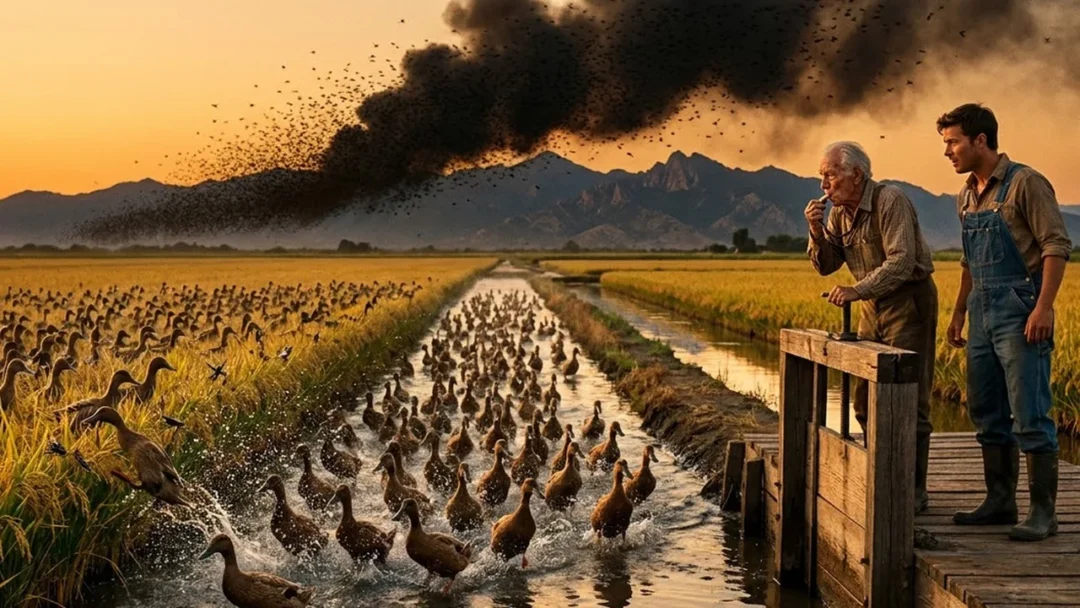
The Golden Rice Harvest And The Battalion Of Runner Ducks
CHAPTER 5: THE CLEAN FURROWS
Defeated, humiliated, and trembling with suppressed fury, Murdock climbed back into his red pickup, backed down the narrow levee road, and disappeared toward the state highway under the watchful tail of Ray’s patrol cruiser.
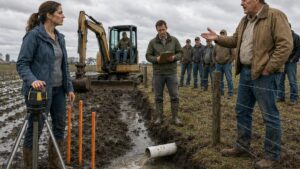
On the levy above the paddies, Julian and Silas remained, watching the final phase of the battle unfold across the forty-acre basin. The sun was dipping lower into the western sky, casting long, honey-colored shadows across the Sacramento Delta. The intense afternoon temperature was beginning to drop, cooling the fierce thermal currents that had carried the locusts down from the mountain passes.
The ducks had now reached the southern boundary fence. Their crops were visibly bulging, packed tight with hundreds of thousands of nutrient-rich insects. Yet their pace barely slackened. They patrolled the perimeter ditch with methodical thoroughness, rooting out every last straggler hiding beneath the watercress and submerged weeds.
Julian walked out onto the wooden catwalk that spanned the center of the field. He knelt down, reaching into the water to inspect the base of the rice stalks. The results were miraculous. There was no chemical film glistening on the water surface. No foul, sulfurous stench of organophosphates hung in the air. Instead, the cool mountain water smelled fresh, rich with the clean scent of wet loam, crushed river mint, and ripened starch.
“Look at this, Silas,” Julian called out, lifting a clump of soil from beneath the roots. “The water movement from their webbed feet washed away the fungal algae that had started forming on the lower stems yesterday. The stalks are cleaner than they were before the swarm hit.”
Silas walked out to join him, his heavy waders sloshing rhythmically through the shallow overflow. The old agronomist pulled a small brass magnifying loupe from his pocket, inspecting a cluster of golden rice grains that hung inches above the water.
“Clean as a newborn calf,” Silas chuckled softly, his eyes crinkling at the corners. “Not a puncture mark on the husk. Not a trace of insect excrement. When the state organic inspectors pull their core samples on Friday morning, this grain is going to test at zero parts per billion for synthetic toxins. You’ll pull thirty percent over the standard commercial board price on the San Francisco specialty grain exchange.”
Julian let out a long, ragged breath that felt like it had been trapped in his chest since his father’s funeral six months ago. He looked across the vast expanse of his land. Forty acres of uninterrupted, shimmering gold. The harvest was saved. The bank note would be paid in full on Monday morning. The Vance family name would remain carved into the heavy oak beam above the front porch for another generation.
Along the levee road, two pickup trucks belonging to neighboring farmers pulled up quietly. The Henderson brothers climbed out, their clothes reeking of chemical fumes, their faces grim and soot-streaked from their seized tractor engine. They stood at Julian’s fence line in stunned silence, staring at the pristine, insect-free field before them, then looking across at their own blackened, trampled acres where half the crop lay ruined in the dirt.
“Julian!” Frank Henderson called out, his voice hoarse with embarrassment and exhaustion. “How in God’s name did you do that? The whole valley thought you were finished when the swarm hit lateral four.”
“Nature doesn’t need chemicals when it has an appetite, Frank,” Julian answered, gesturing toward the flock resting peacefully in the shallow irrigation furrows. “Silas has two thousand soldiers here that work for fresh water and an honest meal.”
Frank Henderson looked down at his own grease-stained boots, then up at Silas with pleading eyes. “Silas… our south forty is getting chewed to pieces right now. The chemical trucks broke down and the sprayers are dead iron. Can you move those birds across the road before dark?”
Silas smiled gently, reaching up to tap his brass whistle against his chest. “If Julian’s field is secure, the battalion is ready for deployment. But you’ll have to shut down your chemical pumps and flush your irrigation ditches with clean river water first. My ducks don’t drink poison.”
“We’ll flush them right now!” Frank said eagerly, sprinting back to his truck with new life in his step.
Word of the ducks’ performance had already begun to ripple through the valley’s rural telephone party lines. In a region where farmers lived on razor-thin operating margins, squeezed between soaring equipment loan rates and fluctuating commodity futures, the sight of two thousand waterfowl outperforming industrial machinery was nothing short of an agricultural earthquake. For decades, the chemical cartels had convinced the valley that modern farming was impossible without their toxic formulations. Now, watching the crystal-clear runoff spill gently into the main canal, the neighboring growers were witnessing the undeniable power of biological equilibrium.
Julian turned to Silas, extending his hand. “I don’t know how I’ll ever repay you for this, Silas. You saved my life and my family’s land today.”
Silas took Julian’s hand in a firm, calloused grip. “You repaid me by trusting the land instead of the poison, son. Your father would have done the exact same thing.”