The Iron Tendons Of The Forgotten Commander At Mile Marker Four
CHAPTER 3: THE GRIP OF CAST IRON
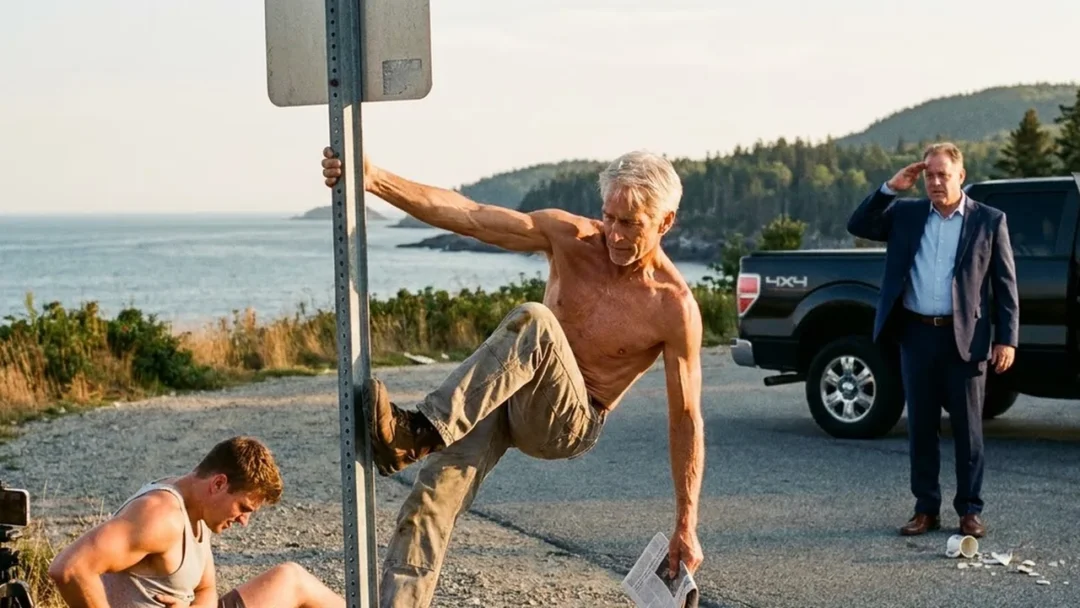
Arthur Vance did not panic, nor did he search through Brody’s designer gym bag for an ice pack or a cellular phone. He simply lowered his hips into a clean, disciplined rigger’s squat, planted his heavy oilskin boots firmly into the crushed rock, and reached down with his bare right hand.
He did not grab Brody by his clothing. He clamped his bare fingers directly around the young man’s chalk-dusted right wrist.
The instant Arthur’s hand closed, Brody’s desperate groaning choked off in his throat.
The contact was a shock to Brody’s nervous system. The old man’s hand did not feel like living human skin. It felt like an ancient, cold-rolled block of forged carbon steel. The calluses across Arthur’s palm were not the tender, raised blisters of a gym enthusiast; they were thick, hard, and yellowed like cured horsehide, running seamless from the pads of his fingers all the way down into the heel of his palm. When Arthur clenched his fingers, there was no cushioning give, no elastic softness, and no tremor of effort. It was the crushing, unyielding mechanical bite of a shipyard vice.
With a single, effortless motion—using zero swinging momentum and keeping his spine completely straight—Arthur straightened his knees and pulled upward.
Brody felt his entire two-hundred-and-ten-pound body hoisted vertically off the gravel as though he were hooked to a twenty-ton drydock winch. There was no straining grunt from the old man, no swelling of his veins, and not a single shudder in his shoulder girdle. In one second flat, Brody was lifted cleanly out of the mud and placed squarely on his feet on the asphalt shoulder.
As Arthur released his grip, the sudden tension pulled the frayed cuff of his heavy wool flannel shirt back toward his elbow.
Brody, still clutching his spasming ribs, looked down at the old man’s exposed forearm and froze in absolute silence.
Carved into the flesh of Arthur’s inner forearm, extending from the base of his thumb past the crook of his elbow, was a jagged, purple, four-inch surgical scar—a horrific shrapnel wound that had torn through muscle and bone decades ago before being pulled together with crude, heavy-gauge naval suture wire.
And directly beneath that jagged line of scar tissue, tattooed in the dark, indelible indigo ink used by military vessels before the era of modern electric needles, was an unmistakable combat insignia: a classic deep-sea brass diving helmet crossed by two naval combat boarding cutlasses, crowned by a trident and wrapped in a banner bearing a Latin motto: Sub Aqua Silentium.
Brody stared at the faded ink, his mouth opening and closing without producing a sound. For all his shallow vanity, Brody had grown up in a military household. He knew naval heraldry. That was not the tattoo of a commercial harbor worker. That was the classified unit crest of Special Boat and Deep Submersible Unit Four—a legendary, covert naval salvage unit that had operated in the blackest depths of the Cold War.
“You…” Brody stammered, his fingers trembling as he pointed at the old man’s arm. “That’s… that’s not a dock rigger’s mark. That’s a classified special salvage crest. Where did you get that?”
Arthur calmly pulled his flannel sleeve back down, covering the purple scar and the faded blue ink, and buttoned the worn horn button at his wrist.
“Gym weights have knurled steel handles, boy,” Arthur said softly, his grey eyes piercing straight through Brody’s soul. “They are shaped to be held. Real strength only comes when you spend forty years holding onto things that are desperately trying to tear your arms off your body.”
Before Brody could find his voice to reply, a deep, throaty roar echoed from the southern crest of Route One.
Tearing through the coastal mist at eighty miles an hour came a midnight-blue heavy-duty diesel pickup truck. The vehicle hit the brakes with such violent urgency that its tires shrieked against the asphalt, leaving twin black skid marks across the lane as it swerved onto the gravel shoulder, stopping six feet from the bus shelter in a swirling cloud of limestone dust.