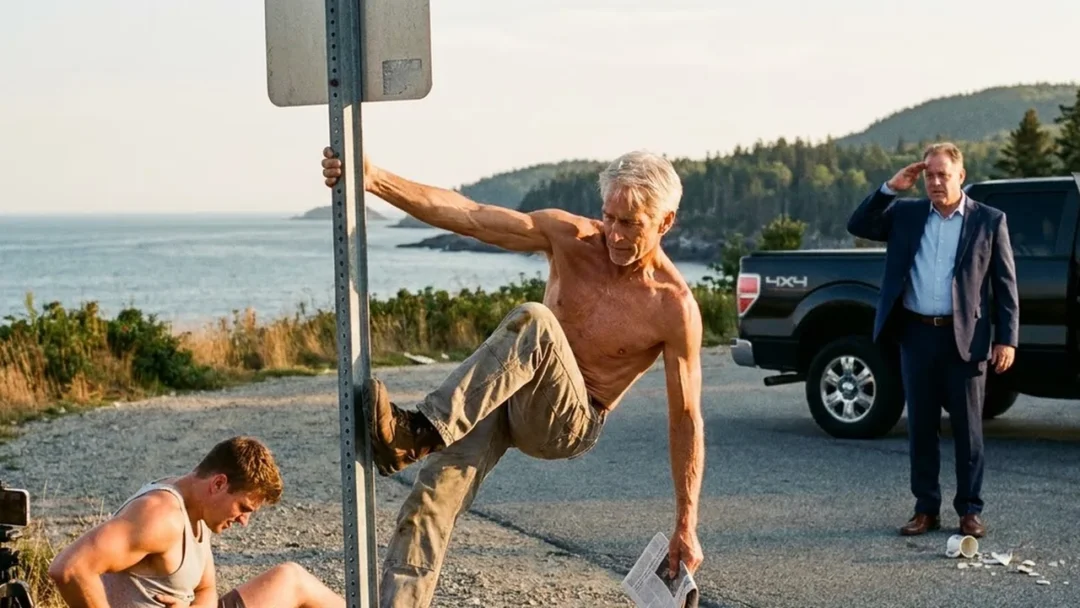
The Iron Tendons Of The Forgotten Commander At Mile Marker Four
CHAPTER 6: THE BLACK SEDANS ON ROUTE ONE
“Brody! Kill that feed!” Thomas roared, lunging toward the ditch to crush the camera with his heel.
“Dad, it’s too late!” Brody shouted, desperately snatching the rig from the weeds. “Look at the monitor! The live stream went viral three minutes ago! There are half a million people sharing the clip on Twitter! The military personnel algorithms in Arlington flag verified combat keywords automatically!”
Arthur Vance did not flinch, nor did he look at the digital screen. He looked up at the grey sky, watching two gulls glide effortlessly along the ocean thermal. “The morning bus from Rockland is twelve minutes late. It’s always late on Tuesdays when the ferry unloads.”
Before Thomas could guide Arthur toward the passenger seat of his pickup to flee the oncoming storm, the low, synchronized roar of high-displacement engines echoed from the southern bend of Route One.
Slicing through the coastal fog at ninety miles an hour came two massive, jet-black Chevrolet Suburbans with heavily tinted windows and low-profile satellite communication antennas mounted along their roofs. They moved with terrifying tactical coordination: the lead vehicle swerved across the center line to block the northbound lane, while the second mounted the gravel shoulder, boxing in the wooden bus shelter with mechanical perfection.
Brody scrambled backward against the steel post, clutching his camera to his chest like a shield. “Oh God… Dad, they’re here to arrest him! I ruined his life! I broadcast his face to the entire world!”
The heavy steel doors of the lead Suburban swung open with a muffled thud. Four men in dark navy windbreakers and tactical earpieces stepped onto the gravel, their hands resting loosely near their concealed sidearms.
Then, the rear passenger door opened.
Stepping down carefully onto the crushed limestone shoulder with the aid of a polished walnut cane was an eighty-two-year-old man wearing an immaculate naval overcoat adorned with the four gold stars of a full Admiral on his shoulder boards.
Thomas Caldwell stiffened, his heels snapping together once more in an instinctual reflex. “Admiral Harris…?”
Admiral Richard Harris—former Vice Chief of Naval Operations and the last surviving member of the 1989 Barents Sea Inquiry Board—walked slowly across the gravel. His breath formed small white clouds in the cold coastal air. He did not look at Thomas Caldwell, and he did not glance at the trembling young influencer with the camera.
His pale blue eyes locked directly upon the weathered, impassive face of Arthur Vance.
Harris stopped three feet from the old rigger. He leaned heavily upon his cane, his chin trembling as he looked at the patched canvas overalls, the grease-stained wool flannel, and the scarred hands that hung loosely at Arthur’s sides.
“Thirty-seven years, Arthur,” Admiral Harris said, his voice thin but carrying the deep, unyielding authority of the fleet. “Thirty-seven years you let this country believe you were rotting in the silt of the Barents trench. Thirty-seven years you lived on a rigger’s wage in a drafty salt-marsh cabin, hauling timber cables and repairing marine winches, while the defense executives who forged those titanium inspection certificates collected dividends in Palm Beach.”
Arthur Vance met the Admiral’s gaze without a trace of resentment. “I had an honest life, Richard. The timber doesn’t lie, and the winch cables don’t file political briefs. I was content.”
“The country was not content, Commander,” Admiral Harris replied. He reached inside his heavy overcoat and produced an oblong rosewood presentation box polished to a deep, mirror-like mahogany sheen. “Forty-eight hours ago, the President signed the final executive declassification order on the nineteen-eighty-nine Barents Sea incident. The titanium contractor’s lobby was dissolved a decade ago. The records are public, Arthur. The world finally knows that eighty-two sailors came home to their families because one man held an iron bulkhead against the Arctic Sea.”