The Magnetic Sweeper And The Blue Chalk Footprint Trail
CHAPTER 4: THE SNAP OF THE MAGNET
Brenda Holloway smirked triumphantly as Arthur disappeared into the dim interior of his garage. She turned to Mrs. Abernathy, who was watching from across the street. “You see that? He has no answer! The coward is running inside to hide! Just wait until the board president hears about this!”
Carl Jenkins shook his head, looking down at his phone, his thumb hovering over the speed-dial for the Cobb County Sheriff’s non-emergency dispatch line. “I hate to do this to an elderly veteran, Mrs. Holloway, but property damage is property damage. If my tires roll over one of those—”
Before Jenkins could press the call button, a low, smooth rolling sound echoed from the concrete floor of Arthur’s garage.
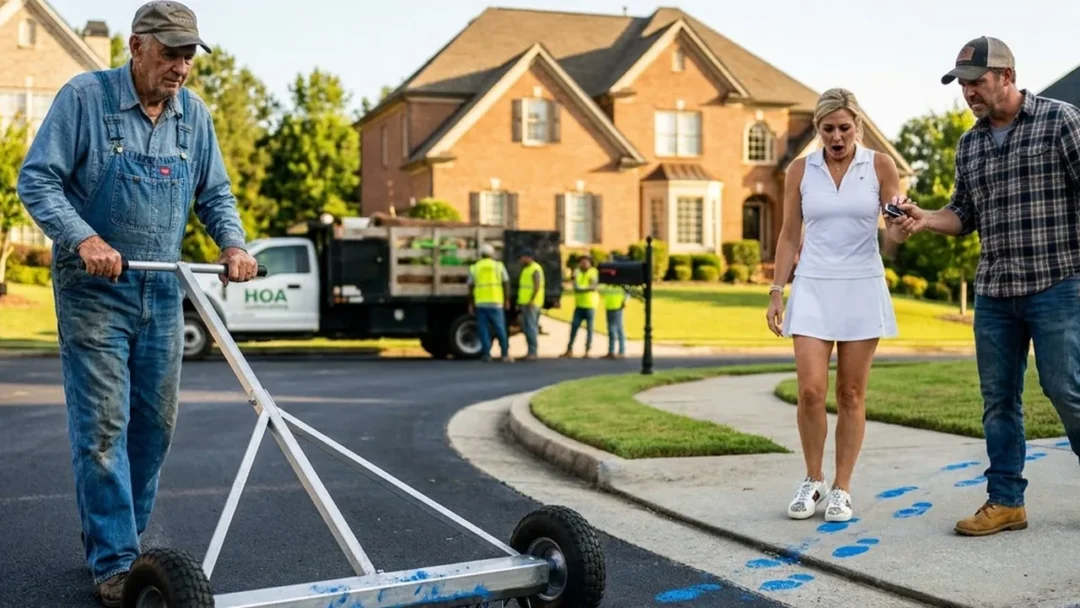
Arthur emerged into the bright morning sunlight. He was not carrying a broom, a dustpan, or a telephone. In his hands, he guided a professional thirty-six-inch heavy-duty magnetic rolling workshop sweeper. The tool was an industrial-grade marvel of mechanical engineering: a solid aluminum housing mounted on ten-inch rubber-tired wheels, featuring an adjustable steel T-handle and housing a series of permanent neodymium rare-earth magnets capable of generating forty-five pounds of direct vertical pull. Arthur had assembled the rig by hand in his machine shop, aligning grade N52 sintered neodymium-iron-boron blocks along a flux-concentrating soft iron backplate. In an aircraft hangar, loose fasteners and safety wire fragments—known as Foreign Object Debris, or FOD—could be sucked into jet turbine intakes with catastrophic results. Arthur’s sweeper had been calibrated to clear runway tarmacs of every microscopic steel shaving; two hundred roofing tacks on flat asphalt were child’s play.
“Stand clear of the curb apron, Carl,” Arthur said calmly, gripping the T-handle with both gloved hands.
Arthur stepped off the curb and aligned the magnetic sweeper with the outer edge of the nail fan.
Then, with smooth, rhythmic strides, he pushed the aluminum bar across the asphalt.
CLACK-CLACK-CLACK-SNAP. The sharp, rhythmic metallic reports echoed across the cul-de-sac like rapid bursts from an automatic rivet gun. Each high-carbon fastener was snatched cleanly from the roadbed, drawn against the aluminum casing by invisible lines of magnetic flux that defied gravity. The speed and mechanical elegance of the clearance left the watching neighbors utterly spellbound; there was no sweeping, no bending down, and no missed fragments—only the relentless, flawless execution of industrial design.
The reaction was instantaneous, hypnotic, and devastatingly loud.
Under the immense electromagnetic field generated by the internal neodymium plates, the two hundred diamond-point steel nails did not wait to be swept. They leaped upward from the black asphalt like a swarm of metallic hornets, snapping against the underside of the heavy aluminum bar in an unbroken, staccato burst of deafening clicks.
Within three seconds, Arthur had completed a single, effortless pass beneath the dual tires of the Ford F-450.
He reversed his stride, swept the outer perimeter of the gutter, and stopped.
The asphalt was completely, immaculately clear. Not a single steel fastener remained on the road. The tires of the heavy maintenance truck were completely safe, untouched by a single puncture.
Arthur lifted the sweeper slightly and tilted it back on its rubber wheels, turning the undercarriage toward Carl Jenkins and the gathered neighbors.
Clinging to the bright silver face of the magnetic bar, aligned in two dense, bristling rows of perfect magnetic polarity, were all two hundred ring-shank roofing nails. Every single nail was caked in the intense, electric-blue cobalt chalk. But more importantly, the magnetic bar itself—along with the ten-inch rubber wheels—was now coated in a fine, powdery smear of that same cobalt-blue chalk dust.
Jenkins blinked, his jaw slack in astonishment. He bent down, ran his calloused hand across the bare asphalt where the nails had been resting three seconds earlier, and looked up at Arthur in genuine awe. “Every single one of them. You got every last nail in three seconds flat.”
“Neodymium permanent magnets,” Arthur said, resting his hand on the handle. “Pulls forty-five pounds from three inches away. Built it myself back in ninety-eight when I was clearing aircraft engine bays.”
Arthur’s gaze shifted slowly from the magnetic sweeper, moving past Carl Jenkins, and settling squarely upon Brenda Holloway. There was no malice in his eyes, only the tranquil clarity of an experienced inspector who had found the exact crack in an airframe.
“Now, Carl,” Arthur said, his voice dropping into a quiet, surgical focus, “look down at the road. Magnetic sweepers pick up iron and steel. But they don’t pick up chalk powder.”
Curiosity Lock: Arthur pointed his brass-tipped walking cane downward at the asphalt gutter, where the bright morning sunlight illuminated a vivid, unbroken trail of cobalt-blue shoe prints leading directly away from the truck.