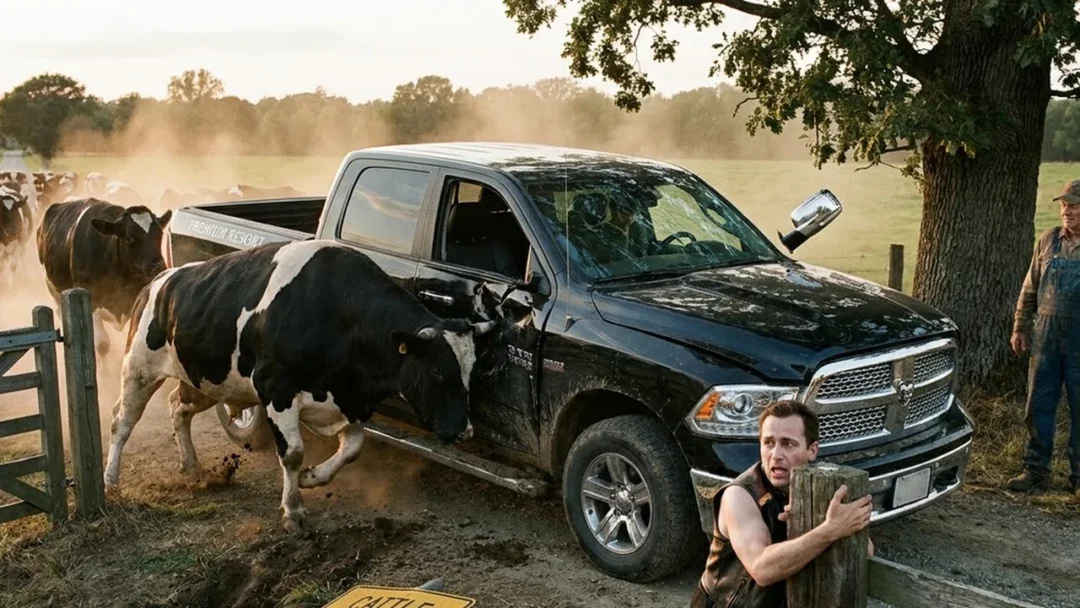
The Open Gate on Mercy Creek Dairy Road
CHAPTER 2: MUD ON THE LATCH
By morning, Blake’s version had reached every local news feed. His publicist called it an unprovoked livestock attack caused by an obsolete farming operation. A photograph showed the crushed truck but cropped out the gate, sign, and herd.
At the milking parlor, Amos attached stainless claws while Ruth reviewed the sheriff’s evidence. The pipeline vacuum hummed. Milk struck the receiver jar in white pulses.
“You need to let me speak for you,” she said.
“I answered the questions.”
“You gave a reporter six words.”
“Six true words beat sixty polished ones.”
Amos believed work established character. Ruth knew courts required exhibits.
Dana brought the broken memory-card fragment and body-camera copies. Her patrol recording showed Blake standing beside the open gate when she arrived, but not the moment he opened it. Mud impressions helped. The tread on Blake’s Italian boot matched the print on the sign. A crescent of orange paint marked his toe. His palm print was on the gate, though he claimed he touched it after the crash.
Dr. Ortega documented the bulls’ response. Their histories showed calm handling and no attacks. An air horn measured at the truck produced sound capable of triggering a flight response at close range.
“Animals aren’t machines,” he said. “But this sequence was foreseeable. Confined cattle, sudden gate opening, extreme sound, clear path.”
Blake’s attorney served an emergency petition at noon. It sought to classify the crossing as a public hazard, enjoin herd movement across the lane, and require Amos to remove both bulls. Without the crossing, cows could not reach pasture. Keeping them confined would triple feed costs and overwhelm the manure system.
The petition also demanded damages for the truck.
“State open-range rules won’t decide this,” Ruth told Amos. “Wisconsin isn’t broad open range. But negligence still turns on who breached a duty. The easement and his conduct matter.”
“He’ll buy experts.”
“Then we’ll bring measurements.”
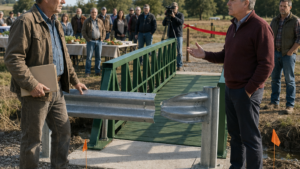
They inspected the crossing with a surveyor. The recorded easement granted livestock priority during posted movements. Township minutes confirmed the sign. The resort’s access approval expressly required guests and contractors to yield.
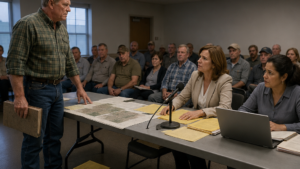
At the township hall, Ruth requested every complaint against the dairy. Seven had appeared in six months: loose cattle, blocked traffic, damaged fencing, early-morning noise. Each included photographs from elevated angles. Amos recognized incidents that had never occurred.
One image showed his orange sign already in the ditch three days before Blake kicked it. Another showed the gate open beneath trees leafless with spring, though the complaint was dated July.
“They built a record,” Ruth said. “They wanted the crossing to look dangerous before yesterday.”
The clerk produced Blake’s construction correspondence. His engineer had warned that emergency vehicles could not reach the planned riverside domes unless the lane was widened through the Keller easement. Buying Amos’s river pasture would solve both access and septic setbacks.
Amos rubbed his thumb over the deed copy. “He offered in January. I said no.”
“And complaints began in April.”
That evening, Dana called. Blake had found a witness: a resort employee who swore Amos opened the gate in anger. Ruth asked for the statement. The timestamp preceded the collision by four hours.
Attached was a photograph of the supposedly dangerous open gate. Metadata showed it had been created ten days earlier with a drone registered to Mercy Creek Retreat.
The incident had not inspired Blake’s lawsuit. The lawsuit had been waiting for an incident.
Ruth traced complaint accounts through recovery addresses. Three led to resort contractors; two used prepaid phones activated near the glamping office. Township road logs contradicted the claimed blockages. On every date, a grader operator passed within minutes and recorded a clear lane.
Amos produced a coffee tin holding decades of gate receipts, veterinary certificates, and crossing schedules. Ruth had teased him for saving paper. Now the archive established maintenance and ordinary use better than any polished slide. They scanned each page and built a chronology no staged photograph could bend.
Before court, Ruth rehearsed his testimony. She taught him to stop after each answer. He taught her why frightened cattle turn toward open space even when danger waits there. Preparation converted old friction into shared craft.