The Quarantined Orange Grove And The Battalion Of Golden Wasps
CHAPTER 3: THE NINETY-SIX HOUR WAR
For three days and three nights, an invisible, microscopic war raged across the sixty acres of the Alvarez citrus orchard.
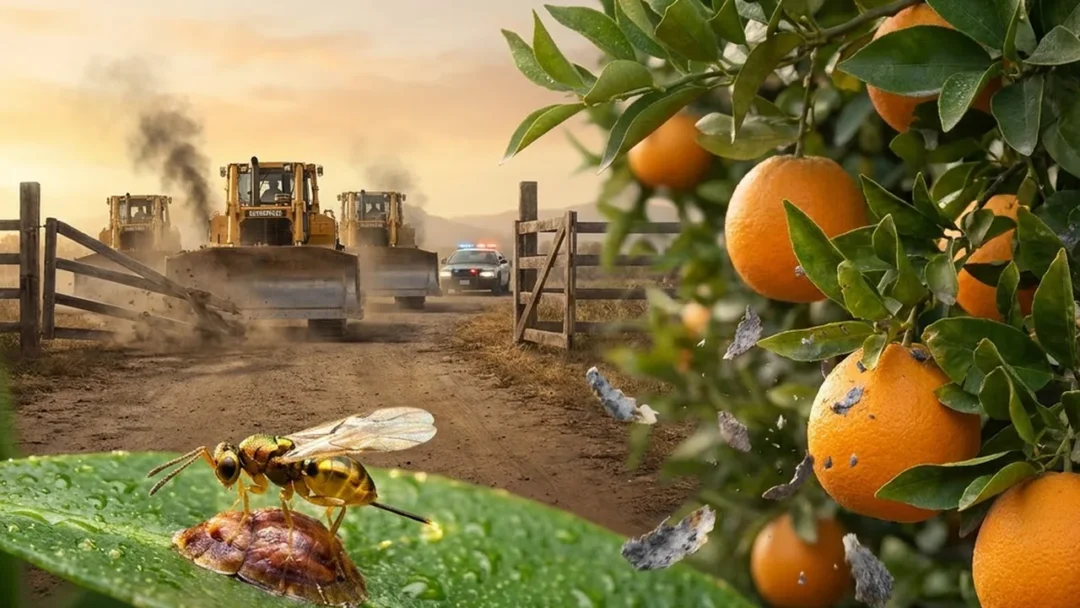
The weather remained unseasonably hot and dry, the Santa Ana winds blowing gently from the east—perfect environmental conditions for Aphytis melinus. In warm air between eighty and eighty-five degrees Fahrenheit, the wasps’ metabolic rate operated at peak biological velocity. Thousands of tiny golden winged warriors moved through the canopy like living dust, sweeping from the lower water shoots to the highest fruiting tips of the Valencia trees.
The economics of predatory insect deployment represented a revolutionary paradigm shift in commercial orchard management. While a conventional chemical pesticide regimen required expensive pressurized tanker rigs, hazardous personal protective equipment, and repeated applications costing upwards of six hundred dollars an acre, a biological release program cost less than sixty dollars an acre. More importantly, chemical sprays inevitably selected for pesticide-resistant super-strains of scale bugs while eradicating native ladybird beetles and lacewings. Sofia’s parasitic wasps, by contrast, co-evolved with their prey, establishing a self-perpetuating biological equilibrium that provided continuous protection year after year.
Leo barely slept. Every four hours, he walked the dark rows with a flashlight, checking the biodegradable cardboard capsules hung in the crotches of the branches. By Wednesday afternoon, every single capsule was empty. The entire ten-thousand-bird army had successfully dispersed into the canopy.
Across the valley, news of Sofia’s biological intervention had provoked intense skepticism among the commercial citrus growers. On Wednesday morning, three pickup trucks belonging to neighboring growers from the Ojai Citrus Exchange parked along the road.
Frank Henderson, a veteran grower who managed two hundred acres of conventional lemons down the valley, walked up to the fence line where Leo was checking an irrigation line.
“Leo!” Frank called out, adjusting his straw hat. “Word is you brought in university bugs to fight the state quarantine. Vance Sterling is in town telling everyone that your place is going to be ground zero for a regional quarantine. If those scale bugs blow into my lemons, Leo, the whole exchange is going to sue you for damages.”
“Look at the leaves, Frank,” Leo answered calmly, gesturing toward the nearest branch. “Come over the fence and look for yourself.”
Frank hesitated, then climbed through the wire. He reached out with thick, calloused fingers, plucking a ripe Valencia orange that had been heavily encrusted with red scale forty-eight hours earlier.
Frank pulled a magnifying glass from his shirt pocket, squinting at the surface of the fruit.
His face shifted in utter bewilderment.
The dark reddish-brown waxy crust that had coated the orange was no longer smooth, moist, or firmly attached to the rind. The scales had turned an unnatural, dull chalk-white. In the center of dozens of the circular shields, tiny, perfectly circular exit holes—scarcely visible to the naked eye—had been carved through the wax.
The internal physiological mechanics of the parasitoid attack were a triumph of evolutionary specialization. Once the microscopic wasp larva hatched from its egg beneath the wax carapace, it secreted digestive enzymes that dissolved the internal fluids of the scale insect while carefully preserving the host’s vital organs until the final stage of development. This ensured that the host insect remained living, fresh, and nutritious throughout the larva’s four-day growth cycle. By day five, the larva entered a rapid pupal metamorphosis, casting off its larval skin and transforming into a fully formed winged adult within the hollow, desiccated husk of the pest.
Frank dragged his thumb across the surface of the orange.
With a soft, dry rasp, the entire crust of dead scale insects crumbled into fine, powdery gray dust, blowing away in the gentle morning breeze like wood ash from a cold campfire. Beneath the crumbling residue, the orange rind was completely intact—glossy, vibrant, bright golden-orange, and completely unblemished.
“I’ll be damned…” Frank whispered, staring at his clean thumb. “They’re hollow. Every damn one of them is empty.”
“They aren’t just empty, Frank,” Sofia said, walking down the row with her digital field log. “The wasp larvae have consumed ninety-two percent of the adult scale population on the south block. By tomorrow afternoon, the natural predatory sweep will exceed ninety-eight percent. The orchard is completely clean.”
Frank looked at Leo, then at Sofia, and slowly took off his hat. “Vance Sterling told the county board that biological control was impossible in an active outbreak. He told us chemical demolition was the only legal remedy.”
Sofia’s eyes narrowed with cold, analytical suspicion. “Inspector Sterling has been lying to this entire valley, Mr. Henderson. And I’m about to find out why.”