The Quarantined Orange Grove And The Battalion Of Golden Wasps
CHAPTER 2: THE MICROSCOPIC AIRBORNE ARMY
The interior of the packing shed was cool and dim, smelling of cedar crates, citrus rind, and dry dust. Sofia set the Styrofoam cooler on the broad wooden sorting table, carefully slicing through the blue biological hazard security tape with a surgical scalpel.
Leo stood beside her, his hands clasped nervously behind his back, staring at the contents of the cooler.
Inside, nestled between frozen gel packs maintaining an exact temperature of fifty-two degrees Fahrenheit, were fifty small, cylindrical cardboard tubes. Each tube was four inches long, made from unbleached, biodegradable paper, and sealed at both ends with fine cotton gauze.
“Sofia…” Leo whispered, peering into the cooler with a mixture of wonder and profound anxiety. “How can something that fits in a small cooler save sixty acres of trees? Vance said there are millions of scale bugs out there.”
“Scale bugs are stationary, Uncle Leo,” Sofia explained, her voice steady with scientific confidence as she lifted one of the cardboard cylinders. “Once a female red scale settles onto a leaf or a fruit, she secretes a hard, circular waxy shield made of protein and lipid esters. She sheds her legs, she sheds her eyes, and she spends the rest of her life anchored in one spot, sucking the sap out of the phloem vessels. She thinks her wax shell makes her invincible to the outside world.”
Sofia brought the cardboard cylinder up to the yellow work light. Through the fine cotton mesh, Leo could see a shimmering, swirling cloud of golden specks, each one no larger than a grain of coarse sand.
“This is Aphytis melinus,” Sofia said, her eyes shining with admiration. “A microscopic ectoparasitoid wasp native to the foothills of the Himalayas. They do not sting humans. They have no venom sacs. They do not feed on fruit or vegetation. They have only one biological purpose on this planet: to seek out armored scale insects and destroy them.”
Sofia walked over to her field kit and pulled out a specialized 100mm optical macro probe lens attached to a digital video monitor. She stepped out into row twelve, motioning for Leo to follow.
She selected an orange leaf heavily encrusted with three dozen reddish-brown scale carapaces. Using a pair of stainless-steel micro-forceps, Sofia opened the cotton end of a release tube, gently tapping a single tiny golden wasp onto the surface of the green leaf.
She positioned the cylindrical probe lens half an inch above the insect, bringing the high-definition display screen into razor-sharp focus.
Sofia’s field probe lens utilized an advanced optical configuration featuring a specialized long-working-distance objective and coaxial fiber-optic ring illumination. This enabled her to capture live, high-resolution forty-eight-megapixel digital imagery of microscopic arthropod interactions in the field without subjecting the delicate living insects to the dehydrating vacuum chambers of traditional laboratory electron microscopes. On the tablet display, every facet of the wasp’s compound eyes, every serration along its tibial spurs, and the micro-sculpting of the scale’s waxy dorsal shield were resolved with breathtaking clarity.
Leo stared at the monitor, his jaw slowly falling open.
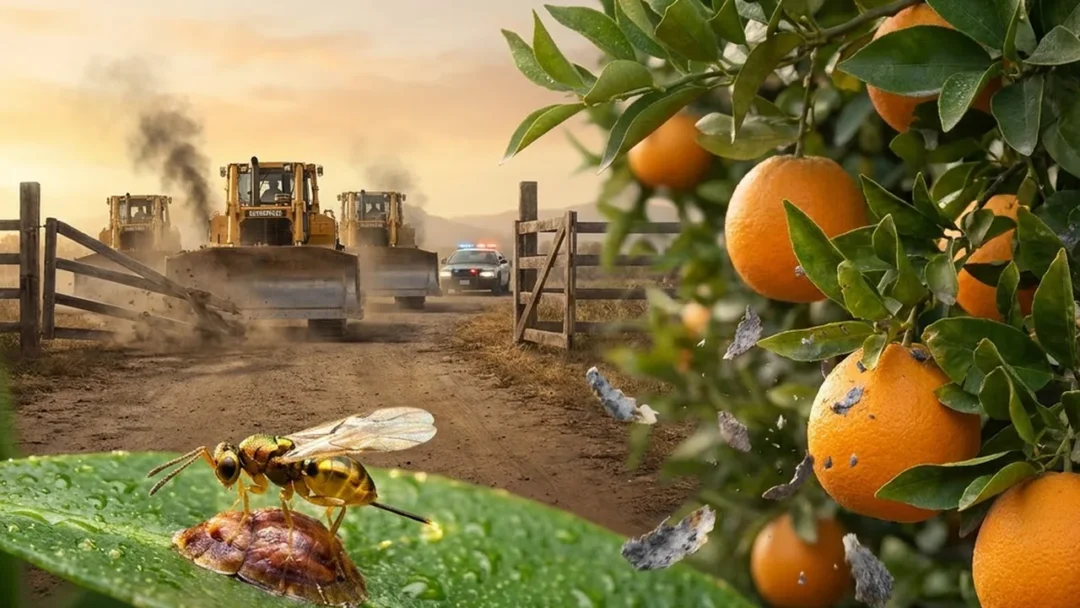
Magnified fifty times, the tiny golden speck was transformed into a magnificent, armored predator. The wasp had translucent, iridescent amber wings that shimmered like stained glass in the morning sun, large, multifaceted emerald compound eyes, and long, delicate antennae that swept across the leaf surface like sensitive radar probes.
The wasp approached a mature red scale insect. It did not hesitate. It walked onto the waxy carapace, tapping the surface rapidly with its antennae to detect the chemical pheromones and physical vibrations of the living pest beneath the shield.
Satisfied that a viable host was trapped inside, the tiny wasp tucked its abdomen beneath its thorax. From between its rear abdominal plates, an exquisite, hair-thin, needle-like organ emerged—an ovipositor forged from hardened sclerotized chitin, sharper and more precise than any surgical needle on earth.
With rhythmic, hydraulic pulses, the wasp drove the ovipositor straight through the impenetrable center of the waxy armor.
“Look at that, Uncle Leo,” Sofia whispered, pointing to the screen. “That wax shield is impenetrable to chemical sprays and tractor mist. But to Aphytis, it’s paper. She drills through the roof, paralyzes the scale insect with a microscopic droplet of tranquilizing secretion, and deposits a single egg directly beneath the armor. When the egg hatches in twenty-four hours, the wasp larva consumes the scale bug from the inside out.”
Leo watched the screen in stunned silence as the tiny golden wasp completed its work, pulled its ovipositor free, and immediately flew to the next scale bug an inch away.
“How many can one wasp kill?” Leo asked, his voice trembling with rising hope.
“A single female deposits up to fifty eggs in her lifetime,” Sofia replied, closing her kit. “And when the adult wasps emerge from the dead shells five days later, they chew an exit hole through the armor and repeat the cycle exponentially. We have ten thousand females in these tubes. Over the next seventy-two hours, they will produce half a million parasitic strikes across your five thousand trees.”
Sofia handed Leo a box of release pins. “Take the eastern rows, Uncle Leo. We hang one capsule every ten trees. We have ninety-six hours before the bulldozers roll.”