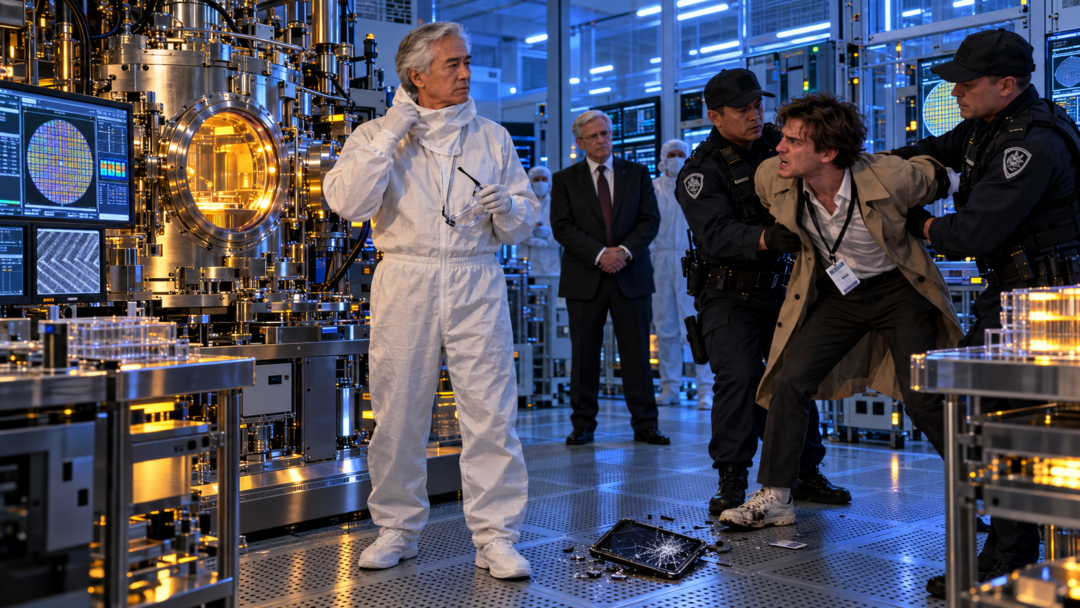
The Shattered Silicon Wafer In The Cleanroom And The Nobel Architect
CHAPTER 2: THE ERASED LITHOGRAPHY RESIST
Forty minutes later, the cleanroom remained sealed under quarantine isolation, its recirculating air blowers roaring at maximum emergency velocity to purge the airborne contaminants. In the adjacent materials characterization suite, separated from the main fab by two pressurized glass airlocks, Dr. Maya Lin sat hunched over a field-emission scanning electron microscope.
At twenty-nine, Maya was the primary architect of the self-assembling organometallic photoresist that had made Robert’s two-nanometer lithography breakthrough possible. She wore a blue antistatic lab coat over a plain white blouse, her dark hair pulled back into a tight bun, her eyes ringed with violet shadows of chronic exhaustion. On the high-resolution monitor before her, a nanoscale cross-section of the damaged wafer displayed a horrifying sight: the crisp, vertical molecular lines of the transistor gates were slumping and melting like wax beneath a blowtorch.
Robert entered the room, having completed the preliminary decontamination cycle. He had removed his bunny suit and now wore his familiar gray wool cardigan and reading glasses, his silver hair neatly combed.
“It’s worse than we thought, Professor,” Maya said, her voice trembling with barely suppressed panic. She brought up an infrared spectroscopy plot on the secondary monitor. “Look at the hydrocarbon absorption peaks between twenty-eight hundred and three thousand wave numbers. That isn’t street salt or common road dust.”
Robert leaned over her shoulder, his reading glasses reflecting the spectral graphs. “What is the molecular signature, Maya?”
“It’s an aerosolized formulation of benzyl trimethylammonium hydroxide,” Maya whispered, looking at him with wide, frightened eyes. “It’s an industrial photo-acid neutralizer. It’s the exact chemical solvent used to chemically strip and destroy EUV resists during semiconductor failure analysis.”
A cold, heavy stillness settled over the room. Robert looked through the glass partition toward the sealed cleanroom where Cross had walked.
“Cross didn’t just walk in here with dirty shoes,” Robert said softly. “The sole of his right shoe had been deliberately coated with an aerosolized chemical neutralizer before he entered the airlock. He intentionally contaminated the wafer cassette to ensure that our prototype demonstration would produce a zero percent electrical yield.”
“Why would he destroy the very prototype his fund is backing?” Maya asked, pressing her palms against her temples.
“Because of the covenant clause in the seed equity contract,” Robert replied, his voice dropping into a razor-sharp tone. “Under section twelve of the Apex Horizon agreement, if the university fails to demonstrate a functioning fifty-percent electrical yield on forty consecutive wafers before the October thirty-first milestone, the intellectual property rights default entirely to Apex Horizon for a nominal liquidation fee of one dollar. Cross didn’t want the prototype to succeed under university ownership. He wanted it to fail catastrophically so his fund could seize the sovereign patent and sell it to an overseas syndicate for three billion dollars.”
Maya swallowed hard, reaching into her desk drawer and pulling out a certified legal notice that had been delivered to her apartment at six o’clock that morning.
“Cross’s lawyers served me with this at home, Professor,” she said, her hands shaking. “It’s a twenty-million-dollar non-disclosure lawsuit. They claim that my doctoral thesis contained proprietary trade secrets belonging to Apex Horizon. They threatened that if I testify before the federal patent review board next week, they will petition the State Department to revoke my research visa and have me deported.”
Robert gently took the legal document from her hands, his jaw tightening with unyielding moral resolve. “They will not touch you, Maya. And they will not touch this patent. In forty years of science, I have seen many predatory men try to build empires on the stolen sweat of young scholars. None of them have ever succeeded against the truth.”
Robert smoothed the crease on the legal document and placed it flat upon the microscope desk. “Bring up the automated log from the airlock sensor array, Maya. We need to see who opened the pressure door for Ethan Cross.”
The field-emission microscope hummed with high-voltage excitation, its vacuum chamber cooling down with the steady whisper of liquid nitrogen cryo-pumps. Maya looked away from the monitor, her face pale under the harsh overhead fluorescent tubes. She took off her blue antistatic lab coat, folding it with mechanical precision as if clinging to routine in the face of complete catastrophe.
“My parents were rice farmers in Tainan, Professor,” Maya said softly, her voice barely carrying above the equipment hum. “They mortgaged their family acreage to pay for my undergraduate laboratory tuition at National Taiwan University. When I received your fellowship offer to come to Cambridge, my father wept with pride at the airport. He told me that in America, truth and dedication mattered more than dynasty or connections. But when Ethan Cross threatened me in my apartment lobby, he laughed in my face. He told me that in high technology, venture capital decides who is remembered as a genius and who is deported as a criminal.”
Robert pulled a wooden chair beside her desk and sat down, his posture calm, upright, and immovable. “Ethan Cross does not understand science, Maya. He understands transaction ledgers and intimidation. He believes that ideas are like physical commodities that can be bought at wholesale and fenced through tax havens. But a mathematical theorem cannot be bullied. A quantum physical law does not yield to a balance sheet. What you created in this laboratory—the self-assembling molecular resist—is an act of pure human genius that will power medical imaging and clean energy for the next fifty years. We will not allow a financial parasite to extinguish your light.”
He pointed to the secondary analytical tab on the screen. “Look at the chemical degradation kinetics. The neutralizer requires an ambient humidity of at least forty percent to fully hydrolyze the polymer backbone. Because our cleanroom maintains an ultra-dry relative humidity of twenty-two percent, sixty percent of the resist matrix remains intact beneath the surface passivation layer. If we recalibrate the laser exposure dose and run an emergency thermal bake cycle at one hundred and forty degrees Celsius, we can recover seventy percent of the test dies before the morning deadline.”