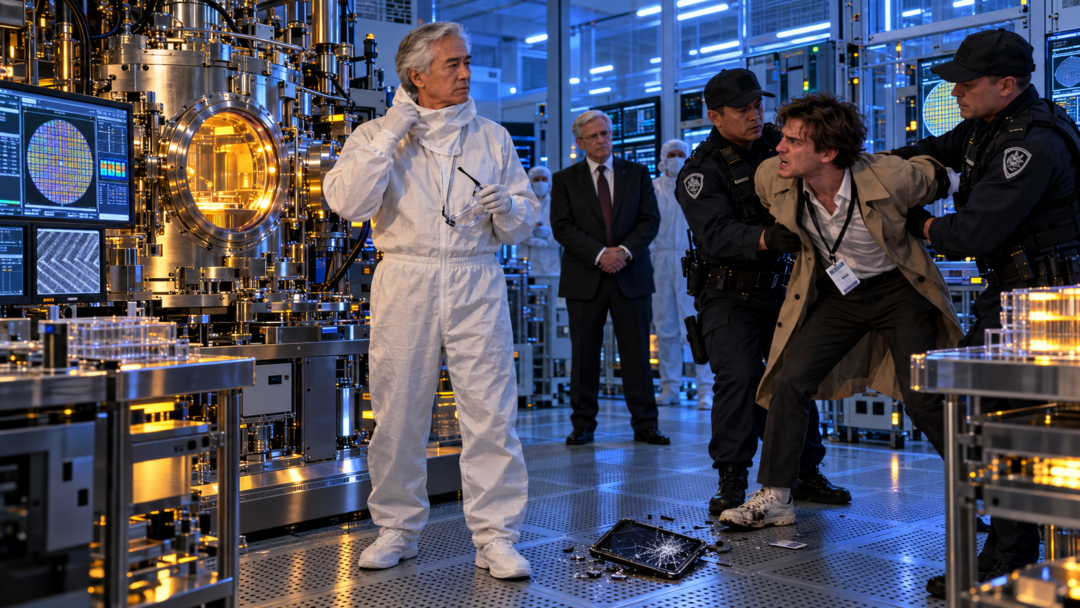
The Shattered Silicon Wafer In The Cleanroom And The Nobel Architect
CHAPTER 4: THE BOARDROOM AT FAN PIER
At 7:30 AM, the morning sun rose cold and blinding over Boston Harbor, glaring off the floor-to-ceiling glass walls of the forty-fourth-floor executive conference room of Apex Horizon Ventures on Fan Pier. Below, luxury yachts bobbed in their slips along the harbor walk, and the glass towers of the financial district stood like granite monoliths against the pale autumn sky.
Ethan Cross stood at the head of the twenty-seat polished rosewood conference table, sipping an iced macchiato from a crystal tumbler. He wore a sharp midnight-blue double-breasted suit, his platinum cufflinks gleaming in the morning light.
Seated along both sides of the table were the executive trustees of the university research foundation, their faces grim, their hands folded tightly over thick manila legal briefs. At the center of the table sat Chancellor Henry Adams, an elderly scholar of constitutional law, his brow furrowed with deep, troubled lines.
“Gentlemen, let us not waste each other’s valuable time,” Cross began, his voice dripping with smooth, venomous confidence. He tapped a remote control, illuminating an eighty-five-inch high-resolution OLED monitor on the wall.
On the screen was a magnified image of the damaged silicon wafer from Robert’s cleanroom, showing the shattered, porous transistor gates.
“What you are looking at is conclusive, indisputable proof of academic malpractice,” Cross said, pacing along the glass wall. “Yesterday afternoon, my independent engineering audit discovered that your high-profile two-nanometer prototype has suffered a total, unrecoverable yield collapse. The chemical resists have degraded, the wafer lattice is contaminated with volatile hydrocarbons, and your lead faculty member—an aging eccentric who refuses to follow standard commercial development protocols—has destroyed forty million dollars of our investment capital.”
Chancellor Adams cleared his throat, his voice trembling with quiet indignation. “Mr. Cross, Dr. Robert Chen is a Nobel Laureate. He is the most respected microelectronics physicist of his generation. Our preliminary internal reports indicate that the cleanroom was breached by an unauthorized individual who bypassed our airlock protocols.”
Cross laughed—a sharp, barking sound of pure, unadulterated ridicule. “An unauthorized individual? Are you accusing me, Chancellor? I am the sole managing partner of the fund that keeps your physics department afloat! If you attempt to slander my firm with baseless conspiracy theories, my litigation team will file thirty federal lawsuits before noon. We will freeze your university’s endowment, tie up your federal research grants in five years of civil discovery, and bankrupt every trustee in this room!”
Cross pulled a leather-bound signature folio from his briefcase and slapped it down onto the polished wood directly in front of Adams.
“This is an emergency assignment of patent equity,” Cross stated, leaning over the table until his face was inches from the Chancellor’s. “Under section twelve, the university forfeits all operational management of the two-nanometer patent to Apex Horizon. You sign this document before nine o’clock this morning, or my firm pulls its liquidity lines, issues an immediate demand notice on your forty-million-dollar construction debt, and closes down the Kendall Square facility forever.”
Adams looked down at the document, his hand hesitating above the fountain pen. “And Dr. Chen? What happens to his research team?”
Cross sneered with icy malice. “Dr. Chen will be stripped of his emeritus title and barred from the campus. And that foreign research assistant of his—Maya Lin—will be on a flight back to Taipei by Friday. Now sign the paper, Chancellor, before I lose my patience.”
The silence in the Fan Pier conference room was suffocating, broken only by the muffled drone of a harbor ferry cutting through the morning chop far below. Across the rosewood table, the university trustees exchanged terrified, helpless glances. Most of them were corporate attorneys, real estate executives, and retired bank presidents—men whose entire lives were governed by balance sheets, reputation risk, and the dread of public scandal. None of them understood the quantum physics of extreme ultraviolet lithography; they understood only that a forty-billion-dollar venture fund was threatening to destroy their institution’s financial credit rating.
Ethan Cross took a slow, theatrical sip of his iced coffee, enjoying every second of their terror. He checked his solid-gold Patek Philippe wristwatch with flamboyant indifference.
“You have twelve minutes remaining before my litigation partners file the preliminary injunction in federal district court, Chancellor,” Cross purred, tapping the signature line on the leather folio with the tip of his gold Montblanc pen. “If you sign the assignment, Apex Horizon will quietly assume all outstanding construction bonds for the Kendall Square center. We will release the university from all financial liability, and we will issue a joint press release praising the academic collaboration. But if this clock strikes nine without your signature, I will personally hold a press conference outside South Station and announce that the university has defrauded federal taxpayers out of forty million dollars in fake quantum research.”
Chancellor Adams looked down at the pen in his trembling hand. He was an honorable man who had dedicated forty years to the university, but the weight of forty million dollars in impending municipal debt felt like an anvil pressing down on his chest.
“Mr. Cross,” Adams said, his voice husky with strain, “Dr. Chen has given his entire adult life to this institution. His name is synonymous with integrity in the scientific world. You are asking us to erase his life’s work.”
Cross laughed—a cruel, dismissive sneer that echoed off the plate-glass windows. “In the tech industry, Chancellor, integrity is what losers talk about when their options expire out of the money. In the real world, the man with the capital writes the history. Now sign the document.”