The Shattered Silicon Wafer In The Cleanroom And The Nobel Architect
CHAPTER 5: THE MIDNIGHT INTERFEROMETER AUDIT
Three floors below street level in Kendall Square, the laboratory was bathed in total, suffocating darkness, broken only by the pulsing emerald status diodes on the automated laser interferometer console.
Robert Chen sat motionless at the master terminal, his fingers moving across the mechanical keyboard with silent, practiced precision. Beside him stood Dr. Maya Lin, holding an external fiber-optic spectrometer probe positioned over the open optical cavity of the lithography scanner.
“The diagnostic firmware log is decrypted, Professor,” Maya whispered, her eyes fixed on the streaming hex code scrolling across the screen. “Look at the internal command register for yesterday afternoon at twelve-fifty-six.”
Robert adjusted his reading glasses. The internal optical diagnostic camera—a high-speed, three-thousand-frame-per-second imaging sensor designed to track microscopic mirror vibrations during vacuum laser pulsing—had captured continuous video during the airlock breach.
Robert clicked the playback interface.
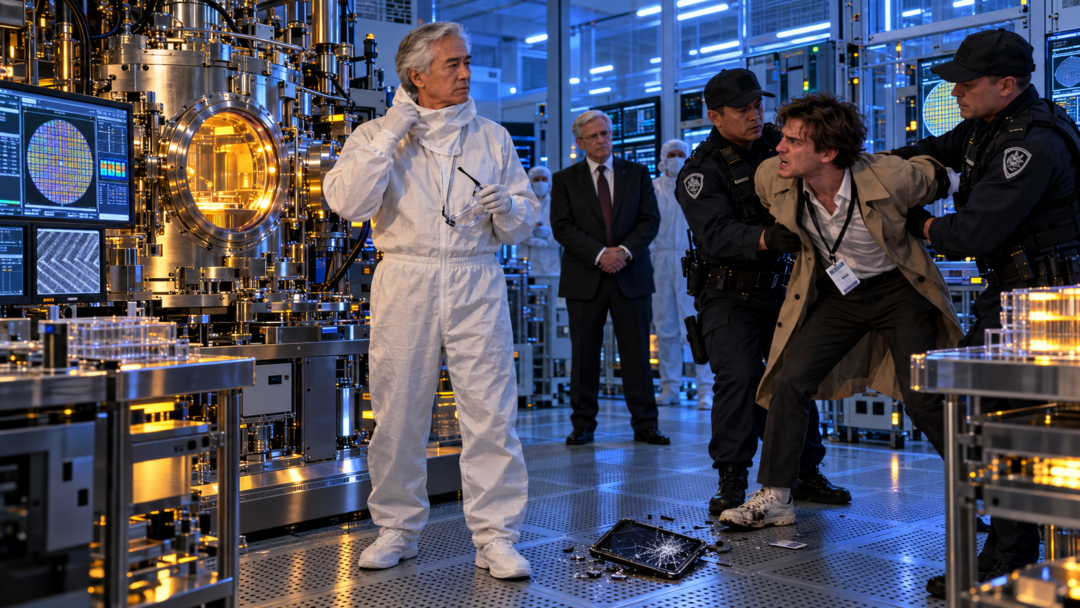
On the screen appeared a crisp, high-definition recording of the cleanroom interior from the high-angle ceiling mount. The video showed Ethan Cross stepping past the yellow line in his designer trench coat. But what happened before the confrontation was horrifying in its calculating clarity.
As Cross walked past the robotic staging cart, his right hand deliberately slipped inside his trench coat pocket. He pulled out a small glass atomizer bottle, concealed it in his palm, and casually depressed the plunger three times, spraying a fine, invisible mist of benzyl trimethylammonium hydroxide directly into the laminar air stream blowing toward the open wafer cassette.
“He didn’t just have solvent on his boots,” Maya gasped, a hand flying to her mouth in shock. “He brought a chemical aerosol spray into the cleanroom! He premeditated the sabotage before he ever stepped through the door!”
“And look at his left sleeve,” Robert said, zooming in on the recording with a digital magnification filter.
Reflected in the polished titanium housing of the vacuum chamber was a small, high-density USB hardware key inserted into the secondary diagnostic port on the back of the lithography terminal. The device’s blue data transfer LED was flickering frantically, downloading forty terabytes of proprietary optical wave-front correction algorithms directly from the machine’s encrypted flash memory.
“He stole the master lithography source code,” Robert stated, his voice ringing with absolute, clinical certainty. “The entire twenty-billion-dollar mathematical architecture of next-generation American semiconductor independence is currently stored on that hardware key.”
Behind them, the pressurized airlock doors suddenly chimed.
The heavy magnetic locks on the outer vestibule disengaged with a dull, resonant thud. The security lights flickered from amber to yellow.
“Someone is entering the anteroom,” Maya whispered, her heart hammering against her ribs.
Robert did not move. He ejected the encrypted optical evidence disc from the console, slipped it into his cardigan pocket, and stood up calmly in the dark fab.
“Do not be afraid, Maya,” Robert said softly, placing a reassuring hand on her shoulder. “The net has been cast. Now we merely wait for the fisherman to pull his own rope.”
The darkness in the Kendall Square sub-basement cleanroom was heavy, chilled by the steady rush of nitrogen gas through the exhaust plenums. Robert Chen stood by the laser diagnostic console, watching the real-time Fourier transform infrared spectroscopy data streaming across the green terminal. Every keystroke was being recorded simultaneously onto three hardened military solid-state drives provided by the Bureau of Industry and Security.
Beside him, Maya worked with steady, courageous hands, applying a specialized fluorinated solvent to the damaged quartz photomask. In the eerie emerald glow of the optical diodes, her face was a portrait of intense, unbreakable concentration.
“The optical mask is undamaged, Professor,” Maya reported, letting out a long, quiet breath. “Cross sprayed the solvent into the cassette, but the synthetic quartz pellicle—the protective membrane you patented twenty years ago—shielded the master reticle from direct liquid contact. The chemical only settled onto the sacrificial test wafers.”
Robert looked down at the delicate, transparent pellicle membrane, barely a few hundred nanometers thick, yet capable of withstanding the immense thermal energy of an extreme ultraviolet laser pulse.
“True engineering is designed with sacrificial layers, Maya,” Robert said softly, his voice imbued with the deep, patient wisdom of a lifetime of discovery. “In materials science, you always anticipate turbulence. You design the structural framework so that when stress arrives, the expendable shield absorbs the impact while the sacred core remains intact. Ethan Cross believes he is a master of leverage, but he does not realize that he has spent thirty-six months operating inside a laboratory designed by men who anticipate every microscopic flaw.”
Through the security intercom, Agent Vance’s voice crackled softly: “Tactical teams are in position outside the cleanroom perimeter, Dr. Chen. Chancellor Adams has arrived at the facility entrance, and Ethan Cross is stepping out of his limousine. He has the hardware key in his briefcase.”
Robert reached up, pulled his cleanroom hood back over his silver hair, and sealed his polycarbonate goggles into place. “Let him enter. It is time for the lesson to conclude.
Maya stood beside the optical inspection console, her hand resting upon the emergency interlock key. Through the reinforced observation glass, the amber illumination of the Lithography bay reflected like liquid gold in her eyes. She had watched her mentors and colleagues spend decades in quiet obscurity, laboring over nanometer equations that would never make the evening news. They did not work for venture options or private jets; they worked because they believed in the sacred beauty of discovery. The trap was set, the evidence was ironclad, and the final curtain was about to fall.”