The Snapped Port Lanyard And The Inspector General At Gate Four
CHAPTER 6: THE LOCKDOWN OF CORBIN STREET
By four o’clock that afternoon, the driving rain had begun to ease into a light, misting fog that rolled off the gray waters of Newark Bay, blurring the yellow sodium lights of the terminal into soft, glowing halos.
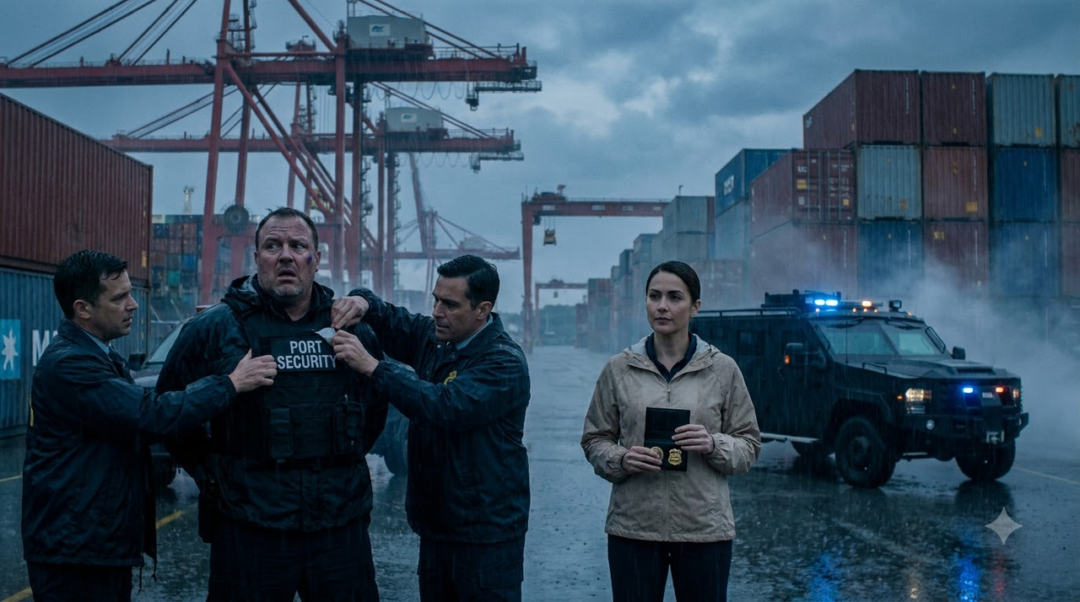
Along Corbin Street—the four-lane commercial artery that served as the sole terrestrial access route for thousands of tractor-trailers entering and exiting Port Newark—a massive, multi-agency tactical operation was reaching its climax. Marked cruisers from the New Jersey State Police, tactical units from U.S. Customs and Border Protection, and armored transport vehicles from the Federal Bureau of Investigation had established an impenetrable perimeter across the entire southern corridor of the complex.
At Gate 4C, the yellow hydraulic barrier arm had been raised permanently. In place of Captain Frank Miller’s private security guards, two uniformed federal CBP officers stood in the guard booth, processing commercial container traffic through calibrated mobile gamma-ray imaging scanners.
Every truck was scanned, every electronic seal was verified against the national manifest database, and every commercial driver was presented with an official informational pamphlet explaining the restoration of legitimate federal oversight.
Standing on the raised concrete walkway beside the gate, Inspector General Evelyn Hayes watched the line of trucks moving smoothly through the checkpoint. Her beige windbreaker was dry now, zipped comfortably against the chilly sea breeze, a new federal credential lanyard hanging neatly around her neck.
Commander Thomas Brennan walked up the concrete steps, holding two steaming paper cups of coffee from the mobile canteen truck. He handed one to Evelyn with a warm, respectful smile.
“All seventy-two container stacks in Yard Fourteen have been audited, Evelyn,” Brennan reported softly. “The hazardous ammonia cylinders have been neutralized and transported to the Picatinny Arsenal facility for safe disposal. The stolen military optics are in the custody of the Naval Criminal Investigative Service.”
Evelyn accepted the coffee, taking a slow, grateful sip. “And Marcus Sterling?”
“He’s currently sitting in the federal holding annex in Newark,” Brennan answered, a grim smile touching his lips. “The magistrate denied bail fifteen minutes ago, citing significant flight risk and international assets. His private security franchise has been permanently dissolved by order of the Port Authority.”
Down on the roadway below, an unmarked federal transport van pulled up to the gate, carrying Frank Miller and his top terminal lieutenants on their way to the federal courthouse for formal arraignment.
As the van paused at the checkpoint, Frank Miller looked through the reinforced steel mesh of the rear window. His tactical vest had been replaced by an orange inmate jumpsuit, his head was shaved, his face pale and hollow, his eyes wide with the realization of his shattered life.
He looked up at the walkway, his eyes locking onto Evelyn Hayes.
Inspector General Hayes met his gaze with absolute, unyielding composure. She didn’t gloat. She didn’t wave. She merely stood tall, holding her coffee, her presence embodying the quiet, eternal strength of the law that he had thought he could break with the heel of his boot.
Miller slowly looked down at the floor of the van, unable to meet her gaze, as the transport vehicle accelerated through the gate and merged into the outbound traffic on Route 1/9.
Commander Brennan watched the van vanish into the mist. “You know, Evelyn… when Miller snapped that visitor pass this morning, he honestly believed you were just a girl with a clipboard who would run away in tears.”
Evelyn smiled faintly, her eyes following the rhythmic swing of the great container cranes working along the pier in the distance.
“Men like Miller always think the clipboard is weak, Thomas,” Evelyn said softly, watching the lights of a container barge glide past the outer channel markers. “They see an auditor with a stack of papers and they assume authority is just paper that can be torn up, thrown in a puddle, or ignored with an aggressive shout. They forget that the clipboard is where the evidence is written. It is where the serial numbers are verified, where the law is anchored, and where the truth is documented down to the second. And when the evidence is written down, the strongest walls in the world come tumbling down.”
She looked down at the Gate 4C checkpoint where federal agents and Port Authority officers worked in smooth, disciplined harmony.
“For twenty years, maritime cartels have operated on the assumption that global supply chains are too vast, too chaotic, and too fast-moving for the law to catch up with them. They rely on the sheer volume of forty-foot steel boxes to hide their crimes. But every container has a point of origin, every ship leaves a wake, and every dollar leaves a signature in the bank servers. When law enforcement does its job with patience and precision, the shadows have nowhere left to hide.”