The Snapped Port Lanyard And The Inspector General At Gate Four
CHAPTER 2: THE SCENT OF HEAVY FUEL OIL
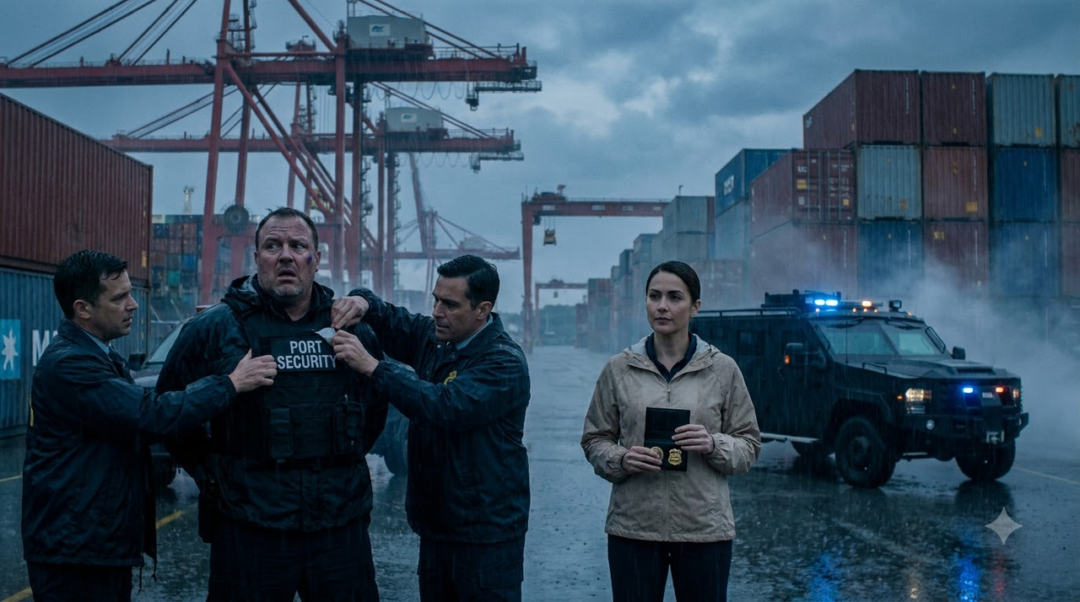
The heavy rain began to fall in earnest, drumming against the corrugated steel roof of the Gate 4C security trailer and splashing violently across the rain-slicked concrete. Two federal tactical operators stepped forward with practiced, synchronized efficiency, flanking Captain Frank Miller like twin walls of green Nomex and ballistic ceramic.
Miller backed away against the yellow hydraulic barrier arm, his hands trembling as he reached toward his radio handset. “Wait… Commander Brennan, sir! There’s been an incredible breakdown in communication! The gate log didn’t flag an Inspector General visit! The protocol for federal audits requires forty-eight hours advance written notice to the terminal operating authority!”
Commander Thomas Brennan didn’t answer with words. He reached out with an iron grip, seized the velcro patch on Miller’s tactical vest that read TITAN SECURITY – COMMANDER, and ripped it off with a sharp, violent tearing sound. He tossed the patch onto the wet asphalt, followed immediately by the gold-plated private contractor badge unpinned from Miller’s collar.
“You don’t get forty-eight hours notice for a criminal contraband interdiction, Miller,” Commander Brennan said, his voice cold as deep ocean water. “Disarm him.”
Before Miller could move a muscle, the two tactical operators had seized both of his forearms, wrenching them behind his back. The Glock 17 was stripped from his tactical holster, cleared of its magazine with a metallic clack, and secured in a federal evidence pouch. A pair of heavy, double-locking stainless-steel handcuffs snapped around Miller’s wrists with a definitive, mechanical click.
“On what charge?” Miller shouted, his voice cracking into high-pitched hysteria as his mirrored sunglasses fell to the concrete, crushed beneath a tactical boot. “I have a private security franchise! Titan has held the port contract for six years! You can’t just cuff a terminal captain on his own gate!”
Inspector General Evelyn Hayes stepped past him, completely unbothered by his protests. She kicked open the reinforced door of the security trailer, stepping inside the heated, fluorescent-lit interior.
The trailer smelled of stale coffee, tobacco smoke, and overheated electronics. Across the main desk sat four high-resolution security monitors displaying live camera feeds from Container Yard 14. But on the secondary console beside the microwave sat an unauthorized piece of military-grade hardware: an active, unshielded tactical radio frequency jammer with four high-gain rubber duck antennas, its green transmitting LED pulsing rhythmically.
Evelyn pointed at the jammer with her pen. “Commander Brennan, look at this frequency readout.”
Brennan leaned over the console, his jaw tightening into iron. “Four-hundred-and-sixty-seven megahertz. That’s the local Coast Guard Sector New York vessel traffic and harbor pilot emergency frequency. He wasn’t just blocking cellular calls at the gate; he was actively jamming maritime emergency communications.”
Evelyn walked behind the desk, pulling open the middle drawer of Miller’s metal desk. Inside, beneath a stack of blank shipping manifests, lay a heavy, padded manila envelope. She picked it up, unfastened the brass clasp, and emptied the contents onto the blotter.
Three thick stacks of fresh, crisp five-thousand-dollar bundles of hundred-dollar bills tumbled out, each wrapped in green paper bands stamped: ATLANTIC MARITIME FREIGHT LOGISTICS – PANAMA CITY.
Beside the cash lay an unencrypted handheld optical terminal scanner—the specialized device used to scan the barcoded seals on maritime shipping containers. Evelyn tapped the power button. The screen illuminated, displaying an active bypass log showing three specific forty-foot refrigerated container numbers that had been marked as “CLEARED – AGRICULTURAL INSPECTION EXEMPT” forty minutes earlier:
CONTAINER MSK-99412-B
CONTAINER MSK-99415-B
CONTAINER MSK-99419-B
Evelyn looked out through the rain-streaked glass window of the trailer. Two hundred yards down the terminal lane, the dark, monolithic stacks of Container Yard 14 rose six tiers high into the misty gloom, surrounded by a heavy perimeter of barbed wire.
“Miller,” Evelyn said, stepping back out into the rain and looking down at the cuffed captain, whose face was pale and slick with cold sweat. “Who authorized the bypass clearance for those three refrigerated units?”
Miller swallowed hard, his breath coming in ragged, shallow gasps that smelled of cheap coffee and nicotine. Rain pooled in the hollows of his collarbones, soaking into the Kevlar weave of his tactical vest. “I… I don’t know what you’re talking about. The logistics office handles automated clearances. The system clears them automatically based on the electronic bill of lading transmitted from the shipping lines in Rotterdam.”
“The shipping lines in Rotterdam didn’t transmit these manifests, Miller,” Evelyn said, her voice dropping into a register of chilling, forensic precision. “These containers originated from a blind coastal transshipment off the coast of West Africa. They were loaded onto an unregistered bulk carrier, transferred to a Panamanian feeder barge, and brought into this terminal without customs declaration. Your personal administrative override code was entered into the primary fiber terminal at three-fourteen this morning to suppress the automated isotope alarms on the gantry cranes.”
“The system didn’t clear them, Miller,” Evelyn replied, holding up the handheld scanner before his eyes. “Your personal administrative PIN was entered into this device twenty minutes ago. You manually overrode the radiation portal monitors at Gate Four to allow those three reefers to skip the secondary gamma-ray imaging scan.”
Evelyn turned to Commander Brennan and Special Agent David Vance, who stood by the tactical Suburbans.
“Commander, seal every perimeter gate from Doremus Avenue to the turnpike. Deploy the canine teams and heavy breaching units to Yard Fourteen. We have three ghost containers sitting on the rail spur, and we have fifteen minutes before the freight train leaves the terminal.”