The Snapped Port Lanyard And The Inspector General At Gate Four
CHAPTER 3: THE GHOST MANIFEST OF YARD 14
The tactical convoy moved through the towering canyons of stacked steel containers like a line of armored shadows.
Container Yard 14 was the most remote and isolated sector of the Port Newark complex, bordered on the west by the brackish waters of the salt marsh and on the east by the active intermodal rail spur where eighty-car freight trains were assembled for transport across North America. The rain was falling in torrential sheets now, cascading off the corrugated sides of thousands of multi-colored shipping boxes—blue, red, orange, and seafoam green—creating a deafening, drumming roar that masked the rumble of the federal engines.
In the passenger seat of the lead Suburban, Inspector General Evelyn Hayes held a ruggedized Panasonic Toughbook connected to the Port Authority’s central satellite positioning network. On the screen, a red flashing cursor pinpointed the exact location of the three target refrigerated units: Row 42, Bay C, resting on heavy steel chassis trailers hooked to terminal yard mules.
Beside her, Special Agent David Vance checked the chamber of his tactical shotgun, his eyes scanning the narrow corridors between the containers.
“Evelyn,” Vance said, his voice low and cautious over the hum of the defroster. “Titan Terminal Services employs sixty armed contractors on this shift. If Miller’s crew realizes the bypass failed, they may attempt to initiate an armed diversion on the rail line to let the freight train pull out.”
“They won’t get the train moving,” Evelyn replied calmly, pointing through the windshield.
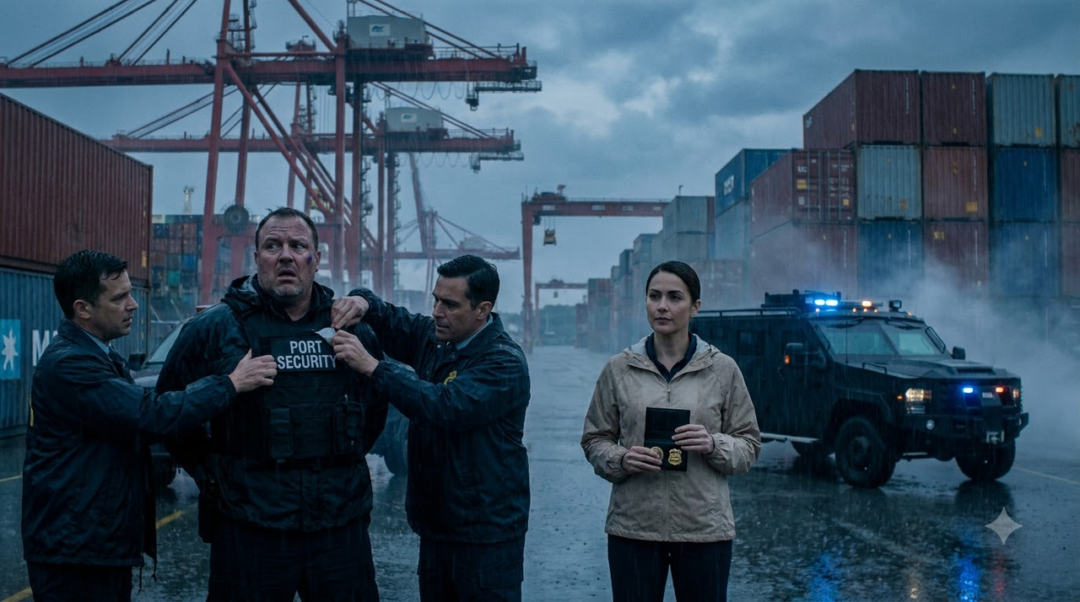
Fifty yards ahead, where the rail spur crossed Corbin Street, a heavy locomotive stood with its diesel engine idling in a deep, rhythmic chug. But standing on the tracks directly in front of the cowcatcher were four tactical officers from the Port Authority Police Department, their heavy tactical cruiser parked across the rails, its emergency strobes bathing the steel locomotive in red and blue light.
The convoy slid to a halt beside Row 42.
Tactical operators poured from the doors, moving in tight, synchronized formation with carbines raised. “PERIMETER SECURE! ROW FORTY-TWO IS LOCKED DOWN!”
Evelyn stepped out into the rain, pulling up the hood of her beige windbreaker. She walked directly toward the rear doors of Container MSK-99412-B. The forty-foot steel box was humming with the continuous, high-pitched mechanical whine of its Thermo King refrigeration compressor.
Mounted to the heavy locking rods on the rear doors was a high-security forged steel bolt seal. But as Evelyn inspected it with her flashlight, she saw that the steel seal had been carefully cut with a diamond wheel and re-joined with a thin sleeve of silver epoxy resin, designed to pass a casual visual check from twenty feet away.
“The seal has been tampered with,” Evelyn noted, pointing to the seam with her pen. “Commander Brennan, bring the pneumatic bolt cutters.”
A tactical operator stepped forward with a heavy hydraulic cutting tool. With a sharp, hydraulic hiss, the hardened jaws closed over the locking rod.
SNAP!
The steel bolt sheared with a loud, metallic crack that echoed between the container walls. The operator yanked the long vertical locking levers, pulling the heavy, rubber-gasketed doors outward.
A blast of sub-zero, nitrogen-chilled air billowed out of the dark interior, carrying a sharp, chemical odor that smelled of formaldehyde, synthetic plastics, and industrial refrigerant.
Special Agent Vance clicked on a high-output tactical floodlight, shining the beam into the interior of the forty-foot container.
The front half of the container was packed with legitimate cargo: hundreds of wooden crates stamped with labels indicating frozen Argentine blueberries. But behind the wooden pallets, hidden behind a false bulkhead of foil-faced insulation board, the real cargo was stacked in heavy, matte-black military flight cases.
Vance climbed into the container, his boots clicking on the ribbed aluminum floorboards. He popped the latches of the nearest black case, lifting the reinforced lid.
Inside, resting in laser-cut high-density foam, were sixteen brand-new, military-grade thermal imaging sniper optics and tactical satellite communication arrays stamped with unredacted Department of Defense inventory numbers.
Vance looked back at Evelyn, his jaw slackened in astonishment. “These are ITAR-controlled military export optics. Stolen from the naval depot in Earle two weeks ago. There’s enough tactical hardware in this box to equip a private mercenary battalion.”
Evelyn climbed onto the rear bumper, her eyes scanning the serial numbers. But as her gaze traveled to the refrigeration unit’s electronic control housing at the far end of the container, her expression suddenly tightened.
Mounted above the evaporator fan was a small, black plastic electronic box with an illuminated digital countdown timer glowing in bright amber LEDs:
00:14:22… 00:14:21… 00:14:20…
Wired to the digital timer were two pressurized canisters of liquid anhydrous ammonia connected to the primary blower duct.
“David! Out of the container! Now!” Evelyn commanded, her voice ringing out with sharp, urgent clarity. “The refrigeration unit is rigged with an automated toxic vapor purge! If that timer reaches zero, it will vent three hundred pounds of liquid ammonia across the entire terminal yard!”