The Snapped Port Lanyard And The Inspector General At Gate Four
CHAPTER 4: THE INTERCEPT AT THE RAIL SPUR
The word “ammonia” hit the tactical team like an artillery shell.
Anhydrous ammonia, when released under high pressure into humid coastal air, forms a dense, suffocating chemical cloud capable of destroying human lung tissue in seconds. In a confined container canyon like Yard 14, three hundred pounds of the pressurized gas would create an instant lethal zone half a mile wide, drifting directly toward the residential neighborhoods of eastern Newark.
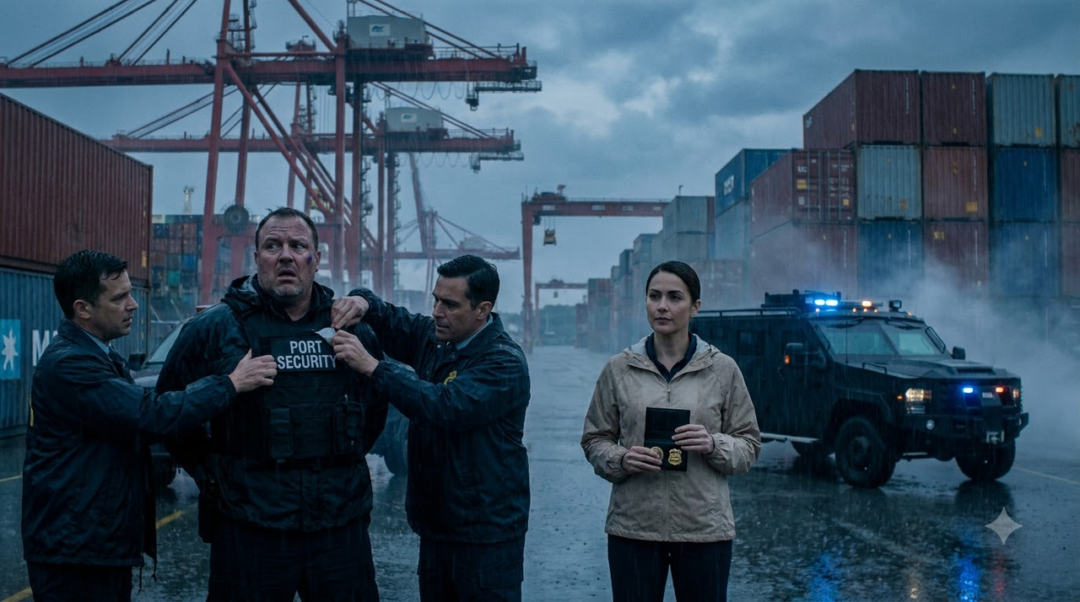
“HAZMAT CODE RED! CLEAR THE CORRIDOR!” Commander Thomas Brennan roared into his command radio, his voice echoing over the drone of the refrigeration units. “ALL UNITS FALL BACK TO PERIMETER POST FOUR! CALL THE REGIONAL BOMB SQUAD AND THE NEWARK FIRE DEPARTMENT CBRN UNIT IMMEDIATELY!”
Tactical operators began moving backward in disciplined formation, their boots splashing through the puddles as they fell back toward the Suburbans.
“Evelyn, move!” Special Agent David Vance yelled, grabbing her arm to pull her toward the vehicle.
“Wait!” Evelyn pulled her arm free, her gray eyes locked onto the amber countdown timer blinking through the open container doors:
00:12:45… 00:12:44… 00:12:43…
She jumped onto the ribbed aluminum floor of the container, landing in a crouch beside the black Pelican cases. Her analytical mind—trained across fifteen years of maritime logistics and explosive hazard mitigation—was working with cold, absolute clarity.
“It’s not an explosive detonator, David!” Evelyn called out over the hum of the compressor. “Look at the wiring harness! It’s tied directly to the Thermo King’s defrost cycle solenoid! The syndicate didn’t design this to explode on the dock; it was designed to vent in transit along the rail line if the train was intercepted by customs!”
Evelyn pulled a multi-tool from the pocket of her windbreaker, unfolding a pair of hardened steel wire strippers. She stepped toward the rear bulkhead, balancing on the wet aluminum floorboards.
Outside the container, the screech of steel wheels on wet rails signaled a sudden, violent development.
Fifty yards down the track, the locomotive’s diesel engine roared into high throttle, venting thick black plumes of exhaust into the gray rain. The heavy steel train cars began to jerk forward with a series of deafening, echoing clangs: CLANG-CLANG-CLANG!
“The train is moving!” Brennan shouted through his radio. “Someone overrode the air brake line from the switching tower!”
Across the wet ballast stone of the rail bed, a man in a yellow rain poncho was running frantically along the tracks, carrying a heavy iron coupling wrench. It was Viktor Kroll—the forty-five-year-old Terminal Operations Director for Titan Terminal Services—attempting to uncouple the three suspect container cars from the rest of the train so they could be pulled out onto the main line before the federal blockade could seal the switches.
“Stop right there! Federal agents! Drop the tool!”
Commander Brennan sprinted across the tracks, his service weapon drawn, cutting off Kroll’s escape route. Two tactical operators tackled Kroll from the side, slamming him into the wet crushed stone of the rail bed. The iron coupling wrench flew from his grip, clattering across the steel rails as Kroll was pinned face-down in the ballast.
Inside the container, Evelyn stood before the humming refrigeration unit. Her hands were perfectly steady as she traced the blue and white wires leading from the digital timer to the pneumatic release valves on the ammonia canisters.
00:08:12… 00:08:11… 00:08:10…
“The blue line feeds the twelve-volt power supply from the auxiliary battery,” Evelyn murmured to herself, her breath frosting in the chilled air. “The white line is the ground. But the green line is a fail-closed deadman loop tied to the temperature sensor.”
Evelyn checked the second pneumatic relay with her fingertip. The brass valve stem was under high pressure, vibrating with the pulse of the liquid refrigerant. She knew that if the ground wire was severed while the solenoid was energized, the valve would fail in the open position, dumping the entire reserve into the intake duct.
She carefully wedged her ceramic alignment tool beneath the relay contacts, isolating the circuit before applying the cutting jaws to the blue primary lead.
With a single, decisive squeeze of her steel pliers, Evelyn clipped the blue power feed cleanly in two.
SNIP.
The amber digital timer died instantly. The green LED on the release valve flickered, turned amber for a fraction of a second, and went black. The high-pitched mechanical hissing within the copper lines subsided into silence, the pressure gauge stabilizing at twenty-two pounds per square inch. The pneumatic hissing inside the solenoid subsided into silence, leaving only the steady, harmless hum of the electric fan.
Evelyn let out a long, slow breath, wiping a bead of cold sweat from her forehead with the back of her sleeve. She stepped out onto the rear bumper of the container and dropped lightly onto the wet asphalt.
Special Agent Vance rushed forward, his face pale with relief. “Evelyn… that was eight minutes from disaster.”
“It wasn’t eight minutes, David,” Evelyn said, closing the multi-tool and slipping it back into her pocket as she looked over at the handcuffed terminal director being dragged toward the cruisers. “It was twenty seconds. Now let’s go up to the terminal tower and find out who signed the master contract.”