The Torqued Home Battery And The Evacuated Suburban Tow Truck
CHAPTER 4: THE CORDON OF FALCON CREST
Within four minutes, the peaceful residential serenity of Falcon Crest Reserve was completely obliterated by the wailing warble of approaching sirens.
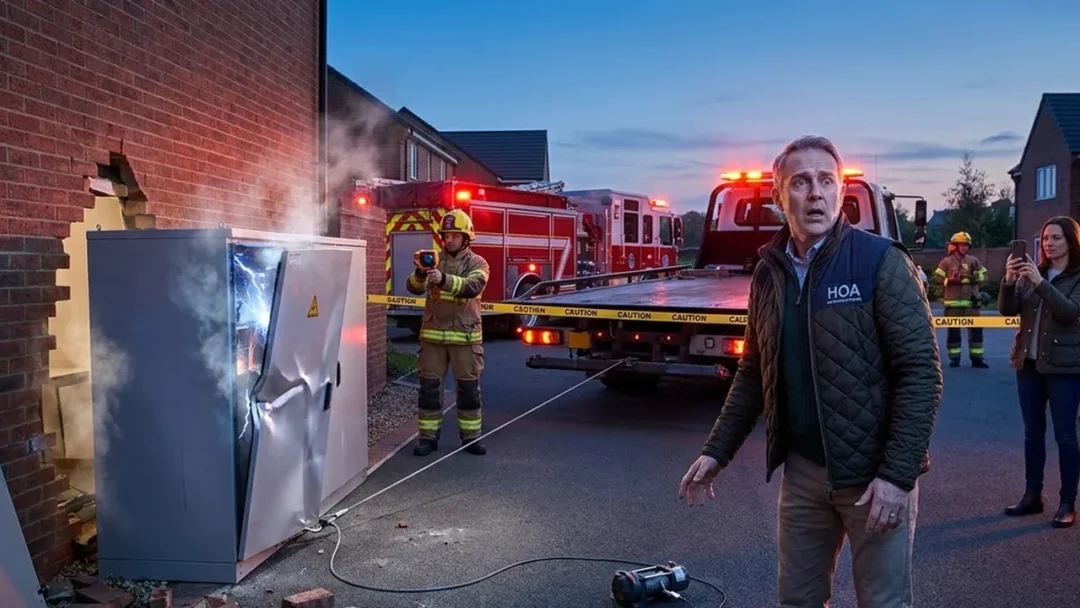
Scottsdale Fire Department Engines Three and Seven roared into the subdivision, followed closely by the massive heavy-rescue rig of Hazmat Tender One. Three Maricopa County Sheriff cruisers and two Scottsdale Police patrol sedans screeched to a halt at the mouth of the cul-de-sac, their red, blue, and amber strobe bars painting the desert stucco in violent flashes of emergency light.
Deputy Derek Ramos jumped from the lead sheriff’s cruiser, his tactical vest rustling as he unrolled a heavy fifty-yard spool of yellow vinyl tape marked: DANGER — HAZARDOUS MATERIALS EXCLUSION ZONE — DO NOT ENTER.
“Lock down the street!” Deputy Ramos shouted to his fellow officers. “No vehicles in or out! Evacuate houses one-twelve, one-fourteen, and one-sixteen immediately! Move all residents toward the community clubhouse on Desert Peak Parkway!”
Firefighters in full structural turnout gear, wearing positive-pressure self-contained breathing apparatus masks with black carbon-fiber air cylinders on their backs, deployed with military speed. They dragged heavy four-inch supply lines from the nearest municipal hydrant at the corner, connecting them to an unmanned, portable ground monitor—a heavy brass deluge gun that could spray eight hundred gallons of water per minute without exposing personnel to toxic fumes.
The ground monitor was positioned fifty feet from Sean’s driveway, aimed directly at the venting Powerwall. With a deafening roar of pressurized water, a massive curtain of cool water enveloped the cabinet, knocking down the toxic vapor cloud and cooling the surrounding concrete to prevent the fire from spreading to the garage structure.
Warren Vance huddled near the rear bumper of a police cruiser two hundred feet down the street, coughing on the dry desert dust, watching his beloved Ford F-550 tow truck sit trapped squarely in the center of the exclusion zone. The wrecker’s diesel engine was still rumbling at idle, its yellow warning lights flashing uselessly, completely enveloped in the water spray and drifting mist.
Warren saw Deputy Ramos walking past and grabbed the officer’s sleeve. “Deputy! My truck! My wrecker is still running in Mitchell’s driveway! Let me run up there and drive it out! It’s an eighty-thousand-dollar custom rig!”
Deputy Ramos stopped, turned slowly, and looked at Warren with cold, incredulous eyes. He reached down and slapped Warren’s hand away from his uniform.
“Are you out of your mind?” Ramos said, his voice hard as tempered steel. “Nothing enters that exclusion zone, and nothing leaves it. Your truck is currently sitting directly inside an active Class Nine hazardous chemical incident that you personally created.”
“I didn’t create anything!” Warren shouted, his voice cracking with hysteria. “I’m an officer of the HOA! Mitchell’s battery was illegal! I have the legal right to tow unauthorized property!”
Deputy Ramos stepped in close, towering over the shorter tow-truck operator. “Mr. Vance, I just spoke with Chief Gallagher and the city building inspector. That battery was fully permitted and legally protected under Arizona law. You backed a commercial wrecker onto private property and used a high-capacity winch to violently rip an energized four-hundred-volt utility installation from a residential structure. That isn’t towing. That is felony criminal damage, reckless endangerment, and illegal release of hazardous materials.”
Ramos unclipped his radio from his belt, keyed the mic, and requested a certified crime-scene investigator to document the scene. Then he looked down at Warren’s right hand, which was still gripping the wireless winch remote.
“Hand me that remote control, Mr. Vance,” Ramos commanded, his tone leaving zero room for argument. “And give me the keys to that truck.”
The geography of Falcon Crest Reserve posed significant tactical challenges for a hazardous materials incident. Situated on a hillside cul-de-sac with only one narrow two-lane access road connecting to the main arterial parkway, an uncontrolled chemical explosion or catastrophic residential structure fire could easily trap dozens of families in their homes. Fire hydrants in the subdivision were spaced three hundred feet apart, fed by an eight-inch municipal main that required careful pressure balancing by the pump operators to ensure adequate flow to the master deluge monitor without collapsing pressure in the adjacent neighborhood lines.
Firefighters from Engine Three advanced a secondary backup line, charging a two-and-a-half-inch blitz line equipped with a specialized fog nozzle to establish an atmospheric water curtain between the burning battery and Sean’s garage roof. The high-pressure mist knocked down the airborne toxic gases, dissolving the water-soluble chemical vapors and funneling the runoff into an isolated containment basin created by deploying sand-filled environmental berms across the lower driveway apron. Neighbors peering through the safety tape could see the intense, methodical discipline of the response—a stark contrast to the reckless, amateurish bullying that had initiated the crisis.