The Torqued Home Battery And The Evacuated Suburban Tow Truck
CHAPTER 2: THE FRACTURE OF THE MASONRY ANCHORS
“Warren, listen to me very carefully!” Sean warned, his voice ringing with absolute, razor-sharp urgency. “You are about to breach a high-voltage lithium battery under active load! That cabinet contains four hundred volts of direct current and seventy pounds of electrolyte solution! If you deform that casing, you will crush the internal separator membranes and cause an uncontrollable thermal event!”
Warren didn’t even pause. His jaw set in stubborn defiance, his eyes gleaming with the thrill of physical intimidation. In his mind, Sean was just another soft corporate desk jockey hiding behind technical jargon. Warren had towed two thousand cars, pulled overturned cement mixers out of highway ditches, and ripped steel security gates off commercial compounds. To him, metal was metal, and force was the only currency that counted.
“Watch how fast your fancy battery pops off this brick!” Warren shouted over the idling diesel engine.
He pressed the toggle switch on the wireless remote.
The hydraulic pump on the F-550 engaged with a sharp mechanical whine. The planetary winch drum began to turn, wrapping the half-inch braided steel cable tightly around the spool. The slack disappeared in two seconds. The heavy alloy chain bit into the brushed-aluminum chassis of the Powerwall with a sickening, metallic screech of crumpling metal.
The four-hundred-volt cabinet flexed under twelve thousand pounds of raw hydraulic tensile force.
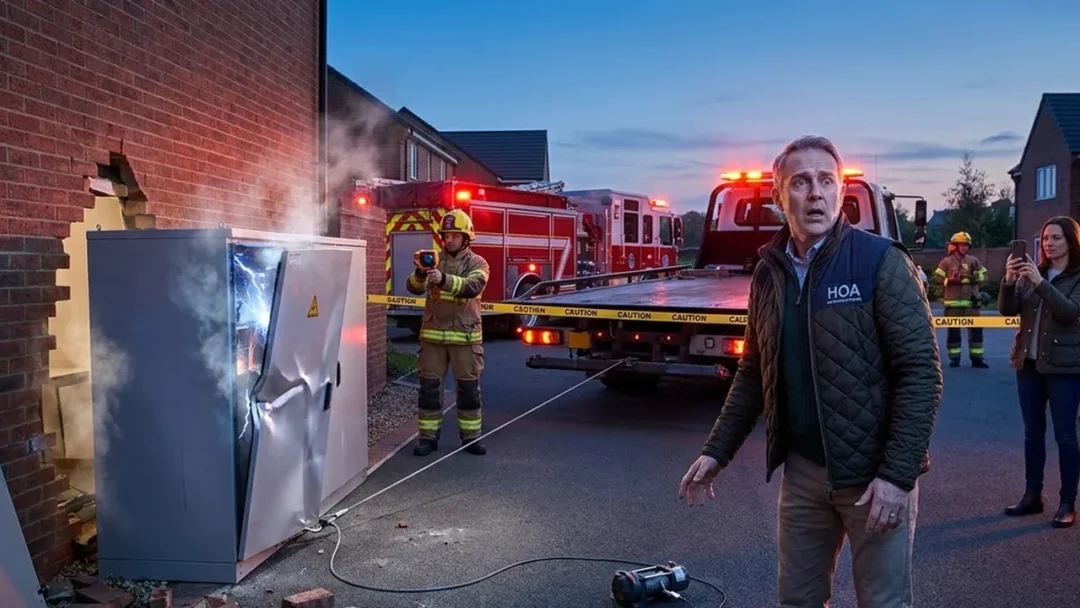
The four heavy three-quarter-inch steel Red Head sleeve anchors, driven four inches deep into the structural brick and mortar of the garage wall, began to groan. Fine plumes of red brick dust puffed out from around the mounting flanges as the shear load exceeded the compressive strength of the masonry.
“Warren, stop the winch!” Sean yelled, stepping back another five feet while keeping his camera locked on the machine. “Hit the emergency stop!”
Instead of releasing the button, Warren leaned forward, grinning as he watched the brickwork crack. “It’s moving! See that? Clean tear! You should’ve hired a real contractor, Mitchell!”
With an explosive, concussive CRACK that sounded like a twelve-gauge shotgun discharging inside a concrete tunnel, the four steel mounting anchors sheared out of the wall simultaneously.
A massive shower of pulverized red brick, mortar chunks, and shattered stucco erupted across the driveway. But the battery cabinet did not come away cleanly.
As the heavy unit was violently wrenched forward, the rigid two-inch schedule-eighty electrical conduit connected to the base was snapped in half. Two thick, four-gauge stranded copper conductors, carrying live four-hundred-volt direct current from the primary rooftop solar array, were violently severed.
A blinding, brilliant flash of blue-white electrical arcing detonated across the driveway apron, casting sharp, unnatural shadows against the midday sun. The ozone-rich crackle of five thousand degrees of electrical plasma shattered the air, accompanied by a deafening bang that rattled the neighborhood windows.
The Powerwall slammed down onto the exposed aggregate driveway with a brutal, hollow thud.
The internal aluminum chassis, crushed by the cinched steel chain and warped by the violent landing, buckled diagonally. Inside the cabinet, the high-density battery module racks compressed, driving the sharp edge of an internal steel mounting bracket straight through the protective outer foil of cell pack number three.
A tiny, high-pitched mechanical chirp sounded from the diagnostic circuit, followed instantly by the system’s warning LEDs switching from steady green to an angry, flashing crimson.
Then came the vapor.
From the crumpled corner seam of the silver cabinet, a thick, pressurized jet of brilliant white chemical vapor hissed violently into the hot Arizona sky, swirling around the tires of Warren’s idling tow truck with the smell of scorched plastic, acetone, and burning metal.
Sean looked at the venting vapor, his blood turning to ice. “You pierced a live cell. It’s in thermal runaway.”
The mechanical forces involved in planetary winch extraction are brutally deceptive. Engineered to pull fully loaded cement mixers out of Arizona washes, a twelve-thousand-pound commercial recovery winch generates enough torque to snap structural steel beams and shear concrete foundations in half. The heavy alloy grab hook had bitten directly into the Powerwall’s thin outer heat sink, crushing the micro-channel liquid cooling lines that circulated non-flammable glycol through the cell packs. As the winch cable tensioned, the internal glycol lines ruptured, draining the coolant into the lower casing and depriving the cells of their primary heat-dissipation medium.
The electrical physics of direct current add another layer of extreme hazard. Unlike alternating current, which cycles through zero voltage sixty times per second and allows an electrical arc to self-extinguish, four hundred volts of continuous direct current forms a sustained, plasma-torch arc that will burn through steel, concrete, and copper until the physical air gap exceeds several inches or the circuit is mechanically broken. When the heavy sleeve anchors tore free from the brick wall, the sudden mechanical shockwave caused microscopic internal shorts between the high-nickel cathode sheets and the graphite anodes inside the battery cells. The internal separator membranes, measured in microns, melted within milliseconds, initiating an uncontrollable chain reaction of chemical decomposition.