The Torqued Home Battery And The Evacuated Suburban Tow Truck
CHAPTER 5: THE EVIDENCE IN THE EXCLUSION ZONE
Warren’s fingers clenched tightly around the yellow plastic remote control. His face flushed bright crimson, veins bulging along his temples. “No! This is my personal commercial equipment! You can’t seize my property without a warrant! I have constitutional rights!”
Deputy Ramos didn’t flinch. He placed his right hand firmly on the grip of his holstered Glock pistol, his stance shifting into a tactical interview posture. His hazel eyes were cold and unyielding.
“Warren Vance, under Arizona Revised Statutes section thirteen-thirty-nine-zero-five, I am securing instrumentalities used in the commission of an active felony that poses an immediate threat to public safety. You will hand me that wireless remote and your key ring right now, or I will take you to the asphalt and place you under arrest for felony obstruction of justice and resisting a lawful command.”
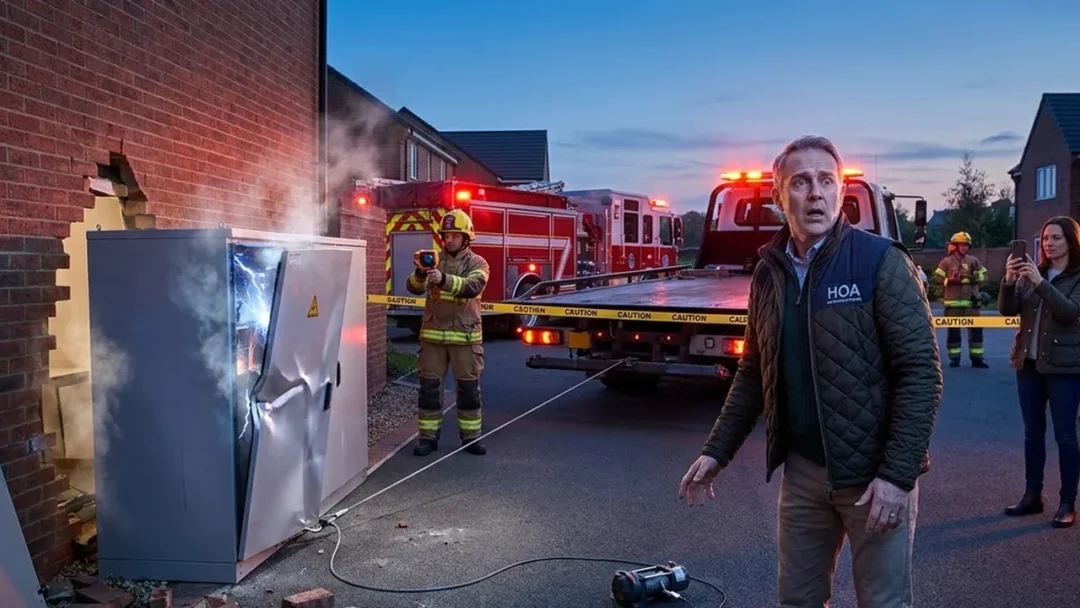
Warren looked around frantically. Neighbors from up and down Falcon Crest were gathered behind the yellow police tape across the street, their cell phones held high, recording his public humiliation. Standing among them was Dr. Alan Keller, the president of the homeowners association, who was looking at Warren with an expression of sheer horror and revulsion.
Slowly, his hands shaking with humiliated rage, Warren uncurled his fingers and handed the yellow winch remote to Deputy Ramos. He reached into his pocket, pulled out his heavy brass key ring containing the transponder keys for the F-550 wrecker, and dropped them into Ramos’s outstretched palm.
Deputy Ramos did not pocket the items. He turned to a responding crime-scene technician who had just stepped up with a hard aluminum evidence case. The technician opened a heavy, transparent polyethylene evidence bag, slipped the winch remote and keys inside, sealed the tamper-evident adhesive strip, and labeled it with a broad black marker: EXHIBIT A — INSTRUMENTALITY OF EXPLOSIVE BREACH.
Brenda Miller walked over, holding an open digital tablet showing the Scottsdale municipal GIS records and the subdivision’s original legal charter.
“Chief Gallagher, Deputy Ramos,” Brenda said, her voice clear and carrying across the street. “I’ve just completed an expedited verification of the property records. Mr. Mitchell’s energy storage installation was fully permitted under permit number E-9921, issued on August fourth. It was signed off by structural and electrical inspectors.”
Brenda scrolled down the screen, her expression tightening into disgust. “Furthermore, on January fifteenth of this year, the City of Scottsdale sent a certified statutory notice to the Falcon Crest HOA Board of Directors, explicitly informing them that under Arizona Revised Statute thirty-three-four-thirty-nine, any homeowner association covenant, rule, or guideline prohibiting the installation or use of a solar energy device or energy storage system is void and unenforceable as a matter of public policy.”
Brenda turned and stared directly into Warren Vance’s pale face. “You signed the certified mail receipt for that notice yourself, Mr. Vance. You knew this system was legally protected. You chose to ignore state law because you wanted to prove you were the boss of this neighborhood.”
Warren swallowed hard, his mouth opening and closing like a landed fish, unable to formulate a single coherent sentence.
Over on Sean’s driveway, under the deluge of the unmanned water monitor, the violently venting Powerwall finally began to subside. The internal thermal runaway had consumed the compromised cell module, but the eighty-gallon-per-minute water curtain had successfully absorbed the heat, preventing the adjacent modules from reaching auto-ignition temperature. The silver cabinet sat blackened and scorched, surrounded by a thick slurry of extinguished foam, pulverized red brick, and severed copper cabling.
In criminal jurisprudence, the transition from a civil dispute to a felony offense often hinges on the statutory element of criminal recklessness—the conscious disregard of a substantial and unjustifiable risk. As Brenda Miller reviewed the municipal registry on her digital tablet, the legal culpability of Warren Vance became inescapable. The certified warning letter sent by the City of Scottsdale in January had been unambiguous: it cited Arizona Revised Statutes section thirty-three-four-thirty-nine, subsection C, which explicitly establishes that any person who willfully interferes with or damages a permitted residential energy storage system is liable for statutory damages and civil penalties, without prejudice to criminal charges.
The evidence bag containing Warren’s wireless winch remote and truck keys was photographed from multiple angles by the crime-scene technician, who noted the grease stains and fingerprints matching Warren’s hands. The remote itself was an industrial Lodar commercial transmitter, serial-numbered and hardwired to the F-550’s auxiliary hydraulic solenoid. In a court of law, that remote was the literal smoking gun—the physical instrument used to deliver twelve thousand pounds of destructive force against an energized public utility interconnection. The audio and video recordings captured by Sean Mitchell provided a chronological, frame-by-frame ledger that no defense attorney could contradict.