The Torqued Home Battery And The Evacuated Suburban Tow Truck
CHAPTER 3: THE INFRARED SIGNATURE ACROSS THE STREET
Across the quiet cul-de-sac of Falcon Crest, parked in the shade of a mature mesquite tree, sat a pristine white Ford Expedition bearing the gold seal of the City of Scottsdale Fire Department and the bold red lettering: HAZARDOUS MATERIALS RESPONSE UNIT.
The vehicle’s passenger door flew open. Battalion Chief Keith Gallagher stepped onto the asphalt, adjusting his heavy command radio harness. At fifty-five, Gallagher was a thirty-year veteran of the fire service, a master hazmat incident commander, and one of the state’s leading technical specialists in lithium-ion battery fire dynamics. Standing beside him was Brenda Miller, the chief zoning and building compliance officer for the City of Scottsdale. They had been parked across the street for ten minutes, having arrived early for Sean Mitchell’s scheduled two-o’clock final municipal sign-off inspection.
Gallagher had witnessed the entire confrontation from the truck cab. The moment the electrical arc detonated and the white chemical vapor erupted, his training overrode any procedural delay.
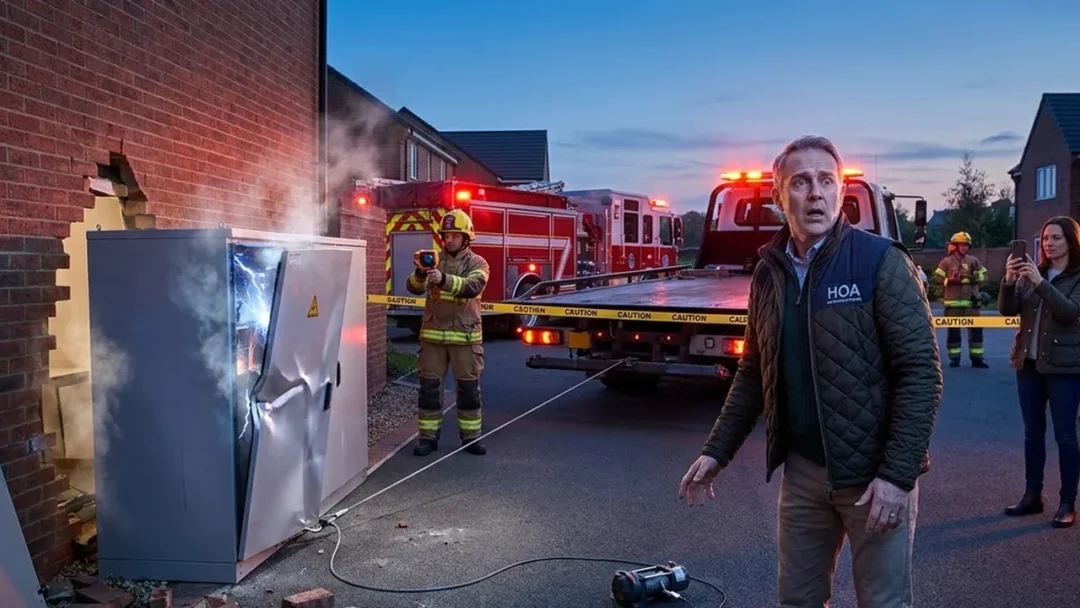
He raised a high-resolution FLIR K55 thermal imaging camera to his eyes, focusing the infrared sensor directly on the silver cabinet resting on Sean’s driveway.
Through the digital viewfinder, the thermal profile was terrifying.
The ambient concrete was reading ninety-eight degrees. But in the lower left corner of the crumpled Powerwall, a bright purple hotspot was blooming into neon orange. The digital temperature readout on the display climbed with breathless velocity: two hundred and ten degrees… three hundred and forty degrees… four hundred and eighty degrees Fahrenheit.
“Holy Mother of God,” Gallagher muttered through clenched teeth.
He grabbed his radio microphone, clicked the side transmit lever, and spoke in the calm, forceful cadence of a veteran commander declaring an active disaster.
“Scottsdale Dispatch, this is Battalion Chief Gallagher on scene at 114 Falcon Crest. Transmit a Code Red Hazardous Materials Commercial Alert. We have an active, uncontained thermal runaway event in an energized residential high-capacity lithium battery bank, caused by mechanical puncture and high-voltage arc fault. I need two structural engines, Hazmat Tender One, Scottsdale Police for street closure, and an emergency response notification to the environmental air quality board. Clear all civilian radio traffic on Channel One.”
Gallagher clicked off his radio and sprinted across the street, his heavy tactical boots pounding the asphalt, his voice roaring with absolute command.
“Evacuate!” Gallagher bellowed, waving his arms in aggressive sweeping arcs. “Clear the area! Get out of that driveway right now! Three hundred feet minimum! Move, move, move!”
Warren Vance stood frozen beside his tow truck, blinking stupidly as the dense white vapor swirled around his shins. He looked at the screaming fire chief, then down at the hissing silver box on the ground. “Hey, hold on, Chief! This guy put an illegal box on his wall! I was just impounding it for the HOA! It’s a civil violation!”
Gallagher reached Warren in three strides, grabbed the larger man by the front of his canvas work shirt, and shoved him violently backward toward the middle of the street.
“Shut your mouth and run!” Gallagher shouted directly into Warren’s face, his eyes blazing with fury. “That isn’t smoke, you complete idiot! That is hydrofluoric acid gas and vaporized lithium electrolyte! If you breathe three lungfuls of that cloud, your respiratory tract will dissolve! That box is about to explode at over a thousand degrees! Get your ass down the street!”
Warren’s arrogant smirk collapsed into absolute, paralyzed terror. He stumbled backward, clutching his throat, turning and running down the asphalt as fast as his heavy cowboy boots would carry him.
Behind them, the hissing sound from the battery shifted into a low, terrifying growl—the rhythmic, pulsing acoustic resonance of individual lithium cells rupturing their pressure caps in rapid, cascading succession.
In modern firefighting doctrine, lithium-ion battery fires are classified among the most hazardous industrial emergencies encountered in residential settings. Unlike conventional timber or gasoline fires, an active thermal runaway generates its own internal oxygen through the chemical breakdown of the lithium metal oxide cathodes. Smothering agents, chemical dry powders, and conventional foam blankets are largely ineffective because the reaction does not rely on atmospheric oxygen to sustain combustion. The only viable tactical response is continuous, high-volume water cooling applied directly to the battery chassis to absorb the thermal energy faster than the runaway reaction can produce it.
Battalion Chief Keith Gallagher had spent decades teaching specialized hazmat modules at the Arizona State Fire Academy. He had investigated multi-vehicle battery fires on Interstate 10 and industrial energy storage facility failures in the East Valley. He knew that the white vapor billowing from the damaged cabinet was not benign smoke; it was a lethal atmospheric cocktail containing hydrogen fluoride, carbon monoxide, phosphorus pentafluoride, and volatile organic hydrocarbons. In contact with moisture—including human sweat or the mucous membranes of the lungs—hydrogen fluoride converts instantly into hydrofluoric acid, penetrating deep into tissue and attacking bone calcium. Every second Warren Vance spent inhaling that drifting plume was a roll of the dice with permanent respiratory damage.