The Turquoise Pool On The Terrace And The Federal Robe
CHAPTER 6: THE SLUICE GATE
With the wind howling at fifty miles per hour, Malcolm shoved past Carl Vance and raced into the rooftop mechanical pump room. The subterranean vault was deafening, the air thick with ozone, hydraulic oil, and the stench of burning electric motors. A six-inch torrent of chlorinated water was already gushing through the ceiling conduit pipes, spraying across high-voltage circuit breakers and cascading down the steel service ladder.
“Where is the master gravity dump valve?” Malcolm demanded, grabbing the terrified building engineer by his soaked collar.
“The yellow wheel! In the rear sump pit!” the engineer stammered, pointing a shaking flashlight toward a cast-iron valve wheel mounted against the reinforced concrete bulkhead. “The automatic electrical actuator failed five minutes ago! The solenoid is burned out! You have to turn it by hand, but the water pressure is over two thousand pounds!”
Malcolm waded through knee-deep water across the flooded sump pit. His muscular hands gripped the heavy cast-iron wheel, his knuckles whitening as he exerted every ounce of his athletic strength. The iron threads were rusted and locked with calcified corrosion, resisting with a screech of tortured metal, but Malcolm locked his legs against the concrete curb, bowed his back, and wrenched the valve clockwise with the full weight of his body.
With a deep, shuddering groan that reverberated through the building’s steel skeleton, the master eight-inch gravity sluice gate swung open.
A deafening acoustic roar erupted from the pipes as eighty thousand gallons of pool water were sucked down through the reinforced municipal drainage riser, bypassing the cracked structural slab and rushing safely into the city’s stormwater tunnels below Brickell Avenue. Outside on the deck, the swirling vortex in the deep end dragged the surface down rapidly, relieving hundreds of tons of hydraulic pressure from the compromised concrete transfer beam just as a second tendon snapped with a sound like a rifle shot.
Ten minutes later, Malcolm walked out onto the rain-swept terrace. The pool was empty, its blue-tiled floor exposed to the downpour, the jagged six-inch fissure clearly visible running through the center drain. The immediate threat of structural collapse had been averted by seconds.
Down on the lobby mezzanine, sixty Miami-Dade police officers and city building inspectors had swarmed the building, safely evacuating the top five floors while structural shoring crews unloaded heavy steel hydraulic jacks from flatbed trucks.
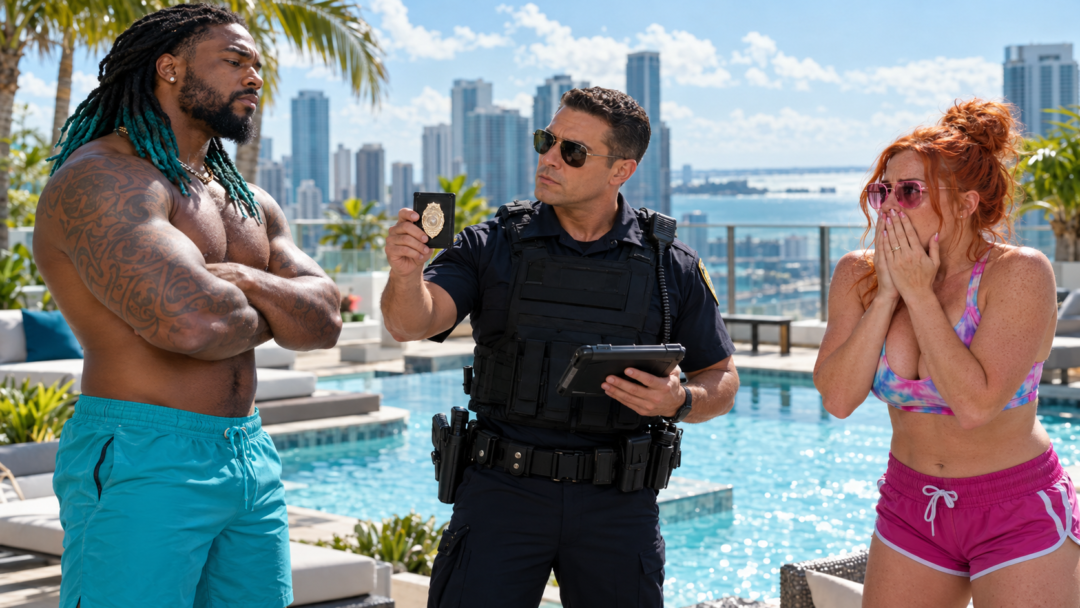
In the circular driveway outside, Carl Vance and Megan had been cornered by Officer Morales and two marked tactical units as they attempted to load four aluminum travel trunks into a chartered limousine.
“Step away from the vehicle, Mr. Vance,” Officer Morales commanded, his service weapon unholstered at low ready.
Megan was weeping hysterically, her pink sunglasses broken on the asphalt, her designer slides lost in the gutters. “Daddy… do something! Call the mayor! Call the governor! We have millions in escrow!”
“The mayor’s office signed off on the federal emergency warrant forty minutes ago, Miss Vance,” Malcolm Price said, walking down the sweeping grand staircase of the lobby in dry clothes, flanked by United States Marshals.
The marshals moved in with practiced speed. The cold steel ratchets of handcuffs clicked shut around Carl Vance’s wrists, then around Megan’s. The four aluminum travel trunks were popped open on the hood of the limousine, revealing stacked bundles of one-hundred-dollar bills, negotiable bearer bonds, and forged deed transfers totaling twenty-eight million dollars.
Malcolm looked down at Carl Vance, who hung his head in broken, ruined silence.
“You thought you could build an empire on stolen money and rotten concrete, Vance,” Malcolm said softly, his voice carrying the finality of an iron gavel. “In this city, the law doesn’t bend for developers who put a price tag on human life.”
Inside the pump room, the water level was rising toward the 480-volt electrical switchgear panels, sending bright blue sparks arcing through the humid gloom with explosive pops. Malcolm threw his full body weight against the cast-iron valve wheel, feeling the rusted gears resist with grinding friction that tore through the palms of his hands. He took a deep breath, plant-locking his heels against the concrete curb, and channeled every ounce of athletic power into a final, violent heave.
The valve wheel broke free with a deafening metallic screech. The brass stem spun three complete revolutions under the immense gravitational suction of the drainage riser. Through the heavy viewing glass on the discharge pipe, a massive, swirling torrent of dark water rushed into the municipal stormwater conduit, roaring with the power of a subterranean waterfall.
On the roof terrace above, the whirlpool in the deep end sucked eighty thousand gallons of water down into the drain within five minutes, stripping the compromised cantilever of over six hundred thousand pounds of dynamic hydraulic mass. The structural groaning ceased instantly, replaced only by the steady drum of rain against the empty fiberglass pool floor.
When Malcolm emerged back into the elevator lobby, dripping wet but completely composed, he was met by Captain Alvarez of the Miami Fire Rescue Hazardous Materials Division. Alvarez looked at the ultrasonic structural sensors in his hand and blew out a long, ragged breath.
“Your Honor,” Alvarez said, wiping rain from his face with a heavy glove. “If you hadn’t opened that gravity gate when you did, that entire sixty-foot cantilever would have sheared off into Brickell Avenue within fifteen minutes. You just saved hundreds of lives in this tower.”