The Record He Asked Them To Read Before The Morning Changed
Part I — The Man in the Denim Jacket
The judge pointed at the old man as if pointing could hold him upright.
“Those medals,” he said, “do not answer the question.”
The room went still in the careful way public rooms go still when everyone wants to watch but no one wants to be caught watching. A woman in the second row leaned toward her husband. A young bailiff near the door pressed his lips together, fighting a smile.
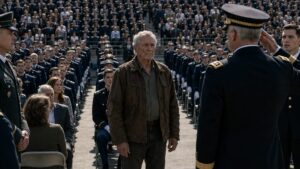
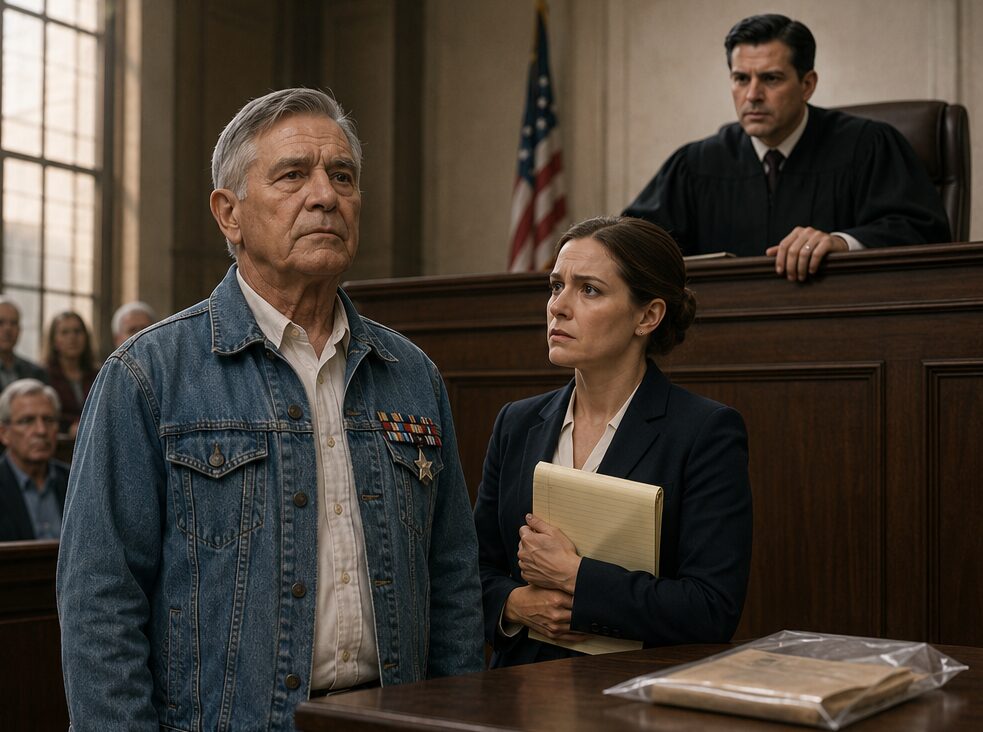
John Hayes stood below the bench in a faded denim jacket, white shirt buttoned to the throat, gray hair combed back with water. His hands hung at his sides. On his chest, pinned crookedly but with care, were four rows of military ribbons and two old medals.
One of the medals had a broken clasp.
It tilted slightly every time he breathed.
“Mr. Hayes,” Judge Timothy Walker said, voice clipped and cold, “I asked whether you understood the charge against you.”
John looked up.
His eyes were pale, not cloudy. Tired, but not empty.
“I heard you,” he said.
The bailiff’s smile disappeared.
Beside John, his public defender, Anna Bennett, lowered her legal pad just enough to whisper, “Please let me answer for you.”
John did not look at her.
The prosecutor stood with one hand on a folder. He had already said the facts twice, as if repetition might make the old man smaller.
Two nights earlier, John Hayes had entered the old county records annex through a rear maintenance door. The building had been closed for years. It was scheduled for demolition at the end of the week. According to the county, he had broken a lock, forced open an archive room, and removed a sealed packet before sheriff’s deputies found him in the hallway with dust on his jacket and a file box in his arms.
He had not run.
He had not resisted.
He had only said, “You’re late.”
Now the packet sat in an evidence bag on the prosecutor’s table.
John had not taken his eyes off it since the hearing began.
Judge Walker leaned forward. He was a tall man even seated, his robe neat, his tie perfectly centered beneath it. People said he ran veterans court with discipline. He gave second chances, but he hated excuses. He believed respect for service required order, not sentiment.
“Do you understand,” the judge said, “that this is a criminal matter?”
Anna touched John’s sleeve.
John’s gaze moved from the packet to the judge.
“I understand exactly what it is.”
A whisper moved through the benches behind him.
Judge Walker’s finger came down against the wood.
“Then you can begin by explaining why you broke into a county building.”
Anna stepped in quickly. “Your Honor, my client is prepared to enter a preliminary plea, but given his age and—”
“I did not break in,” John said.
Anna closed her eyes.
The judge’s jaw tightened. “The rear lock was damaged.”
“It was already damaged.”
“You entered a restricted building.”
“Yes.”
“You removed county property.”
John’s mouth pressed into a thin line.
Then he said, “I was taking back what never belonged to them.”
The gallery stirred.
Anna turned toward him, whispering sharply now. “Mr. Hayes. John. Stop talking.”
But he had already gone quiet again.
That was what unsettled Anna most. He did not ramble. He did not plead. He did not seem confused by where he was or what might happen. He spoke rarely, and when he did, each sentence landed like something he had carried for years and refused to set down cheaply.
Judge Walker noticed the medals again.
His eyes went to them, then back to John’s face.
“You served?”
John straightened slightly.
“Army medic. 3rd Evacuation Support. Marwa Province. Seventy-four to seventy-five.”
The words came without pride.
They came like coordinates.
Judge Walker did not soften. “This court sees veterans every day, Mr. Hayes. Service may be relevant to sentencing. It is not permission to ignore the law.”
John looked down at the broken clasp on the medal nearest his heart. His thumb rose and touched it once.
Not like a man showing it off.
Like a man checking whether something still hurt.
“I know what permission is,” he said.
The judge’s voice hardened. “Do not turn this hearing into a parade.”
The bailiff looked at John’s denim jacket again.
Anna heard someone in the back row whisper, “Poor thing.”
Something in John’s face changed.
Not much.
Just enough.
Anna had seen anger before. She had seen fear, shame, panic, defiance. This was none of those. It was older than anger. Colder than fear.
Judge Walker glanced at the clock.
“We will take a fifteen-minute recess. Ms. Bennett, speak with your client. When we return, I expect clarity.”
The gavel came down once.
John did not move until Anna touched his elbow.
Then he picked up his cane from beside the table, though he had not leaned on it once, and followed her out.
As he passed the prosecutor’s table, the evidence packet lay inches from his hand.
He did not reach for it.
But his fingers curled.
Part II — Box 12C
The interview room smelled of old coffee and floor cleaner.
Anna shut the door behind them and set her legal pad on the table harder than she meant to.
“John,” she said, “you are one bad sentence away from a competency evaluation. Do you understand that?”
He sat slowly, not because he was weak but because every joint seemed to negotiate separately.
“I told you. I understand.”
“Then help me help you.”
“I am.”
“No,” Anna said. “You are making yourself look like a confused old man who broke into a building because he wanted souvenirs.”
His eyes lifted.
For the first time, she saw him take offense.
Not at “broke into.”
Not at “confused.”
At “souvenirs.”
He reached into his jacket.
Anna stiffened. “Hands where I can see them.”
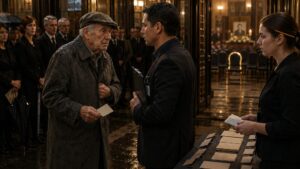
He stopped, then withdrew slowly with two fingers holding a folded scrap of paper. He placed it on the table.
No drama. No flourish.
Just a rectangle of paper softened by being carried too long.
Anna unfolded it.
There was a hand-drawn floor plan of the county records annex. Not rough. Precise. Hallways measured by paces. Doors marked by old department labels. A stairwell crossed out. A rear entrance circled.
At the bottom, written in small block letters:
BOX 12C. FIELD REPORTS. MARWA EVAC. SEALED.
Anna looked up.
John said, “Second floor archive room. North wall. Third shelf from the bottom. The box was misfiled in 1981 when county veterans records were consolidated.”
“How do you know that?”
“Because I put it there.”
Anna stared at him.
The old man in the denim jacket, who had let a judge talk down to him for ten straight minutes, tapped one finger against the map.
“The demolition crew starts Friday at six. They already moved pension files, enlistment copies, discharge forms. They left sealed field attachments behind because nobody wanted to sign for them.”
“You know the demolition schedule?”
“Yes.”
“And the lock code?”
“Changed in 2009. Then never changed again.”
“How would you know that?”
“A man named Larry used to work maintenance. He owed me a favor.”
Anna almost asked for Larry’s last name, then stopped herself. John would know it. That was the problem.
He knew too much to be confused.
Not enough to be safe.
“What is in Box 12C?” she asked.
John looked toward the door as if the answer might hear him.
“A report.”
“What kind?”
“After-action.”
“For what?”
His hand moved again to the medal with the broken clasp.
Anna waited.
For once, she did not fill the silence.
Finally he said, “An evacuation.”
“That’s all?”
“That is enough.”
“No,” Anna said, softer now. “It isn’t. Not for the judge. Not for me. Not if you want that packet admitted into anything.”
John leaned back. The fluorescent light caught the deep lines around his mouth.
“You think I want to get out of trouble.”
“Most people in your chair do.”
“I got into trouble on purpose.”
The sentence stopped her.
Outside the room, footsteps passed. Someone laughed in the hallway. The normal world, continuing badly.
Anna sat across from him.
“Why?”
John took a long breath through his nose.
“Because paper dies quieter than people.”
Anna did not know what to do with that.
So she did what she knew.
She opened her legal pad. “Give me the name attached to the report.”
He looked at her for a long moment, weighing something.
Then he said, “Stephen.”
Anna wrote it down. “Stephen what?”
John’s jaw shifted.
“Reed.”
The name did something to him.
It did not break him. He had spent too long preventing that. But it entered the room like another person.
“What was Stephen Reed to you?” Anna asked.
John’s eyes went back to the door.
“A radio operator.”
“Family?”
“No.”
“Friend?”
A pause.
“He was nineteen.”
That was not an answer.
It was worse.
Anna looked again at the map, at Box 12C, at the old man’s careful handwriting.
When she had first met John that morning, she had assumed he was another impossible case in a building full of impossible cases. Too proud to listen. Too old to frighten properly. Too attached to a past no court had time to honor.
Now she was not sure what he was.
But she knew he was not lost.
“John,” she said, “if I ask the court to examine the packet, the prosecutor will fight it. The judge may reject it. If there’s classified or restricted material—”
“It isn’t classified.”
“How do you know?”
“Because they buried it under shame instead.”
Anna’s pen stopped moving.
John looked at her, and for the first time his voice lowered into something almost pleading.
“Get it opened.”
“Why now?”
His hand trembled once on the table.
He made it still.
“Because Friday comes whether I’m ready or not.”
Part III — The Name in the File
The prosecutor did not want to release the packet.
Judge Walker did not want to widen the hearing.
Anna expected both.
What she did not expect was John standing before the bench and reciting the evidence number before the clerk could find it.
“County Property Voucher 1981-443. Misindexed under civil defense transfer.”
The clerk froze with one hand on the keyboard.
Judge Walker looked down from the bench.
“Mr. Hayes,” he said, “how do you know that?”
John did not answer.
The prosecutor did. “Your Honor, this is exactly why the county is concerned. Mr. Hayes appears to have been fixated on this material for some time.”
“Fixated,” John repeated quietly.
The word did not sound like anger in his mouth.
It sounded like fatigue.
Anna rose. “Your Honor, the defense is requesting limited review of the sealed packet already in evidence. My client’s intent is central to the charge.”
Judge Walker folded his hands. “Intent to enter a closed building is not complicated.”
“With respect, it may be. If the packet contains information relevant to ownership, record preservation, or—”
“This is not a historical inquiry, Ms. Bennett.”
“No, Your Honor. But it may be a moral one.”
The room changed.
Not much.
Enough.
Judge Walker’s eyes sharpened.
“Be careful,” he said.
Anna felt heat rise in her face, but she did not sit. “My client is seventy-eight years old. He has no prior record. He did not flee. He did not sell or destroy anything. He carried one packet out of a building scheduled to come down in three days. If the court wants clarity, the packet is where we find it.”
The prosecutor objected.
The judge let him speak.
Then he looked at John.
John stood still, cane in one hand, medals crooked on his jacket.
Judge Walker sighed through his nose. “Limited review. In chambers. Ms. Bennett, the prosecutor, clerk present. Mr. Hayes remains here.”
John’s head lifted. “No.”
Anna turned. “John.”
“No,” he said again.
Judge Walker’s patience thinned. “You do not dictate court procedure.”
“That paper has been read without me before.”
The judge stared at him.
John’s voice stayed quiet.
“Not again.”
For a moment, no one moved.
Then Judge Walker said, “You may remain seated at counsel table while the packet is opened. If you interrupt, you will be removed.”
John nodded once.
The clerk brought the evidence bag forward.
The seal made a small tearing sound when opened.
That sound did something to John. His eyes closed.
Not long.
Just long enough that Anna saw the years pass over his face.
Inside was a stained manila envelope, brittle at the corners. Several typed pages. A carbon copy. A smaller folded sheet tucked between them.
The prosecutor reached first.
Anna stopped him with two fingers.
“May I?”
Judge Walker nodded.
Anna unfolded the typed report.
The language was dry, official, merciless in the way official language can be when it wants to sound clean.
Evacuation route compromised.
Radio contact lost.
Operator absent from assigned post.
Casualty recovery incomplete.
Name: Stephen Reed.
Anna read the line twice.
Operator absent from assigned post.
Across the table, John stared at nothing.
Judge Walker said, “Mr. Hayes?”
John did not answer.
Anna turned to the smaller folded sheet.
It was handwritten. The ink had faded brown. One corner was darkened with an old stain that had sunk into the paper fibers.
A casualty note.
Time marks. Names. Injuries. Evacuation positions. Radio relay attempts.
Anna read fast, then slower.
Her breath caught at the final line.
Reed held position under direct order. Do not list as deserter.
Below it was a signature.
John Hayes.
Anna looked up.
The room was silent.
The prosecutor reached for the typed report again. “Your Honor, this is unauthenticated—”
John’s voice cut through.
“That boy died following an order I gave him.”
No one whispered after that.
Not even the people who had come to court hoping for something to watch.
Judge Walker leaned back slightly.
For the first time that morning, his hand moved away from the gavel.
John looked at the judge, and the old restraint in him finally cracked enough for sound to come through.
“He stayed because I told him to stay. We had wounded men in the west corridor. We had no line out except his. I told him to hold the radio until we cleared the last stretcher.”
Anna could feel the court pulling toward him now, every person listening despite themselves.
John swallowed.
“When the report came back, it said he abandoned his post. Said he broke contact. Said the failure was his.” His eyes moved to the typed pages. “It was easier that way.”
Judge Walker’s voice was lower when he spoke.
“Easier for whom?”
John looked down.
“For the men who came home.”
Part IV — The Quiet Offer
They recessed again.
This time, no one smirked when John walked past.
Anna guided him back to the same interview room. He did not sit until she did.
The silence between them had changed. Before, she had been trying to manage him. Now she was afraid of mishandling him.
“You signed the casualty note,” she said.
“I wrote it before we were lifted out.”
“But it was never submitted.”
“I tried.”
“To whom?”
He gave her a look that said he had already given enough names to the dead.
Anna did not push.
John rubbed his thumb along the broken clasp.
“I was twenty-nine,” he said. “Old enough to know better. Young enough to be told I didn’t.”
That was the closest he came to explaining.
Anna let it stand.
Through the door, they heard voices in the hallway. The prosecutor. The clerk. Then Judge Walker’s voice, low and controlled.
The system rearranging itself around an inconvenient truth.
Anna looked at John’s face. “Why didn’t you come forward later?”
His answer was immediate.
“I did.”
“And?”
“Records lost. Officer retired. Witnesses unavailable. Matter reviewed. No correction warranted.” He recited the phrases with no feeling. That made them worse. “After a while, official words start wearing boots.”
Anna looked down at her pad because she did not want him to see her face.
He continued anyway.
“Stephen had a sister.”
Anna looked up.
“Mary,” he said. “She wrote letters for six years. Asked where he had been found. Asked if he had been alone. Asked if the report was true.”
“Did you answer?”
John’s lips parted.
No sound came.
That was answer enough.
Anna felt her first real anger at him then. Not at the old man in front of her. At the younger one inside him. The one who had known a family was waiting and still let silence do its work.
John saw it.
He did not defend himself.
“I saved seven men that day,” he said. “And I let one carry the shame for all of us.”
The door opened before Anna could respond.
The prosecutor stepped in, carrying a folder, his expression newly polite.
That politeness was worse than contempt.
“Ms. Bennett. Mr. Hayes. The state is prepared to offer a resolution.”
Anna stood. “What kind?”
“Suspended sentence. No custody. Restitution for the lock. Six months unsupervised probation.”
Anna blinked.
It was better than she expected.
Too good.
“And?”
The prosecutor looked at John. “The archive matter remains outside the record. Mr. Hayes acknowledges his conduct was unlawful and apologizes to the county. The disposition is sealed.”
John’s face did not move.
Anna felt the trap close.
No jail. No public truth.
Mercy in exchange for silence.
The prosecutor softened his voice as if speaking to a difficult grandfather.
“This is a generous offer. Given Mr. Hayes’s age, I would advise serious consideration. The court is not obligated to entertain decades-old disputes.”
John’s fingers rested on the table.
Anna could see the veins beneath the skin.
She waited for him to explode.
He did not.
He only asked, “Does the packet go back in the box?”
The prosecutor hesitated. “It remains county property.”
“And Friday?”
“The demolition schedule is not part of this proceeding.”
John nodded as if something had been confirmed.
The prosecutor left them with the offer.
Anna shut the door.
For a moment, she said nothing. Then she sat across from John.
“I have to tell you something as your lawyer,” she said. “You should consider it.”
He looked at her.
She hated the sentence before it left her mouth.
“You are tired. You could go home today. No jail. No public fight. No more risk.”
“I know.”
“If the judge rules against us, you may not get that offer again.”
“I know.”
“You could lose.”
“I lost before,” John said.
Anna’s throat tightened.
He looked at the wall, not at her.
“I have lived long enough with people calling Stephen Reed a coward. I won’t buy my comfort with his name.”
The room held the sentence.
Anna closed her legal pad.
For the first time all morning, she stopped preparing to save him from himself.
“What do you want me to do?” she asked.
John looked at the door.
“Stand there,” he said. “Don’t stop me.”
Part V — The Medal With the Broken Clasp
When they returned, Judge Walker did not point.
That was the first thing Anna noticed.
His hands were flat on the bench. His face remained controlled, but something in the room had shifted around him. The judge had not softened into sentiment. He had become more careful.
That was better.
Careful could matter.
The prosecutor restated the offer. Anna declined it.
The gallery stirred again, but differently now. No one whispered “poor thing.”
Judge Walker looked at John.
“Mr. Hayes, before I rule on admissibility and disposition, I am going to give you one opportunity. Not a speech. Not a performance. One clear explanation.”
John stood.
Anna reached to steady him, then stopped.
He had asked her not to.
He set his cane against the table.
For a second, his body seemed to argue with him. Knees, spine, breath. All of it asking to be spared.
He ignored all of it.
With both hands, he reached for the medal with the broken clasp.
The room watched.
It took him longer than it should have. His fingers were stiff. The clasp caught in the denim. The metal scratched softly against the pin.
No one moved to help him.
That, too, was a kind of respect.
At last, the medal came free.
Without it, the fabric of his jacket held two tiny holes over his heart.
John placed the medal on the defense table.
Then he picked up the evidence packet and set it beside it.
Metal.
Paper.
Debt.
He looked at Judge Walker.
“I was awarded this after the Marwa evacuation,” he said. “The commendation said I maintained casualty movement under loss of communications.”
His voice was even.
“The communications were not lost. They were held open by Private Stephen Reed until the last stretcher cleared the building.”
Anna saw Mary Reed in her mind then, though she had never met her. A woman somewhere who had read one sentence for forty-nine years and tried not to let it become the whole of her brother.
John continued.
“I ordered him to stay. I told him I would come back.”
His lips pressed together briefly.
“I did not come back in time.”
The room did not breathe.
“He was not absent from his post. He did not abandon his radio. He did not cause the failure that was written into that report.” John’s eyes lowered to the medal. “He did what he was told. Better than I did.”
Judge Walker’s face changed, but only around the eyes.
John put one hand on the table, not to lean, but to remain.
“When the report came down, I objected. Quietly. Then less quietly. Then not at all.” His voice thinned on the last words. “I accepted the medal because men I respected told me the living needed clean records. They said the dead were beyond paperwork.”
He looked at the packet.
“They were wrong.”
No one interrupted.
Not the prosecutor.
Not the judge.
Not Anna, who had spent her morning trying to keep him from saying exactly what needed to be said.
John lifted his gaze again.
“I am guilty of entering that building. I am guilty of taking the packet. I am guilty of waiting too long.” His hand touched the medal one last time. “But I am not guilty of being confused.”
The line struck harder because he did not raise his voice.
“I came here to put his name where it should have been before mine.”
Judge Walker looked down at the medal.
The old authority of the room had nowhere easy to go.
The law could punish the entry.
It could not unhear the truth.
The prosecutor cleared his throat. “Your Honor, the state maintains—”
Judge Walker raised one hand.
The prosecutor stopped.
For several seconds, the judge said nothing.
Then he leaned forward, not over John, but toward him.
“Mr. Hayes,” he said, “why bring the medal?”
John looked at the small piece of metal on the table.
“Because I wore it when I was too afraid to refuse it.”
His face tightened.
“And because I wanted it to be in the room when I finally did.”
Anna looked down at her hands.
She had heard dramatic testimony before. She had heard people beg, accuse, collapse, lie, confess.
This was different.
This was an old man setting down the shape of his life and asking no one to pretend it was clean.
Judge Walker turned to the clerk.
“The handwritten casualty note will be marked as Defense Exhibit A. The typed after-action report as Defense Exhibit B. The medal as Defense Exhibit C for identification.”
The prosecutor stood. “Your Honor—”
“Sit down.”
The prosecutor sat.
The gallery did not move.
Judge Walker’s voice stayed firm. “This court will not adjudicate every decision made in another place forty-nine years ago. But this court will not seal relevant evidence to make today easier.”
John closed his eyes.
Anna saw his shoulders lower by a fraction.
Only a fraction.
But it looked like the first breath he had taken all day.
Part VI — What the Record Held
The ruling did not make John innocent.
Judge Walker made that clear.
“You entered a restricted county property,” he said. “You damaged, or at minimum bypassed, a secured area. You removed a packet that was not yours to remove.”
John nodded.
He did not argue.
“But the court also finds,” the judge continued, “that the packet contained information directly relevant to motive, public record integrity, and the disposition of this case.”
He looked at the clerk.
“The court orders Defense Exhibits A, B, and C entered into the public record. Copies of the report and casualty note will be transmitted to the county veterans archive, the state records office, and the next of kin listed for Private Stephen Reed.”
The clerk typed quickly.
The sound filled the room like rain on a roof.
Judge Walker looked back at John. “Mr. Hayes, you will complete one hundred hours of community service.”
Anna’s stomach tightened.
John remained still.
“At the county veterans archive,” the judge said. “Under supervision. Your assignment will be to assist with identifying and preserving neglected service records before the annex transfer is complete.”
Anna exhaled.
The prosecutor looked unhappy but not surprised.
John’s face did not change at first.
Then he looked toward the evidence table.
“My medal?” he asked.
Judge Walker followed his gaze.
For the first time, the judge seemed uncertain.
“The court will retain it long enough to document the exhibit,” he said. “After that, unless you object, it will be sent with the corrected packet to Ms. Reed.”
John’s hand closed once around nothing.
“No objection.”
Two words.
Forty-nine years behind them.
The hearing ended without applause. No one stood. No music rose. No one rushed to shake John’s hand.
That was right.
Anything louder would have cheapened it.
Anna helped gather her files. John picked up his cane. When he turned toward the aisle, the young bailiff by the door stepped aside.
Not casually.
Deliberately.
John paused as if noticing the space being made for him.
Then he walked through it.
In the hallway, Anna caught up to him near a window overlooking the side lot. Beyond it, county workers were loading boxes into a white truck. The old annex stood in the distance, windows boarded, brick dark with years.
Friday was still coming.
But not everything would be inside when it did.
Anna stood beside John without speaking.
After a while, he said, “You’re angry with me.”
She considered lying.
“Yes.”
He nodded. “You should be.”
“Mary Reed should have known sooner.”
“Yes.”
“You should have answered her.”
“Yes.”
The plainness of his guilt left no place for accusation to land cleanly.
Anna looked at him. “Then why does this still feel like the right thing?”
John kept his eyes on the annex.
“Because late is not the same as never.”
The clerk found them twenty minutes later.
She held a photocopy of the casualty note and a form requiring John’s signature. Her voice was gentler than it had been in court.
“Mr. Hayes, we located Ms. Reed’s current address. The packet will be sent today.”
John signed carefully.
His hand trembled only at the end.
Anna expected him to ask where Mary lived. To ask if he could write. To ask whether she might forgive him.
He did not.
Maybe he had learned, finally, not to ask the living for what only the dead could release.
As they stepped outside, the sun hit his denim jacket.
Without the medal, the fabric looked strangely bare.
Two tiny holes remained over his heart.
John touched them once, not with grief exactly, and not relief.
With recognition.
Behind them, inside the courthouse, Judge Timothy Walker remained at the bench for several minutes after the room emptied. The clerk came to collect the last file, but he held up a hand.
On the polished wood before him lay a photocopy of the handwritten note.
Reed held position under direct order.
Do not list as deserter.
The judge read it again.
Then he placed it on top of the typed report, not beneath it.
Across town, before the courthouse closed, an envelope was prepared for Mary Reed.
Inside were copies of the corrected record, the handwritten note, and a small medal with a broken clasp.
No one wrote that it would be enough.
No one pretended it would give back the years.
But when Mary opened it two days later at her kitchen table, she took out the photograph she had kept in a drawer for most of her life. Her brother at nineteen, grinning too widely, one sleeve rolled higher than the other.
She set the medal beside his picture.
Then she read the handwritten line once.
Twice.
A third time, more slowly.
There are truths that do not arrive in time to save anyone.
But sometimes they arrive in time to change how a name is spoken.
Back at the archive the following Monday, John Hayes reported for his first hour of service. He wore the same denim jacket, freshly washed, the ribbons still crooked, the space over his heart still empty.
A county employee handed him a clipboard and began explaining the filing system.
John listened politely for half a minute.
Then he pointed to a stack of transfer boxes near the rear wall.
“Those are mislabeled,” he said.
The employee blinked. “How can you tell?”
John stepped closer, reading the faded numbers.
His voice was quiet.
Certain.
“Because paper remembers where people try to hide things.”
No one laughed.
No one called him poor thing.
And when he reached for the first box, the young worker moved it toward him carefully, as if what the old man carried now was not weakness, not trouble, not the past refusing to stay put.
As if it was evidence.
As if it mattered.