The Old Veteran Held His Cane While A Young Soldier Finally Read The Name On His Uniform
Chapter 1: The Old Uniform Under The Blue Canopy
George Bennett had not worn the brown uniform in eleven years.
It hung from the back of the bedroom door while he sat on the edge of the bed and worked the buttons of his white shirt with hands that no longer liked small things. The morning light came through the blinds in thin bars, touching the polished toes of his black shoes, the cane leaned against the dresser, and the garment bag folded open like something that had been waiting longer than he had admitted.
Susan stood in the doorway with her keys in one hand and a folded rain jacket in the other.
“We don’t have to go,” she said.
George did not look up. “You said that already.”
“I can say it again.”
“That won’t make it different.”
She stepped into the room and softened her voice. “Dad, I just don’t want you sitting out there if they make a mess of it.”
He slid the last button through its hole and rested a moment, not because the button had tired him but because the sentence had. Outside, a truck moved down the street too fast, its tires humming over the patched asphalt. Somewhere a dog barked once and quit.
“They’re not making a mess,” he said.
Susan gave the uniform a look. It was old wool, brown gone a shade flat with age, shoulders brushed clean, brass polished but not bright. A few ribbons sat on the chest, careful and modest, and one decoration leaned no matter how many times he straightened it. The jacket had been taken out, aired, brushed, and returned to the bag many times over the years. Most of those times, it had never left the house.
George lifted it from the hanger.
Susan came forward at once. “Let me.”
He let her help because his shoulder had been troubling him since February, not because he could not manage. She held the jacket wide and guided his right arm through, then the left. The wool settled around him with a weight that was not all cloth.
For a moment neither of them spoke.
Susan reached for the crooked decoration.
George caught her wrist gently. “Leave it.”
“It’s turned.”
“I know.”
She looked at him, searching his face the way she had searched it since her mother died, as if there were instructions hidden in the lines around his mouth. “You always fix everything before we leave.”
“Not everything,” he said.
She lowered her hand.
He took his cap from the dresser. The brown had faded at the band where his fingers touched it. He set it on his head, adjusted it once, then reached for the cane. The cane was dark wood, worn smooth below the handle. It had been bought from a pharmacy after his first fall in the kitchen, but he had sanded the handle himself until it fit his palm better.
Susan opened her mouth, then closed it.
“What?” he asked.
“You look like you’re going somewhere far.”
He smiled without showing teeth. “Town memorial is six minutes away.”
“That’s not what I meant.”
George looked toward the window. On the dresser beneath it sat a small frame turned facedown. Susan had dusted around it yesterday without turning it over. He had noticed. She had learned which things in his house asked not to be touched.
“I know,” he said.
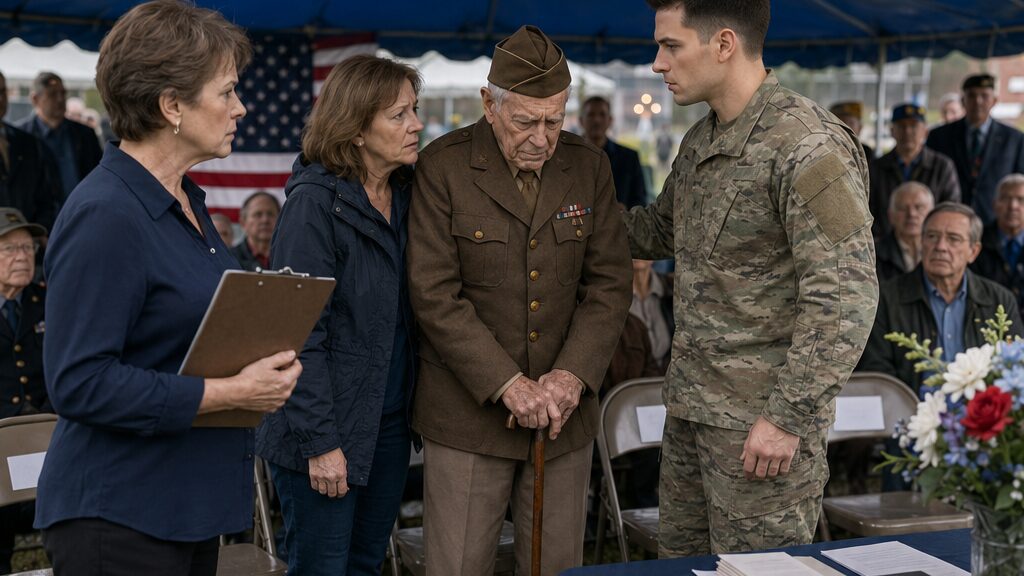
The ceremony was being held on the lawn beside the veterans memorial, between the library and the old courthouse. By the time Susan pulled into the parking lot, volunteers were already wrestling folding chairs into rows beneath a blue canopy. The canopy snapped in the light wind. A large American flag hung from a temporary frame at the front, its lower edge lifting now and then like it was trying to breathe.
George sat in the passenger seat with both hands on the cane across his knees.
“There’s not too many people yet,” Susan said.
“That’s good.”
“We can park closer if you want.”
“This is fine.”
She turned off the car but did not open her door. He knew she was waiting to see whether he would change his mind. He had raised a daughter who did not push a door open if someone was still deciding whether to walk through it.
Across the lawn, a young soldier in camouflage carried a box of programs under one arm. Another soldier checked the flag stand. A woman with a clipboard moved quickly between the chairs, pointing, shaking her head, pointing again. The folding chairs made a hollow metal sound whenever a volunteer set one down too hard.
George looked at the blue canopy. The color reminded him of tarps stretched over supply crates, of sky seen through dust, of a shirt someone once waved from a ditch when they had no flag and no clean bandage left. The memory came and went like heat off pavement.
“Dad?”
He blinked. “I’m coming.”
It took longer than he liked to stand. Susan came around and opened the door, but he had already planted the cane and leaned forward. His knee complained. His back sent a hard line up between his shoulders. He waited until both feet were sure of the ground before he rose.
The wind touched the jacket. He smoothed the front with his palm.
Susan locked the car and fell into step beside him, close enough to help and far enough to pretend she wasn’t. They crossed the parking lot slowly. Gravel clicked under the cane’s rubber tip when they left the pavement. The sound was small, regular, and somehow louder to him than the volunteers, louder than the flag rope tapping the pole.
At the edge of the lawn, a volunteer offered Susan a program. Then he looked at George’s uniform and straightened a little.
“Thank you for your service, sir.”
George nodded. “Thank you.”
The words were familiar, kindly meant, and never quite easy to receive. Sometimes they landed on the wrong part of him. Sometimes they felt like a hand over a door he had not opened.
Susan unfolded the program as they moved toward the canopy. George saw the printed seal at the top, the schedule of remarks, the list of honorees and dedications. He did not reach for it. He told himself he had not come for ink on paper.
But when Susan’s steps slowed, he knew.
“What is it?” he asked.
She tried to fold the paper back. “Nothing.”
“Susan.”
Her mouth tightened in the way it did when she was angry but aiming the anger elsewhere. She handed him the program.
He took it with his left hand while keeping the cane steady in his right. The print wavered until he lowered the page and brought it closer. There were names, some he knew, some he did not. There was a dedication line to the 38th. There was a paragraph about sacrifice and community gratitude. His own name was not where he had expected it might be, but that did not surprise him as much as it should have.
He read lower.
Then he read again.
Susan’s voice was careful. “Maybe it’s on another page.”
There was no other page.
George stood in the sun with the blue canopy ahead and the flag moving gently behind the rows of chairs, and the one name he had made himself come to hear was not there.
The paper folded slightly in his hand.
Susan stepped closer. “Dad, we can leave.”
He looked toward the front row. The chair legs glinted. The soldier with the box of programs set them down on a table. The woman with the clipboard waved someone toward the back.
George’s fingers moved to the crooked decoration on his chest. He touched it once, not fixing it, only feeling that it was still there.
“No,” he said.
Susan studied him. “Are you sure?”
He handed the program back to her. “I got dressed.”
“That doesn’t mean you have to stay.”
George placed the cane forward and took one measured step toward the canopy. “Today it does.”
Chapter 2: The Seat Reserved For Someone Else
The front row was marked with white cards taped to the backs of folding chairs. Most of the names had been printed in bold black letters. A few cards still sat blank, waiting for someone from the clipboard to decide who mattered enough to sit close to the flag.
George stopped at the edge of the blue canopy. Shade crossed his shoes first, then the hem of his trousers, then the old wool jacket. The day cooled at once beneath the fabric roof. The flag at the front seemed larger from there, red and white stripes moving with a soft snap whenever the wind found them.
Susan glanced at the cards. “Maybe Benjamin Carter is here already. He’ll know.”
“I don’t see him.”
“He said he would come.”
“He said he’d try.”
A woman in a navy blouse and sensible shoes turned from the program table. Her clipboard was pressed to her chest like a shield. “Can I help you?”
Susan answered before George could. “My father is here for the ceremony.”
The woman smiled quickly. It was a practiced smile, not unkind, but used too often to slow anyone down. “Wonderful. General seating is right over there, just beyond the aisle. We’re asking guests to leave the front section open.”
George followed her pointing finger to a set of chairs outside the canopy, where the shade ended and the sun lay bright on the metal seats.
Susan’s face changed. “He’s not general seating.”
The woman looked again at George, then at the clipboard. Her eyes moved over the cap, the jacket, the cane, and stopped at the decorations on his chest. “Is he with one of the families?”
George felt the old instinct arrive: do not make trouble, do not explain unless asked properly, do not spend yourself on someone too rushed to receive it. His hand tightened on the cane.
Susan said, “He’s George Bennett.”
The woman lowered her eyes to the clipboard. “Bennett,” she murmured, flipping a page. “Bennett…”
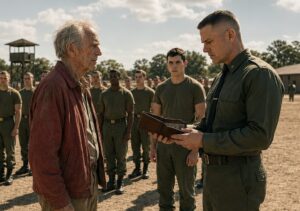
A young soldier approached with a stack of programs tucked under his arm. He was tall, clean-shaven, and young enough that his face still held the open sharpness of someone who believed fatigue was a temporary condition. The name tape on his uniform read Reed.
“Ma’am,” he said to the woman, “the color guard is asking where to line up.”
“One second, Daniel.” She kept scanning. “Bennett, Bennett. I’m sorry, I don’t see that name listed with reserved seating.”
Susan held up the program. “The program is missing things.”
The woman’s smile thinned. “I understand these events can feel personal, but we had to go from the records we were given.”
George said, “It’s all right.”
Susan turned to him. “No, it isn’t.”
He gave her a look, small but firm. She went quiet, but the anger stayed in her shoulders.
Daniel shifted the programs from one arm to the other. “Sir, we can get you a chair in the shade on the side if standing is difficult.”
The words were polite. That made them harder. George had no quarrel with politeness. It was often the paper wrapped around dismissal.
“I can stand,” George said.
Daniel’s eyes flicked to the cane, then away. “Of course.”
The woman with the clipboard—Sharon Miller, according to the small name tag pinned near her shoulder—tapped her pen against the paper. “The front row is for honorees and designated family. We have limited seats under the canopy.”
Susan stepped in. “He is an honoree.”
Sharon gave the program another glance. “Not according to this list.”
The sentence landed harder than she intended. George knew that. He had spent a long life learning the difference between a blade and a careless elbow. Still, both could bruise.
A couple of seated veterans looked over. One man in a ball cap turned his head, then looked away as if embarrassed to witness the moment. The flag moved at the front. A microphone squealed briefly, then cut off.
George lowered his gaze.
The grass beneath the canopy was flattened where volunteers had walked back and forth. A paper clip lay near the leg of a chair. Someone had spilled a little coffee by the program table, and the dark stain spread slowly into the dust.
He had been in places where names were everything. Names written on tape, on tags, on envelopes, on lists carried close because a man could become unrecognizable before noon. He had been in places where losing a name was another way of losing the person again.
This was not that place.
It was a town lawn with a library behind it and children laughing near the sidewalk.
Still, the old feeling moved through him.
George turned slightly. “Susan, sit wherever they have room.”
“No.”
“Susan.”
“No,” she repeated, softer but more dangerous.
Daniel cleared his throat. “Sir, why don’t I help you over to those chairs for now? We can sort this out after the opening remarks.”
After. George almost smiled at that. People loved after. After was where uncomfortable things were sent to grow quiet.
He took one step back from the front row. The cane tip pressed into the grass. His knee bent poorly. Daniel moved quickly, reaching as if to steady his elbow.
George did not pull away, but his body stiffened.
Daniel noticed and stopped. “Sorry, sir.”
George gave a small nod.
As he shifted, the old jacket caught on the back of the nearest folding chair. The fabric tugged open at the front. Daniel bent instinctively to free it, one hand careful on the chair, the other on the lower edge of the jacket.
“Hold on,” Daniel said. “It’s snagged.”
George stood still, eyes down. Susan’s breath sounded sharp beside him.
Daniel worked the wool loose from a rough metal corner. As the jacket opened slightly, the inner lining showed: faded brown satin, a repaired seam, and a narrow strip of cloth sewn inside by hand. The letters had faded, but they were still there.
G. BENNETT
Daniel’s fingers stopped.
It was only a second. Perhaps less. But George felt the change before anyone spoke.
The young soldier’s hand withdrew from the jacket as if he had realized he was touching something older than cloth. His shoulders came back. His voice lowered.
“Sir,” Daniel said, “may I see that again?”
Susan looked between them. Sharon frowned at the delay. “Daniel, we really need—”
“Ma’am,” Daniel said, not loud, not rude, but different enough that Sharon stopped. He kept his eyes on George. “Please.”
George studied him. The soldier was no longer looking at the cane first. He was looking at the name.
“You saw it,” George said.
“Yes, sir.” Daniel swallowed. “Were you with the 38th?”
The air beneath the canopy seemed to draw inward. Susan’s fingers tightened around the program. Sharon looked down at her clipboard again, but now her confidence had thinned.
George’s thumb moved along the cane handle.
“I was attached to them for six months,” he said.
Daniel’s face changed again, more slowly this time. Recognition did not come all at once. It arrived like someone opening a door onto a room he had not known was occupied.
“The dedication today,” Daniel said. “The packet mentioned a Bennett, but the line was incomplete. I thought it was a family note, not—”
He stopped himself.
George waited.
Daniel straightened fully. “Mr. Bennett, would you mind staying here for a moment?”
Sharon stepped closer, her clipboard lowered now. “What’s going on?”
Daniel did not take his eyes off George. “I think we have the wrong list.”
Susan let out a breath that was almost a laugh and almost not.
George looked past them to the front row, to the blank cards waiting for names. Then he looked at the program in Susan’s hand, folded so the missing line was hidden.
“There are worse things than a wrong list,” he said.
Daniel heard the weight in it. George could tell by the way he did not rush to answer.
The young soldier lowered his voice further. “Sir, who else is missing?”
Chapter 3: The Name Inside The Jacket
Daniel Reed had been told the ceremony would be simple.
Arrive at nine. Help unload chairs. Hand out programs. Stand near the flag during the remarks. Smile for the photographer. Shake hands if asked. Leave by noon.
No one had mentioned an old man in a brown uniform whose name was sewn inside his jacket like a fact nobody had bothered to read.
Daniel stood beside the program table with George Bennett in front of him, Susan Bennett at her father’s shoulder, and Sharon Miller trying not to look as shaken as she was. Around them the ceremony continued assembling itself. People arrived in pairs. Chairs scraped. The color guard waited near the sidewalk with flags angled carefully away from the wind. A local announcer tapped the microphone and said, “Testing,” three times with increasing irritation.
Daniel kept hearing George’s answer.
I was attached to them for six months.
Not proud. Not evasive. Just placed there between them, plain as a folded flag.
Sharon flipped through the packet on her clipboard. “Daniel, the finalized honoree list came from the veterans office. If there’s an issue, Benjamin needs to handle it.”
“Where is he?”
“Not here yet.”
“Call him.”
She glanced toward the growing audience. “The ceremony starts in twelve minutes.”
Daniel looked at the printed program Susan held. “Then we have twelve minutes not to get it wrong.”
Sharon’s face tightened. “That is not fair.”
He knew it wasn’t. She had been there since before sunrise, hauling boxes, answering questions, fixing the microphone, arguing with the town electrician over a power cord. She was not a villain. She was a woman trying to make a public thing look seamless. But Daniel had seen enough of military ceremonies to know that seamless could become careless if nobody stopped it.
George shifted his weight. The cane pressed deeper into the grass.
Daniel turned to him. “Sir, would you like to sit?”
A faint crease touched the corner of George’s mouth. “Now you’re asking different.”
Daniel felt heat rise behind his ears. “Yes, sir.”
George nodded once. “I’ll stand a little longer.”
Susan looked as if she wanted to protest, but did not.
Daniel opened the folder from the program table. The packet was filled with printed emails, scanned forms, a ceremony outline, a list of donors, and a short historical note about the 38th. The relevant page had been paper-clipped near the back. He found the line that had snagged at his attention during the morning briefing.
Local recognition will include surviving family representatives and mention of attached personnel where records confirm.
Below that, someone had typed:
Bennett — first initial G. — attachment period unclear.
He had seen it at eight-thirty and thought it was unfinished clerical residue, the kind of thing that showed up in community packets when older records were copied too many times. He had not asked. He had been thinking about chair spacing and whether his sleeve patch was straight.
Now the line looked like an accusation.
Susan leaned closer. “That’s it? That’s all they had?”
Daniel did not answer too quickly. “This is what’s in the packet.”
“My father drove here in that uniform for ‘attachment period unclear’?”
George said, “Susan.”
She turned away, jaw tight.
Daniel scanned the rest of the page. There was another name, printed correctly in a paragraph about the ceremony’s dedication. The name did not belong to the allowed names in Daniel’s mind the way George’s had; it belonged to history, to a man who would not be present. But there was a problem. The paragraph referred to the man only by last name and unit. No first name. No hometown. No connection to George.
“Sir,” Daniel said carefully, “the dedication mentions an incident. It says two men were separated from the unit during extraction, one returned with critical injuries, and one was listed as lost before recovery. Is that the same—”
George’s eyes lifted.
Daniel stopped.
It was not fear on the old man’s face. Daniel had seen fear. This was something quieter and more practiced. A door closed from the inside.
Sharon returned with her phone in hand. “Benjamin Carter is on his way. Five minutes, maybe ten. He says traffic by the courthouse is blocked.”
“Did you tell him?” Daniel asked.
“I told him there’s a question about Mr. Bennett.”
George looked toward the flag.
Daniel noticed he did not correct the title, did not say Sergeant, Corporal, Specialist, whatever had once applied. The old man accepted “Mr.” easily. Maybe too easily.
Susan unfolded the program again. “This says the dedication is for the 38th and the memorial plaque update. It says nothing about Dad.”
“I didn’t come for my name,” George said.
“Then whose?”
He did not answer.
The question hung there, and even Sharon seemed to understand not to push it with clipboard energy.
A white sedan turned into the parking lot too fast and stopped crooked near the curb. Benjamin Carter got out with a folder under one arm. He was an older man, not as old as George, but moving with the stiffness of someone whose knees forecast rain. He wore a gray suit that had seen many town events and a small veteran services pin on his lapel.
He crossed the lawn with urgency he tried to disguise as dignity.
“George?” Benjamin called.
George turned. Something passed over his face, not surprise exactly, but the weariness of being found.
Benjamin slowed when he reached them. “I wasn’t sure you’d come.”
Susan looked at him. “You knew?”
“I hoped.” Benjamin removed his glasses and cleaned them on his tie though they were not dirty. “Your father has been invited before.”
George said, “Not for this.”
“No,” Benjamin admitted. “Not for this.”
Daniel held out the packet. “Sir, I’m Daniel Reed. There’s an incomplete Bennett line in the records. Mr. Bennett’s name is in his uniform. He says he was attached to the 38th.”
Benjamin took the page, read it, and closed his eyes briefly. “That line should have been removed or corrected.”
“Which one?” Susan asked.
Benjamin looked at George.
George said nothing.
The announcer’s voice crackled over the speaker. “Ladies and gentlemen, we’ll be beginning shortly. Please take your seats.”
The words moved people toward the chairs. A small crowd gathered under and around the canopy, drawn by shade, duty, curiosity, and the kind of local pride that came with flags and printed programs. Daniel felt time pressing at his back.
Benjamin lowered his voice. “George, we can still keep this simple.”
George’s hand tightened on the cane. “Simple for who?”
The question changed Benjamin’s face.
Daniel saw it then: the veterans officer knew more than the packet, less than George, and exactly enough to be ashamed.
Benjamin tapped the paper once. “The record says you never completed the final statement.”
Susan looked at her father. “What statement?”
George watched the flag. “One that left a man out.”
The wind shifted. The canopy fabric shuddered overhead.
Daniel waited for Benjamin to explain, but the older man only looked at the grass. Sharon stood very still with her clipboard lowered at her side.
Susan’s anger drained into something more frightened. “Dad?”
George took the program from her hand and folded it along the center crease with careful fingers. “You can start your ceremony.”
Benjamin said, “George—”
“You can start it,” George repeated. “But don’t call it corrected.”
The announcer called again for everyone to take their seats.
Daniel looked at the old brown jacket, the crooked decoration, the name tape hidden back inside the lining. Then he looked at George’s face and understood that the missing thing was not a scheduling problem, not a typo, not even an insult that could be fixed by adding one chair.
It was a debt.
Benjamin folded the packet closed. “There’s a small office behind the memorial hall. Quieter there.”
George’s eyes stayed on the flag for one more moment.
Then he turned slowly, planted his cane, and began walking out from under the blue canopy, away from the front row that had not known what to do with him.
Chapter 4: The Statement George Never Signed
The office behind the memorial hall smelled of paper, rain coming, and coffee burned too long in a machine no one had cleaned properly.
George lowered himself into the chair nearest the small desk because Benjamin pointed to it and because his knee had begun to tremble. He did not like the trembling. Pain was private if a man could keep it from showing, but trembling announced itself without permission. He set the cane upright between his shoes and held the handle with both hands until the shaking passed into the wood.
Susan remained standing near the door. Daniel stood by the filing cabinet, cap tucked beneath one arm, shoulders straight but no longer stiff with ceremony. Sharon had stayed outside to delay the opening remarks, though George had heard the reluctance in her steps when she left. The whole town was sitting under the canopy, waiting for a program that had already failed before anyone read a word from it.
Benjamin closed the office door halfway, not all the way. Sound slipped in from the lawn: folding chairs creaking, a microphone pop, the soft lift of voices trying to be patient.
“I should have called you myself,” Benjamin said.
George looked at the floor. “You did.”
“I left messages.”
“That’s not the same.”
Benjamin accepted that with a small nod. He placed the folder on the desk. It was the kind of folder county offices kept too long, its corners rounded and its label rubbed gray from fingers. George could see his own name on a photocopied page tucked inside. G. Bennett. Incomplete attachment period. Statement pending.
Pending. After all these years, the word still sat there waiting as if he might get around to being easier.
Susan took one step closer. “What statement?”
George kept his hands on the cane. He had heard that question many times in his head, always in Susan’s voice, sometimes in her mother’s. He had answered it a thousand ways and never once aloud.
Benjamin opened the folder. “Your father was asked to complete a final account related to the extraction incident attached to the 38th.”
“Asked by who?” Susan said.
“Records division first. Later the state veterans office, when they were compiling service histories for local recognition.” Benjamin glanced at George. “There were gaps.”
“There were names,” George said.
Daniel shifted slightly. Not impatience. Attention.
Benjamin took a breath. “The official incident record confirms your father returned with injuries after being separated from the main unit. It also confirms another soldier was lost before recovery. Some witness accounts were incomplete. Some contradicted each other.”
George heard rain tick once against the small window.
Susan looked at him. “You never told me that.”
“I told your mother enough.”
“That isn’t the same either.”
No, George thought. It wasn’t.
He ran his thumb along the cane handle, finding the smooth place where years of his palm had darkened the wood. The office walls held framed certificates, a faded photo of the memorial dedication from decades earlier, and a shelf of binders labeled by year. A small American flag stood in a mug filled with pens. Everything in the room looked preserved, but not alive.
Benjamin turned one page. “The final statement they wanted from George would have confirmed the wording for later records. He never signed.”
Susan’s voice lowered. “Why?”
George looked at the crooked decoration on his chest. It had turned again when he sat down. He did not straighten it.
“Because they wrote it wrong.”
Benjamin waited.
George felt the room settle around him, expecting a story. That was the problem with old pain. People thought if you opened the door, the whole thing would walk out in order. But memory did not come like a report. It came as fragments: a boot slipping in mud, a radio hiss, breath in someone else’s throat, the taste of metal, the blue of a torn shirt lifted above tall grass.
He said, “They put my name down because I came back.”
Susan’s eyes shone, but she did not interrupt.
“They left his name small because he didn’t.”
Daniel’s jaw moved once, then stilled.
Benjamin said softly, “George, the dedication does include him.”
“No.” George lifted his eyes. “It includes the unit. It includes the incident. It says one man was lost. That’s not a name.”
The words cost more than he expected. He looked away from all of them.
Outside, Sharon’s voice came through the speaker, bright and strained. “Ladies and gentlemen, thank you for your patience. We’re giving everyone a few extra minutes to find their seats.”
A few extra minutes. He had been given decades and still had not found his way to the sentence.
Susan came to the side of his chair. “Who was he?”
George’s mouth tightened.
The room waited again.
“He was younger than me,” he said at last. “Not by much. He talked when he was scared. Talked when he wasn’t. Talked so much I thought I’d give anything for five minutes without his voice.”
A sound almost like a laugh escaped him, but it had no humor in it.
“He had a sister who sent him lemon drops in wax paper. He’d eat two and save the rest until they stuck together. He had a shirt he said was lucky. Blue. He waved it when the smoke cleared because he thought they might see the color.”
Susan knelt beside his chair slowly, as if approaching a sleeping animal. “Dad.”
George looked at her. “He pulled me by my collar when my leg wouldn’t work. I remember his hands. That’s what I remember best. Not the noise. Not after. His hands under my arms. Then he pushed me toward the ditch where the others could reach.”
Daniel’s face had gone still in the way soldiers sometimes became still when they understood the shape of a thing without needing the full picture.
Benjamin said, “The record says you were found alone.”
“I was found alive.”
The rain began properly then, a soft rush on the roof, gathering above the office and over the blue canopy outside. For a moment it covered the voices on the lawn.
George leaned back. The chair complained beneath him. He was tired in a way sleep could not fix. He had come to hear one name spoken because he had believed, foolishly perhaps, that a town ceremony might do what paperwork had not. Now the program sat outside in people’s laps, neat and wrong.
Susan touched the cuff of his jacket. “Why didn’t you tell us?”
“Because I came home to a wife who had already spent months afraid. Then I had you. Then I had work. Then your mother got sick. Then years passed, and people wanted stories with endings.” He looked at Benjamin. “They wanted a clean statement.”
Benjamin lowered his eyes.
Daniel said, “Sir, what was his name?”
George heard the respect in the question. Not curiosity. Not pressure. Permission.
He closed his hands tighter around the cane.
For years he had kept the name in places no one could misprint it. Behind his teeth. Under his ribs. In the turned-down frame on his dresser. Keeping it there had felt like loyalty until it began to feel like another kind of burial.
“Edward,” he said.
Susan bowed her head.
“Edward Walker.”
The name entered the small office and changed the air.
Benjamin wrote it down, though George knew he already had it somewhere. Maybe not first and last together. Maybe not in a way that mattered. Daniel repeated it once under his breath, careful with both parts.
George looked toward the half-open door. Beyond it, the ceremony waited under the rain-darkened canopy.
“If they speak today,” he said, “they speak him first.”
Chapter 5: The Program Could Not Hold The Whole Truth
Susan had spent most of her life believing her father’s silence was a wall. In the small office, she realized it had been a door he was holding shut with his back against it.
When they returned to the canopy, the rain had changed everything without stopping the ceremony. The blue fabric sagged slightly at the corners. Volunteers had moved the program table farther under cover. Guests leaned closer together, knees angled away from wet grass. The American flag hung heavier now, its colors deepened by the gray light.
Her father walked slowly, cane first, uniform darkened in small places where rain had touched the wool. Daniel walked beside him, not holding him, not hovering, just matching the pace. That, more than anything, made Susan’s throat tighten. For years people had either rushed ahead of George or reached too quickly to help. Daniel had learned in less than half an hour what she herself sometimes forgot: her father did not need to be dragged toward kindness.
Sharon met them near the program table with the expression of a woman who had been asked to repair a clock while it was striking noon.
“We’ve delayed as long as we reasonably can,” she said. Then, seeing George’s face, she softened. “Mr. Bennett, I’m sorry for earlier.”
George gave a small nod. “You were working from paper.”
The sentence did not excuse her. It simply refused to make her the center of the wound.
Sharon looked down at the program in her hand. “Benjamin told me there’s a correction.”
“A correction and an addition,” Daniel said.
The local announcer stood nearby, one hand over the microphone, watching them with nervous interest. Behind him, the second soldier adjusted the flag stand again, securing it against the wind. The color guard waited in a line along the sidewalk, rain speckling their shoes.
Benjamin opened his folder on the table and weighed the pages with his palm. “We can’t reprint the programs.”
Susan surprised herself by speaking sharply. “No one asked you to.”
Her father glanced at her, not warning, not approving. Just noticing.
She took a breath and lowered her voice. “Sorry.”
Benjamin removed his glasses. “We can alter the remarks.”
Sharon looked toward the seated audience. “The mayor’s note is already on the podium. The veterans dedication is after the pledge. The plaque update wording was approved last week.”
“Approved wrong,” Susan said.
Sharon flinched slightly.
George remained quiet, one hand on his cane, the other near the front of his jacket. The crooked decoration caught Susan’s eye. As a child she had seen him polish coins, sharpen pencils, fold towels with corners squared. He did things carefully, not obsessively, but with a respect for order that had made their house feel safe. That decoration had always bothered her when he tried the uniform on. Today he had stopped anyone from fixing it.
She understood now that its crookedness was not neglect. It was witness.
Daniel placed the ceremony packet beside the printed program. “The audience doesn’t need a full explanation. Not now. But the name needs to be spoken.”
The announcer cleared his throat. “Which name?”
George looked at him.
The announcer lowered his eyes at once. “I mean, so I say it correctly.”
“Edward Walker,” Daniel said.
The second soldier turned slightly at the sound, then faced forward again.
Sharon wrote the name on the back of a spare program in careful block letters. “Edward Walker,” she repeated. “And Mr. Bennett?”
George said, “After.”
Benjamin looked pained. “George, this recognition was meant in part for you.”
“I heard you.”
“You should not have to stand at the edge of your own ceremony.”
George’s hand shifted on the cane. “Then don’t make it mine.”
Susan looked at him then, really looked. The rain had put silver on the brim of his cap. His face was lined and tired, but his eyes were not lost in the past the way she had feared. He was standing exactly where he had chosen to stand: between the mistake and the correction.
She had wanted to take him home because she had thought the day might hurt him. It had. But she saw now that leaving would have hurt him in a different way. Maybe worse.
When she was young, she had found the brown uniform in the hall closet and asked why he never wore it in the Veterans Day parade. Her mother had said, “Your father does not like being looked at.” Susan had believed that for decades. Now she wondered how much of her family life had been arranged around explanations gentle enough for children and wrong enough to last.
“Dad,” she said.
He turned.
“Do you want me to stand with you?”
The answer took a moment. “Yes.”
It was so simple, and so unlike him to ask without being cornered, that Susan nearly reached for him. Instead she nodded.
Sharon turned to the announcer. “We’ll open as planned. After the pledge, before the dedication paragraph, you’ll say there is a correction to the printed program.”
The announcer looked worried. “Should I say printing error?”
“No,” George said.
Everyone went still.
He looked at the program lying on the table. “A printing error is when letters fall wrong. This was people not asking long enough.”
Sharon’s face colored, but she did not defend herself. “What would you like him to say?”
George’s gaze moved to Daniel.
The young soldier took a blank card from the stack meant for reserved seats. He did not write immediately. “May I?”
George nodded.
Daniel wrote slowly, shielding the card from the rain with his body.
In recognition of Edward Walker, who did not come home, and George Bennett, who carried his name.
He turned the card toward George.
Susan watched her father read it. His expression barely changed, but his fingers tightened once on the cane.
“No,” George said.
Daniel’s face fell. “Sir?”
George tapped the card lightly with one finger. “Don’t say I carried it. Makes me sound better than I was.”
Susan felt the protest rise in her, but stopped herself.
Daniel waited.
George said, “Say I remembered it.”
Daniel crossed out the line and wrote again.
In recognition of Edward Walker, who did not come home, and George Bennett, who remembered his name.
This time George looked at it longer.
“That’ll do,” he said.
Benjamin exhaled.
Sharon took the card with a care that had not been in her hands earlier. “I’ll place this at the podium.”
“No,” Daniel said.
She looked at him.
He held out his hand. “I’ll do it.”
It was not a challenge. It was a promise.
Susan saw Sharon understand that. She handed him the card.
The rain softened. Beyond the edge of the canopy, sunlight began to press through the clouds in pale strips. People shifted in their chairs. A child whispered and was hushed. The microphone crackled.
George looked smaller under the canopy than he had in the bedroom doorway that morning, but not weaker. The uniform hung from his shoulders with its old weight. The cane stood planted in the grass.
Susan brushed a raindrop from his sleeve before she could think better of it.
He let her.
Then Daniel returned from the podium and stood in front of George, holding something small in his palm: a brass-backed pin that had come loose enough to make the decoration tilt.
“I found why it keeps turning,” Daniel said quietly. “The clasp is bent.”
George looked down at it.
“I can leave it,” Daniel added. “Or I can try to set it straight before we begin.”
Susan held her breath.
For a long moment, George said nothing. Then he lifted his eyes to the young soldier.
“Not yet,” he said.
Daniel closed his hand around the pin and nodded.
At the microphone, the announcer asked everyone to rise.
George did not move at first. He looked at the flag, then at the card Daniel had placed near the podium, then at the rows of people holding programs that could not hold the whole truth.
When he stood, Susan stood with him.
Chapter 6: Permission Before The Pin
The pledge ended with voices fading unevenly beneath the canopy.
George remained standing while others settled back into their chairs. Some lowered themselves carefully, some glanced at the rain-dark grass, some folded programs across their laps. Susan stayed beside him. Daniel stood a few paces away near the flag, hands at his sides, face forward. Benjamin had taken a place near the program table. Sharon stood beside the podium with no clipboard in her hands.
The announcer adjusted the microphone. The small squeal that followed made several people wince. George watched him look down at the card Daniel had placed t
Chapter 7: The Handshake After The Name Was Spoken
George had intended to say one sentence.
He stood at the microphone with his hand on the cool metal stand, Daniel’s corrected card lying beneath his fingers, and felt the whole ceremony lean toward him. The faces under the blue canopy blurred at the edges. Rain ticked from one corner of the fabric roof into a small puddle by the front chair. The flag behind him lifted and settled.
He could hear Susan breathing just to his left.
“I won’t take long,” he said again, though no one had asked him to hurry.
The microphone carried his voice farther than he expected. It came back to him from the speaker with a thin, older sound.
He looked down at the card.
“Edward Walker talked too much,” George said.
A few people shifted, uncertain whether they were allowed to smile.
George let the silence sit.
“He talked when we were tired. Talked when we were lost. Talked when the rest of us were saving our breath for being scared.” His thumb pressed the edge of the card. “He had a sister who sent lemon drops wrapped in wax paper. He saved them too long and they always stuck together.”
Susan lowered her head.
George kept his eyes on the card because if he looked at her, he would stop. “He had a blue shirt he said was lucky. I never saw anything lucky about it. But when smoke came low and we needed to be seen, he waved that shirt like a flag.”
Daniel stood very still near the edge of the podium. Not at attention exactly. Listening had its own posture.
George swallowed. The old wound did not open cleanly. It pulled.
“He got me far enough that I could come home and stand here years later in a uniform that still has buttons and a name inside it.” He looked at the rows of people now. “That is why I would not sign a paper that made him smaller than the truth.”
No one moved.
George felt the ache in his leg sharpen. His left hand trembled against the microphone stand, so he lowered it and gripped the cane instead.
“I don’t need a big ceremony,” he said. “I don’t need anyone to make me more than I was. I was scared. I was hurt. I was young. I came home because another man spent the last strength he had getting me where hands could reach me.”
The wind moved through the canopy. The flag gave one soft snap.
George looked at Benjamin, who stood near the program table with the folder against his chest.
“If the town keeps a record,” George said, “then keep it with his whole name. Edward Walker. Not one man lost. Not unknown attachment. Not a line too small to read. His name.”
Benjamin nodded once, slowly.
George turned his eyes to Sharon. She had both hands folded around the clipboard now, though she was not writing. Her face was pale with attention.
“And if next year there’s a program,” George said, “ask long enough before printing.”
Sharon’s mouth tightened, not with offense. She nodded too.
That was enough. George had no more to give the microphone.
He stepped back. For one alarming second his knee softened, and Daniel moved without rushing, his hand coming near but not taking hold. George steadied himself on the cane before Daniel touched him.
“I’ve got it,” George murmured.
“Yes, sir,” Daniel said.
The audience remained quiet until George had returned to Susan’s side. Then the applause came, not loud at first. It sounded hesitant, like rain beginning again. George did not know what to do with it. Applause had always made him feel as if people were clapping for the wrong part.
Then a man in a veterans cap removed it and held it against his chest. The second soldier followed. The color guard stood straighter. Several people who had been clapping stopped and simply stood.
That he could bear.
Not because standing fixed anything. It did not. But standing left room for silence, and silence could hold more than praise.
Susan touched his sleeve. This time he covered her hand with his own for a moment.
The ceremony continued after that, though nothing said afterward carried the same weight. The mayor shortened his remarks. Benjamin spoke of the memorial file being amended and did not use the phrase administrative oversight. Sharon walked through the front row and quietly removed the blank reserved card from the chair that had nearly sent George to the side.
When the formal dedication ended, people approached him one by one. Most only said thank you. Some said nothing and shook his hand. One older woman told him her brother had served with the 38th and then could not continue. George listened as long as he could. Daniel stayed near, gently turning people aside when their kindness became too much.
At last the crowd thinned.
The rain had stopped. Water dripped from the canopy seams. The folding chairs sat crooked now, pushed back by people rising and turning. A few programs lay damp in the grass. The corrected card remained on the podium, the ink slightly blurred at one corner but still readable.
George stood beneath the flag while Susan retrieved his cap from the chair where she had set it. He had not realized he had taken it off.
Benjamin approached with the folder held differently now, less like an answer and more like a burden.
“George,” he said, “I’ll bring the amended record to your house before it’s filed.”
George looked at him. “Don’t bring it for my approval.”
Benjamin hesitated.
“Bring it so I can read his name.”
“I will.”
“And write his sister if there’s anyone left to find.”
Benjamin nodded. “I’ll try.”
“Try hard enough to be tired.”
A small, rueful smile crossed Benjamin’s face. “I will.”
Sharon came next. She held the clipboard at her side, no longer against her chest. “Mr. Bennett, I’m sorry.”
George did not answer immediately.
She seemed to understand that sorry was not a bridge unless someone walked differently afterward. “We’re changing how we collect names for these events,” she said. “No more final list without a phone call to the families and veterans involved. And no more reserved seats without someone checking who’s standing in front of them.”
George studied her. “That would be better.”
“It will be better.”
He nodded.
She looked at the old jacket, then at his face. “Thank you for staying.”
“I almost didn’t.”
“I know.”
When she left, Daniel remained.
The young soldier had removed his cap. His hair was damp at the edges from the rain. In one hand, he held the bent clasp he had taken from George’s decoration. In the other, he held the corrected card from the podium.
“I thought you might want this,” Daniel said, offering the card.
George took it. The paper was soft from the wet air. Daniel’s handwriting had pressed deep enough that the words seemed more engraved than written.
Edward Walker, who did not come home.
George Bennett, who remembered his name.
George folded the card once and slipped it carefully into the inside pocket of the brown jacket, just below the faded name tape.
Daniel opened his other hand. “And this.”
The bent clasp lay in his palm, small and dull.
George looked at it. “Throw it away.”
Daniel’s eyebrows lifted slightly.
“It did its work,” George said.
Daniel closed his hand around it. “Yes, sir.”
They stood a moment without speaking. Around them, volunteers began stacking chairs. The metal legs clattered. Someone lowered the flag halfway to untie it from the temporary frame, then stopped and asked the second soldier for help. The lawn smelled of wet grass and coffee.
Daniel extended his hand.
George looked at it, then took it.
This handshake was different from the one in front of the crowd. No ceremony held it up. No microphone waited. Daniel’s grip was warm and steady, and his eyes did not slide away from age, from grief, from the uniform, from the cane.
“Thank you for telling us his name,” Daniel said.
George held his hand a moment longer than he normally would have.
“Thank you for asking before you touched the jacket.”
Daniel glanced down, almost embarrassed. “I should’ve done that the first time.”
“Yes,” George said.
Daniel accepted it. “I will next time.”
That was better than an apology.
Susan returned with George’s cap. She brushed a bit of damp lint from the brim and handed it to him. He set it on his head, adjusting it by habit.
“You ready?” she asked.
“In a minute.”
She did not rush him.
George turned toward the flag as the two soldiers folded it with practiced care. Not the grand triangular fold of a burial flag, just a careful gathering of cloth that had hung in the rain for a town ceremony and now needed to be kept from touching the wet grass. Still, each fold was deliberate. Respect in the hands, not the announcement.
He thought of the turned-down frame on his dresser. When he got home, he would turn it upright. Susan would see the faded photograph then: three young men squinting in sunlight, one of them George, one of them Edward Walker in a shirt too bright to trust, one of them someone whose name had not hurt to remember. He would not explain all of it at once. Maybe he would not need to.
Susan stepped beside him. “Dad?”
George looked at the row of chairs, at the place they had tried to send him, at the front row where a blank card had waited for a name. He felt tired enough that the edges of the day seemed softened. But beneath the tiredness there was something else, not relief exactly. Room.
“I’m ready,” he said.
They began walking toward the parking lot.
His cane sank lightly into the damp ground, then lifted. Step. Tap. Step. Tap. Susan walked beside him, close enough to catch him and far enough to let him move. Behind them, Daniel helped the second soldier fold the flag. Sharon gathered wet programs from the chairs. Benjamin stood by the podium, already writing something on the inside of his folder.
At the edge of the lawn, George paused and looked back.
The blue canopy sagged with rainwater. The chairs were half stacked. The ceremony was coming apart in ordinary pieces. But the corrected card was no longer on the podium. It was in his pocket, against the lining of the old brown jacket, near his own faded name.
George touched the place once.
Then he walked on, slower than the others, steadier than he had expected, carrying the cane in one hand and not carrying Edward Walker alone.
The story has ended.