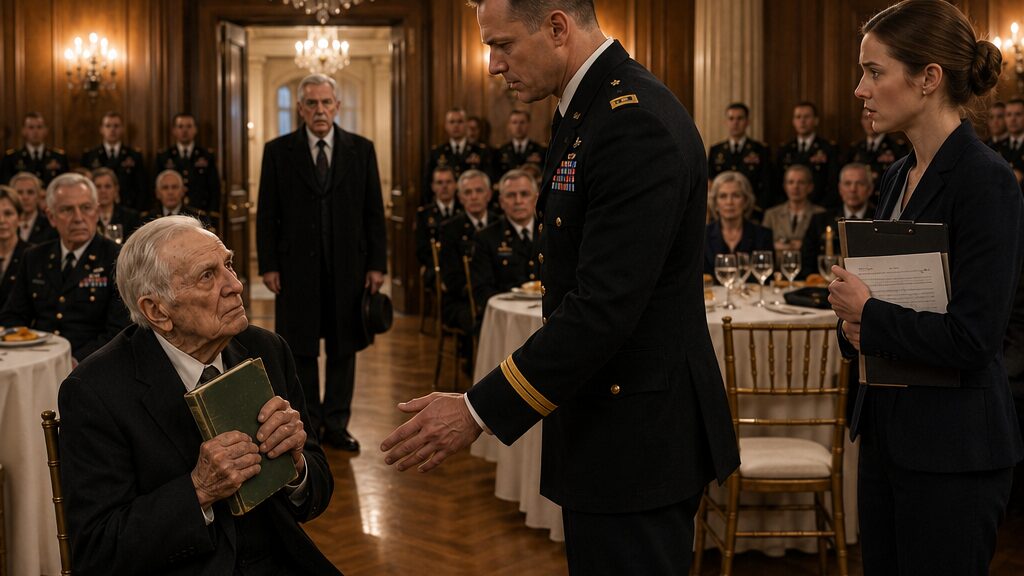
A Young Officer Tried To Take An Old Man’s Green Notebook Before The Room Learned Who Commanded Them
Chapter 1: The Old Man With The Green Notebook
The major’s hand stopped less than an inch from the old man’s notebook.
For a moment, no one in the entrance hall moved. The brass doors behind Michael Harris had not yet closed, and the evening air still clung to his black suit, cold in the sleeves, smelling faintly of rain and pavement. Ahead of him, the military dining hall glowed with chandeliers and polished wood. White tablecloths stretched in neat rows. At the far end, beneath two folded flags and a framed operation map, an empty chair waited at the head table.
Michael’s fingers tightened around the worn green notebook against his chest.
“Sir,” Major Justin Wright said, his voice low enough to sound controlled and loud enough to be heard, “I need to see what you’re carrying.”
Michael looked up at him.
Justin was tall, pressed, and young enough that the shine on his shoes seemed part of his personality. His dress uniform was exact: ribbons straight, collar clean, nameplate level. He stood between Michael and the dining hall with the careful impatience of a man responsible for order in a room full of people who outranked him.
The notebook remained under Michael’s hands.
“It’s mine,” Michael said.
“I understand that.” Justin’s eyes moved from Michael’s plain dark suit to his old black shoes, then to the notebook again. “But this is a restricted ceremonial dinner. No outside materials near the head table unless they’re cleared.”
Michael glanced past him.
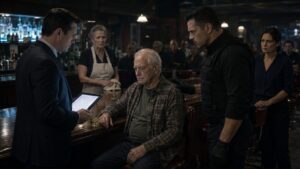
The dining hall was already half full. Retired officers sat with their spouses. Active-duty personnel moved along the aisles. A staff captain adjusted place cards. At one table near the wall, two junior officers paused over a tray of folded programs and looked toward the doorway.
A young event assistant with a clipboard stepped closer. Her name tag read Emma Johnson. She had the anxious expression of someone trying to become invisible while standing in the exact wrong place.
Justin turned toward her without removing his attention from Michael. “Check the seating sheet again.”
Emma looked down. “Yes, sir.”
Michael waited. He was good at waiting. Airports, field tents, hospital corridors, command rooms gone silent at three in the morning—waiting had been part of his life long before his hands became thin and his left knee began reminding him of weather.
The notebook pressed against his ribs. Its cloth cover had faded from military green to something softer, almost gray at the corners. The tape along the spine had yellowed. A dark line, worn by decades of handling, ran along the edge where his thumb always found it.
Emma ran her finger down the sheet clipped to her board.
“Harris,” Justin said. “Michael Harris.”
Emma checked again. Her brow folded.
“I don’t see that name on the visible seating list, sir.”
Justin exhaled through his nose. Not loudly. Not rudely. But enough.
Michael heard it.
“Could be under general invitation,” Emma added quickly. “There were late additions from the archive office and honorary guests—”
“If he were honorary, he’d be on this sheet.” Justin gave Michael a professional smile that made no room for warmth. “Sir, who invited you?”
Michael shifted his weight slightly on his cane. The cane was plain black, rubber-tipped, bought at a pharmacy after Rebecca had insisted he stop using the back of chairs to cross rooms. He had almost left it in the car. Pride had lost to the rain.
“I received a call,” he said.
“From whom?”
Michael’s gaze moved again to the empty chair. The place card in front of it was turned at an angle. He could not read the name from where he stood.
“From the office arranging the memorial.”
“Which office?”
Michael looked down at the notebook. Beneath his hand, he felt the raised crease where one page had been folded and unfolded too many times.
“It was enough that I came.”
Justin’s jaw moved once. “Sir, this event is for Operation Lantern Bridge personnel, invited families, and cleared guests. We have widows, senior officers, and press representatives arriving shortly. I can’t have unverified attendees seated near the front.”
The word unverified settled around Michael with more weight than Justin intended.
In the dining hall, someone laughed softly at a table, unaware. A fork chimed against china. The smell of coffee drifted from the service station. Everything was polished, arranged, commemorated.
Michael had spent half his life watching institutions polish memory until it no longer cut anyone.
“I can sit in the back,” he said.
Justin blinked, as if the answer irritated him because it sounded reasonable. “That doesn’t address the issue.”
“The issue is a chair?”
“The issue is access.”
Michael nodded once. “Access.”
Emma looked from one man to the other. She seemed about to speak, then swallowed the words.
Justin lowered his voice again. “Sir, are you here with someone?”
“No.”
“Family?”
“No.”
“Are you a veteran of the operation?”
Michael’s hand stilled on the notebook.
Across the room, a large printed banner hung above the display wall: OPERATION LANTERN BRIDGE — THIRTY YEARS OF REMEMBRANCE. Beneath it were photographs, maps, unit patches, and a list of names printed in formal black type. From this distance, the names blurred into columns.
Michael had not looked at the list yet.
“I knew men who were there,” he said.
Justin waited for more. When nothing came, his patience thinned.
“With respect, sir, a lot of people knew someone. That doesn’t place you at the head table.”
“I didn’t ask for the head table.”
“You were walking toward it.”
Michael looked down at his shoes. One lace had loosened during the walk from the parking lot. He had tied it twice in the car and had not trusted his fingers enough to try again in the doorway.
“I was looking for the display,” he said.
Justin followed his glance toward the wall. “The display opens after the invocation.”
Michael gave a faint, almost tired smile. “Does memory also open after the invocation?”
Emma’s eyes lifted.
Justin did not smile. “Sir, I need you to step aside while we verify your invitation.”
Michael stepped half a pace to the side. He did it carefully, to keep from bumping the stand holding the guest programs. The movement made him look smaller. The cane tapped once on the polished floor.
The two junior officers had stopped pretending not to watch.
Justin noticed them noticing. His posture sharpened.
“And the notebook,” he said. “I’ll need to have that checked.”
“No,” Michael said.
It was not loud. It did not echo. But it was the first word he had spoken that did not bend.
Justin’s eyes narrowed slightly. “Sir?”
Michael held the green notebook closer. “No.”
“This is not optional.”
“It is not dangerous.”
“You don’t get to decide that in this facility.”
Michael looked at Justin’s hand, still hovering near the notebook, then back at his face.
“You can check the name again,” he said.
Emma glanced quickly at the list. “Major, I can call Jennifer Garcia in archives. She has the extended roster and—”
“Not yet.” Justin kept his focus on Michael. “Sir, I’m trying to handle this discreetly.”
The room had grown quieter.
Michael knew that kind of quiet. It was not silence. It was attention gathering itself.
“I believe,” Justin said, “you may have come to the wrong event.”
Michael’s eyes moved once more to the empty chair at the head table.
“No,” he said softly. “I came to the right one.”
Justin held out his hand.
“Then let me check the notebook before you remain here.”
Michael did not move.
Chapter 2: The Major Who Trusted The List Too Much
Emma Johnson had seen protocol save a room from chaos. She had also seen it used like a locked door.
She stood close enough to notice that Michael Harris’s hands were trembling, but not from panic. His fingers held the notebook with a steadiness that seemed learned somewhere else, under worse pressure than a dining hall full of uniforms. The skin over his knuckles was thin. A small dark spot marked the back of his right hand. His wedding ring hung loose.
Major Wright’s hand stayed open.
“Sir,” Justin said, “I won’t ask again.”
That was when several heads turned fully.
At the nearest table, an older veteran lowered his coffee cup. Beside the program table, one of the junior officers stopped sorting name cards. The banquet staff captain looked over from the service doors and quickly looked away.
Michael remained seated in the chair Emma had brought him during the first delay. He had not asked for it. She had seen the stiffness in his knee and placed it behind him without permission. He had thanked her with a nod so small she almost missed it.
Now the chair made the scene worse. Major Wright stood over him. Michael sat below him, notebook against his chest, cane hooked on the chair beside one polished shoe.
“Major,” Emma said carefully, “the extended roster might clear this up.”
Justin did not look at her. “The extended roster is for verified late arrivals. He hasn’t provided a sponsor, unit contact, or invitation card.”
Michael’s left thumb shifted along the notebook’s taped spine.
“I had a call,” he said.
“From a number you remember?”
“No.”
“A name?”
Michael paused.
Emma watched that pause change Justin’s face. It was not cruelty that moved through him first. It was relief. The relief of a man whose suspicion had found evidence.
“Sir,” Justin said, “do you understand why that’s a problem?”
Michael looked toward the display wall. “I understand problems.”
A few people near the aisle heard that and exchanged glances.
Justin straightened. “This dinner honors Operation Lantern Bridge. It is not open seating. It is not a public reception. We have families here who waited three decades for this memorial, and I will not allow confusion at the front of the room.”
The words were formal. The meaning beneath them was not.
Confusion.
Emma felt heat rise in her neck.
Michael’s face did not change, but his eyes lowered for a moment to the printed program on the small table beside him. Emma had placed it there after handing one to every guest. The cover showed a black-and-white image of a temporary bridge crossing a flooded river. Beneath the image, in silver letters, were the words: LANTERN BRIDGE MEMORIAL DINNER.
Michael had not touched the program.
Justin picked it up and opened it. “If you served in the operation, your unit should be listed. If you’re family, the memorial office would have your household name. If you’re a guest of honor, you would be seated by escort.”
He turned a page, then another.
Emma saw Michael’s gaze follow the pages, not with curiosity but with a tired caution, as if he already knew what would be missing.
“Harris,” Justin said, scanning the list. “No Michael Harris.”
Emma looked at the notebook.
A corner of the cover had slipped beneath Michael’s hand. Under the worn green cloth, almost hidden by age and tape, was a faded marking written in black pencil or grease pencil. It was not a name. It looked like numbers and letters, maybe a route code. She could make out only part of it: LB-7.
She leaned closer without meaning to.
Justin noticed.
“Emma.”
She pulled back. “Sir.”
“Please inform the staff captain we may need this seat cleared.”
Michael lifted his eyes. “The seat is not mine.”
“You were moving toward it.”
“I was moving toward the wall.”
“The wall display is not open yet.”
Michael breathed in slowly. “It should be.”
Justin’s expression hardened. “Enough.”
The word carried farther than he intended. Conversation at the closest tables thinned. Someone in uniform near the far aisle stood halfway, then sat again when another guest touched his sleeve.
Emma could feel the room deciding what it was watching.
Michael drew the notebook closer. The motion was small, protective, almost private. But because everyone had gone quiet, it became the loudest thing in the room.
Justin stepped nearer.
“Sir, I am going to take that item for inspection.”
Michael’s cane shifted against the chair.
“No.”
The same word again. Quiet. Unshaken.
Justin lowered his hand toward the notebook.
Emma spoke before she had decided to. “Major, he said no.”
The room seemed to tilt toward her.
Justin turned slowly. “Excuse me?”
Emma felt her grip tighten on the clipboard. “I mean—he said it isn’t dangerous. Maybe we can just call archives before touching his personal property.”
Justin’s eyes flicked to the people watching. His voice dropped. “This is not a debate.”
“No, sir.”
“Then follow instructions.”
Emma looked at Michael. He did not ask her for help. That made it harder.
Justin turned back to him. “Sir, if you cannot surrender the item voluntarily, I’ll have to ask security to remove you from the front area.”
Michael’s eyes closed briefly.
For half a second, Emma thought he might give in. Instead, he opened the notebook just enough to slide two fingers between the front cover and the first page. The movement exposed more of the faded marking.
LB-7 / EAST SPAN / H-H.
Justin saw it too.
“What is that?” he asked.
Michael closed the cover again.
“Old weather,” he said.
Justin stared at him. “That doesn’t answer the question.”
“No,” Michael said. “It doesn’t.”
A murmur moved through the nearest tables.
Emma’s attention caught on the display wall again. Operation Lantern Bridge. East Span. Route Seven. Those phrases belonged together somehow. She had studied the archive summaries for her graduate project, enough to know that the East Span had collapsed after the final evacuation convoy. Enough to know that the official program called the last hour of the operation “unverified in command detail.”
She looked at Michael’s notebook.
Justin extended his hand again, closer this time.
Michael did not pull away. He simply bowed his head a fraction and held the notebook with both hands, as if whatever was inside deserved better than a struggle.
That was when the doors behind them opened.
Rain-scented air entered the hall. A retired officer in a dark suit and overcoat stepped in, removing his hat. He was broad-shouldered despite his age, with silver hair and a face that looked carved by old weather. He paused to let an honor guard pass, then looked across the room.
His eyes moved over Justin, over Emma, over the seated old man.
Then they stopped.
The retired officer’s hat lowered slowly to his side.
Emma watched his face change.
He was not looking at Michael’s face at first. He was looking at the green notebook.
Chapter 3: The Salute No One Understood
Robert Mitchell had not seen that notebook in thirty years.
Not the whole of it. Not the taped spine. Not the faded cloth darkened where a commander’s hand had held it through rain, smoke, river mud, and a night when nobody had enough light to trust the maps.
But he knew the mark.
LB-7 / EAST SPAN / H-H.
His own lungs seemed to forget the room around him.
The dining hall’s chandeliers blurred. The white tablecloths, the folded programs, the faces turned toward the argument at the front—all of it narrowed until only the notebook remained in the old man’s hands.
Then Robert looked at the man holding it.
The years had done their damage. The shoulders were narrower. The face had sunk into age. The hair had gone white and thin. But the stillness was the same. Robert remembered that stillness from a command tent lit by a lantern swinging on a wire, from a radio table where every bad option had arrived at once, from the moment a younger officer had shouted that the East Span would not hold.
Robert’s hand rose before he chose to raise it.
His fingers came to the brim of an invisible cap. His spine straightened. His heels aligned on the polished floor with a sound too soft to matter and too precise to ignore.
The room went silent.
Emma Johnson saw the salute first as a mistake.
The retired officer had just entered; maybe he had recognized someone behind Major Wright. Maybe some senior official was coming through the doorway. She turned halfway, expecting a general officer in uniform, an honor guard command, some explanation that matched the room’s rules.
There was none.
Robert Mitchell was saluting the old man in the chair.
Major Wright turned, irritation already on his face. Then he saw Robert’s posture, the held breath in the room, the unmoving hand at Robert’s brow.
“Colonel Mitchell?” Justin said.
Robert did not lower his salute.
Michael Harris looked at him for a long moment.
The notebook remained against his chest. His fingers did not relax. Something passed across his face—not surprise exactly, and not pleasure. More like the sorrow of being found before he had finished what he came to do.
Slowly, with visible effort, Michael lifted his right hand from the notebook.
His elbow rose only as far as it needed to. His palm angled with old precision. His fingers trembled once, then steadied at his brow.
He returned the salute.
No one breathed loudly enough to be heard.
Emma felt the hair rise along her arms. She did not understand what had happened, but she understood that something in the room had changed shape. The old man seated beneath Major Wright no longer looked small. Or rather, he looked just as small, just as old, just as tired—but the room around him had become smaller instead.
Robert lowered his hand first.
“Sir,” he said.
The word crossed the hall quietly and struck harder than an announcement.
Justin’s face tightened. “Colonel, do you know this gentleman?”
Robert took one step forward. “Yes.”
Michael’s hand returned to the notebook.
Justin waited. “And?”
Robert’s gaze did not leave Michael. “I served under him.”
A ripple moved through the tables.
Justin looked down at Michael, then back at Robert. “Under him in what capacity?”
Robert’s mouth pressed into a line. “That is not my story to tell in a doorway.”
Michael spoke before Justin could answer. “Robert.”
It was the first time he had used anyone’s name.
Robert stopped. The old command still lived somewhere in the sound, not sharp, not loud, but complete.
Michael shook his head once.
Do not.
Emma saw Robert receive the order as plainly as if it had been spoken in full. His shoulders lowered a fraction. The salute had escaped him; obedience had not.
Justin’s uncertainty lasted only a few seconds before training and embarrassment covered it. “Sir, with respect to Colonel Mitchell, I still have procedures to follow.”
Michael looked up at him. “Then follow them.”
The calmness in his voice made Justin’s ears redden.
“I intend to.” Justin turned to Emma. “Call Jennifer Garcia. Tell her we need archive verification on a personal item marked LB-7, East Span.”
Emma nodded quickly. Her fingers fumbled with the radio clipped at her waist.
Robert stepped closer, but not too close. He stood beside the chair as if positioning himself there had meaning. Not in front of Michael. Not between him and Justin. Beside him.
Michael noticed and gave him the faintest look.
“You’re older,” Michael said.
Robert almost smiled. “So are you, sir.”
Michael’s eyes softened. “I had hoped you would be.”
For a moment, Robert’s face broke around the edges.
Justin heard the exchange and seemed further unsettled by its intimacy. “Colonel Mitchell, I’ll need you to clarify what you recognize about the item.”
Robert looked at the notebook. “The field mark.”
“What does it mean?”
Robert glanced at Michael.
Michael said nothing.
Robert chose his words carefully. “Lantern Bridge. Route Seven. East Span. The final hold point.”
“That much is in the program,” Justin said.
“No,” Robert answered. “Not like that.”
Emma lowered the radio from her mouth. “Archive is sending Jennifer now.”
Justin nodded without looking at her. His control had returned, but it sat uneasily.
He bent slightly toward Michael again, less aggressive now but still determined. “Sir, are you willing to open the notebook for verification in the presence of archives?”
Michael’s gaze shifted to the dining hall wall.
The display stood under soft lights. Photographs from thirty years ago lined the panels: temporary bridges, flooded roads, soldiers carrying children, medical tents, vehicles caught in water up to the axles. On the right side, the honor roll hung in black letters.
Michael looked at it for a long time.
Then he said, “Not here.”
Justin’s jaw tightened. “Sir—”
“Not in front of the tables.”
Robert’s voice was low. “Major.”
Justin looked at him.
Robert did not raise his voice. “You asked for verification. He did not refuse. He asked for privacy.”
Justin looked around. The room was watching him now, not Michael. That difference landed visibly.
“All right,” he said. “Side corridor. Archives present. Colonel Mitchell may accompany us.”
Michael remained seated.
Emma stepped forward. “Sir, can I help you up?”
Michael looked at her hand. Then at her face.
For the first time that evening, he seemed to see how young she was.
“Thank you,” he said.
He let her steady his elbow, but he rose mostly on his own. The movement cost him. Emma felt it in the way his arm tightened for one second, then released before anyone could call it weakness.
The green notebook never left his other hand.
As they turned toward the side corridor, Justin reached for the printed program lying on the table. It slid open under his fingers to the list of honored command staff.
His eyes moved down the names once more.
No Michael Harris.
He looked toward Robert Mitchell, then toward the old man walking slowly ahead with Emma at his side.
“Colonel,” Justin said quietly, “who is he?”
Robert did not answer at first.
At the corridor entrance, Michael paused beneath the display lights. His face turned toward the honor roll. Emma saw his eyes move down the list, line by line.
Then stop.
Robert followed his gaze.
His expression changed.
Before Justin could ask again, footsteps sounded from the archive hallway, brisk and approaching.
Robert’s voice dropped to almost nothing.
“Call Jennifer Garcia,” he said. “And tell her to bring the sealed Lantern Bridge file.”
Chapter 4: The Empty Chair At The Head Table
The side corridor was cooler than the dining hall and smelled faintly of wax, paper, and old wood.
Michael Harris walked slowly beside Emma Johnson, the green notebook tucked under his left arm now instead of against his chest. The change looked small, but Emma noticed it. In the dining hall, he had held it as if protecting it from hands. Here, away from the tables and the staring faces, he carried it as if protecting it from memory.
Robert Mitchell followed one pace behind him. Major Justin Wright walked on Michael’s other side, close enough to maintain authority, not close enough now to touch him.
The corridor curved along the edge of the hall toward a narrow archive alcove where several framed photographs had been mounted for the evening. Some were reproductions from official records; others were personal submissions from families. Under glass and warm light, the past had been arranged to look orderly.
Michael stopped before the first display.
The image showed a river swollen beyond its banks, muddy water rushing beneath a temporary bridge of steel panels and timber supports. Vehicles waited nose-to-tail on the far side. Soldiers stood in rain gear, faces blurred by motion and weather. Someone had written the date in white pencil at the bottom of the photograph.
Michael did not need the date.
He heard rain against canvas. He heard a radio operator coughing into his sleeve. He heard a young sergeant say, East span is taking too much weight, sir, and then grin because fear embarrassed him.
Emma watched Michael’s hand move to the notebook’s spine.
Justin cleared his throat. “Sir, archives will verify the item in the office. The display area isn’t—”
Robert gave him a look.
Justin stopped.
Michael stepped closer to the honor roll mounted beneath the photographs. Names ran in two columns. Officers, enlisted personnel, medical staff, drivers, engineers, communications crew. The letters were sharp, black, final.
He read them with his eyes only.
Emma stood beside him and tried not to look like she was searching for what he searched for.
Michael reached the lower half of the second column.
His jaw tightened.
Not much. Barely enough to change his face. But Robert saw it. So did Emma.
Justin saw it too, though he did not understand it.
“What is it?” Emma asked quietly.
Michael did not answer at once. He lifted the notebook and opened it with care. The first page was covered in faded pencil lines, shorthand, route numbers, weather marks, and initials. Some entries had been written so quickly they looked like scratches. Others had been underlined twice. A brittle paper tab marked a page near the back.
He did not turn to it yet.
On the honor roll, the empty space was not visible. There was no gap where a name should have been. That was the trouble with erasure. It learned to look complete.
Michael closed the notebook halfway.
“How long has that list been printed?” he asked.
Emma glanced at Justin, then answered when he did not. “The final program was approved last month. The wall panels came from the archive office.”
“Final,” Michael said.
Justin shifted his weight. “If there’s a correction request, the archive office can log it after the dinner.”
Michael looked at him then.
Not sharply. Not angrily. That made it worse.
“After,” Michael repeated.
Justin’s face colored slightly. “I mean there is a process.”
“There usually is.”
Robert stepped nearer to the honor roll. His eyes moved over the names, then returned to the place Michael had stopped.
“Sir,” Robert said, almost under his breath.
Michael looked down at the notebook.
A door at the far end of the corridor opened, and a woman in a dark suit came toward them carrying a flat archival case against her body. Jennifer Garcia moved briskly but not carelessly. A laminated staff badge swung from her jacket pocket. Her hair was pinned back, and her expression carried the alertness of someone who had been pulled from a controlled room into an uncontrolled one.
“Major Wright,” she said, then slowed when she saw Robert. “Colonel Mitchell.”
Robert nodded.
Jennifer’s eyes moved to Michael. For a brief instant, she seemed to compare his face to something in her memory and fail to place it.
Justin spoke first. “Ms. Garcia, we need verification on a personal notebook marked LB-7, East Span, H-H. The item was brought into the dining hall by Mr. Michael Harris, not listed on the visible seating sheet.”
Jennifer’s gaze sharpened at the code.
“LB-7?” she asked.
Michael turned the notebook slightly, enough for the faded cover mark to show.
Jennifer took one careful step closer, but unlike Justin, she did not reach for it.
“May I?” she asked.
Michael studied her for a moment. “You may look. Not take.”
Jennifer accepted that with a small nod. “Of course.”
He opened the notebook to the first page.
Jennifer leaned in. Emma saw her eyes move across the markings. Professional curiosity changed to recognition, then to something more guarded.
“This isn’t a souvenir,” Jennifer said.
Justin folded his arms. “What is it?”
Jennifer did not look at him. “It appears to be a field command notebook.”
“Appears?”
“I need the sealed file to confirm.”
Robert’s voice was low. “You brought it?”
Jennifer tapped the case under her arm. “A copy of the declassified packet. The sealed addendum remains in the archive office unless authorized.”
Michael’s hand moved to the paper tab near the back of his notebook.
“Not everything sealed was classified,” he said.
Jennifer looked at him sharply.
The corridor quieted.
From the dining hall, the muted sound of a microphone being tested reached them. A thin burst of feedback, then a man’s voice apologizing. Dinner had not begun. The room was waiting.
Justin checked his watch. “We are already delaying the invocation.”
Michael looked past him to the dining hall entrance.
The empty chair at the head table was visible through the open doors. It had been set slightly apart from the others, with a folded program on the plate and a small card standing before it. The card faced away.
“Who is that chair for?” Michael asked.
Justin answered automatically. “Symbolic remembrance. For those unable to attend.”
Michael’s fingers rested on the notebook.
“All of them?”
Justin hesitated. “It represents the lost and the absent.”
Michael looked back at the honor roll.
“No,” he said. “Not all of them.”
Emma’s throat tightened before she understood why.
Jennifer opened the archival case on a narrow side table. Inside were copied maps, typed summaries, weather reports, and several photographs in protective sleeves. She removed a route map and placed it beside the notebook without touching Michael’s pages.
“Route Seven,” she said. “East Span. The final civilian convoy crossed at 2310 hours. Collapse recorded shortly after.”
“Not shortly,” Michael said.
Jennifer looked up.
He stared at the map. “Twenty-two minutes.”
Robert closed his eyes.
Justin looked from one to the other. “How would you know that?”
Michael turned a few pages of the notebook. His hands were slow but precise. He stopped at a page where most of the writing had been blurred by water long ago. Along the edge was a narrow column of names. Some had check marks. One had no mark at all.
Emma could not read the last name from where she stood.
Michael’s thumb covered it.
Jennifer saw enough to grow still.
“There’s a discrepancy,” she said.
Michael looked again at the empty chair.
“There is a man missing from your wall,” he said.
Justin’s voice came softer this time. “Who?”
Michael did not answer him. He looked at Emma, perhaps because she had offered her hand without demanding anything from him.
“The chair,” he said, “is not for me.”
Chapter 5: The Photograph Behind The Program Table
Jennifer Garcia had spent six months preparing the Lantern Bridge display, and until that evening she had believed absence was a matter of damaged records.
Files disappeared. Ink faded. Field reports contradicted each other. Men under floodlights and mortar fire did not always write history in clean sentences. She had learned to distrust certainty, especially the kind printed in commemorative programs.
But the notebook on the side table did not feel uncertain.
It lay open under Michael Harris’s hand, not surrendered, not hidden. The pages smelled faintly of dust and old rain. Pencil marks ran across them in compressed field shorthand that matched not the public record but the raw command logs Jennifer had seen only in scan copies. Whoever had written those entries had not been reconstructing events. He had been inside them.
Major Wright stood at the edge of the alcove with a program folded in one hand, his posture tighter than before. The dining hall behind him had grown restless. People had begun turning in their chairs. The event host came to the doorway once, received one glance from Justin, and retreated.
Jennifer placed a copied operations map beside the notebook.
“Mr. Harris,” she said, “I need to ask how this came into your possession.”
Michael looked at the map.
“I carried it.”
“In the operation?”
“Yes.”
Justin spoke before she could continue. “In what role?”
Michael did not answer.
Robert Mitchell’s face tightened, but he obeyed Michael’s earlier warning and kept silent.
Jennifer studied the page again. The mark on the notebook cover—LB-7 / EAST SPAN / H-H—had appeared in only one other place she knew: a scanned command overlay in the restricted historical packet. H-H had puzzled the archive staff. Some thought it meant high hazard. Others assumed it was a unit shorthand lost to time.
She turned to the case and pulled a folder marked FIELD OVERLAY COPY.
“I need to compare this with the command notation,” she said.
Justin stepped closer. “Do it quickly.”
Jennifer looked up at him. “Major, if this is what I think it is, quickly is how the mistake was made the first time.”
The words landed before she could soften them.
Justin’s mouth closed.
Emma, standing near the wall with her clipboard against her chest, looked down as if hiding a flicker of approval.
Jennifer slid a photocopied overlay from the folder. The paper showed a hand-drawn route map, annotated in the same dense style as the notebook: arrows, bridge load estimates, weather intervals, evacuation numbers, call signs. In the lower right corner was the same code.
LB-7 / EAST SPAN / H-H.
Beneath it, in small letters, a signature line had been partly obscured by a reproduction stamp.
Jennifer angled the page toward the light.
The signature was not fully visible, but the first letter was.
H.
Her pulse shifted.
She reached for another folder.
“Where is the original display photograph from the program table?” she asked Emma.
Emma blinked. “The one behind the folded programs?”
“Yes. The command tent photograph.”
Emma hurried into the dining hall.
Justin looked toward Michael. “Sir, if you are connected to the operation in an official capacity, you could have said so earlier.”
Michael’s eyes remained on the notebook. “You did not ask if I had a duty here.”
“I asked who invited you.”
“That is not the same question.”
Justin’s grip tightened on the program.
Robert looked at the younger officer then, not with anger, but with the disappointment of a man watching someone fail a test that had never been announced.
Jennifer opened the next folder. Inside was the declassified summary of Operation Lantern Bridge: dates, weather conditions, civilian evacuation numbers, command structure. The public version had been edited for length. She had read it many times.
At the top of the command structure page, the name had been printed in formal type.
COMMANDING OFFICER: GEN. M. HARRIS
Jennifer went still.
Not because the name was there. She had seen it before. The operation’s commanding general had been a historical figure in the file, a stern face in a blurred photograph, a title attached to decisions. But she had never connected that name to the old man in the corridor, the man whose shoes were still damp from the parking lot, whose notebook had nearly been pulled from his hands.
She looked at Michael’s face.
Age had thinned him, folded him inward, softened the hard lines visible in archive images. But the eyes were the same. Tired, direct, impossible to rush.
Emma returned carrying a framed photograph carefully in both hands.
“It was behind the program table,” she said.
Jennifer cleared space.
The photograph showed a command tent under heavy rain. Men leaned over a map table lit by a lantern. In the center stood a much younger Michael Harris in wet fatigues, one hand braced on the table, the other holding a green notebook open. His face was turned slightly toward a radio operator outside the frame. On the table beside him, a marked overlay showed the East Span.
Robert inhaled once.
Emma looked from the photograph to Michael.
Justin did too.
No one spoke.
Jennifer turned the frame. A small typed caption was taped to the back.
General Michael Harris, command tent, final night of Operation Lantern Bridge.
Justin’s face drained of its practiced color.
“General,” he said, barely above a whisper.
Michael looked at the photograph for only a moment, then away.
“That was a long time ago.”
Robert’s voice came rough. “Not long enough.”
The dining hall noise faded again as word began to move. Those nearest the corridor had seen the photograph. A junior officer whispered to another. The event host appeared in the doorway and stopped when he saw Justin standing rigid before the old man he had nearly removed.
Jennifer closed the folder gently.
“General Harris,” she said, formal now because accuracy required it, “you are listed in the historical command file, but not in tonight’s printed guest program.”
“I know.”
“You knew before you came?”
Michael’s hand rested on the notebook. “I suspected.”
Justin swallowed. “Sir, I apologize. I didn’t realize—”
Michael turned to him.
The apology died unfinished.
Not from fear. From the sudden awareness that it was too small for the shape of what had happened.
Michael said, “Realizing is not the same as seeing.”
Justin lowered his eyes.
Jennifer looked back at the command structure page. Something troubled her now beyond Michael’s omitted name. He had not come to correct his own absence. His attention had never settled on the place where his title should have been. It had gone instead to the lower half of the honor roll, to the empty chair, to the tabbed page near the back of the notebook.
She opened the archival case again and removed a smaller envelope with a red archival band around it.
Robert saw it and stiffened.
Justin looked at the label. “What is that?”
Jennifer read it silently first.
LANTERN BRIDGE — CASUALTY CLASSIFICATION ADDENDUM. SEALED COPY. REVIEW RESTRICTED.
“This shouldn’t be in the public packet,” she said.
Michael’s eyes closed briefly.
Jennifer looked at him. “You knew there was an addendum.”
“I signed the request for it.”
“Then why is the name not on the wall?”
Michael looked toward the dining hall, where the empty chair remained untouched beneath the chandelier light.
“Because requests can be buried more quietly than men.”
Jennifer broke the red band.
Justin did not stop her.
Inside was a thin stack of documents, copies of radio transcripts, a casualty classification form, and a handwritten correction memo that had never been implemented. Jennifer turned the first page. Then the second.
On the third, one name appeared in the margin beside East Span delay.
Sergeant Frank Ramirez.
A line had been drawn through an initial classification. Beneath it, in different ink, someone had written: Held position voluntarily to maintain crossing time for final evacuation. Recommend honor roll correction.
Jennifer looked at Michael.
He had already opened the notebook to the tabbed page.
There, in faded pencil, beside Route Seven and twenty-two minutes, was the same name.
Frank Ramirez.
The room beyond the corridor waited for a ceremony that had not yet begun, while the reason for it sat in silence on the table between them.
Chapter 6: The Name That Was Never Read
Michael Harris had not intended to stand at the podium.
When the event host approached him with a pale face and both hands open in apology, Michael nearly refused before the invitation was spoken. He knew the look. Institutions wore it when they discovered they had misplaced someone important. The apology came wrapped in titles, urgency, and fear of witnesses.
“General Harris,” the host said, voice trembling at the edges, “we would be honored if you would take your place at the head table.”
Michael looked past him.
The empty chair waited under the lights.
“No,” he said.
The host faltered. “Sir?”
Michael held the green notebook at his side. “Begin the ceremony.”
The host glanced at Jennifer, then at Justin Wright, then at Robert Mitchell. No one rescued him.
“Of course, sir. Would you like to make remarks after the invocation?”
“No.”
The host looked relieved too quickly.
Michael saw it and added, “Before the honor roll.”
The relief vanished.
The dining hall had changed by the time Michael entered it again.
The same chandeliers burned overhead. The same white tablecloths lay clean and straight. The same officers and veterans occupied the same chairs. Yet the room that had watched him being questioned now watched him as if afraid to move too loudly.
That kind of silence did not comfort him.
Emma walked a few steps behind, carrying the framed photograph from the program table. Jennifer held the sealed addendum folder against her chest. Robert moved beside Michael, steady but not possessive. Justin followed last.
As they passed the nearest table, an older veteran started to rise. Michael lifted one hand slightly, not quite a command, not quite a plea. The man remained seated.
Please, Michael thought. Do not make this about standing.
At the front, the event host took the microphone and cleared his throat. The sound echoed once.
“Ladies and gentlemen,” he began, then stopped. The prepared cards in his hand looked suddenly useless. “Thank you for your patience. This evening, as we gather to remember Operation Lantern Bridge, an important correction has come to our attention.”
A stir moved through the room.
Michael stood beside the podium instead of behind it. His knee ached. His hands felt colder than they should have. The notebook was open to the tabbed page, but he kept his palm over the lower margin.
The host turned to him. “General Harris, sir.”
There it was.
The title.
The room reacted in a way it tried to hide: a catch of breath, a shift of chairs, the quick shame of people remembering where he had been seated and who had stood over him.
Justin stood near the first row, eyes forward, face set.
Michael stepped to the microphone.
For a second, the dining hall disappeared.
He was not in polished wood and ceremony. He was back beneath rain hammering canvas, one lantern fighting the dark, the river swollen beyond reason. A radio voice cracked in and out. Someone shouted that the last vehicle had children in it. Someone else said the East Span would not hold another crossing.
Then Sergeant Frank Ramirez, soaked to the skin, had looked at Michael across a table covered in bad choices.
Give me twenty minutes, sir.
Michael had said no.
Frank had grinned because he was young enough to make courage look like mischief.
Then give me twenty-two.
Michael looked down at the notebook.
The dining hall returned.
“I was not planning to speak tonight,” he said.
His voice was rougher than he expected, but it carried.
“I came because a name was missing.”
No one moved.
Michael lifted the notebook slightly. “This was my field notebook during the final night of Operation Lantern Bridge. It is not complete. It is not clean. Some pages are wrong because they were written when we knew less than we needed to know.”
He looked toward the honor roll.
“But this page is not wrong.”
Jennifer stepped forward and placed the copied addendum beside the podium. The host took it with both hands as if it were fragile enough to break.
Michael turned a page and exposed the final margin.
“On the official honor roll, there is no Sergeant Frank Ramirez.”
A woman somewhere in the back made a small sound. A chair shifted. Robert lowered his head.
Michael continued.
“Sergeant Ramirez held the East Span for twenty-two minutes after the final order to withdraw. Those minutes allowed the last evacuation vehicle to cross. The early report classified him incorrectly because the span collapsed before his position could be confirmed. A correction was requested. It was signed. It was received.”
He paused.
“It was not read.”
The words did not accuse loudly. They did not need to.
Justin’s eyes closed for half a second.
The host whispered, “General, we can update the printed record. We can issue a statement. We can—”
Michael turned from the microphone.
“Major Wright.”
Justin’s head lifted.
The room seemed to tighten around his name.
Michael did not look triumphant. That made the moment harder to bear.
Justin stepped forward. His polished shoes sounded too loud on the floor. When he reached the podium, he stood at attention, not because anyone had ordered him to, but because he needed something to do with his body.
“Yes, sir.”
Michael looked at him for a long moment.
Earlier, the young officer had seen only an old man with a notebook. Now he saw the notebook, the old man, the room, and himself inside the same frame. Michael could see the struggle in his face: shame, fear, duty, and a young man’s desperate wish to undo a public wrong with one correct gesture.
Michael did not give him that easy escape.
“Do you have the program?” he asked.
Justin looked confused, then reached into his jacket and removed the folded program he had opened earlier when searching for Michael’s name.
“Yes, sir.”
“Turn to the honor roll.”
Justin did.
Michael placed the notebook open on the podium between them, his finger resting just above the penciled name. Jennifer placed the addendum beside it.
“The record in your hand is incomplete,” Michael said. “The record here corrects it.”
Justin’s throat moved.
The host reached toward the microphone. “General, I can read—”
“No,” Michael said quietly.
The host stopped.
Michael kept his gaze on Justin.
Justin understood then.
His face went still.
For a few seconds he did not speak. The dining hall waited, not with the curious silence from before, but with something heavier. This was not about whether a young officer would be embarrassed. It was about whether he could let embarrassment become responsibility.
Justin stepped behind the microphone.
He unfolded the program with both hands. The paper shook once. He flattened it against the podium, then looked at the notebook.
His voice came low at first.
“Sergeant Frank Ramirez.”
The room received the name.
Justin looked at Michael, then at the addendum, and began again, stronger.
“Sergeant Frank Ramirez, Operation Lantern Bridge, East Span hold point. Held position voluntarily to maintain crossing time for final evacuation.”
He stopped there, though there was more on the page. His mouth tightened.
Michael did not rescue him.
Justin looked out at the room.
“His name was omitted from tonight’s program,” he said. “That omission was wrong.”
He turned slightly toward Michael, but Michael’s eyes told him not to stop there.
Justin faced the room again.
“And I was wrong to mistake an old man’s silence for confusion.”
The sentence changed the air.
Michael lowered his gaze to the notebook. He had not asked for that line, but he did not reject it.
Justin stepped back.
The host looked uncertain, then whispered to the honor guard captain. Chairs scraped softly as several people began to rise, but Michael lifted his hand again.
This time the room understood faster.
They remained seated.
Michael returned to the microphone.
“Do not stand for me,” he said. “If you must stand later, stand when his name is placed where it belongs.”
He closed the notebook, leaving one finger inside the final page.
“The chair at the head table,” he said, “is not mine.”
He turned and looked at the empty place beneath the lights.
“It belongs tonight to Sergeant Ramirez. And after tonight, if this institution has memory enough, it will belong to every name that arrives late because someone with authority failed to listen the first time.”
No applause came.
For once, the room seemed to know that applause would be too easy.
Michael looked at Justin.
“Read it once more,” he said.
Chapter 7: The Chair Was Left For The Forgotten
Justin Wright read the name again.
“Sergeant Frank Ramirez.”
This time the words did not tremble.
They crossed the dining hall and settled over the untouched place at the head table, over the folded program on the empty plate, over the framed photograph now standing beside the podium. No one clapped. No one needed to be told not to. The silence that followed was not confusion anymore. It was room being made.
Michael Harris stood with one hand on the podium and the other on the green notebook.
The room had finally learned his title, but he could feel how little it mattered beside the name that had just been restored to the air. General was a word people used when they needed history to stand at attention. Frank had been a man who laughed in the rain and bargained for two more minutes than anyone believed he had.
The event host moved carefully to the microphone. “The official record will be corrected,” he said. “Tonight’s honor roll will be amended before it is displayed again.”
Jennifer Garcia stood near the archive table, already holding the addendum and the copied command page together. Her face was pale with concentration. Emma Johnson watched beside her, the clipboard lowered at her side as if she no longer trusted it to contain anything important.
Michael looked toward the empty chair.
“Not just the wall,” he said.
The host turned back to him. “Sir?”
Michael closed the notebook. The old cloth cover made a soft sound against the pages.
“The chair,” he said. “Leave it.”
The host glanced at the place setting. “Of course. For Sergeant Ramirez.”
“For him tonight,” Michael said. “After that, for the names that arrive late.”
No one answered too quickly this time.
Michael appreciated that.
A man near the front table lowered his eyes. A woman seated beside him pressed a napkin between her fingers. At the back of the room, one of the junior officers who had watched Justin question Michael now stood very still, as if afraid his own posture might reveal too much about what he had thought earlier.
Justin remained by the podium with the folded program in his hand. He did not move away. Michael could see the young officer’s instinct fighting with itself: report, correct, recover, perform competence, make the damage smaller. Those were useful instincts in a crisis. They were poor ones after a wound.
The host began to speak again, but Justin stepped forward before he could.
“General Harris,” he said.
Michael turned.
Justin held himself straight, but his face had lost its polished certainty.
“I owe you an apology.”
The room seemed to draw back from the sentence.
Michael waited.
Justin looked briefly at the notebook, then at the framed photograph of the command tent, then finally at Michael’s face.
“I treated you disrespectfully,” he said. “I questioned your right to be here. I reached for your property. I assumed you were confused because you didn’t fit what I expected an honored guest to look like.”
Michael said nothing.
Justin swallowed. “I was wrong, sir.”
The last word came out heavy with rank.
Michael heard it. So did Emma. So did Robert Mitchell, who stood with his hands folded in front of him, watching both men as though this moment mattered as much as the record correction.
Michael leaned slightly on the podium. His knee throbbed, and the long evening had begun to gather in his bones.
“Major,” he said, “are you apologizing because I was a general?”
Justin’s face tightened.
The question did not strike loudly, but it stripped the room bare.
Justin looked down at the program in his hand. In its printed pages, Michael’s name had been absent. Frank Ramirez’s name had been absent. Yet the paper had still looked complete.
“No,” Justin said at last.
Michael kept his eyes on him.
Justin corrected himself. “Not only because of that.”
Michael waited again.
Justin breathed in. “I should not have needed to know who you were to treat you decently.”
Michael’s grip on the notebook eased.
“That,” he said, “is the apology.”
Justin’s eyes lowered, not in defeat, but in recognition.
Michael turned slightly and looked at the seated guests. Many of them were older. Some wore uniforms that fit differently than they once had. Some wore suits with small pins at the lapel. Some had brought sons, daughters, spouses, or grandchildren. Some had brought only themselves and old memories that no program could arrange correctly.
“I have worn rank,” Michael said. “I have also sat in hospital waiting rooms where no one knew my name. I have stood at pharmacy counters and repeated myself to people who thought age had made me slow. I have watched widows explain paperwork to clerks young enough to mistake grief for confusion.”
The room remained still.
He did not raise his voice.
“Rank is not the reason a person deserves patience. It is not the reason a person deserves to be heard. It is only the reason some people discover their mistake faster.”
Justin’s throat moved.
Michael looked toward the empty chair again. “Sergeant Ramirez did not have a title that made rooms fall quiet. He had a job, a bridge, and twenty-two minutes. That should have been enough.”
The host bowed his head.
Jennifer stepped forward. “General Harris, with your permission, I’ll enter the notebook pages into the archive record tonight. The addendum will be cross-filed with the ceremony materials and the corrected honor roll.”
Michael looked down at the green notebook.
For the first time all evening, he did not hold it tightly.
It had spent thirty years in his desk drawer, then in a locked box after his hands began misplacing keys. It had sat through moves, surgeries, anniversaries, and sleepless nights. He had opened it less often than he thought about it. The pages had become both proof and punishment.
Emma watched him, and he knew from her face that she understood something important: letting go of an object was not the same thing as being free of it.
Michael opened the notebook one final time at the tabbed page. With careful fingers, he removed a folded photocopy tucked behind the original sheet. The copy was newer, made that morning at a public library by an old man who had taken too long with the machine and apologized twice to the person waiting behind him.
He folded the copy once more and placed it inside his jacket pocket.
Then he closed the notebook and handed it to Jennifer.
She received it with both hands.
Not like evidence.
Like remains.
“I’ll take care of it,” she said.
Michael nodded. “Take care of the names. The book is only paper.”
Jennifer held it close. “Yes, sir.”
Across the room, the host quietly lifted the place card from the empty chair. He turned it over, wrote something on the blank back, and set it down facing the room.
Emma could read it from where she stood.
For Sergeant Frank Ramirez, and for every name still owed a place.
No one ordered the guests to rise.
After a long moment, the older veteran near the front table stood anyway. Not quickly. Not theatrically. He stood with one hand braced against the table edge, his chair shifting softly behind him. Then the woman beside him rose. Then Robert Mitchell. Then the junior officers at the wall. Then, table by table, the room came to its feet.
Michael did not stop them this time.
They were not standing for him.
He looked at the empty chair and let them stand.
When the moment had held long enough, Michael stepped away from the podium. Robert moved as if to offer his arm, then stopped himself. Michael noticed and gave him a faint look of thanks for both the impulse and the restraint.
Emma approached instead with his cane.
“You left it by the side table,” she said.
“So I did.”
She handed it to him.
Their fingers did not touch, but something passed between them all the same.
“I’m sorry,” she said.
Michael looked at her. “You brought the chair before anyone knew my name.”
Emma’s eyes shone, but she blinked the tears back.
“That should not feel brave,” she said.
“No,” Michael answered. “But sometimes it is.”
Justin stood a few feet away, still holding the folded program. He looked as if he wanted to say more and knew he had already been given enough space.
Michael turned to him. “Major Wright.”
Justin straightened. “Sir.”
“Tomorrow, someone else will arrive without the right paper, the right coat, or the right voice.”
Justin nodded once.
“Check the name again,” Michael said.
Justin’s face changed at the echo.
“Yes, sir.”
Michael held his gaze for one more second. “And if there is no name to check, start with the person standing in front of you.”
Justin looked down. “I will.”
The dinner did not resume in the way it had been planned. The invocation was spoken softly. The honor roll was read again, this time with Frank Ramirez added by hand. When Justin reached the corrected line, his voice held. Not perfectly. Better than perfectly.
Michael did not sit at the head table. He took a chair near the side wall, close enough to see the empty place, far enough that the room had to decide for itself what respect looked like when it was not arranged around rank.
Food was served late. Coffee cooled in cups. Conversations began carefully, then honestly. People came to Jennifer with small corrections, uncertain memories, spellings, dates, initials from photographs. Emma wrote them down on fresh sheets instead of relying only on the printed forms.
Near the end of the evening, Michael stood to leave before anyone could organize a formal farewell.
Robert found him in the corridor.
“Sir,” he said.
Michael adjusted his coat sleeve. “Robert.”
“I should have spoken sooner.”
Michael looked at him. The old colonel’s face carried thirty years of things almost said.
“You spoke when it mattered.”
Robert shook his head. “I saluted before you wanted me to.”
“That also mattered.”
A small, painful smile moved across Robert’s face. “You still giving orders?”
“When necessary.”
“For what it’s worth,” Robert said, “I’m glad you came.”
Michael looked through the open doorway at the empty chair. The place card remained facing the room.
“So am I,” he said, as if the answer surprised him.
Emma appeared at the end of the corridor with Michael’s overcoat folded over one arm. She did not hurry. The old instinct of the evening had changed in her too; she no longer rushed him as if slowness were a problem to solve.
“Your coat, General Harris,” she said, then stopped herself. “Mr. Harris.”
Michael accepted it. “Michael is fine.”
She smiled slightly. “Michael.”
Behind her, Jennifer was carrying the green notebook toward the archive office in its case. Justin walked beside her, not leading, not commanding, but carrying the corrected program and the addendum copies under her direction.
Michael watched them go.
The notebook disappeared through the archive door.
For a moment, his hand lifted toward his chest, reaching for the familiar weight that was no longer there. Then he remembered the folded page in his inside pocket. He touched it lightly.
One page was enough.
Outside, the rain had stopped. The pavement shone under the entrance lights. Michael stepped through the brass doors in the same plain dark suit, with the same old shoes, the same careful walk, the same cane tapping once before each measured step.
Behind him, through the glass, the dining hall remained bright.
No one followed to salute him at the door. No one announced his departure. No one turned the night into a spectacle he would have disliked.
But in the room he left behind, the empty chair stayed where it was.
And this time, everyone knew why.
The story has ended.