The Young Marine Moved an Old Veteran’s Chair Before the Blue Ribbon Changed the Room
Chapter 1: The Chair No One Thought Was His
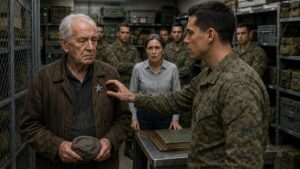
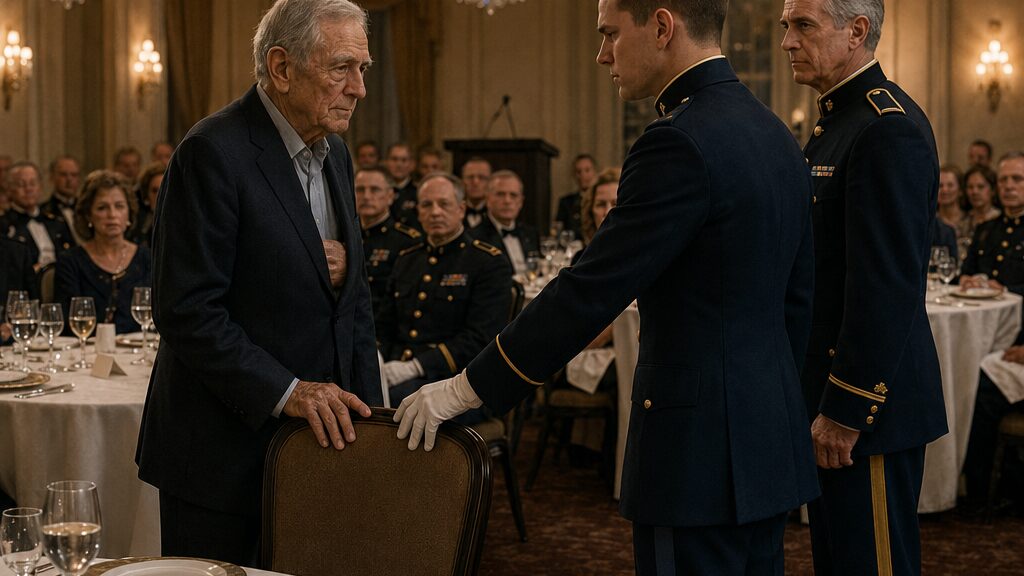
The young Marine put one white-gloved hand on Richard Carter’s chair before Richard had finished unfolding his name card.
“Sir, this section is reserved.”
Richard kept his fingers on the small folded card, pinning it lightly against the white tablecloth so the air from the ballroom doors would not lift it away. The card had been set near the front of Table Seven, just beside a second chair no one had pulled out yet. His own name, printed in black, stood sharp against the cream paper.
Richard Carter.
He looked at the name for one extra second, as if it belonged to someone who might arrive later.
Around him, the ballroom moved with polished urgency. Dress-blue uniforms crossed between round tables. Hotel staff adjusted forks by fractions of an inch. At the far end of the room, the color guard waited beneath chandeliers that made the brass fixtures glow like warmed coins. A low swell of dinner music drifted above murmured greetings and the soft clink of water glasses.
Richard had hoped to slip in quietly.
That hope had lasted less than a minute.
The Marine standing beside him was young, square-shouldered, and careful in the way men are careful when they know others are watching. His name tape was not visible in dress blues, but Richard had heard a coordinator call him Brandon Miller near the entrance. Brandon’s jaw was clean-shaven, his posture exact, his expression trained into politeness that had no room inside it.
“I believe this is my seat,” Richard said.
He said it mildly. Not as a challenge. Not even as a correction.
Brandon glanced down at him, then at the card, then at the front table. His eyes moved quickly, measuring age, suit, slow hands, civilian shoes. Richard could almost feel the decision forming. It was not hatred. Hatred had heat. This was something colder and more common: a young man trying to keep a ceremony neat.
“These seats are for honored guests,” Brandon said.
The words were quiet enough that they did not carry far, but not quiet enough.
A woman at the next table paused with her hand on the back of her chair. A uniformed guest stopped halfway through lowering himself into his seat. Near the podium, a banquet photographer lifted his camera and then lowered it, unsure whether this was a moment he was supposed to catch.
Richard’s right hand moved instinctively toward the inside of his suit jacket.
He stopped it.
Beneath the jacket, the blue ribbon lay against his shirt, folded down where it would not catch the light. He had tucked it there in the car after Christine looked at him too long and said nothing. The weight of it was small. The years behind it were not.
“I have an invitation,” Richard said.
Brandon’s face tightened just a little. “Yes, sir. There are guest tables toward the rear. I can help you find one.”
Richard looked past him.
Table Seven was close enough to the podium that every speech would land there first. Two glasses had been placed at his setting. One for water, one for iced tea. A program lay beside the plate, its cover embossed with the Marine emblem. Beside his own place, the second chair stood empty, pushed in, its table setting complete except for a name card.
Richard had not expected them to set it.
He had asked that they not.
His thumb pressed against the folded card in his pocket, the one he had brought himself. Paper softened from years of being unfolded and folded again. He could feel the crease through the fabric.
“I’m not lost,” he said.
Brandon’s eyes flicked briefly toward the coordinator across the room. Kathleen Young stood near the podium with a clipboard tucked against her dark dress, speaking to hotel staff while scanning the room for problems. This, Richard understood, had become one.
“Sir,” Brandon said, lowering his voice in the way younger people did when they thought kindness required firmness, “we’re starting the formal program soon. I’m happy to escort you. But this table has assigned seating.”
Richard almost smiled. Not because anything was funny. Because assigned seating had once meant transport manifests, casualty lists, bunks on ships, names taped to lockers. It had meant men insisting they would trade places until a senior voice told them no one was trading anything tonight.
He looked again at the card on the table.
Richard Carter.
The old habit rose in him: do not make the young man smaller than he already is. Do not turn your years into a weapon. Do not slap a ribbon on the table and make every face change because you can.
“My name is on the card,” Richard said.
Brandon reached for it before Richard could stop him. Not rudely. Efficiently. He picked it up, read it, and looked back at Richard with confusion sharpening into discomfort.
“This may have been placed incorrectly.”
The words moved through Richard like a draft.
At the nearby table, someone whispered. The woman who had paused earlier looked away, embarrassed for him or by him. Richard could not tell. He had lived long enough to know those two embarrassments often wore the same face.
He drew himself a little straighter.
His back objected. His knee gave its familiar dull warning. His left hand found the top rail of the chair, not leaning hard, only enough to steady the small sway that came when standing too long under bright lights. He had taken three minutes from the lobby to the table because the carpet was thick and the room was crowded and his right foot dragged when he was tired.
Brandon saw the hand on the chair.
Something like pity softened his mouth.
That was worse.
“Sir, let me take care of this,” Brandon said. “You shouldn’t have to stand here.”
Richard let his hand fall away from the chair.
Across the ballroom, an older officer in dress uniform turned from a conversation near the flags. His face was lined, his hair silver at the temples, his bearing so settled that rank seemed less pinned to him than grown into him. Richard recognized him from the invitation packet. Alexander White. Senior officer for the evening. The man had written a handwritten note on heavy stationery, one Richard had read twice and then put in a drawer.
Alexander had not yet seen him.
Richard preferred it that way.
“I can wait,” Richard said.
Brandon looked relieved, as if a difficult civilian had finally agreed to be manageable. He stepped slightly between Richard and the front table, making his body a polite barrier.
Behind him, guests continued taking seats. Programs opened. Chairs scraped softly. The color guard adjusted their positions. The banquet was doing what banquets did: making order out of ceremony and ceremony out of memory.
Richard looked at the empty chair again.
It stood beside his place, untouched.
For one brief moment, he saw another room layered over this one. Not chandeliers. Not white cloth. Not polished shoes. Just a narrow place with men too young to be tired, laughing because if they did not laugh, they would count the hours. A voice beside him saying, Carter, if they ever put you at a fancy table, save me a chair.
Richard blinked and the ballroom returned.
Brandon was still speaking, now with more certainty because Richard had not interrupted him.
“We can put you at the family seating until this is sorted out. I’m sure it’s just a mix-up.”
“It is not a mix-up,” Richard said.
The younger Marine’s eyes hardened at the edge. Not anger, exactly. Strain. He had been given a job, and this old man was becoming the part of the job that would not move.
Kathleen looked over from the podium. Her gaze landed on Brandon, then Richard, then the chair. She started toward them.
Richard felt the blue ribbon beneath his coat, hidden and heavy.
He could have opened the jacket. He could have let the room solve itself. He could have watched Brandon’s face change and accepted the apology that would come quickly after. But then the whole evening would become about the ribbon, and the chair beside him would become decoration.
He kept the jacket closed.
Brandon set the name card back on the table, but not quite where it had been. It sat crooked now, turned slightly away from Richard’s plate.
That small wrongness caught in Richard more sharply than the words had.
He reached out and straightened it.
Brandon watched the gesture, impatient now.
“Sir,” he said, and this time there was no mistaking the command tucked inside the courtesy. He placed his gloved hand on the back of the empty chair beside Richard’s setting. “The front table is reserved for honored guests.”
Chapter 2: The Ribbon He Kept Under His Coat
That afternoon, before the banquet lights and the white gloves and the mistaken chair, Richard had stood in his bedroom with the blue ribbon in his palm and wondered whether cloth could remember weight.
The ribbon was not as blue as it had once been. Time had softened it. The edges were still clean because he had kept it wrapped properly, but the fabric had lost the sharp brightness of official photographs. It looked quieter now. That suited him.
Christine Carter stood in the doorway with his suit jacket over her arm.
“You don’t have to wear it,” she said.
Richard looked at her in the mirror.
She had inherited her mother’s way of holding worry still, as if worry were a cup filled too high. She was no longer young, though some part of him still expected to see her with scraped knees and a school ribbon in her hair when she appeared in doorways. Now her hair was threaded with gray of its own, and the expression on her face was one she had worn through doctor visits, grocery-store stares, and ceremonies he had refused to attend.
“I was asked to,” he said.
“You were invited. That’s different.”
Richard lowered his eyes to the ribbon. “The note said it would mean something to the young ones.”
Christine came into the room and laid the jacket on the bed. The suit was dark, plain, and slightly loose at the shoulders. He had worn it to funerals, mostly. It had the shape of a garment that knew how to stand in silence.
“The young ones can learn without making you sit through a room full of people staring at you.”
“They won’t stare.”
She gave him a look.
Richard allowed the corner of his mouth to move. It was not quite a smile, but it was enough for her to see he knew better.
On the dresser lay the official invitation, the event program folded open, and a small card he had taken from a wooden box that morning. The card was old enough that the paper had yellowed. A name was written on it in Richard’s younger hand, careful block letters darkened by time. He had not shown Christine the name that day. She already knew it. There were names children learned not because adults explained them, but because silence gathered around them year after year until they became part of the house.
Christine picked up the event program.
“‘Annual Marine Scholarship and Recognition Banquet,’” she read. “Dinner. Color presentation. Remarks. Scholarship presentation. Special recognition.” She looked up. “Dad.”
“I asked them not to do that.”
“And did they agree?”
Richard reached for his cuff button and missed the hole the first time. Christine stepped forward, but he gave the smallest shake of his head. She stopped. They had worked out this language over the years: help offered, help refused, dignity left intact.
“They said they understood,” he said.
“That isn’t an answer.”
“No.”
He got the button through.
Christine set the program down. “You could call. Tell them you’re not well.”
“I’m well enough.”
“You were awake half the night.”
“That happens.”
“You sat at the kitchen table with that card until almost two in the morning.”
Richard looked toward the dresser.
The folded card did not accuse him. It never had. That was the problem with promises made to the dead. The dead did not enforce them. They left the living to do that work alone.
Christine softened her voice. “Is this about the chair?”
Richard did not answer at once.
Outside, somewhere down the block, a delivery truck backed up with three dull beeps. The bedroom clock clicked forward. His polished shoes waited beside the bed, toes pointed toward the door like they were more ready than he was.
“I asked them to leave a seat,” he said.
“For him.”
Richard nodded once.
Christine crossed her arms, not in anger but against the ache of knowing. “And if they don’t?”
“Then I’ll place the card myself.”
“And if they ask you to speak?”
“I won’t.”
“You say that now.”
He turned from the mirror. “Christine.”
The word held more exhaustion than warning.
She looked away first. She always did when his voice changed that way, because she knew it came from places she could not enter. After a moment, she picked up the suit jacket and held it open for him. This time he allowed the help.
The jacket settled over his shoulders. He adjusted the sleeves, then lifted the ribbon.
For a moment, he considered leaving it in the drawer.
He could go in plain. He could sit at the table, place the card, eat what was put in front of him, stand for the anthem, and leave before dessert. No one would know. No one would make their face change into reverence. No one would ask him what it had been like, as if memory were a room he could unlock for strangers between courses.
But the invitation had come from Marines.
Young ones would be there.
Scholarship recipients would be there.
Some of them would see old men only as old men unless someone taught them to look longer.
Richard fastened the ribbon under the jacket, low enough that it would not show unless the fabric opened. The medal itself rested against his shirt, cool through the cotton.
Christine watched him.
“You’re hiding it.”
“I’m wearing it.”
“That’s not the same.”
“It is today.”
She sighed, but there was no force behind it. “I’m driving you.”
“I can drive.”
“I know you can. I’m driving you.”
He did not argue. There were battles age won by surrendering early.
In the car, the city moved past in soft late-afternoon light. Flags hung from street poles near the hotel district. A group of young people crossed at a corner laughing around something on a phone. Richard watched their easy bodies, their careless shoulders. He did not resent them. Once, he had been young enough to think old men were mostly made of stories that had already ended.
Christine kept both hands on the wheel.
“Promise me you’ll leave if it gets too much.”
Richard looked down at his hands. The veins stood high now. The knuckles had thickened. His left thumb rubbed the edge of the folded card in his pocket through the fabric.
“I have one thing to do.”
“You keep saying that.”
“It’s true.”
“What thing?”
He watched the hotel come into view, its entrance bright with polished glass and flags near the doors.
“I need to make sure he has a place.”
Christine pulled into the drop-off lane and stopped behind a line of cars. Marines in dress blues moved through the entrance with spouses, parents, children, donors, officials. The scene was formal and ordinary at once, ceremony wrapped around dinner.
Christine turned toward him. “Dad, who is the chair really for?”
Richard kept his eyes on the hotel doors.
“For someone who asked me not to forget him,” he said.
She did not ask more.
At the entrance, a staff member opened the car door and offered a hand. Richard thanked him but used his cane instead, though he disliked the cane almost as much as he disliked being watched. Christine walked beside him into the lobby, close enough to catch him if needed, far enough not to shame him.
Inside, the ballroom doors stood open. Warm light spilled across the carpet. A sign welcomed guests to the banquet. Beyond it, Richard could see rows of round tables and the front dais.
Kathleen Young met them near the registration table with a bright, practiced smile.
“Mr. Carter? We’re honored you came.”
Richard gave a small nod. “Thank you.”
Christine’s eyes moved at once to the packet Kathleen handed over. “He requested no speech.”
Kathleen’s smile held. “Of course. We made a note of his preferences.”
Preferences. Richard almost heard the word rattle in the air like a tray set down too quickly.
He took the packet before Christine could say anything else.
“I’ll be all right,” he told her.
She hesitated. “I can stay.”
“You have your own evening.”
“I can cancel.”
“Don’t.”
The old command still worked, though neither of them liked admitting it. Christine touched his sleeve, just once. Her fingers pressed over the place where the ribbon lay hidden, and her face changed because she felt the shape beneath the coat.
Then she let go.
Richard entered the ballroom alone.
For a minute, it seemed possible that the evening might pass quietly after all. He found Table Seven near the front. He saw his printed name card. He saw the empty chair beside it, set properly, water glass filled, napkin folded.
His throat tightened with something he refused to name.
Then he saw the program beside his plate.
He opened it.
Halfway down the order of events, after the scholarship presentation and before closing remarks, the words waited in neat black print.
Special Recognition: Richard Carter.
Chapter 3: When the Officer Lowered His Voice
Brandon Miller had been told three things before the ballroom doors opened.
Keep the front tables clear.
Do not let guests wander into reserved seating.
If anything looks wrong, fix it before the senior officers notice.
Those instructions had seemed simple when Kathleen Young gave them near the podium, tapping her clipboard with one finger while hotel staff moved around her like a tide. Brandon had repeated them in his head with the relief of a man given a defined mission. A banquet was not combat. It was timing, posture, courtesy, and prevention. He could do that.
Then the old man had appeared at Table Seven.
At first, Brandon saw only the problems. Civilian suit. Slow steps. No visible escort. Hand on the chair. Front-table placement. A name card that might have been set wrong by hotel staff who did not know the difference between a donor table and an honoree table. The man’s voice was calm, but calm did not prove he belonged. Brandon had seen confused guests insist on the wrong room before. He had seen relatives push into reserved areas because grief or pride made every chair feel personal.
He did not see the ribbon.
He saw the old man’s hand tremble when he straightened the card.
That made him gentler than he might have been. It also made him more certain.
“Sir,” Brandon said, his gloved hand resting on the chair, “the front table is reserved for honored guests.”
The old man looked at him for a long moment.
Not angry. Not afraid.
That unsettled Brandon more than either would have.
The ballroom seemed to lean toward them. A few guests had stopped pretending not to watch. Kathleen had begun crossing from the podium, her clipboard held tight. Brandon could feel the danger of delay. If the program started with a seating issue at the front table, it would reflect on everyone assigned to protocol.
“I can move this chair back for you,” Brandon said. “We’ll find where you’re supposed to be.”
The old man’s fingers remained on the top rail.
“If the seat is needed,” he said, “I can stand.”
There was no sarcasm in it. No accusation. That, somehow, made Brandon flush.
“You don’t need to stand,” he said. “That isn’t what I meant.”
He tightened his grip on the chair and drew it back an inch.
The old man’s jacket opened slightly with the movement, because his hand shifted from the chair to his chest. Brandon caught only a flash of blue before the man covered it with his palm.
A ribbon, maybe. Or a tie. Or some old civilian decoration.
Brandon did not know.
But someone behind him did.
“Sergeant.”
The single word cut through the room without being loud.
Brandon released the chair as if it had heated under his hand. He turned.
Alexander White stood three steps away in dress uniform, his face composed so completely that Brandon felt the correction before it arrived. The senior officer’s eyes moved past him, not to the crooked chair, not to Kathleen, not to the watching guests, but to the old man’s hand pressed against his jacket.
For a moment, no one spoke.
Then Alexander removed his cover, tucked it beneath his arm, and stepped around Brandon.
“Mr. Carter,” he said.
The old man’s hand tightened slightly over the hidden ribbon. “Sir.”
Alexander’s voice changed. It did not become softer exactly. It became lower, stripped of ceremony.
“I’m grateful you came.”
Brandon felt the floor seem to drop an inch beneath him.
Kathleen stopped beside the table, smile gone. The woman at the neighboring table put her hand over her mouth. Somewhere near the podium, the photographer lifted his camera again, but Alexander turned his head just enough that the camera lowered.
The old man—Richard Carter, the name card said, and Brandon had held that card in his own hand—gave a small nod.
“I said I would.”
Alexander looked at the chair Brandon had moved. Then he looked at Brandon.
The correction that followed was quiet enough that only those close to Table Seven heard it, which made it worse.
“Put the chair back.”
Brandon moved at once.
His gloves made the chair feel fragile. He lifted rather than dragged it, aligning its legs with the faint marks pressed into the carpet. The old man watched, expression unchanged, but Brandon noticed now what he had missed before: the way every movement cost him something and the way he refused to let that cost become anyone else’s burden.
When the chair was back, Brandon stepped away.
Alexander’s gaze held him there.
“Read the card.”
Brandon swallowed. “Richard Carter.”
“The other one.”
Brandon looked at the empty place beside Richard’s setting. There was no printed card there. Just a clean plate, a folded napkin, a water glass catching chandelier light.
Richard reached into his inner pocket.
His fingers took longer than Brandon expected. No one rushed him. The room had quieted in widening circles, conversations dying as people sensed the shape of something formal, though no one had announced it.
Richard drew out a folded card.
He did not hand it to Brandon. He laid it beside the empty plate himself and pressed the crease flat with two fingers.
The writing on it was too small for Brandon to read from where he stood.
Alexander read it.
His face did not change much. Only the muscles near his jaw set.
“I understand,” Alexander said.
Richard looked down at the card. “I hope you do.”
Brandon stood with his hands at his sides, suddenly aware of every polished button on his uniform, every inch of his young body, every assumption he had made in the name of order. He wanted to apologize, but apology felt too large and too small at the same time. If he spoke, everyone would hear him trying to repair himself.
Alexander turned back to him.
“This table was set this way by request,” he said. “Mr. Carter is exactly where he belongs.”
“Yes, sir,” Brandon said.
The words scraped out.
Alexander’s voice remained controlled. “Courtesy is not protocol after rank has been confirmed. Courtesy comes first.”
Brandon’s eyes dropped before he could stop them.
“Yes, sir.”
Richard shifted.
The small movement drew Alexander’s attention away from Brandon, and for that Brandon was unexpectedly grateful. Richard’s hand had returned to the inside of his coat. The blue ribbon was still mostly hidden, but Brandon could see enough now to know it was not a tie, not a decoration bought for dinner, not anything casual. It lay against the old man with the quiet gravity of something earned at a price Brandon had not imagined before touching the chair.
Alexander took a half step back and inclined his head—not a full bow, not spectacle, just the smallest adjustment of one man making room for another.
“Would you like assistance with your seat, Mr. Carter?”
Richard looked at the chair, then at Brandon.
For one awful second, Brandon thought he would be asked to leave.
Instead Richard said, “The chair is fine.”
He lowered himself slowly. Alexander did not touch him. Brandon did not touch him. Kathleen did not move. It took several seconds, and the room endured those seconds in silence. When Richard was seated, he adjusted the edge of his jacket so the ribbon disappeared again.
Kathleen found her voice first.
“Mr. Carter, I’m so sorry for the confusion.”
Richard did not look at her harshly. “There was confusion.”
It was not forgiveness. It was not condemnation. It was simply true.
Brandon felt the truth of it settle into him more heavily than a reprimand would have. He had wanted the room smooth. In doing so, he had made it cruel.
Alexander faced him again. “Sergeant Miller.”
“Sir.”
“You will remain assigned to Table Seven.”
Brandon lifted his eyes. He did not know whether that was punishment.
Alexander’s expression gave him no answer. “Not to control it. To attend it.”
The difference landed slowly.
“Yes, sir.”
The program began late by four minutes.
The color guard moved into position, and the room rose. Chairs whispered back. Hands settled at sides and over hearts. Richard rose more slowly than everyone else. Brandon saw the effort and stepped half an inch forward before remembering.
Ask. Do not assume.
He stopped himself.
Richard stood on his own. His hand rested lightly on the back of the chair, the same chair Brandon had almost removed. During the anthem, Richard did not sing loudly. His lips moved just enough to form the words. His eyes stayed fixed on the flag.
Brandon stood near the table, rigid with a different kind of attention than before.
He had spent the first part of the evening guarding the order of the room. Now he found himself guarding the space around one old man and one empty chair without fully understanding either.
When the anthem ended and the room sat, Alexander remained beside Richard for a moment longer than necessary.
Guests looked at them, then away, then back again. Whispering began in cautious threads. Brandon heard pieces.
“Who is he?”
“That ribbon—”
“I didn’t realize—”
Richard heard them too. Brandon could tell because his shoulders changed, not shrinking, exactly, but gathering inward under the suit.
Alexander seemed to notice as well.
“Mr. Carter,” he said quietly, “I owe you an apology for how this began.”
Richard looked at him. “You didn’t move the chair.”
“No. But it happened in my room.”
Richard’s gaze moved to Brandon.
There was no escape in it, but there was also no cruelty.
“Rooms are hard things to command,” Richard said.
Alexander absorbed that. Brandon did not yet understand it, but he knew enough to remember it.
Kathleen approached again, more carefully now. “Sir, we’ll adjust anything you need.”
Richard touched the old folded card beside the empty plate.
“Don’t adjust that.”
“No, sir.”
Kathleen’s voice had changed too. Everyone’s had. That was what made Brandon’s stomach twist. Respect had arrived all at once, but it had arrived late, and its lateness stood in the room with them.
Alexander looked toward the podium, then back at Richard. “We can make sure the program reflects your wishes.”
Richard’s eyes went to the printed program beside his plate. The words Special Recognition waited there in black ink, as if ink had authority over the living.
He closed the program.
“Colonel,” he said, though Brandon had not heard Alexander’s rank spoken aloud before and felt another quiet correction in Richard knowing it, “please don’t make the room about me.”
Chapter 4: The Empty Seat at Table Seven
Dinner began with careful hands.
Servers moved between tables carrying plates beneath silver covers, their black sleeves passing close enough to brush the white chair backs without touching them. Water glasses filled, bread plates shifted, knives aligned themselves under hotel light. The ballroom recovered its rhythm because rooms full of people often preferred rhythm to truth.
Richard sat at Table Seven with his jacket closed.
To his left, the empty chair remained exactly where Brandon had replaced it. The old folded card lay beside the untouched plate, its creases pressed flat under Richard’s fingertips. He had placed it at a slight angle so he could see the name without making anyone else read it. The handwriting looked younger than he felt.
The guests at Table Seven tried not to look at it.
That was the first new discomfort.
Before Alexander White had spoken, Richard had been an old man in the wrong place. Afterward, he became something else just as flattening: a question everyone was afraid to ask.
A uniformed guest across from him lifted his fork, set it down, and said, “Mr. Carter, can I get you anything?”
Richard looked at the full water glass, the full iced tea glass, the bread untouched on his plate. “No, thank you.”
The man nodded too quickly.
On Richard’s right, a woman in formal dress leaned toward him with careful gentleness. “It’s an honor to sit with you.”
He gave the same answer. “Thank you.”
She waited, perhaps expecting more, perhaps hoping the proper words would unlock a story. Richard took his napkin from the table and laid it across his lap. The movement ended the conversation without making it rude.
Across the ballroom, the podium speaker welcomed guests, thanked sponsors, and spoke about young Americans carrying forward the values of service. Richard listened because listening was a form of respect. But the words arrived wrapped in polished phrases, each one clean enough not to cut anyone.
Honor. Sacrifice. Legacy.
He had heard those words many times. They were good words. He did not dislike them. He only knew they became dangerous when people used them to cover names.
Brandon stood several feet away near the service path, hands behind his back, shoulders squared. He no longer scanned the room with the busy impatience he had shown before. His attention stayed on Table Seven with a kind of disciplined unease. When a server approached from Richard’s left, Brandon moved half a step, saw the path was clear, and stopped himself before interfering.
Richard noticed.
He noticed everything now, though he wished he did not. The whispers from the next table. The glance toward his coat. The way one guest’s eyes dropped to his chest whenever he shifted. The way Kathleen Young paused near the podium, spoke into the ear of the banquet photographer, and pointed subtly away from Table Seven.
She meant well, Richard thought.
Most people did.
That had never made things simple.
The first course was placed before him, a small salad arranged with more care than appetite required. Richard lifted his fork, then lowered it when his hand brushed the folded card.
The name on it was not printed. It had never been printed anywhere that mattered after the service ended. No podium had spoken it in decades. No program had listed it beside donors and ranks and scholarship winners. Yet here it was, in Richard’s own hand, sitting at a formal table under chandeliers as if it had always belonged there.
Richard touched the corner of the card.
The man across from him noticed. “Was he family?”
Richard looked up.
The man’s face reddened immediately. “I apologize. I shouldn’t have asked.”
Richard could have let the apology close it. He usually did.
Instead, because the chair had already been moved once and because the evening was already failing to stay quiet, he said, “Not by blood.”
The woman beside him lowered her gaze.
The man waited.
Richard took a breath that did not quite fill him. “He was younger than I was. That mattered to him more than it mattered to anyone else.”
No one at the table moved.
The podium speaker’s voice continued in the distance, thanking the scholarship committee. Applause rose from the back of the ballroom and passed over Table Seven like weather.
The man across from Richard said, “Did he serve with you?”
Richard’s hand tightened once on the fork. Not enough to shake it. Enough that he saw Brandon notice from the service path.
“Yes,” Richard said.
The question that followed did not need to be spoken. It arrived in every face turned toward the empty chair.
Richard let silence answer it.
He looked down at his salad. He had no desire to eat, but he took a bite because the body required ordinary acts even when memory did not. The lettuce was cold, the dressing too sweet. He chewed slowly and thought of a tin cup passed from hand to hand, of somebody laughing with half his mouth full, of a voice saying that if he ever saw a ballroom, he would steal the bread rolls first.
The empty chair remained empty.
After the first course, Alexander came to the table. He did not approach from behind Richard. He came from the front, where Richard could see him, and stopped at a respectful distance.
“Mr. Carter,” he said, “may I sit for a moment?”
Richard nodded toward the empty chair, then stopped himself. A flicker crossed Alexander’s face; he had understood without being told.
“There’s another chair,” Richard said.
A hotel staff member brought one quickly. Too quickly. The room had become alert to Richard’s smallest needs, and that alertness felt like a net.
Alexander sat beside the table, not at it.
That, Richard appreciated.
“I spoke with Kathleen,” Alexander said. “Your request about the program was noted.”
Richard looked toward the podium. Kathleen stood with her clipboard, speaking to the podium speaker, who glanced toward Table Seven and then away.
“Noted,” Richard said.
Alexander accepted the word’s edge. “Not followed.”
“No.”
“I can stop it.”
Richard looked at him then.
Alexander’s face held sincere control, the kind senior officers practiced until sincerity itself wore a uniform. He meant what he said. If Richard asked, Alexander would walk to the podium, change the order, remove the recognition, and bear the displeasure of every sponsor and committee member in the room.
But the program was not the whole problem.
“If you stop it,” Richard said, “they’ll still wonder.”
“They already wonder.”
“That’s not the same as knowing what to do with it.”
Alexander sat back slightly.
Richard touched the folded card again. “Most people don’t mean harm when they turn a man into a lesson.”
Alexander was quiet.
At the edge of Richard’s vision, Brandon looked down.
The dinner plates arrived. Conversation resumed in patches, softer than before. Richard ate some of the entrée because Christine would ask later and know if he lied. The chicken was tender, the vegetables bright, the roll warm enough to steam when he tore it open. He set half the roll on the small bread plate beside the empty chair before he thought.
The woman at his table saw.
So did Brandon.
Richard’s hand paused above the plate. He nearly took the bread back. Then he left it there.
Some things a man did not need to explain.
Midway through dinner, the scholarship recipient stood near the podium, nervous and young, and thanked the room for believing in future service. His voice cracked once. The crowd smiled kindly. Richard listened with more tenderness than he expected. Young voices were allowed to crack. That was part of being young.
When the applause faded, Kathleen walked swiftly toward Alexander, who had returned to a position near the flags. She held the program against her chest and spoke low, but Richard had spent years reading conversations from across noisy rooms.
Alexander’s head turned once toward Table Seven.
Kathleen shook her head in that determined way efficient people used when they believed urgency could become compassion if polished enough.
Richard looked away.
He did not need to hear the words to know the meaning. The room had been given a story, and now the people running the room wanted to shape it before it slipped out of their hands.
Brandon came closer to refill Richard’s water, though a server had already done it.
He stopped when he saw the glass was full.
For a second, he stood there with nothing to do.
Richard said, “Sergeant Miller.”
Brandon straightened. “Sir.”
Richard nodded toward the empty chair. “Leave that plate as it is.”
Brandon’s eyes moved to the half roll beside the folded card.
“Yes, sir.”
Not loud. Not dramatic. But he said it as if it mattered.
Richard felt something in his chest loosen and tighten at once.
Across the room, Kathleen finished speaking to Alexander and turned toward the podium speaker. Alexander remained still for one beat too long before following.
The banquet music softened. The photographer moved to the side aisle. The podium speaker reviewed a note card, then looked toward Richard with a face already arranged for solemnity.
Richard closed his hand over the old folded card.
The empty chair beside him seemed suddenly brighter under the chandelier than any medal hidden under his coat.
Near the flags, Kathleen leaned close to Alexander and said something Richard could finally read on her lips more than hear.
The board wants to add a surprise tribute.
Chapter 5: An Apology That Still Missed the Point
Brandon found Richard in the hallway near the service doors because he had followed the empty plate.
He had not meant to follow it. Not at first. A server had lifted Richard’s dinner plate, then reached toward the untouched setting beside him, and Brandon had stepped in too quickly.
“Leave that one,” he said.
The server blinked.
Brandon lowered his voice. “Please.”
Richard had already gone, moving slowly through the side exit while the podium speaker introduced the scholarship committee. The old folded card was no longer beside the plate. The half roll remained there, absurd and solemn.
Brandon stood a moment staring at it.
Then he saw something small on the tablecloth near Richard’s glass.
The printed name card.
Richard Carter.
It must have slipped behind the water glass when Richard stood. The first card. The one Brandon had picked up and judged like a misplaced object. Its corner had bent slightly where Brandon’s glove had pressed too hard.
He lifted it with both hands.
In the hallway, the ballroom sound dulled into a low murmur behind the doors. The air smelled faintly of coffee, furniture polish, and the steam from covered trays lined against the wall. Richard stood near a narrow table stacked with extra programs, one hand resting on the edge. He was not looking back toward the banquet. He was looking at nothing Brandon could see.
Brandon stopped several feet away.
“Mr. Carter.”
Richard turned.
The hallway light was less kind than the ballroom chandeliers. It showed the fine lines around his mouth, the tiredness beneath his eyes, the careful way he held himself upright. Without the room watching him, he looked older. Not weaker. Older in a way that made Brandon feel younger than he wanted to be.
Brandon held out the name card.
“You left this.”
Richard looked at it but did not take it.
So Brandon stepped closer, then thought better of it and stopped again. He held the card with both hands, palms up, as if returning something ceremonial. The gesture felt awkward. He did it anyway.
Richard noticed.
After a moment, he took the card.
“Thank you.”
Brandon’s throat worked. He had planned words while crossing the ballroom. They had arranged themselves neatly in his mind. Sir, I apologize for my conduct. Sir, I failed to verify before acting. Sir, I showed poor judgment.
Now each one sounded like something written on a report.
“I’m sorry,” he said.
Richard slid the name card into his jacket pocket. “For what?”
Brandon’s answer came too fast. “For not recognizing you.”
Richard looked at him.
The silence that followed was not cruel. It simply refused to move.
Brandon felt his face heat. “For moving your chair,” he added.
Richard still waited.
“For assuming you were in the wrong place.”
The old man’s eyes stayed on him, steady and tired.
Brandon forced himself not to look away. “For making you explain what I should have checked.”
Richard lowered his hand from the table.
“That one is closer,” he said.
The words did not absolve him. They gave him a direction.
Brandon nodded once. “Yes, sir.”
Richard studied him. “Do you know why Colonel White corrected you?”
“Because you’re an honored guest.”
Richard’s mouth tightened, almost invisibly.
Brandon heard the mistake after he said it.
“Because I was disrespectful,” he tried.
“Also closer.”
Brandon stood very still.
From the ballroom came a burst of applause. The sound struck the service hallway flat and thin. Richard glanced toward it, and his shoulders drew inward just enough for Brandon to see that applause did not comfort him.
“I thought respect meant knowing where everyone fits,” Brandon said, more quietly.
Richard’s gaze returned.
“At events like this,” Brandon continued, “rank, seating, titles, order. If it’s wrong, people notice. If I let it get sloppy, it looks like I don’t care.”
“And do you?”
“Care?”
Richard nodded.
“Yes, sir.”
“About what?”
The question opened under him.
Brandon had answers. His uniform. His evaluation. The senior officers. The reputation of the unit. The event running cleanly. His own fear of being the Marine someone remembered for the wrong reason. All true. None of them large enough.
“I don’t know,” Brandon said.
Richard looked at him for a long time. Then he gave the smallest nod, as if that answer had more use than the others.
“That’s a start.”
Brandon swallowed. “I embarrassed you.”
“You embarrassed yourself.”
It landed harder because Richard said it gently.
“Yes, sir.”
“And you moved his chair.”
Brandon looked toward the ballroom doors.
The empty place. The half roll. The folded card he had not been allowed to read.
“I didn’t know it was his,” he said.
“No.”
“I should’ve asked.”
“Yes.”
The plainness of that word stripped away the last defense Brandon had been holding.
He nodded, once, but his eyes stung in a way that startled him. He was not a child. He was a Marine in dress blues standing in a hotel service hallway while trays rattled behind him. He had no right to feel wounded by being corrected.
Richard seemed to understand that too.
“Sergeant Miller,” he said.
Brandon straightened. “Sir.”
“You’re trying to be the kind of man who doesn’t make mistakes in public.”
Brandon said nothing.
“That kind of man learns slowly.”
Brandon looked at him.
Richard’s face had changed. Not softened exactly, but opened by a fraction. “The kind who can admit he was wrong while people still remember it—he has a better chance.”
The ballroom doors opened behind them. Kathleen stepped into the hall with Alexander beside her. They both stopped when they saw Richard and Brandon.
Kathleen recovered first. “Mr. Carter, there you are. We’re nearing the next portion of the program.”
Richard’s expression closed again.
Alexander noticed. His eyes moved from Richard to Brandon to the card half visible in Richard’s pocket.
“Everything all right here?” he asked.
Brandon answered before Richard had to. “Yes, sir. I was returning Mr. Carter’s name card.”
Alexander gave him a brief look that contained more assessment than approval.
Kathleen clasped her clipboard. “Mr. Carter, we wanted to speak with you about a small adjustment.”
Richard said nothing.
“It would be very brief,” she continued. “Not a speech from you. Just a moment of acknowledgment. The board feels the room would benefit from understanding who is with us tonight.”
Richard’s hand went to his coat.
Brandon saw it and knew, with a sudden clarity that made his stomach drop, that everyone kept looking for the ribbon while Richard kept trying to cover something else.
“Ms. Young,” Alexander said, voice controlled.
Kathleen turned to him. “Colonel, I know his request. But after what happened, people are already aware something significant was missed. If we handle it properly, it could become a respectful moment instead of awkward whispers.”
“A respectful moment,” Richard repeated.
Kathleen looked at him, and for the first time Brandon saw that she was not careless. She was anxious. She wanted to repair damage with the tools she trusted: timing, lighting, language, applause placed at the correct interval.
“Yes,” she said. “Something dignified.”
Richard’s eyes moved toward the ballroom doors. Through the narrow gap, Brandon could see Table Seven. The empty chair waited in its place. The folded card was too far away to read.
“Dignified for whom?” Richard asked.
Kathleen had no immediate answer.
Alexander stepped closer. “Mr. Carter, we can remove the segment.”
Richard looked back at him. “Can you remove what the room already thinks it knows?”
No one spoke.
The podium speaker’s voice rose inside the ballroom, warm and practiced. “Before we move to our closing remarks, we have an unexpected moment of honor tonight…”
Richard closed his eyes briefly.
Brandon looked at the old man’s hand against the jacket, at the hidden blue ribbon beneath it, at the name card now returned to the right pocket with more care than Brandon had shown it the first time.
He wanted to help.
For once, he did not know whether helping meant moving or standing still.
Chapter 6: The Tribute He Never Asked For
By the time Richard returned to Table Seven, the room had already prepared itself to admire him.
That was what he saw first.
Not respect. Admiration.
There was a difference, though it was hard to explain to people who meant well. Respect left room around a man. Admiration crowded close, hungry for shape. It wanted a story it could hold in one hand and repeat later without hurting too much.
The podium speaker stood beneath the lights with a note card in both hands. Kathleen waited off to the side, face composed but tense. Alexander stood near the flags, not behind the podium, which told Richard he had not fully agreed and had not fully stopped it either.
Brandon held the ballroom door open.
Richard paused before entering.
“Sir?” Brandon said softly.
Richard looked at him.
The young Marine no longer had his earlier certainty. He was watching Richard’s face, not the room’s timing. That small change mattered. It did not fix anything. It mattered anyway.
Richard stepped back into the ballroom.
A hundred heads turned with the cautious unity of people who believed they were about to witness something meaningful. Some faces had already softened. Some eyes shone with anticipation. The photographer stood in the side aisle, camera lowered but ready. The scholarship recipient sat very straight near the front, hands folded around a program.
Richard’s chair waited.
So did the empty one.
He sat slowly. No one spoke while he did. That silence might have been consideration or might have been performance. He could not tell anymore.
The podium speaker smiled with solemn warmth.
“Ladies and gentlemen, sometimes an evening meant to honor the future is also reminded of the lives of service that made that future possible.”
Richard looked down at his hands.
The blue ribbon lay under his jacket. He could feel the medal’s edge against his shirt with each breath. It seemed heavier under public attention, as if metal changed weight when looked for.
The speaker continued. “We are privileged tonight to have among us Mr. Richard Carter, whose distinguished service—”
Richard’s fingers closed around the arms of the chair.
Distinguished. Service.
Clean words again.
He saw, not for the first time, how a room could take the hardest part of a man’s life and polish it until no one had to touch the sharp edge.
Across from him, the man at the table lowered his eyes. The woman beside him pressed her napkin to her lips. They were moved already. The story had not even been told, and they were moved.
Richard turned toward the empty chair.
On its plate lay the half roll, still untouched. Beside it, the folded card waited where he had returned it after the hallway. Its old paper looked plain under the chandelier, almost out of place among linen and crystal. That plainness steadied him.
He had promised a young man once.
Not in a dramatic hour. Not with music swelling. There had been no flag in that memory, no podium, no polished shoes. Only exhaustion, fear made ordinary by repetition, and a joke spoken because both of them needed to pretend the future was still making plans.
Carter, if they ever put you at a fancy table, save me a chair.
Richard had laughed then. He had been young enough to laugh.
The speaker said, “Mr. Carter, would you please stand so we may recognize—”
“No.”
The word left Richard before he decided to shape it.
It was not loud.
It reached every corner of the ballroom anyway.
The podium speaker stopped with his mouth slightly open. Kathleen froze. Alexander’s chin dipped once, as if he had expected this and still regretted not preventing it. Brandon shifted at the edge of the room, then stopped himself.
Richard placed both hands on the table and rose.
No one helped him. For that, he was grateful.
The room remained suspended while he found his balance. His knee argued. His back tightened. The ribbon tugged beneath his coat as the jacket fell open a little, showing a narrow strip of blue.
The photographer raised the camera.
Alexander moved his eyes, not his head.
The camera lowered.
Richard looked toward the podium but did not walk there. The microphone waited beneath the lights like a trap. He stayed at Table Seven, one hand resting near the empty chair.
“I asked not to be introduced that way,” he said.
The podium speaker’s face went pale. “Mr. Carter, I apologize. We only meant—”
“I know what you meant.”
That stopped him.
Richard drew a slow breath. He could feel the room asking him to make this easy. To smile. To say he was humbled. To let them clap and sit down feeling they had done right by him.
His hand moved to the folded card.
He did not pick it up yet.
“When Sergeant Miller moved that chair,” Richard said, and Brandon’s face tightened across the room, “he made a mistake.”
No one looked at Brandon openly, which meant everyone wanted to.
Richard kept his eyes on the table. “It was not the worst mistake in this room tonight.”
Kathleen lowered her clipboard.
“The worse mistake,” Richard said, “is thinking the chair matters because of who I am.”
The silence changed.
It became less polished.
He felt Alexander watching him. Christine was not in the room, but he could imagine what she would do: one hand at her mouth, angry and proud and frightened for him all at once.
Richard opened his jacket with two fingers.
The blue ribbon came into view.
A small movement passed through the ballroom. Not applause. Recognition trying to become sound and stopping itself.
Richard looked down at the ribbon. “This has made many people speak gently to me who did not know how to speak to me one minute before.”
No one moved.
“I have been grateful for gentleness,” he said. “I have also been tired of what people ask it to do.”
The speaker stepped back from the microphone.
Richard took the folded card from beside the empty plate.
His hand shook. He let it. Hiding the tremor would make the tremor more important than the name.
“There is a chair at this table because a young Marine once made a foolish request in a place where neither of us had any business imagining chandeliers.”
A few guests lowered their heads.
“He told me if I ever sat at a fancy table, I should save him a seat.” Richard looked at the empty chair. “I told him he could save his own seat.”
The words nearly failed there.
They did not.
“He did not get to.”
A sound moved through the room then. Not a gasp. Something smaller. The sound of people understanding too late that they had been ready to applaud the wrong part.
Richard held the card, still folded.
“I came tonight because scholarships matter. Young Marines matter. Memory matters. But I did not come to be made large enough that he disappears behind me.”
He looked at Kathleen then, not accusing her. That made her eyes fill faster.
“I know you meant honor,” he said. “But honor is not always putting a man under lights. Sometimes it is leaving room beside him.”
Kathleen nodded once, barely.
Alexander stepped away from the flags. For a moment, Richard thought he would come to the table and take control of the room, as officers are trained to do when silence becomes uncertain.
Instead, Alexander stopped.
He waited.
Richard’s gaze found Brandon.
The young Marine stood near the service aisle, white gloves at his sides, face stripped of every protocol expression he had worn earlier. He looked afraid of doing the wrong thing again.
That, Richard thought, might be the beginning of wisdom.
“Sergeant Miller,” Richard said.
Brandon straightened. “Sir.”
Richard held up the folded card. “Come here, please.”
Brandon crossed the room without hurry. His shoes made almost no sound on the carpet. When he reached Table Seven, he did not step too close.
Richard looked from him to the empty chair.
Brandon understood only part of it. Richard could see that. But part was enough for the next step.
“The chair is crooked,” Richard said.
Brandon looked down.
It was barely angled, perhaps from the server passing, perhaps from Richard rising. Earlier, Brandon would have corrected it instantly to restore order. Now he looked at Richard first.
“May I?” Brandon asked.
Richard closed his eyes for half a second.
When he opened them, the room looked different. Not healed. Not solved. Different.
“Yes,” he said.
Brandon placed both hands on the back of the empty chair and moved it carefully, not dragging, not rushing, setting it square with the table as if the person it waited for might arrive and notice. Then he stepped back.
Richard held out the folded card.
Brandon did not take it until Richard gave the smallest nod.
The card passed from old fingers to white gloves.
At the podium, the microphone still waited.
Richard did not go to it.
He looked at Brandon and said, “Read the name.”
Chapter 7: The Room Learned How to Stand Quietly
Brandon looked down at the folded card as if it weighed more than paper should.
The ballroom waited.
No one coughed. No chair shifted. Even the hotel staff along the wall had gone still with serving trays held carefully at their sides. The microphone at the podium remained unused, its small red light glowing in front of the speaker who had stepped away from it. The room had been prepared for a tribute. Instead, it had been asked to listen.
Brandon unfolded the card.
His gloves made the old crease awkward. He took longer than he wanted to, but he did not rush. Richard watched the care in that small act and felt the sharpness in his chest ease by a fraction. Earlier, those same white gloves had moved his chair aside. Now they held a dead man’s place as if paper could bruise.
Brandon read the name silently first.
His throat moved.
Then he lifted his eyes, not to the room, but to Richard.
Richard gave him one nod.
Brandon turned slightly, enough for his voice to carry without using the microphone.
“Lance Corporal Harris.”
That was all.
No first name. No rank beyond what the card held. No story dressed up for strangers. Just the name Richard had carried long after official lists had filed it away and family photographs had faded at the edges.
The sound entered the ballroom differently from the speaker’s polished phrases. It did not ask to be admired. It asked to be held.
Richard looked at the empty chair.
“He was twenty-one,” he said.
A few people lowered their heads. The young scholarship recipient stared at the table in front of him, both hands tight around the program.
Richard kept standing. His legs hurt now. The pain was steady, honest, and almost welcome because it belonged to the present.
“He was not a symbol,” Richard said. “He cheated at cards badly. He sang under his breath when he was afraid. He had a habit of saving half his bread because he said every meal should leave proof you expected another.”
The half roll on the empty plate seemed to draw every eye.
Richard almost regretted saying that much. Then he looked at Brandon, who was not looking at the ribbon anymore. He was looking at the chair.
That was better.
“I came tonight to keep a promise,” Richard said. “Not to be thanked for surviving it.”
Alexander stood near the flags with his hands at his sides. He had the posture of command, but for the first time that evening he did not use it. Kathleen held her clipboard against her body as if she had forgotten what it was for. The podium speaker stepped farther away from the microphone.
Richard touched the blue ribbon.
“This is part of my life,” he said. “I will not pretend it is not. But it is not the whole of it. And it is not large enough to hold everyone who should be remembered.”
He looked around the room then. At the older guests who understood more than they wanted to. At the young Marines who understood less than they would someday. At the donors and parents and staff and officers who had come for a ceremony and found themselves inside something less comfortable.
“If you want to honor me,” Richard said, “do not make me bigger. Make room.”
No one applauded.
For one fragile second, Richard feared they had not understood.
Then the man across from him at Table Seven stood. Not sharply. Not for display. He stood because the empty chair had become impossible to sit beside casually. The woman next to Richard stood too, slowly, one hand resting near her plate. Around the ballroom, others began rising, but not with the burst of a standing ovation. There was no wave of praise, no clapping, no shouted thanks.
They stood quietly.
Richard’s hand tightened on the chair before him.
He had not asked them to stand. If the room had roared, he might have sat down and closed himself away from it forever. But this silence did not crowd him. It made space. It left the empty chair visible.
Brandon still held the folded card.
Richard looked at him. “Put it back, please.”
Brandon turned to the place setting. He did not lean across it carelessly. He stepped to the side, placed the card beside the plate, and adjusted it so it faced the empty chair rather than the room.
Richard saw that.
So did Alexander.
Brandon stepped back. His eyes were wet, but he did not wipe them. Some lessons were not improved by hiding the cost.
Richard lowered himself into his chair. The motion was slow, and the old instinct in Brandon made him move half a step forward.
Then he stopped.
“May I help you, sir?” he asked.
Richard paused with one hand on the chair arm.
The question was so small that most of the room could not have heard it. But it traveled through Richard more deeply than the speech had. Not because help was grand. Because it had asked permission before entering his body’s struggle.
“Yes,” Richard said.
Brandon stepped in and steadied the chair, not Richard. He held it in place while Richard sat. When Richard was settled, Brandon released it and stepped away.
Alexander crossed the room then, but not to take over. He approached the podium and removed the speaker’s note cards gently from the stand. He looked at Kathleen, who gave a small nod through tears she was trying to master.
Alexander spoke without touching the microphone.
“We will take a moment,” he said.
No one asked how long.
The silence that followed was not empty. Richard heard small sounds inside it: a breath caught and released, a fork set down with care, fabric shifting as people stood without fidgeting. Beyond the ballroom doors, a cart rolled somewhere in the hotel hall, ordinary life continuing because it always did.
Richard looked at the empty chair.
For years, the promise had belonged only to him. It had lived in drawers, in pockets, in the quiet before sleep. He had feared that bringing it into a room like this would cheapen it, would turn the dead into a story people could applaud and leave behind.
But the room was not applauding.
It was standing quietly.
Brandon remained beside Table Seven. He did not face the audience. He faced the chair, as though guarding it from being misunderstood again.
After a while, Richard lifted one hand.
People sat.
Not all at once. Slowly, unevenly, respectfully. Chairs made soft sounds against carpet. The room returned to itself, but changed. No one seemed eager for the next program item. No one reached for applause to seal the moment shut.
The scholarship recipient rose from his seat before anyone told him to. He carried his program to Table Seven, stopped at the proper distance, and looked at Richard.
“Sir,” he said, voice shaking, “may I leave this there?”
Richard looked at the program.
It was folded to the page with the scholarship listing, not the special recognition. There was no drama in the gesture. Just a young man asking whether his future could sit for a moment beside someone else’s past.
Richard nodded.
The young man placed the program near the empty plate and returned to his seat.
Kathleen quietly removed the remaining tribute cards from the podium.
Alexander saw it and said nothing.
Brandon looked at Richard again, waiting.
Richard understood then that the young Marine wanted an order, some clean instruction that would tell him what a changed man did next.
Richard did not give him one.
Instead, he said, “Sergeant Miller.”
“Yes, sir.”
“After dinner, make sure that card comes back to me.”
Brandon’s eyes moved to the folded card beside the empty plate.
“Yes, sir.”
“With both hands.”
Brandon swallowed. “Yes, sir.”
Richard leaned back slightly. The pain in his legs had settled into a dull throb. The blue ribbon lay visible now, a strip of color against his dark suit. He did not cover it. He also did not adjust it for the room.
For the rest of the program, no one mentioned special recognition.
The closing remarks were shorter than planned. The podium speaker thanked the scholarship recipient, the families, the Marines present, and the staff. When his eyes moved toward Richard, they did not linger. That restraint, too, was a form of repair.
When the final words ended, the room did not rush him.
Guests began moving carefully around Table Seven, not avoiding Richard, not surrounding him. A few stopped and spoke simple words.
“Thank you for coming.”
“I’m glad he had a chair.”
“Good evening, Mr. Carter.”
No one asked what it had been like. No one asked to see the ribbon more clearly. No one asked for a photograph.
Kathleen approached last. Her clipboard was gone.
“I’m sorry,” she said.
Richard looked up at her.
She did not add an explanation. She did not say she had meant well.
That was why he answered, “Thank you.”
Alexander came beside her. “Mr. Carter.”
“Colonel.”
Alexander’s eyes went to the empty chair. “You were right to stop us.”
“I was late stopping you.”
Alexander accepted that. “So was I.”
The admission sat between them, plain and useful.
Brandon returned as the hotel staff began clearing distant tables. He stood beside the empty place and waited until Richard looked at him.
“May I return the card now, sir?”
Richard nodded.
Brandon lifted the folded card with both hands, careful not to disturb the program or the half roll. He brought it to Richard and held it out.
Richard took it.
The paper was warm from the young man’s gloves.
Brandon said, “I’ll remember his chair.”
Richard studied him. “Remember why you’re remembering it.”
Brandon nodded slowly.
“Yes, sir,” he said. “Because he was a man before he was a lesson.”
Richard folded the card once along the old crease and put it back into his inner pocket, beside the ribbon.
Only then did he allow himself to breathe as if the evening had finally loosened its grip.
Chapter 8: Respect After the Banquet Lights Went Out
After the ballroom lights dimmed, the empty chair looked like any other chair.
That was the first mercy of the night.
The white tablecloths had been stripped from half the tables. Glasses stood in gray plastic racks. The flags had been removed from their stands near the podium, and the microphone lay unplugged on its side. Without music and speeches, the room became a room again: carpet, walls, stacked plates, tired staff, the faint smell of coffee cooling in silver urns.
Richard stood near Table Seven with his coat buttoned.
The blue ribbon was hidden again, not from shame but because the night no longer required it. In his inner pocket, the folded card rested beside it. He had checked twice with his fingers, a habit he did not apologize for.
Christine arrived just as the hotel staff began rolling the tables away.
She stopped inside the ballroom doors.
Richard saw at once that someone had told her something. Not everything. Enough. Her eyes moved over him quickly: his face, his posture, his hands, the space beside him where the empty chair had been.
“You said you’d leave if it got too much,” she said.
“I don’t remember promising that.”
“You never do.”
Her voice trembled at the edge, but she did not come rushing across the room. She had learned not to make fear look like rescue unless rescue was needed.
Richard took one step toward her, then another. His knee had stiffened during the last half hour. The effort must have shown because Christine moved forward.
Before she reached him, Brandon stepped from the side aisle.
He had changed in no obvious way. Same dress blues. Same white gloves. Same polished shoes. But the young man who had blocked Richard from his seat seemed farther away now than the banquet’s opening remarks.
“Mr. Carter,” Brandon said.
Richard turned.
Brandon stood still, hands visible at his sides. “Your daughter’s car is at the front entrance. There’s a curb drop. It may be easier from the west door.”
Christine glanced at Richard, then at Brandon.
Richard said, “You arranged that?”
“I asked the hotel staff which exit had the shorter walk,” Brandon said. “I didn’t move anything.”
Richard heard the care in the last sentence.
Christine heard it too. Her expression softened slightly.
Brandon continued, “May I walk with you?”
Richard looked at him for a moment.
Earlier, Brandon would have taken his arm or cleared a path or spoken to him in the public voice people used with frail strangers. Now he had asked a question and left space for refusal.
“Yes,” Richard said.
They crossed the ballroom slowly. Christine walked on Richard’s right. Brandon stayed to his left, not touching him, close enough to be useful and far enough to respect the effort. When they reached the side exit, Brandon opened the door and held it without making a display.
In the quiet hallway, the banquet sounds disappeared behind them.
Christine looked at Brandon. “Were you the one who moved the chair?”
Brandon did not look to Richard for rescue.
“Yes, ma’am.”
She studied him.
“I was wrong,” Brandon said.
Christine’s face did not soften all at once. Richard watched her measure the young Marine the way a daughter measures anyone who has hurt her father: not for rank, not for apology, but for whether the apology has roots.
“What did you do after?” she asked.
Brandon hesitated only a moment. “I put it back.”
Christine looked at Richard.
Richard said, “He asked first, later.”
That did soften her.
The west exit opened into a covered drive where night air moved cool against Richard’s face. Cars waited beneath hotel lights. A flag near the entrance shifted faintly in the breeze. Christine’s car sat near the curb, hazard lights blinking.
Richard stopped before the last step down.
It was not a high curb. It was only a curb. That was the indignity of age: the small things could become negotiations.
Brandon saw him looking.
He did not move.
“May I offer my arm, sir?”
Richard looked at the white glove, then at Brandon’s face.
There was no pity there. No hunger to be forgiven. Only attention.
Richard nodded.
Brandon offered his arm and held steady while Richard stepped down. He did not pull. He did not hurry. At the bottom, he waited until Richard released him first.
Christine opened the car door.
Richard lowered himself into the seat with the slow care of a man who had spent the evening standing longer than he should have. Christine leaned in to adjust the seat belt, then stopped and looked at him.
“May I?”
Richard almost laughed.
Not because it was funny. Because the lesson had traveled faster than he expected.
“Yes,” he said.
She buckled it.
Brandon stood outside the open door.
For a moment, none of them spoke. The night had taken the large words out of them and left only the useful ones.
Richard reached into his inner pocket and drew out the printed name card from the banquet table. Richard Carter. The corner was still slightly bent from Brandon’s first handling.
He looked at it, then at the young Marine.
“Keep this until you can return it properly,” he said.
Brandon’s eyes widened. “Sir?”
“Not tonight. Later.”
Brandon accepted the card with both hands.
This time, Richard did not need to tell him.
Christine closed the car door gently. Through the window, Richard saw Brandon step back from the curb and stand straight—not saluting, not performing, just present. Alexander appeared near the entrance behind him, speaking quietly with Kathleen. Kathleen’s clipboard was still nowhere in sight.
Christine drove away without turning on the radio.
For several blocks, neither of them spoke.
The city lights passed over Richard’s lap in pale bands. Beneath his coat, the blue ribbon and folded card rested against him. He felt tired beyond bone, but not emptied. That surprised him.
Christine kept her eyes on the road. “Was it awful?”
Richard watched a streetlamp slide across the windshield.
“Parts.”
“Was it worth going?”
He thought of the chair replaced with care. The half roll left untouched. The room standing quietly instead of applauding. Brandon’s voice reading a name he had not earned the right to know until he knew how to hold it.
“Yes,” Richard said.
Christine breathed out slowly. “Good.”
A week later, Richard went to the veterans’ hall on a Thursday morning because Thursday was when the coffee was strongest and the room was least crowded.
The hall was plain, low-ceilinged, and smelled of old wood, paper cups, and raincoats drying on hooks. A few role-only older veterans sat near the back arguing softly over a card game. The bulletin board held notices for rides, memorial services, and a scholarship thank-you letter pinned slightly crooked.
Richard stood before that board with his cane in one hand and the folded card in his pocket.
The door opened behind him.
He did not turn at once.
Footsteps entered, paused, then approached slowly.
“Mr. Carter?”
Richard turned.
Brandon stood inside the veterans’ hall in civilian clothes, a dark jacket held in one hand. He looked less certain without the dress blues, which made him look more honest. In his other hand, he held a small envelope.
“I hope it’s all right that I came,” Brandon said. “Colonel White told me where the hall was. He didn’t tell me to come.”
Richard nodded toward a nearby table. “Sit down if you came to sit.”
Brandon sat.
Richard took the chair across from him. No one hurried him. The men at the back glanced over, then returned to their game.
Brandon placed the envelope on the table and slid it forward.
Richard opened it.
Inside was the printed name card from the banquet, flattened carefully. Beneath it was a second card, blank except for one line written in Brandon’s neat hand.
Table Seven has two chairs.
Richard read it twice.
His throat tightened, but he did not hide behind a cough or a joke.
“You wrote this?”
“Yes, sir.”
“Why?”
Brandon looked down at his hands. No gloves now. Young hands. Human hands.
“So I don’t remember the night as the night I got corrected,” he said. “I want to remember what the correction was for.”
Richard set the card beside the envelope.
Outside, a truck passed on the wet street. Inside, one of the older veterans laughed at the card table, a rough sound made gentle by distance.
Richard reached into his coat and took out the old folded card. He placed it on the table beside Brandon’s.
Two pieces of paper. One softened by years. One new enough to resist the fold.
“He would’ve liked the bread,” Richard said.
Brandon looked up.
Richard did not explain further. He did not need to.
After a while, Brandon said, “May I ask you something?”
Richard looked at him carefully.
Brandon added, “You can say no.”
That mattered more than the question.
Richard nodded.
Brandon’s voice was quiet. “Would it be all right if I came by sometimes? Not to ask about the ribbon. Just to listen. Or help set up chairs. Whatever they need here.”
Richard looked toward the bulletin board, at the crooked thank-you letter, at the room that held more names than any banquet program ever could.
Then he looked back at Brandon.
“Start with the chairs,” he said.
Brandon nodded. “Yes, sir.”
He stood and crossed to the stack near the wall. Before moving the first one, he looked back.
“Where do you want them?”
Richard leaned on his cane and rose more slowly than he wished, but without shame.
“Not too close together,” he said. “Leave room for people to get through.”
Brandon waited.
Richard touched the old card once, then the new one.
“And leave one extra at the end.”
Brandon did not ask why.
He set the chair carefully at the end of the row, squared it with both hands, and stepped back as if making sure someone unseen would have space enough to sit.
Richard watched him from across the room.
The blue ribbon remained inside his coat. No one there needed to see it.
The story has ended.