The Seat by the Window
The Seat by the Window
Part I — The Look Before the Fall
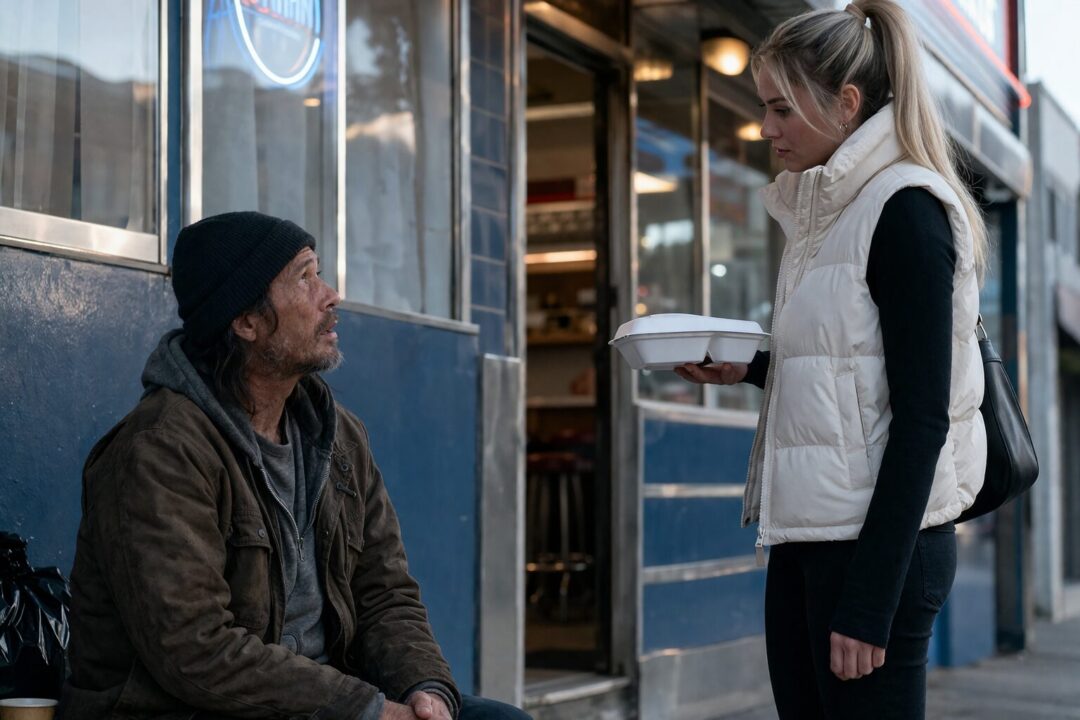
By the time the woman with the white takeout box stopped in front of him, Darius had already learned not to believe in lucky moments.
He still looked up.
It was a reflex older than pride. Older than the cold. Older, maybe, than hunger itself. Some part of him still turned toward kindness the way bruised skin turns toward warmth, even after it has been burned too many times to trust it.
The diner behind her glowed gold through the glass, soft with steam and movement. People sat at the counter and in the booths, their hands curled around mugs, their shoulders relaxed in that careless way only full people could manage. The windows were fogged at the corners. Every so often the door opened and let out a ribbon of heat and the smell of onions, coffee, grease, bacon, fresh bread. Then it shut again, and the world went back to being November.
Darius sat with his back to the brick wall and his knees bent close, a gray hood tucked under a faded brown jacket that had long ago given up on keeping out wind. His knit cap was pulled low. His beard had grown in unevenly, streaked with a little gray, and his hands were red at the knuckles where the cold bit hardest.
He had chosen that spot carefully.
Not too close to the door, where management might tell him to move.
Not too far from it, where people could pretend they hadn’t seen him.
Close enough to the window to borrow a little of the building’s trapped heat. Far enough to remain a problem no one had to name.
It was just after lunch rush, the hour when the staff moved fast and the customers slowed down. Darius knew the rhythm of the place better than he knew the dates anymore. Knew who took smoke breaks. Knew which server slipped uneaten toast into a paper napkin instead of the trash. Knew which men would not meet his eyes and which women would smile sadly from the safety of inside.
He hated himself a little for learning those things.
Three winters earlier, he had managed a warehouse on the edge of town. He had owned two decent coats, one church coat and one work coat, and a pair of boots he polished on Sundays. He had never passed a man sitting outside a restaurant without feeling either pity or distance. He had believed, as so many people do, that disaster announced itself loudly. That it came with warning labels. That if you paid attention to your own life, if you got up on time and signed the papers and kept your temper and did not drink too much and did not miss payments and did not get unlucky in the wrong sequence, you could remain on the safe side of glass forever.
Then his wife got sick.
Then she got better for six months.
Then she got worse.
Then the medical leave ended.
Then the warehouse brought in somebody younger who could lift more and ask fewer questions.
After that, life did not collapse all at once. It frayed. Rent first. Then the car. Then the couch in his cousin’s basement. Then the patience of friends who had their own small disasters to carry. Pride kept him moving longer than money did. Pride also kept him from asking for help until hunger made a fool of pride every single time.
Now he spent his afternoons outside places that smelled like survival.
He never begged. Not exactly. Sometimes that distinction mattered only to him.
The woman had blonde hair tied in a high ponytail and a cream-colored vest that looked warm enough to sleep in. Her shoes were spotless. She came out of the diner briskly, one shoulder already turned toward the sidewalk, a white foam box balanced in one hand. She looked like she was moving through a problem she did not intend to inherit.
Still, when she slowed, Darius’s throat tightened.
The box was close enough for him to see the grease shining faintly along its fold.
He heard his own voice before he had decided to speak.
“Is that for me?”
It came out rougher than he meant. Smaller, too. A voice that knew the answer and asked anyway.
The woman looked down at him.
Her face did not harden; that would have required feeling. It simply closed.
“No.”
One word.
Flat as a door shutting.
Darius held still, as if stillness might make the humiliation less visible. He had been turned away before. Had been ignored, brushed off, looked through, stepped around. But there was something in the precision of it that landed differently. She had paused. She had let the possibility exist. She had watched him lift his eyes to it.
Then she turned, took two quick steps to the trash can by the curb, and dropped the box in.
Not hard. Not theatrically. Almost carelessly.
As if the food mattered so little it was not worth carrying another ten feet.
For a second, the whole world narrowed to a white lid disappearing into a black plastic opening.
The sound it made was small.
That was the worst part.
Not the cruelty. Not even the shame. The ordinariness of it.
Inside the diner, someone laughed.
A truck rolled through the intersection.
The woman kept walking.
Darius stood slowly, every joint stiff with cold and dread. He hated that his body moved before his mind could stop it. Hated that hunger translated humiliation into motion. Hated that he could already feel the calculation beginning—how dirty the can might be, whether the lid had come loose, how fast he could get the box back out before anyone noticed.
He took one step toward the trash.
Then a voice from the diner doorway cut through the air behind him.
“Leave that.”
Darius froze.
Part II — The Door That Opened
The voice was low, not loud, but it carried the kind of force that made people stop because it did not need repeating.
Darius turned.
An older man stood half inside the diner, half out, one hand still on the door. He wore a navy work shirt under a white apron. His hair was silver and cut close, his face broad and weathered, the kind built by years of heat, grease, and hard mornings. He looked like he belonged to the room behind him in a way the polished customers never quite did. Like he was part of its bones.
Darius had seen him before, always in motion.
At the grill.
Behind the register when things got busy.
Carrying a sack of potatoes through the side entrance.
He had never spoken to him.
Now the man let the door swing shut behind him and came down the short step to the sidewalk. He did not look at the trash can. He looked at Darius.
Only Darius.
The kind of look that makes a man aware, all at once, of how long it has been since someone regarded him as a person instead of a category.
Darius felt his shoulders draw in.
“I wasn’t—” he started, though he did not know what defense could possibly follow.
The older man shook his head once.
Not angry. Not accusing.
Just stopping the sentence before it had to humiliate them both.
Up close, he smelled faintly of coffee and clean dishwater and grilled onions. A kitchen smell. A working smell. A smell that belonged to places where people fed each other because the day required it.
“Come inside,” he said. “Eat hot.”
For a moment Darius only stared.
The words were plain. There was no pity in them. No soft, public tone people used when they wanted credit for compassion. Just instruction. Fact. A thing being offered without performance.
Behind them, traffic hissed over wet pavement. The blonde woman did not turn around.
Darius glanced once toward the glass, half expecting faces pressed there, judgment, curiosity, the beginning of a scene. But the windows reflected only pale sky and passing cars. A couple at the counter bent over their plates. A waitress moved between tables with a coffeepot. Life inside had not paused to witness his embarrassment.
The man in the apron waited.
That waiting did something unexpected. It gave Darius a choice. Did not tug him by the elbow. Did not toss a folded bill at him. Did not make a show of rescue. He simply stood there, square in his stance, leaving room for the invitation to be accepted with the little dignity it had come bearing.
“For me?” Darius heard himself ask.
The question escaped before he could stop it.
The older man’s face shifted then—not into a smile exactly, but into something warmer and more tired and more human than that.
“For a guest,” he said.
Something inside Darius gave way.
Not dramatically. Not enough for tears in the street, not enough for some movie-worthy collapse. Just a quiet internal failure of resistance. The part of him that had been holding itself upright all day loosened one notch.
He followed the man to the door.
The heat hit first.
Then the sound.
Plates touching down. A grill scraping. Low conversation. The bell of the register. The familiar, aching perfume of food arriving faster than thought. Darius had been inside places like this all his life, but it felt strangely unreal to cross a threshold he had spent weeks studying from outside.
The man led him past the counter, not to some hidden corner or back hallway, not to a box in a kitchen doorway, but to a small table near the front window.
That was what nearly undid him.
The window.
The same glass that had separated him from warmth fifteen seconds ago now caught the two of them in reflection as if they belonged in the same frame.
“Sit here,” the man said, pulling the chair out with one hand.
Darius sat carefully, as though someone might change their mind if he moved too quickly.
His hands, he realized, were trembling.
The older man disappeared into the kitchen without ceremony. No grand declarations. No checking to see if anyone approved. Darius sat alone for less than a minute, but in that minute he became acutely aware of himself all over again: the roughness of his jacket, the damp at the hem of his pants, the dirt under one thumbnail, the smell of outside still clinging to him.
At the counter, a woman in a red scarf glanced over.
Darius braced.
She looked away just as easily, not dismissive, not curious. Simply allowing him to exist without inspection.
He had forgotten how merciful that could feel.
The older man came back carrying a plate that sent up little ghosts of steam. Eggs. Potatoes. Toast thick enough to matter. A slice of sausage. Not leftovers. Not scraps. A meal made to be eaten now.
He set it in front of Darius with both hands, steady as if placing something valuable.
Darius stared at it.
“There you go,” the man said.
His voice had softened, but only a little.
Darius opened his mouth and nothing useful came out. He had spent so long protecting himself from humiliation that gratitude felt almost more dangerous. Gratitude required exposure. It admitted need. It acknowledged the wound.
Still, he managed, “Thank you.”
The older man nodded once, as if thanks were unnecessary but acceptable.
“Name’s Merritt,” he said.
Darius blinked.
The introduction startled him more than the meal.
Not because names were rare, exactly. But because names created continuity. They suggested that this moment was not a random act dropped from nowhere. They meant a person had stepped forward as himself.
“Darius,” he said back.
Merritt gave another nod, then glanced toward the grill. “Eat before it gets cold.”
And just like that, he returned to work.
No speech. No sermon.
The waitress refilled a coffee mug at the next table. Two men in work jackets argued mildly over the score from last night’s game. Outside the window, the trash can remained by the curb, anonymous and black and no longer the center of the world.
Darius lifted his fork.
The first bite hurt.
Not because it was too hot, though it was. Because his body had almost forgotten what it meant to receive something warm without bargain or shame attached to it.
He lowered his head and kept eating.
Part III — What Hunger Remembers
After that day, Darius did not suddenly become a different man.
This was not that kind of story.
No miracle job appeared by dinnertime. No estranged relative called with a spare room and a second chance. Hunger did not evaporate because someone had finally seen him. Winter did not soften. The systems that had pushed him to the sidewalk remained cold and efficient and mostly invisible.
But the world tilted.
Sometimes that is how survival begins—not with rescue, but with a change in angle.
Merritt started leaving a cup of coffee by the front window around three each afternoon. If Darius came in, he sat. If he did not, no one carried it outside like charity. It waited as if his presence were ordinary. Sometimes there was soup. Sometimes toast. Once, on a sleeting Thursday, a bowl of chili so rich and hot it made Darius’s eyes water.
Merritt never asked too many questions at once.
He learned piece by piece.
The warehouse. The hospital bills. The car that had died in spring and never come back. The cousin who had moved away. The nights in shelters when there was space. The nights under the overpass when there wasn’t.
In return, Darius learned that Merritt had buried a wife twelve years earlier and still wore his grief like an invisible apron. That he had taken over the diner when his brother’s heart gave out on a Tuesday morning near the pie case. That he trusted steady hands more than polished words. That he believed a person could tell the truth of another person by how they handled hot plates, sharp knives, and the messes nobody wanted to claim.
One week after the woman with the white box, Merritt asked, “You ever wash dishes?”
Darius nearly laughed.
He had managed inventory for a warehouse with seventy employees and three loading bays. He had balanced payroll discrepancies, coordinated shipments, trained men barely old enough to shave, and once fixed a busted conveyor with a pry bar and electrical tape. But he understood the question underneath the question, and he respected it.
“I can wash dishes,” he said.
Merritt handed him an apron.
That was all.
The work started small. Two hours after close. No promises. No paperwork at first, just cash and trust and the chance to stand in heat instead of weather. Darius washed, dried, stacked, swept. He kept his head down. He came early and stayed late. He learned again the rhythm of usefulness.
The first Friday Merritt let him help unload produce from the back truck, Darius stood for a moment with a fifty-pound sack of onions on his shoulder and felt something almost unbearable move through him.
Weight.
Purpose.
The clean exhaustion of labor.
He had forgotten how much dignity lived in being expected somewhere.
One evening, as he wiped down a prep table, he looked up through the front window and saw a woman with a blonde ponytail pause at the curb outside.
It took him a second to recognize her without the white box.
She peered in, maybe searching for a table, maybe for nothing at all. Her eyes slid past him. Then returned.
For just a flicker of time, he saw recognition land.
Not certainty. Not apology.
Just the brief, disorienting shock of finding the man from the sidewalk on the inside of the glass.
Darius did not wave. He did not stare. He did not offer her the satisfaction of knowing whether he remembered.
He picked up a stack of clean plates and carried them calmly to the counter.
When he glanced back, she was gone.
That night, after closing, Merritt counted the register while Darius tied off the trash.
“Funny thing about people,” Merritt said, not looking up. “They think the line between inside and outside means more than it does.”
Darius waited.
Merritt finally set the drawer shut. “Mostly it’s just a door.”
Darius stood very still with the trash bag in his hands.
He thought of the moment his own hand had almost gone into that can. Thought of how close a life can come to shrinking around the wrong kind of necessity. Thought of glass, of thresholds, of who gets seen and who gets edited out of the frame.
Then he looked around the diner.
At the checkered floor that needed replacing. At the cracked corner of the pie case. At the coffee-stained order wheel. At the warm lights reflected in the window. At the stool near the register where Merritt rubbed his knee when the weather changed. At the plate rack he himself had organized by size the previous afternoon. At the ordinary, beautiful untidiness of a place that fed people every day whether they deserved it or not.
Mostly it’s just a door.
Months later, when the air thawed and the city loosened its grip on winter, Darius signed a lease on a room above a barber shop three blocks away. The mattress sagged in the middle and the radiator hissed like an angry cat, but the key turned in his own lock, and that was enough to make him stand in the doorway smiling like a fool for nearly a full minute.
He still worked evenings at the diner.
Sometimes mornings too.
Merritt complained about his knees and pretended not to be proud when Darius took over the produce orders without being asked. The waitress in the red scarf, whose name turned out to be Corinne, insisted on packing him leftovers at the end of late shifts, though now they were leftovers given among coworkers, which changed everything. The men at the counter nodded to him by name.
Darius kept the knit cap. Kept the brown jacket too, though spring made it unnecessary. Not because he wanted to remember the worst of it, but because forgetting felt dangerous in its own way. Hunger remembers. Shame remembers. Glass remembers.
So does mercy.
One rainy afternoon near the end of March, a thin teenage boy drifted under the awning outside the diner, hands shoved deep into his sleeves, face sharpened by the kind of caution that comes from being disappointed young. He did not knock. He did not ask. He only lingered too close to leave and too far to belong.
Darius saw him through the window while carrying a pot of coffee back to the kitchen.
For a second he was struck by the strange violence of memory. Not because the boy looked like him—he did not—but because need wore the same posture on almost everybody.
Darius set down the coffee, untied his apron, and reached for a clean mug.
Merritt glanced up from the grill.
Their eyes met.
No words were needed.
Darius stepped to the door and opened it.
The boy startled.
Darius stood in the warm spill of light from inside, the mug in one hand, the familiar smell of onions and coffee drifting around him.
“Come in,” he said.
And when the boy hesitated, as if kindness might still turn at the last second and throw itself away, Darius held the door wider and added, with quiet certainty born from the day someone had first said it to him:
“Eat hot.”