The Veteran Who Came for a Plaque and Left the Range Silent Behind Him
Chapter 1: The Man Beside the Damaged Plaque
The crack ran straight through the last name on the plaque.
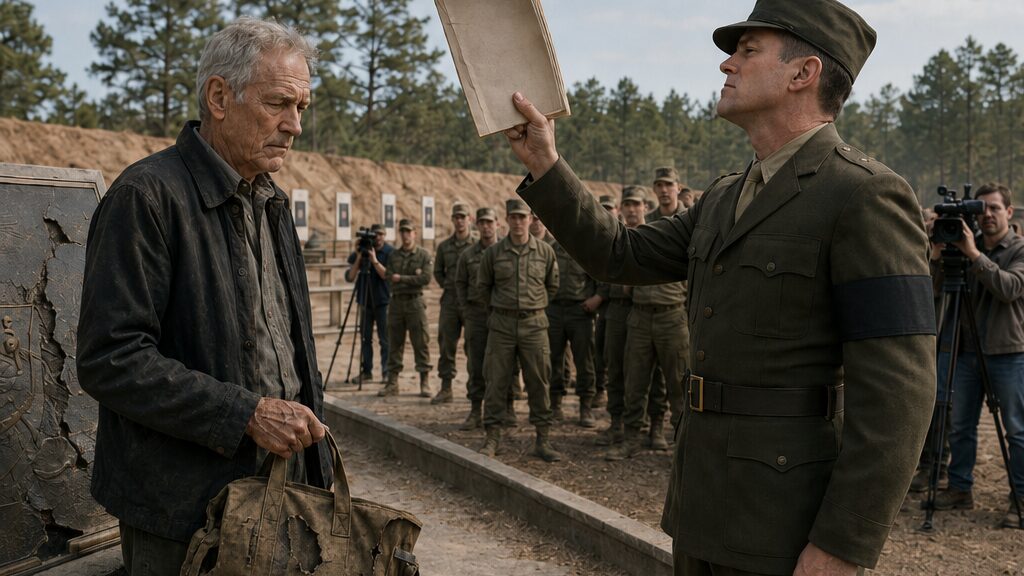
John Miller stood with one hand on the stone frame and the other wrapped around the handle of a faded rifle bag, staring at the split bronze as if the damage had happened to flesh. Morning range noise rolled across the installation in hard bursts—engines, shouted commands, the metallic clatter of target frames—but the sound seemed to stop at the memorial.
Only one letter remained clear in the damaged name.
John touched it with two fingers.
“Should’ve come sooner,” he murmured.
The replacement plaque rested in a padded wooden case at his feet. He had carried it from the visitor lot himself, refusing the young gate guard’s offer of a cart. The guard had looked at his cane, then at the rifle bag, then at the paperwork. John had watched him decide not to ask.
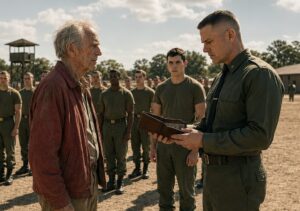
Now, beside the barracks walkway, the old memorial leaned under a temporary strap, its bronze face dulled by dust from the demolition range. Beyond it, rows of soldiers formed near the firing lanes. A white canopy had been raised for officers. A civilian camera crew adjusted tripods near the review platform.
John had chosen the wrong morning.
Or maybe the installation had chosen the wrong morning to forget what stood ten yards from its range.
He set the rifle bag carefully against the low wall, bent with slow effort, and unlatched the wooden case. The new plaque caught the sun. Each engraved name was sharp, black-filled, readable from a respectful distance. John checked the fourth line. Then the fifth. Then the name that had almost disappeared on the broken one.
His thumb stopped there.
“Hey.”
The voice cut across the walkway.
John closed the case before turning.
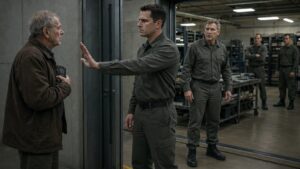
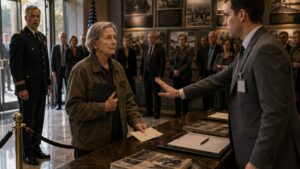
A military police officer strode toward him with a clipboard under one arm and a sidearm riding high on his belt. His name tape read CLARK. His face carried the kind of alert impatience that made even routine things look like violations.
“You lost, sir?” the officer asked.
John looked past him at the staging area. Soldiers were glancing over now. So were two civilians with press badges.
“No,” John said. “I’m here for the plaque.”
“The what?”
John nodded toward the memorial.
The officer’s eyes moved to the damaged bronze, then to the wooden case, then to the rifle bag. His mouth tightened.
“This is a restricted review area today,” he said. “Active-duty marksmanship standard. Top brass on site. Media on site. Nobody wanders in with a weapon case.”
John did not correct him. He reached into his jacket and drew out a folded authorization packet, the pages softened at the creases. “Range office cleared it. Maintenance escort was supposed to meet me.”
The officer took the packet but did not unfold it fully. He flicked one page up with his thumb, saw letterhead, and looked again at the rifle bag.
“That yours?”
“Yes.”
“What’s in it?”
John’s grip shifted on the cane. “A rifle.”
A few soldiers near the first bench stopped pretending not to listen.
The officer gave a short laugh through his nose. “You brought a personal rifle onto an active range during a command review?”
“It stays in the bag.”
“That’s not how this works.”
John reached for the packet, but the officer held it back.
“My name is John Miller,” he said quietly. “I’m expected.”
“You were expected by maintenance, maybe. Not by me.” The officer looked toward the canopy where senior officers were beginning to gather. The cameras were being tested now, red lights blinking, microphones lifted. “Today is not a nostalgia tour.”
John let the words pass over him. His eyes moved to the plaque again, to the ruined line.
“I’ll replace it and leave.”
The officer’s gaze sharpened, as if John’s calm had made him more suspicious. “You don’t just replace memorial property because you feel sentimental.”
John opened the wooden case again, slower this time. “It was ordered. Paid for. Approved.”
The new bronze gleamed between them.
For a moment, the officer’s expression changed—not softened, but caught. The plaque was heavier than he had expected. Realer. Not a souvenir. Not a complaint from an old man looking for someone to listen.
Then a burst of laughter rose from the staging area. Someone had made a joke near the cameras. Jeffrey Clark glanced that way and seemed to remember the audience.
He cleared his throat. “Pack it up until I verify.”
John’s hand rested lightly on the edge of the new plaque. “The old one is already loosened. If dust gets under the frame—”
“Sir.” Jeffrey stepped closer. “Do not instruct me on my range.”
John looked at him then. Not sharply. Not angrily. Just directly enough that Jeffrey’s jaw tightened.
“This isn’t your range,” John said. “It’s theirs.”
He nodded toward the names.
The silence around them became noticeable.
One of the camera operators turned the lens slightly. A few soldiers shifted in place. John saw a young woman in civilian safety gear watching from near the orientation table, her arms folded tight across her chest. She looked nervous already, even before the shooting began.
Jeffrey noticed the attention too. Color rose along his neck.
“Identification,” he said.
John opened his packet and removed a worn service file sealed inside a plastic sleeve. It was not the whole file, only the portion the office had requested years ago to confirm his connection to the plaque. He had not wanted to bring it. He had argued with himself in the kitchen before dawn, one hand on the envelope, the other on the rifle bag.
Paper invited questions.
Questions invited stories.
Stories took names away from the dead and gave them to whoever was still alive to answer.
Jeffrey pulled the file from his hand before John had fully offered it.
John’s fingers closed on empty air.
“That’s not—”
“I’ll determine what it is.” Jeffrey flipped open the sleeve. The first page crackled. “Miller, John. Combat engineer attachment. Qualification dates…” He paused, glanced at John over the top of the page, and smiled in the direction of the watching soldiers. “These dates still printed in ink or carved in stone?”
A few laughs broke loose.
John’s face did not change, but his hand went to the handle of the rifle bag.
The laugh traveled farther than it should have. Across the walkway. Past the benches. Up to the canopy where officers turned to see what had interrupted the review schedule.
A woman with a press badge—Margaret White, according to the lanyard—tilted her microphone toward the sound.
Jeffrey saw all of it.
What had begun as a check had become a performance, and he stepped into it with the confidence of a man who believed any stage could be made safer if he owned it loudly enough.
“Careful, everyone,” he called, lifting the old file. “This hero probably fought with muskets.”
The platoon’s laughter hit the memorial and bounced back wrong.
John lowered his eyes. His thumb pressed against the rifle bag’s worn canvas seam, right where the fabric had been patched twice and darkened by years of oil from his hand.
The replacement plaque remained open at his feet, the names shining up at people who were no longer looking.
Jeffrey turned the page with a sharp snap.
“Let’s see,” he said loudly, “why Grandpa brought a museum piece to my range.”
Chapter 2: The File Read Aloud Like a Joke
The first page snapped in Jeffrey’s hand like a starter pistol.
“John Miller,” he read, pitching his voice so it reached the soldiers nearest the firing lanes. “Former combat engineer support. Qualification entries from…” He paused long enough to make the date do the work. “Well. Before most of your fathers owned razors.”
Laughter broke from the platoon in uneven bursts. Some of it was real. Some of it was nervous. Some came from men who looked toward the officers first, checking whether laughter was allowed.
John stood beside the bench with his head slightly bowed. The file was not thick. It had never been meant to explain him. A few copied pages. Approval forms. A faded photograph he wished he had removed. The installation office had asked for proof of connection to the memorial years ago, and after that the packet had traveled back and forth whenever repairs were needed.
Not once had anyone read it like a joke.
Jeffrey angled the page toward the soldiers. “Special notation here. ‘Range familiarity.’ That’s one way to say old habits die hard.”
A soldier near the back muttered something about black powder. Another laughed too loudly. John’s eyes moved to the damaged plaque and stayed there.
Margaret White’s camera operator came closer. Not enough to interfere. Enough to catch the file, Jeffrey’s grin, John’s lowered face, the rifle bag leaning like an accusation against the bench.
“Officer Clark,” Brenda Sanchez called from near the control table.
Jeffrey ignored her.
Brenda’s expression was tight beneath her range cap. She had a radio in one hand and a schedule board tucked under the other arm. Beyond her, the day’s review was waiting: flags, target arrays, ammo crates, command observers, invited civilians in oversized ear protection. Everything about the morning had been planned to look clean and competent.
John had become the one thing not on the schedule.
Jeffrey turned another page.
“Purpose of visit,” he read. “Memorial plaque replacement.” His eyes flicked toward John. “That usually requires a maintenance crew, not a personal weapons case.”
John said nothing.
“Speak up,” Jeffrey said. “You wanted to be here.”
“I wanted the plaque fixed.”
The answer was too plain to entertain anyone. It made the laughter falter for a moment.
Then Jeffrey lifted the file again. “And the rifle?”
John’s fingers moved once along the canvas handle. “Mine.”
“For what?”
John looked at the firing lanes. Targets stood in rows downrange, black silhouettes against pale dirt. He had no intention of stepping to them. He had told himself that in the parking lot. He had told himself again when the gate guard stared at the bag. The rifle was not for review. It was not for pride. It had traveled with the plaque because the promise had always included both.
Jeffrey waited, then filled the silence himself.
“Decoration?”
A few soldiers laughed again.
At the edge of the platoon, David Torres did not. He stood with arms folded, rifle slung, eyes narrowed—not at the file, not at Jeffrey, but at John’s chest.
Inhale.
Hold.
Slow release.
Not fear. Not confusion.
David had spent too many hours watching shooters breathe badly under pressure. Too fast meant panic. Too shallow meant ego. Too forced meant a man was trying to control the rifle instead of himself.
John Miller’s breathing had changed the moment the laughter started. It had not sped up. It had settled.
David looked at the old man’s hands. The left trembled slightly where it rested against his cane. The right, curled over the rifle bag, did not.
“Watch him,” David said under his breath.
The soldier beside him smirked. “What?”
“His breathing.”
The soldier looked, then shrugged. “He’s trying not to pass out.”
David did not answer.
Jeffrey had found the photograph.
He pulled it halfway from the sleeve, and John’s head came up.
That small motion should have been enough. Any decent man would have seen the warning in it—not threat, but pain. Jeffrey saw it too. For one second, his thumb stopped.
Then someone near the camera shifted, and Jeffrey remembered he was being watched.
“Well, look at this.” He held the photo out but not close enough for anyone to really see. “Young once, apparently.”
John stepped forward. “Put that back.”
The words were quiet, but they carried farther than his earlier answers.
Jeffrey’s eyebrows lifted. “There he is.”
“Put it back.”
Brenda started toward them. “Clark, enough. We need lanes hot in five.”
“In a minute.” Jeffrey slid the photo back into the sleeve, but the damage was done. The soldiers had seen John react. The camera had seen it. Margaret had seen it.
John’s face had gone still in a way that looked less like calm than containment.
Jeffrey tapped the file against his palm. “You know what I see, Mr. Miller? I see a lot of old paper. I see a man wandering into an active review with a rifle he won’t explain. I see risk.”
“You see what you need to see,” John said.
That landed badly.
Jeffrey’s smile thinned.
“Risk is my job,” he said. “Not yours anymore.”
The platoon had gone quieter, but the quiet was not respect. It was appetite. Everyone could feel the shape of a confrontation and wanted to know how far it would go.
Margaret raised one hand to signal her camera operator to keep rolling.
John noticed. His shoulders dropped a fraction. The sight of the camera disturbed him more than Jeffrey’s jokes had. He looked away from the lens, toward the plaque, toward the name the crack had almost swallowed.
Jeffrey followed his glance.
Something about John’s refusal to meet the crowd made him push harder. Maybe he mistook it for weakness. Maybe the silence left him with too much room to perform.
He tossed the file onto the nearest bench. It slid across the wood and stopped against an ammo block.
“All right,” Jeffrey said. “Since you brought your museum piece and your paperwork and interrupted my review, let’s simplify this.”
“Clark,” Brenda warned.
Jeffrey lifted a hand without looking at her. “No live handling unless cleared. I know.” Then to John, louder: “But I’m curious what the old days taught you. Posture? Stories? How to polish brass?”
A few laughs returned, thinner now.
John’s thumb moved over the canvas seam again. His eyes did not leave the file on the bench.
“You don’t have to do this,” Brenda said, this time to John.
He heard the kindness in it, but also the schedule underneath. She wanted the problem contained. She wanted the old man moved aside without more embarrassment. Maybe that would have been the wise thing. Maybe he should have picked up the plaque, packed the rifle, and waited until the review was over.
He had been good at leaving rooms before they turned toward him.
Jeffrey stepped back and spread one arm toward the firing line as if granting a favor.
“Come on then,” he said. “Show everyone what the old days taught him.”
Chapter 3: A Rifle Bag Older Than Their Laughter
The zipper on John’s rifle bag sounded louder than the generators.
Its teeth parted slowly under his hand, and the range fell into a curious half-silence, the kind that did not mean respect yet. It meant people had stopped laughing long enough to see whether the joke would improve.
John hated that silence most.
He lowered the flap and folded it back with care. Inside, wrapped in oiled cloth, lay a rifle whose dark metal carried scars no display case would have allowed. The stock had been rubbed smooth in places by use, not decoration. The receiver bore thin pale marks along one edge. The sling was old but clean, the leather conditioned until it looked almost soft.
Someone behind Jeffrey whispered, “That thing’s ancient.”
John did not look up.
He drew the cloth away as if uncovering a sleeping face. His fingers trembled at first. They always did now when the morning was cold or when too many eyes found him at once. But as he touched the receiver, the tremor changed. It did not disappear yet. It narrowed, like water finding a channel.
David Torres took one step forward before he knew he had moved.
That was not a souvenir grip. That was not nostalgia. John checked the rifle without fuss, without display, every motion small and exact. Safety. Chamber. Magazine well. Muzzle discipline so natural that even while being mocked, he never let the barrel wander toward a living body.
David glanced toward Brenda.
She had seen it too.
Brenda Sanchez came close enough to Jeffrey that she could speak without feeding the crowd. “He had authorization.”
Jeffrey’s head turned a few degrees. “For plaque access.”
“And ceremonial item transport, according to the note.”
“It’s a rifle.”
“It’s documented.”
Jeffrey kept his face forward, jaw set. “Then the documentation should have come through my desk.”
“It came through the range office.”
“My review. My security perimeter.”
Brenda’s mouth tightened. Around them, officers under the canopy were now watching without pretending otherwise. Jeffrey knew it. Brenda knew he knew it.
“Handle it clean,” she said. “Don’t make it worse.”
That was the wrong thing to say to a man already feeling the morning slip out of his control.
Jeffrey’s voice rose. “Mr. Miller, before anybody touches a firing lane, that weapon will be inspected and cleared by range staff.”
John nodded once. “Of course.”
The simple compliance left Jeffrey with no obvious place to put his anger.
John lifted the rifle and placed it on the bench with the muzzle downrange. No flourish. No challenge. Then he reached into the bag and removed a small folded cloth, worn thin at the corners. Something was stitched into it by hand. Not a name anyone nearby could read, only initials and a date.
Emily Brown saw it from the civilian line.
She had been told this would be a community demonstration, a chance to understand military discipline and safety. Instead, she had watched a uniformed officer turn an old man into entertainment. Her borrowed ear protection hung around her neck. Her palms were damp. The rifle she would later be expected to hold suddenly seemed less like equipment than judgment.
When John touched the stitched cloth, Emily saw his mouth move.
No one else seemed to notice.
She did not hear the words, but she understood that they were not for the living.
Jeffrey picked up on none of it. He stood with arms crossed while a range assistant inspected the rifle. The assistant’s earlier smirk faded as the inspection continued.
“Clear,” the assistant said.
“Again,” Jeffrey ordered.
The assistant hesitated.
“Again,” Jeffrey repeated.
John waited.
The rifle was checked a second time. Same result. Clear, safe, meticulously kept.
Brenda looked toward the review platform. The senior officers had begun murmuring among themselves. Margaret White was no longer filming wide crowd shots. Her camera was tight on John’s hands.
John noticed the lens and turned his body slightly, shielding the stitched cloth before placing it back in the bag.
Margaret lowered her microphone a little. Not from shame, not yet. From instinct. She sensed the story had a layer she did not understand.
Jeffrey tapped the bench beside the rifle. “You carry this for the plaque?”
John folded the oiled cloth with exact corners. “Yes.”
“That make sense to you?”
John said nothing.
Jeffrey leaned closer. “Because from where I stand, it looks like theater.”
At that, John looked at him.
The old man’s eyes were pale and tired, but they did not beg to be understood. That unsettled Jeffrey more than anger would have.
“It isn’t,” John said.
“Then explain it.”
John’s gaze moved beyond him, past the soldiers, past the cameras, to the cracked plaque. The damaged name was turned slightly away now, but John could still see where the split cut through it.
Years ago, a woman with both hands wrapped around a folded flag had asked him only one thing. Not for stories. Not for details. Not for the part everyone else wanted. Just this: Don’t let them forget his name.
John had said yes before he knew what such a promise would cost.
He had kept the rifle because the man named on that line had carried it the last day he came back alive from a range. He had kept the plaque repaired because names unattended faded faster than metal should. He had kept his mouth shut because whenever he spoke, people stopped hearing the names and started hearing his.
Jeffrey saw only refusal.
“You don’t get to stand here mysterious,” he said.
“No,” John said. “I don’t.”
The answer confused him.
John turned toward Brenda. “The plaque can still be mounted before the review finishes.”
Brenda glanced at the schedule board, then at the watching command. “Not while this is unresolved.”
“There’s nothing unresolved about the plaque.”
“There is now,” Jeffrey said.
A small sound came from Emily’s direction—a breath caught too sharply. John looked over and saw her staring at the rifle, then at Jeffrey, then at the firing lanes as if each thing had grown teeth.
He knew that look.
Not fear of weapons exactly. Fear of failing in front of people who had already decided what weakness looked like.
John’s hand settled on the bench.
The soldiers were watching Jeffrey. The cameras were watching John. Emily was watching both, learning the lesson the morning seemed to be teaching: loud men owned the range, and anyone uncertain became a target before a shot was ever fired.
John closed his eyes once.
When he opened them, he reached for the rifle.
Brenda moved half a step. “Mr. Miller—”
“I’ll follow your commands,” he said.
Jeffrey gave a short, disbelieving laugh. “You want to shoot?”
John lifted the rifle, checked the chamber with a clean motion, then rested it again with the muzzle downrange. His breathing slowed until even David noticed the space between inhale and release.
“No,” John said.
He looked once more at the damaged plaque.
“Not for me.”
Chapter 4: The Breath That Changed the Range
“Watch his breathing,” David Torres whispered.
The soldier beside him had been grinning a moment earlier, but the words made him turn back toward the old man at the firing line. John Miller stood behind the bench with the rifle angled safely downrange, his shoulders rounded under his jacket, his left hand still marked by a faint tremor.
Then he inhaled.
The change was not dramatic enough for the cameras. It was too small for most of the platoon. But David saw it. The breath entered low. It did not lift John’s chest or tighten his neck. It settled him from the inside out.
Jeffrey Clark saw only an old man with a rifle.
“Range staff clears the lane,” Brenda Sanchez said, her voice clipped now. “No movement without command.”
John nodded.
No argument. No insult returned. No glance toward the soldiers who had laughed. He listened to the instructions as if each word mattered more than the humiliation that had led him there.
That bothered Jeffrey more than defiance would have.
The range assistant stepped back from the bench. “Rifle clear and inspected. Ammunition issued for review string only.”
Jeffrey’s eyes cut to Brenda. “We’re really doing this?”
“We’re doing it under control,” Brenda said. “Because you made it public.”
The words were quiet enough that most people did not hear them. Jeffrey did. His jaw shifted, but he said nothing.
A senior officer under the canopy folded his arms. Margaret White’s camera operator adjusted focus. Emily Brown stood frozen near the civilian line, safety glasses too large for her face, watching John as if his next move might decide whether the morning was cruel by nature or only by accident.
John accepted the issued rounds one at a time. His fingers moved slowly at first, thumb and forefinger setting each cartridge where it belonged. The small tremor remained until he seated the last round.
Then his hands went still.
Not steadier.
Still.
David felt the hair rise along the back of his neck.
John lifted the rifle into position and settled behind it. The stock found his shoulder like an old key entering a lock. His cheek lowered. His spine, bent only seconds ago, aligned without strain. Age did not leave him; it simply stopped being the loudest thing about him.
The range grew quieter.
Jeffrey stood behind the safety line with the file tucked under one arm. He had expected fumbled handling, a sheepish retreat, some visible proof that his suspicion had been justified. Instead, the old man waited with such unadorned patience that Jeffrey became aware of his own breathing—too quick, too shallow, full of the anger he had mistaken for command.
“Shooter ready?” Brenda called.
John did not answer with his mouth.
His right index finger rested outside the trigger guard. His left hand supported the rifle without gripping it to death. He exhaled once, slow and narrow.
Brenda looked at the scoring table, then downrange.
“Stand by.”
The command hung over the dirt.
The first target snapped up.
John fired.
The shot cracked across the range and struck clean. Before the echo had finished rolling against the berm, the next target rose. John shifted. Not hurried. Not slow. The rifle moved as if attached to his breath, and the second shot landed with the same sharp finality.
A third target.
A fourth.
The watching soldiers stopped looking at one another.
John’s face gave them nothing. No triumph. No strain. Only breath, sight, pressure, release. The rifle reports came in a rhythm that made the earlier laughter seem childish, almost obscene. Each shot was separate. Each shot finished before the next began. No wasted motion tied them together.
At the scoring table, one of the technicians leaned closer to the monitor.
“That can’t be right,” he muttered.
Brenda heard him. “What?”
“Clean through four.”
“Then keep watching.”
The next sequence started faster.
John adjusted with a small turn of the hips. He did not fight the rifle. He let it settle and returned it to the work as if the barrel remembered before his body did. A target at the far edge rose half-shaded by dust. He waited a fraction longer than anyone expected.
Fired.
The plate dropped.
David’s mouth went dry.
“Who is this guy?” the soldier beside him whispered.
David did not take his eyes off John. “Someone Clark should have asked before he talked.”
Jeffrey heard the murmur. He looked toward the platoon and saw expressions changing. Smirks had become attention. Attention had become something close to unease. Not fear of John. Fear of what they had joined without understanding it.
“Scoring system?” Jeffrey called.
The technician blinked at him. “It’s live.”
“Check it.”
Brenda turned her head. “Do not interrupt my line.”
Jeffrey went red, but the senior officer under the canopy was watching Brenda now, not him. He swallowed whatever he had been about to say.
The second sequence ended clean.
The monitor showed no misses.
Margaret moved closer until a range assistant lifted a hand to stop her. She stopped, but the camera stayed trained on John. The story in her face had changed. She had arrived expecting a polished review, perhaps a few safe quotes about standards and readiness. Then she had seen humiliation, and humiliation becoming spectacle. Now something else was forming in front of her, and she could feel every instinct in her profession reaching for it.
John looked once toward the lens.
Just once.
The rifle did not move, but his eyes did, and Margaret felt the warning in them. Not anger. Not vanity. A plea without pleading.
Do not make this about me.
She lowered her microphone a few inches.
“Final string,” Brenda called.
The range seemed to draw in with John.
Emily pressed both hands together at her waist. She had forgotten the nervous ache in her own stomach. The old man’s hands were the only calm thing she could see.
A breeze dragged dust across the line. The first final target rose through it.
John waited.
Jeffrey’s lips parted, ready to seize on hesitation.
The shot broke.
Hit.
Another target rose at a different angle. Hit. Then two in fast succession. Hit. Hit. The rifle moved, settled, breathed. A smaller target came up late on the far left, half-hidden behind glare from the berm marker. Several soldiers leaned unconsciously, as if their bodies could help him see.
John’s finger remained outside the trigger guard until the rifle stopped moving.
Inhale.
Exhale.
The last shot cracked.
For one long second, nobody spoke.
Then the final target dropped.
The monitor at the scoring table flickered as the system tallied the run. The technician stared at it, looked down at the manual backup sheet, then looked at Brenda.
“Well?” Jeffrey demanded.
The technician turned the screen toward the range.
PERFECT SCORE.
No cheer followed.
The silence was heavier than applause could have been. It moved across the platoon like an order no one had issued. Soldiers who had laughed now stood with their eyes fixed on the old man. One lowered his chin. Another removed his cap without seeming to know he had done it.
John engaged the safety, cleared the rifle under Brenda’s instruction, and placed it back on the bench. Only then did his left hand tremble again.
The tremor looked different now.
Not weakness. Cost.
Brenda stepped closer, her voice softer. “Weapon clear.”
John nodded. His eyes went to the plaque.
Jeffrey had not moved.
The file sagged in his hand. His earlier grin had drained away, leaving behind a young man who suddenly understood he had been loud in a room he did not know how to read. He looked from the monitor to John, then to the soldiers, searching for some remaining piece of authority.
No one offered one.
Margaret White stepped past her camera operator, microphone lifted before she seemed to remember lifting it. Her face held astonishment, professional hunger, and something more cautious.
“Sir,” she said, “who are you?”
John turned toward her as if she had aimed the question at an old wound instead of his name.
Behind him, the screen still glowed.
PERFECT SCORE.
Chapter 5: The Name He Would Not Give
Margaret White’s microphone stopped inches from John’s chest, and he turned away from it as if the foam windscreen were a muzzle.
“Sir, just your name,” she said, gentler than before but still moving with the camera. “People are going to want to know who they just saw.”
John reached for the oiled cloth. “No.”
The answer was so quiet Margaret almost missed it.
The camera operator did not. The lens followed John’s hands as he folded the cloth over the rifle, each corner aligned with a precision that looked almost painful now. The perfect score still shone behind him, but John never looked back at it.
Jeffrey did.
He stared at the screen as though waiting for it to correct itself.
Brenda stepped between Margaret and the bench. “Media stays behind the marked line.”
Margaret lowered the microphone, not enough to give up. “We were cleared for review coverage.”
“And this review is still active.”
“After what just happened, that’s not just review coverage anymore.”
John slid the rifle into the bag. The zipper closed halfway before his hand stopped.
Margaret’s words had struck exactly where he had feared they would. Not just review coverage anymore. That was how it always happened. A mission became a headline. A name became shorthand. The men who did not come back became details trimmed for time.
He saw again the newspaper clipping folded in a kitchen drawer he never opened. His own young face, grainy and stunned. Words like heroic and lone survivor printed large enough for strangers to praise. Three other names, including the one now split by the crack in the plaque, buried in the final paragraph.
The mother had not cried when she showed it to him. That had been worse.
John zipped the bag the rest of the way.
“Mr. Miller,” Brenda said.
He looked at her.
She had picked up the authorization packet from the bench. The old file lay beneath it, the photograph hidden again inside the sleeve. Brenda opened the top sheet properly this time, reading instead of skimming.
Her expression changed at the second page.
Jeffrey noticed. “What?”
Brenda did not answer him. She read the handwritten note clipped behind the authorization. It had been folded smaller than the rest, the ink faded but legible.
To Range Office: Mr. John Miller is authorized to replace the memorial plaque for Combat Engineer Memorial 7A on behalf of the family of—
Brenda’s eyes moved to the damaged plaque.
The cracked name was the same.
She looked back at John. “You knew him.”
John’s fingers tightened on the rifle bag handle.
“Yes.”
The single word pulled more silence from the people nearest them than the score had. It did not explain enough, which made it worse. It gave the memorial weight without giving anyone permission to touch it.
Brenda lowered the paper. “This family asked for you specifically.”
John did not answer.
Margaret had heard. Her eyes moved quickly from the paper to the plaque to John’s face. The story sharpened in her mind, becoming more human, more valuable, more dangerous. She could almost see the caption: Elderly Veteran Silenced Mockers With Perfect Score While Honoring Fallen Friend.
It would travel fast.
She hated that she knew exactly how fast.
Jeffrey stepped in before the silence could become reverence. “That still doesn’t authorize firing a personal weapon during a command review.”
Brenda turned. “Clark.”
“No.” His voice came out too sharp, and he pulled it back under control. “No, we don’t just ignore procedure because everyone got sentimental. He was challenged, yes. Fine. But he chose to fire. That rifle is not on today’s approved weapons list.”
The range assistant looked uncomfortable. “We inspected it.”
“Inspection doesn’t make it approved.”
John picked up the wooden plaque case.
Jeffrey pointed at the rifle bag. “Leave that.”
For the first time all morning, John’s calm cracked visibly. Not in his voice. Not in his face. In the way his hand closed around the handle so tightly the old canvas creased.
Brenda saw it.
David saw it.
Jeffrey saw it and mistook it for an opening.
“Until this is reviewed, the weapon remains with range control.”
John’s eyes lifted to Jeffrey’s.
“No.”
The word landed harder than his perfect score.
Jeffrey straightened, almost relieved. Defiance gave him something familiar to manage. “That is not a request.”
Brenda stepped closer to John. “Mr. Miller, let me sort this.”
He looked past her to the plaque. “It belongs with me.”
“The rifle?” Jeffrey asked. “Or the performance?”
John did not answer, but his face went older.
David moved from the platoon line toward the bench, stopping just outside the conversation. “Officer Clark,” he said carefully, “maybe we should take this out of the open.”
Jeffrey rounded on him. “Did I ask for input?”
“No.”
“Then hold your position.”
David’s jaw flexed. He obeyed, but slowly enough that several soldiers noticed.
Brenda folded the authorization packet and tucked it under her arm. “The review board will need to determine whether there was a procedural violation.”
Jeffrey seized on the formal language. “Exactly.”
“Because you escalated a plaque replacement into a firing demonstration,” she added.
Jeffrey’s face colored again. “I maintained security.”
“You read his file aloud.”
“He brought a rifle into my perimeter.”
“He had paperwork.”
“He didn’t explain himself.”
John looked at him then, and something tired passed through his eyes. “You had the names in front of you.”
Jeffrey opened his mouth, but no answer came quickly enough.
Margaret’s camera captured that too.
Brenda exhaled once. “Until we have a ruling, the rifle may need to be held.”
John’s gaze snapped to her.
She did not like saying it. That was clear. But the words were official now, and official words had a way of building walls around people before anyone meant to imprison them.
“It would be temporary,” Brenda said.
John looked down at the bag.
His thumb found the patched seam.
For a moment, Margaret thought he might finally tell them everything. The promise. The name. The rifle’s history. Why being praised looked to him like theft. She stepped half a pace closer despite herself.
John only shook his head.
Brenda’s voice softened. “Mr. Miller, if the board asks, I need to know whether you want to file a complaint.”
John looked at Jeffrey, then at the soldiers who had laughed, then at the plaque waiting in its open case. A complaint would put his name on every report. It would make him the center. It would preserve the facts and damage the purpose.
Jeffrey reached into a pouch on his belt and pulled out a red confiscation tag.
John watched the tag unfold.
Brenda did not stop him.
Jeffrey held it above the rifle bag and said, with the authority of a man trying to rebuild himself from rules, “This stays here until the violation is resolved.”
Chapter 6: The Rule That Could Not Measure Honor
The red tag touched the rifle bag, and John’s hand moved before the string could be looped.
Not far. Not violently. Just enough to cover the old canvas with his palm.
The movement froze the range office doorway.
Jeffrey’s fingers tightened around the tag. Brenda stood between them with the authorization packet pressed to her side. David had followed at a distance, and behind him a small cluster of soldiers lingered near the memorial walkway, pretending not to watch. Emily Brown remained several steps back, her borrowed safety glasses still on, her face pale with the effort of staying unnoticed.
“Remove your hand,” Jeffrey said.
John looked down at the bag. “No.”
The word was quiet, but it carried the strain his face refused to show.
Jeffrey’s expression hardened. “You are making this worse.”
John almost laughed. It would have been a dry, broken sound, and he swallowed it before it escaped. Worse had happened long before Jeffrey Clark learned to stand straight in a uniform. Worse had worn dust and smoke and someone else’s blood. Worse had been a folded flag and a newspaper that made one man too large because the dead could no longer object.
“This isn’t evidence,” John said.
“It is an unapproved weapon used during an official review.”
“It was cleared.”
“For safety,” Jeffrey said. “Not for authorization.”
Brenda stepped in. “We can secure it in place without removing it from his custody until command decides.”
Jeffrey looked at her as if she had betrayed the uniform. “That is not standard.”
“Neither was reading a visitor’s file to a platoon.”
The words struck him publicly enough to sting. Jeffrey glanced toward the soldiers at the edge of the walkway. Some looked away too late.
He lowered his voice. “With respect, Senior Range Officer, if this becomes an incident, it will not be written up as a misunderstanding. It will be written up as a breach during a command-observed review. My name is on the perimeter plan.”
There it was, small and human beneath the damage he had caused.
John heard it. Brenda did too.
Jeffrey was not only protecting rules. He was protecting a record, a reputation, a future that could be dented by one morning of looking unprepared. That did not excuse what he had done, but it explained the desperate grip in his voice.
David stepped closer, choosing his words like he would choose a shot in wind. “Officer Clark.”
Jeffrey turned. “You keep appearing where you’re not needed.”
David accepted that without flinching. “Does the same rule apply to ceremonial weapons used during memorial observances?”
Jeffrey blinked. “This was not a memorial observance.”
David looked at the cracked plaque. “It was before we turned it into something else.”
No one spoke.
The question did not solve the rule. It opened it. Brenda’s eyes shifted to the authorization note again. John watched her think through the paperwork, the sequence, the cause. He had not come to shoot. He had been mocked into touching the rifle in front of people who should have known better. Then he had chosen to fire anyway.
That choice belonged to him.
He could not hand all of it to Jeffrey.
Brenda seemed to arrive at the same uncomfortable place. “Mr. Miller,” she said, “command will give you options. A formal complaint would create a complete record of what happened and why you fired.”
Jeffrey’s face tightened.
“Or,” Brenda continued, “you accept a procedural reprimand for unauthorized participation, temporary hold on the rifle pending review, and we keep the rest informal.”
John looked at her. “Informal.”
She did not pretend it was fair. “Quiet.”
The word should have comforted him. It had always been the kind of exit he chose.
Quiet meant no interview. No article. No phone calls from men who wanted to tell him he was a hero and did not know which names they were stepping over to say it. Quiet meant the plaque could be mounted after the paperwork cleared. Quiet meant the day might fold itself back into silence.
But quiet also meant Jeffrey could tell the story later as a security problem contained. The soldiers could remember the laugh, the score, the rule, and miss the thing between them. Emily could go home knowing the old man had been right and still punished.
John’s flaw had always dressed itself as humility.
He saw that now, and hated how late he saw it.
“I don’t want a complaint,” he said.
Jeffrey exhaled through his nose.
John turned his head slightly. “Don’t be relieved.”
Jeffrey’s eyes flicked up.
John did not continue. The silence forced the younger man to stand inside the words he had already heard.
Brenda closed the folder. “Then I need command to approve an alternate handling. Until then, the rifle remains tagged but not removed. Agreed?”
John looked at the red tag.
His hand remained on the bag.
“If it leaves my sight,” he said, “I file.”
Jeffrey’s mouth opened.
Brenda cut him off. “Agreed.”
The word had enough authority to hold.
For a few seconds, the matter seemed contained. Not resolved. Contained. The tag lay across the bag without being tied. John’s palm rested over it, keeping it from becoming final.
Then from behind David came a small, unsteady voice.
“He shouldn’t have to file anything.”
Everyone turned.
Emily Brown stood at the edge of the walkway with both hands curled around the strap of her safety glasses. She looked terrified of the attention and furious that terror had not kept her silent.
Jeffrey’s expression shifted into official patience. “Ma’am, this doesn’t concern you.”
Her throat moved. “It does if I’m supposed to go out there next.”
Brenda glanced toward the schedule board. The civilian demonstration was indeed next, delayed now but not canceled. Officers were still waiting. Cameras were still present. The entire morning, wounded and awkward, had not stopped needing to proceed.
Emily looked at John, then at the rifle bag, then at Jeffrey.
“I was already scared,” she said. “Before all this. I thought everyone would see it. Then you made fun of him, and everyone laughed, and I thought—” She stopped, embarrassed by how much she had revealed.
John watched her fingers tighten on the glasses strap.
Jeffrey softened a fraction, but pride held his posture rigid. “Range instruction will be professional.”
“It wasn’t,” Emily said.
The words were not loud. They did not need to be.
A soldier near the walkway lowered his eyes.
Emily’s voice shook harder now, but she kept going. “He was the only one here who made me less afraid.”
Chapter 7: Easy, Let the Rifle Settle
Emily Brown froze before she ever touched the rifle.
The civilian demonstration lane had been reset, the targets lowered, the benches cleared, but the air still held the shape of what had happened. Soldiers stood too straight. Officers spoke in low voices under the canopy. Margaret White’s camera waited behind the marked line, lowered for the moment but not off. The red tag still lay across John Miller’s faded rifle bag, untied, trapped beneath the old man’s palm.
Brenda Sanchez looked from Emily to the schedule board and knew the morning was about to fail in a quieter way.
“Ms. Brown,” she said, careful now, “we can delay your portion.”
Emily shook her head too quickly. “No. I’m fine.”
Nobody believed her.
She stepped toward the civilian rifle laid out for orientation, then stopped with her hands hovering uselessly at her sides. Her safety glasses slipped down the bridge of her nose. She pushed them back, looked at the firing line, then at Jeffrey Clark.
Jeffrey did not laugh. That almost made it worse. He stood rigid beside the range office door, the confiscation tag string still looped around two fingers. His face had lost the sharp pleasure it had carried earlier, but not the authority. To Emily, he looked like a man who could turn any mistake into a lesson at someone else’s expense.
John saw her look at him.
He also saw the platoon watching her the way they had watched him before the first shot—not cruelly now, perhaps, but with attention that could feel just as heavy.
Brenda lifted one hand. “We’ll have an instructor walk you through it.”
Emily nodded.
The assigned instructor moved forward, professional and brisk. “All right, ma’am. Feet shoulder-width. Keep the muzzle downrange. Finger straight until ready. We’ll go dry first.”
Emily reached for the rifle.
Her fingers closed wrong. Too tight. Knuckles pale. Shoulders rising toward her ears.
The instructor corrected her grip. “Relax.”
The word did nothing.
Emily swallowed. Her eyes flicked once toward the soldiers, once toward the camera, then to Jeffrey again. Her breathing turned shallow.
John’s hand lifted from his rifle bag.
The red tag stayed where it was.
He did not notice at first. His attention had narrowed to the young woman on the line, to the way fear was making her body fight itself. He had seen new soldiers do the same thing. He had seen grown men grip a rifle as if strength could replace steadiness. He had seen panic hide behind obedience.
Brenda noticed John watching.
So did Jeffrey.
“Mr. Miller,” Jeffrey said, warning already in his voice.
John looked at Brenda, not Jeffrey. “May I?”
The question did not carry pride. It was not a request to reclaim the stage. It was almost reluctant.
Brenda understood that and hesitated anyway. Procedure pressed on her from one side, the morning’s damage from the other. “You’re asking to instruct?”
“To correct her grip.”
Jeffrey gave a humorless laugh. “Absolutely not.”
Emily flinched at the sharpness.
John’s eyes moved to her hands again. “She’s not afraid of the rifle.”
Jeffrey’s jaw tightened. “You don’t know what she’s afraid of.”
“No,” John said. “But I know what you taught her.”
The line went still.
It was not a speech. It was barely more than a fact laid on the bench between them. That made it harder for Jeffrey to push away.
Brenda looked at Emily. “Ms. Brown?”
Emily’s voice came out thin. “I’d like him to show me.”
The instructor stepped back at once, almost relieved.
Brenda made the decision before Jeffrey could object again. “Under range supervision. No live fire until cleared. Mr. Miller, hands-on correction only with her consent.”
John nodded and walked toward the firing line without taking his rifle bag.
That detail moved through the watchers quietly. He was leaving the rifle under the red tag. He was not fighting for possession now. He was not proving he deserved it. He was going to an unsteady civilian who had asked for help.
Margaret White lifted her camera halfway, then stopped.
John approached Emily slowly enough not to crowd her. “May I adjust your hands?”
She nodded.
“Say it,” he said.
She blinked at him.
“Never let anyone move you around a weapon unless you’ve agreed.”
A little color returned to her face. “Yes. You may.”
Only then did John touch the rifle. He did not grab it. He placed two fingers beneath the stock and one hand near Emily’s support hand, guiding without taking over.
“Loosen here,” he said.
“I feel like I’ll drop it.”
“You won’t.”
“My hands are shaking.”
“They’re allowed.”
That answer changed her face.
Behind them, one of the younger soldiers looked down at his own boots. David Torres caught the movement and said nothing.
John adjusted Emily’s stance by tapping the outside of one boot with his cane. “Not so much fight in your knees. The ground is already holding you.”
She gave a nervous breath that almost became a laugh.
“The rifle doesn’t need you angry,” John said. “It doesn’t need you strong. It needs you honest.”
Jeffrey looked away.
Brenda watched him do it.
John stepped beside Emily, angled so he could see her shoulder, cheek, and hands without crossing the muzzle line. “Breathe low. Don’t lift your shoulders. Let the sights move. They’ll settle if you stop chasing them.”
Emily tried. The front sight wavered.
“It’s moving,” she whispered.
“It will.”
“I can’t hold it still.”
“Nobody can. Not forever.” John’s voice stayed low enough that the crowd had to quiet itself to hear him. “Wait for the quiet part.”
“The quiet part?”
He nodded. “Between wanting and forcing.”
The words struck Margaret with such force that she lowered her camera again.
Emily breathed in. Her shoulders rose.
John waited.
She noticed and let them drop.
“Again,” he said.
This time the breath came lower.
“Easy,” John murmured. “Let the rifle settle.”
The phrase moved through the range without being announced. It reached David first, then Brenda, then the soldiers nearest the bench. It was not a command. It was the opposite of one. Permission, almost.
Emily’s cheek found the stock. Her support hand loosened. The muzzle steadied—not perfectly, but enough.
Brenda watched the safety line. “Dry fire only.”
Emily followed the instructor’s earlier command sequence. Finger straight. Safety check. Breath. Sight. The click sounded small against the huge morning.
She did not flinch.
John stepped back half a pace. “There.”
Emily lowered the rifle, surprised. “That was it?”
“That was enough to learn from.”
Brenda studied Emily’s face. “Do you want to continue with one live round?”
Emily hesitated. Then she nodded.
Jeffrey’s head lifted.
Brenda gave the command sequence herself this time, calm and exact. One round was issued. The instructor loaded under supervision, then stepped aside. John did not touch the rifle now. He stood close enough for Emily to feel steadiness near her, far enough that the shot would be hers.
Emily raised the rifle.
The range held its breath, but John did not let her borrow that pressure.
“Only your lane,” he said.
She breathed.
The target rose.
For a moment, the muzzle wandered. Emily’s shoulders twitched, wanting to seize control. John saw it and spoke before fear could harden.
“Let it come back.”
She waited.
The rifle settled.
She fired.
The target plate rang.
Emily lowered the rifle as if the sound had surprised her out of a bad dream. The hit was not perfect. It did not need to be. It was clean, safe, earned.
A small sound moved through the platoon—not applause, not laughter. A release.
Emily turned toward John, eyes bright behind the oversized glasses. “I did it.”
John nodded. “You did.”
Margaret’s camera remained lowered now. Her operator looked at her for direction, but she shook her head once. Not yet.
Jeffrey stood near the bench, watching John refuse every chance to turn victory into revenge. The old man could have looked at him after Emily’s shot. Could have made the range feel the difference between cruelty and instruction. Could have said something sharp enough to be quoted.
He did none of it.
That restraint did what the perfect score had not. It left Jeffrey with no defense.
John returned to the bench. The red tag still lay across the rifle bag. His service file lay beside it, crooked, the plastic sleeve dusty where Jeffrey had tossed it earlier.
Jeffrey picked up the tag.
Brenda watched him.
So did David.
For a second, Jeffrey’s hand hovered over the bag. His face tightened—not with anger this time, but with the visible pain of surrendering the only rule he had left to hide behind.
He pulled the tag away.
Then he picked up John’s service file, straightened its pages inside the sleeve, and placed it back on the bench without a word.
Chapter 8: The Plaque Stood Straight Behind Him
The replacement plaque caught the light before it touched the stone.
Two maintenance workers held it level while Brenda Sanchez guided them into place, one hand raised, eyes narrowed at the mounting points. The cracked old plaque rested on a padded cloth nearby, its damaged face turned upward like something that had endured as long as it could. Dust clung inside the split where the fading name had nearly disappeared.
John Miller stood close enough to read the new engraving but not close enough to interfere.
For the first time all morning, no one hurried him away.
The review had not ended, but it had changed shape around the memorial. The firing lanes were quiet. The soldiers had been held back without needing to be ordered twice. Even the officers under the canopy had drifted nearer, not in formation, not for cameras, but because the morning no longer made sense unless they looked at the plaque.
The workers lifted.
The bronze settled.
Brenda checked the level, then gave one small nod. “There.”
A worker tightened the final screw.
The once-faded name stood clean in the sunlight.
John’s mouth moved, but no sound came. His hand lowered toward the rifle bag at his side, then stopped before touching it. The bag was his again. No red tag. No string. No claim on it except the old, private ones.
Margaret White stood several yards away with her microphone lowered against her thigh. Her camera operator had enough footage to make the day travel far beyond the installation gate: Jeffrey’s mockery, the perfect score, Emily’s first clean shot, the old man’s face turning away from a name he would not give.
She knew what an editor would want.
She also knew, with a discomfort she could not turn into a clean sentence, that wanting it did not make it hers.
Jeffrey approached from the side of the walkway.
His steps were slower now. He had removed his cap and held it in both hands, but the gesture seemed to embarrass him as soon as he realized what he was doing. He stopped near John, glanced once toward the cameras, then toward the soldiers.
John saw the glance.
“No,” John said.
Jeffrey blinked. “Sir?”
“Not for them.”
The words were soft, but Jeffrey understood. He had been about to apologize loudly enough to repair himself in public. Maybe he had not meant it that way. Maybe some part of him truly wanted to say the right thing. But the habit of performance still clung to him, and John had caught it before it could dress itself as humility.
Jeffrey’s face tightened, then changed.
He stepped closer, turning his back slightly to the cameras. “I was wrong.”
John looked at the plaque, not at him.
Jeffrey swallowed. “I saw the bag. The old file. The crowd. Command watching. I thought if I looked uncertain for one second, I’d lose the perimeter.”
“You lost it when you needed laughter to hold it.”
The sentence did not rise in volume. That made Jeffrey receive all of it.
He nodded once, eyes down.
John shifted the rifle bag higher on his shoulder. “You read the paper before you read the names.”
Jeffrey looked at the plaque then.
Really looked.
The engraved lines held men he did not know, men whose service had become part of the landscape he walked past every day. He had stood beside them that morning and made an old man prove he belonged near them.
John let him look.
The range stayed quiet around them, but it was not the cruel quiet from before. Not the waiting silence of a crowd hoping for embarrassment. This one had weight and room inside it.
Behind them, Emily Brown stood near David Torres, still holding her safety glasses. “Is he leaving?” she asked.
David watched John adjust the rifle bag strap. “Looks that way.”
“Shouldn’t someone ask him to stay?”
David’s eyes moved to Margaret, then to the soldiers, then to Jeffrey. “I think enough people asked him for things today.”
Emily accepted that with a small nod, though disappointment remained on her face.
Brenda came to John with the authorization packet. This time she held it like something returned, not processed. “Mr. Miller.”
He took it.
“The plaque is recorded as replaced,” she said. “No complaint filed. No reprimand entered.”
Jeffrey looked at her sharply.
Brenda did not look back. “Command reviewed the sequence. Range control accepts responsibility for allowing the matter to leave normal procedure.”
John tucked the packet inside his jacket. “That enough for your schedule?”
Brenda’s mouth moved toward a smile and stopped somewhere more respectful. “The schedule can wait two minutes.”
She turned toward the soldiers and officers gathered near the walkway. Her voice carried cleanly.
“Review will resume after personnel have had a moment at the memorial.”
No speech followed. No forced ceremony. No demand that John stand in front of the plaque and be thanked.
One by one, almost awkwardly at first, soldiers moved closer. Some read only the first line. Others read every name. David came with them and stopped at the name the crack had nearly taken. Emily stood beside him, lips moving silently as she read.
Margaret watched through all of it without lifting the microphone.
Her camera operator whispered, “We still using the score?”
She looked at John. He had stepped slightly aside, already outside the center of the frame, as if he knew how to disappear even while standing ten feet away.
“No,” she said.
The operator waited.
Margaret took a breath. “We lead with the memorial. No full name unless he gives it.”
“He did give it earlier. Clark read—”
“No full name,” she repeated.
Across the walkway, John heard enough to understand. He did not thank her. Gratitude would have made an agreement out of something that should have been instinct. But he looked at her once, and the absence of refusal in his face was all she received.
Jeffrey remained near the plaque after the others shifted away.
John had already turned to leave when Jeffrey spoke, low enough that only he could hear.
“What should I have done?”
John paused.
The question was not polished. It did not sound like training language. It sounded like a younger man standing in the wreckage of his own certainty and not knowing which piece to pick up first.
John looked back at the memorial.
“Start there,” he said.
Jeffrey followed his gaze.
“Read the names before you read another file aloud.”
For a moment, Jeffrey looked as if the words had struck deeper than an insult could have. Then he nodded, once, like a man accepting an order he should have known without being given.
John walked to the old cracked plaque. The workers had not yet carried it away. He rested his fingers on the broken line, over the name that had brought him there, and let them remain for the length of one breath.
Not long enough for a photograph.
Long enough for a promise.
Then he lifted the rifle bag onto his shoulder.
Emily took a step as if to follow, then stopped when David gently shook his head. Margaret did not call after him. Brenda did not ask him to sign one more form. The soldiers near the memorial parted without command, making a narrow path from the plaque to the range gate.
John walked through it with his cane in one hand and the worn rifle bag against his shoulder, the same bag Jeffrey had mocked, the same silence everyone had misunderstood.
Behind him, the new plaque stood straight in the sun.
Jeffrey Clark remained where he was, cap in hand, reading each name until the last one no longer looked like decoration. When he finally looked up, John Miller was almost past the gate, already beyond the cameras, leaving the range with no applause following him and no laughter left behind.
The story has ended.